2014 SUBARU TRIBECA parking brake
[x] Cancel search: parking brakePage 276 of 426
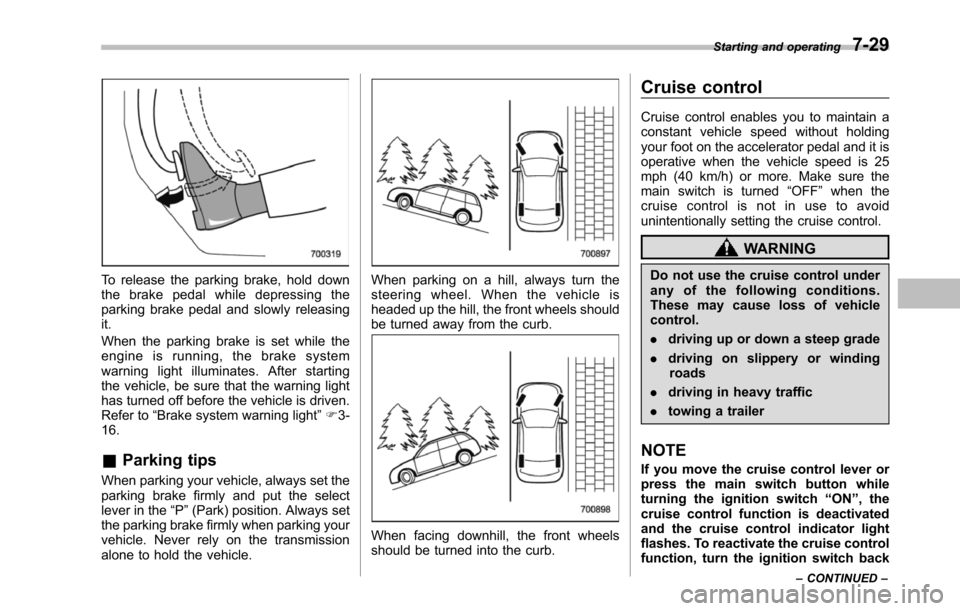
To release the parking brake, hold downthe brake pedal while depressing theparkingbrake pedal and slowly releasingit.
When the parking brake is set while theengine is running, the brake systemwarning light illuminates. After startingthe vehicle, be sure that the warning lighthas turned off before the vehicle is driven.Refer to“Brake system warning light”F3-16.
&Parking tips
When parking your vehicle, always set theparking brake firmly and put the selectlever in the“P”(Park) position. Always setthe parking brake firmly when parking yourvehicle. Never rely on the transmissionalone to hold the vehicle.
When parking on a hill, always turn thesteering wheel. When the vehicle isheadedup the hill, the front wheels shouldbe turned away from the curb.
When facing downhill, the front wheelsshould be turned into the curb.
Cruise control
Cruise control enables you to maintain aconstant vehicle speed without holdingyour foot on the accelerator pedal and it isoperative when the vehicle speed is 25mph (40 km/h) or more. Make sure themain switch is turned“OFF”whenthecruise control is not in use to avoidunintentionally setting the cruise control.
WARNING
Do not use the cruise control underany of the following conditions.These may cause loss of vehiclecontrol.
.driving up or down a steep grade
.driving on slippery or windingroads
.driving in heavy traffic
.towing a trailer
NOTE
If you move the cruise control lever orpress the main switch button whileturning the ignition switch“ON”, thecruise control function is deactivatedand the cruise control indicator lightflashes.To reactivate the cruise controlfunction, turn the ignition switch back
Starting and operating7-29
–CONTINUED–
Page 288 of 426
could make the pedals slippery anddriving dangerous.
While warming up the vehicle beforedriving, check that the accelerator pedal,brake pedal, and all other controls operatesmoothly.
Clear away ice and snow that hasaccumulated under the fenders to avoidmaking steering difficult. During severewinter driving, stop when and where it issafe to do so and check under the fendersperiodically.
!Parking in cold weather
WARNING
Snow can trap dangerous exhaustgases under your vehicle. Keepsnow clear of the exhaust pipe andfrom around your vehicle if you parkthe vehicle in snow with the enginerunning.
Do not use the parking brake whenparking for long periods in cold weathersince it could freeze in that position.Instead, you should observe the followingtips.
1. Place the select lever in“P”position.
2. Use tire stops under the tires toprevent the vehicle from moving.
When the vehicle is parked in snow orwhen it snows, raise the wiper blades offthe glass to prevent damage to them.
When the vehicle has been left parkedafter use on roads heavily covered withsnow, or has been left parked during asnowstorm, icing may develop on thebrake system, which could cause poorbraking action.Check for snow or icebuildup on the suspension, disc brakesand brake hoses underneath the vehicle.
If there is caked snow or ice, remove it,being careful not to damage the discbrakes and brake hoses and ABS har-ness.
!Refueling in cold weather
To help prevent moisture from forming inthe fuel system and the risk of its freezing,use of an antifreeze additive in the fueltank is recommended during cold weather.
Use only additives that are specificallydesigned for this purpose. When anantifreeze additive is used, its effect lastslonger if the tank is refilled whenever thefuel level reaches half empty.
If your SUBARU is not going to be usedfor an extended period, it is best to havethe fuel tank filled to capacity.
&Driving on snowy and icy
roads
WARNING
Do not use the cruise control onslippery roads such as snowy or icyroads. This may cause loss ofvehicle control.
CAUTION
Avoid prolonged continuous drivingin snowstorms. Snow will enter theengine’sintakesystemandmayhinder the airflow, which could re-sult in engine shutdown or evenbreakdown.
To prevent skidding and slipping, avoidsudden braking, abrupt acceleration, high-speed driving, and sharp turning whendriving on snowy or icy roads.
Always maintain ample distance betweenyour vehicle and the vehicle ahead of youto avoid the need for sudden braking.
To supplement the foot brake, use theengine brake effectively to control thevehicle speed. (Shift into a lower gearwhen necessary.)
Avoid shifting down abruptly. Such beha-
Driving tips8-9
–CONTINUED–
Page 299 of 426
8-20Driving tips
5. Use only a hitch ball that is appropriatefor the ball mount and your trailer. Thehitch ball must be securely installed on theball mount.
6. Connect your trailer to the hitch ball.
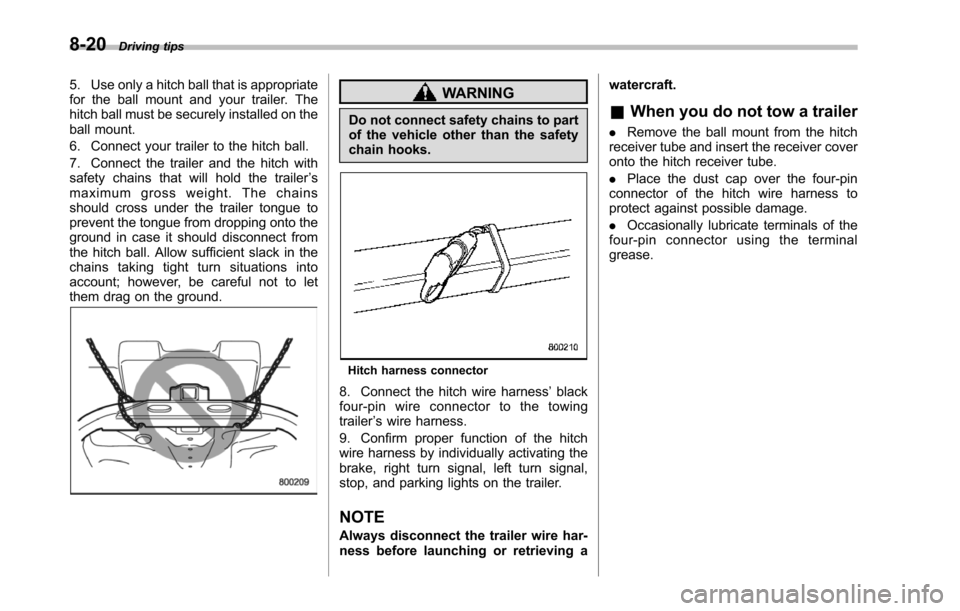
7. Connect the trailer and the hitch withsafety chains that will hold the trailer’smaximum gross weight. The chainsshould cross under the trailer tongue toprevent the tongue from dropping onto theground in case it should disconnect fromthe hitch ball. Allow sufficient slack in thechains taking tight turn situations intoaccount; however, be careful not to letthem drag on the ground.
WARNING
Do not connect safety chains to partof the vehicle other than the safetychain hooks.
Hitch harness connector
8. Connect the hitch wire harness’blackfour-pin wire connector to the towingtrailer’s wire harness.
9. Confirm proper function of the hitchwire harness by individually activating thebrake, right turn signal, left turn signal,stop,and parking lights on the trailer.
NOTE
Always disconnectthe trailer wire har-ness before launching or retrieving a
watercraft.
&When you do not tow a trailer
.Remove the ball mount from the hitchreceiver tube and insert the receiver coveronto the hitch receiver tube.
.Place the dust cap over the four-pinconnectorof the hitch wire harness toprotect against possible damage.
.Occasionally lubricate terminals of thefour-pin connector using the terminalgrease.
Page 305 of 426
8-26Driving tips
blind spots occur with the vehicle’s stan-dard side mirrors, use towing mirrors thatconform with Federal, state/province and/or other applicable regulations.
!Trailer lights
CAUTION
Direct splicing or other improperconnection of trailer lights maydamage your vehicle’selectricalsystem and cause a malfunction ofyour vehicle’s lighting system.
Connection of trailer lights to your vehi-cle’s electrical system requires modifica-tions to the vehicle’s lighting circuit toincrease its capacity and accommodatewiring changes. To ensure the trailer lightsare connected properly, please consultyour SUBARU dealer. Check for properoperation of the turn signals, stop lightsand parking lights each time you hitch up.
!Tires
WARNING
Never tow a trailer when the tem-porary spare tire is used. The tem-porary spare tire is not designed tosustain the towing load. Use of thetemporary spare tire when towing
can result in failure of the spare tireand/or less stability of the vehicle.
Make sure that all the tires on your vehicleare properly inflated. Refer to“Tires”F12-8.
Trailer tire condition, size, load rating andproper inflation pressure should be inaccordance with the trailer manufacturer’sspecifications.
In the event your vehicle gets a flat tirewhen towing a trailer, ask a commercialroad service to repair the flat tire.
If you carry a regular size spare tire in yourvehicle or trailer as a precaution againstgetting a flat tire, be sure that the sparetire is firmly secured.
&Trailer towing tips
CAUTION
.Never exceed 45 mph (72 km/h)when towing a trailer in hillycountry on hot days.
.When towing a trailer, steering,stability, stopping distance andbraking performance will be dif-ferent from normal operation. Forsafety’s sake, you should employ
extra caution when towing atrailer and you should neverspeed. You should also keep thefollowing tips in mind:
!Before starting out on a trip
.Check that the vehicle and vehicle-to-hitch mounting are in good condition. Ifany problems are apparent, do not tow thetrailer.
.Check that the vehicle sits horizontallywith the trailer attached. If the vehicle istippedsharply up at the front and down atthe rear, check the total trailer weight,GVW, GAWs and tongue load again, thenconfirm that the load and its distributionare acceptable.
.Check that the tire pressures arecorrect.
.Checkthat the vehicle and trailer areconnected properly. Confirm that–the trailer tongue is connectedproperly to the hitch ball.–the trailer lights connector is con-nected properly and trailer’s stop lightsilluminate when the vehicle’s brakepedal is pressed, and that the trailer’sturn signal lights flash when thevehicle’s turn signal lever is operated.–the safety chains are connectedproperly.
Page 307 of 426
8-28Driving tips
zone in the“D”position than in themanual mode position.
.Avoid using the accelerator pedal tostay stationary on an uphill slope insteadof using the parking brake or foot brake.That may cause the transmission fluid tooverheat.
!Parking on a grade
Always block the wheels under bothvehicle and trailer when parking. Applythe parking brake firmly. You should notpark on a hill or slope. But if parking on ahill or slope cannot be avoided, youshould take the following steps.
1. Apply the brakes and hold the pedaldown.
2. Have someone place wheel blocksunder both the vehicle and trailer wheels.
3. When the wheel blocks are in place,release the regular brakes slowly until theblocks absorb theload.
4. Apply the regular brakes and thenapply the parking brake; slowly releasethe regular brakes.
5. Shift into“P”and shut off the engine.
Page 314 of 426
.Always turn off the engine beforeraising the flat tire off the groundusing the jack. Never swing orpush the vehicle supported withthe jack. The jack can come outof the jacking point due to a joltand this can result in a severeaccident.
1. Park on a hard, level surface, when-ever possible, then stop the engine.
2. Set the parking brake securely andshift in the“P”(Park) position.
3. Turn on the hazard warning flasherandhave everyone get out of the vehicle.
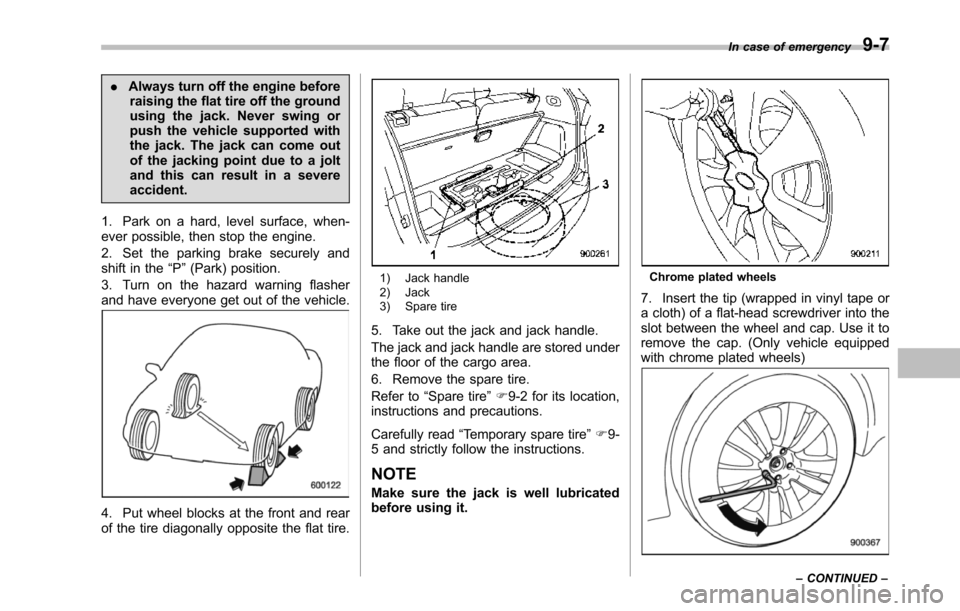
4. Put wheel blocks at the front and rearof the tire diagonally opposite the flat tire.
1) Jack handle2) Jack3) Spare tire
5. Take out the jack and jack handle.
The jack and jack handle are stored underthe floor of the cargo area.
6. Remove the spare tire.
Refer to“Spare tire”F9-2 for its location,instructions andprecautions.
Carefully read“Temporary spare tire”F9-5 and strictly follow the instructions.
NOTE
Make sure the jack is well lubricatedbefore using it.
Chrome plated wheels
7. Insert the tip (wrapped in vinyl tape ora cloth) of a flat-head screwdriver into theslot between the wheel and cap. Use it toremove the cap. (Only vehicle equippedwith chrome plated wheels)
In case of emergency9-7
–CONTINUED–
Page 324 of 426
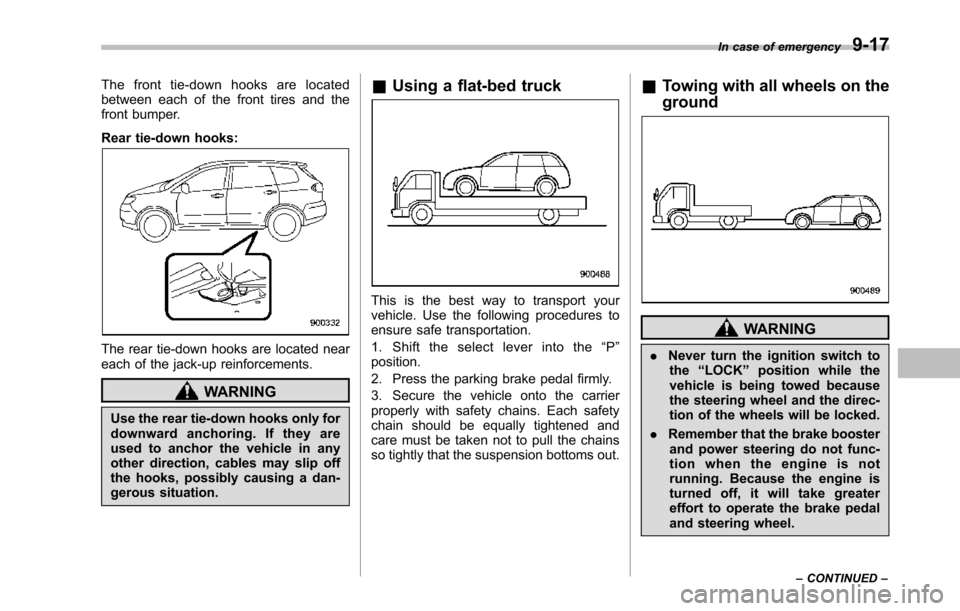
The front tie-down hooks are locatedbetween each of the front tires and thefront bumper.
Rear tie-down hooks:
The rear tie-down hooks are located neareach of the jack-up reinforcements.
WARNING
Use the rear tie-down hooks only fordownward anchoring. If they areused to anchor the vehicle in anyother direction, cables may slip offthe hooks,possibly causing a dan-gerous situation.
&Using a flat-bed truck
This is the best way to transport yourvehicle. Use the following procedures toensure safe transportation.
1. Shift the select lever into the“P”position.
2. Press the parking brake pedal firmly.
3. Secure the vehicle onto the carrierproperly with safety chains. Each safetychain should be equally tightened andcare must be taken not to pull the chainsso tightly that the suspension bottoms out.
&Towing with all wheels on the
ground
WARNING
.Never turn the ignition switch tothe“LOCK”position while thevehicle is being towed becausethe steeringwheel and the direc-tion of the wheels will be locked.
.Remember that the brake boosterand power steering do not func-tion when the engine is notrunning. Because the engine isturned off, it will take greatereffort to operate the brake pedaland steering wheel.
In case of emergency9-17
–CONTINUED–
Page 325 of 426
9-18In case of emergency
CAUTION
.If transmission failure occurs,transport your vehicle on a flat-bed truck.
.Do not run the engine while beingtowed using this method. Trans-mission damage could result ifthe vehicle is towed with theengine running.
.The traveling speed must belimited to less than 20 mph (30km/h) and the traveling distanceto less than 31 miles (50 km). Forgreater speeds and distances,transport your vehicle on a flat-bed truck.
1. Release the parking brake and put thetransmission in neutral.
2. The ignition switch should be in the“Acc”position whilethe vehicle is beingtowed.
3. Take up slack in the towline slowly toprevent damage to the vehicle.
Rear gate–if the rear gate
cannot be unlocked
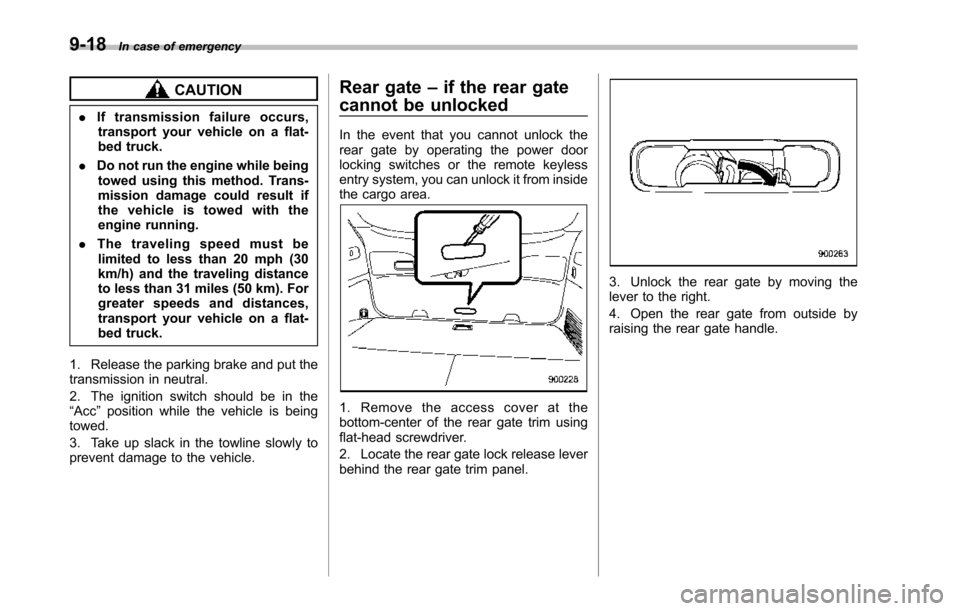
In the event that you cannot unlock therear gate by operating the power doorlocking switches or the remote keylessentry system, you can unlock it from insidethe cargo area.
1. Remove the access cover at thebottom-center of the rear gate trim usingflat-head screwdriver.
2. Locate the rear gate lock release leverbehind the reargate trim panel.
3. Unlock the rear gate by moving thelever to the right.
4. Open the rear gate from outside byraisingthe rear gate handle.