2014 SUBARU TRIBECA tire size
[x] Cancel search: tire sizePage 289 of 426
8-10Driving tips
vior can cause the wheels to lock, possiblyleading to loss of vehicle control.
An anti-lock brake system (ABS) en-hances your vehicle’sbrakingperfor-mance on snowy and icy roads. Forinformation about braking on slipperysurfaces, refer to“ABS (Anti-lock BrakeSystem)”F7-20 and“Vehicle DynamicsControl system”F7-23.
!Wiper operation when snowing
Before driving in cold weather, make surethe wiper blades are not frozen to thewindshield or rear window. If the wiperblades are frozen to the windshield or rearwindow, use the defroster with the airflowcontrol button in the“”position and thetemperature control dial set for maximumwarmth until the wiper blades are com-pletely thawed out. The wiper deicer ishelpful to thaw the windshield wiperblades. To thaw out the rear wiper blade,use the rear window defogger.
When driving in snow, if frozen snow startsto stick on the surface of the windshielddespite wiper operation, use the defrosterwith the airflow control button in“”andthe temperature control dial set for max-imum warmth. After the windshield getswarmed enoughto melt the frozen snowon it, wash it away using the windshieldwasher.
Snow stuck on the wiper arm prevents thewiper from working effectively. If snow isstuck on the wiper arm, pull off the road toa safe place, then remove it. If you stopthe vehicle at road side, use the hazardwarning flasher to alert other drivers.
We recommend use of non-freezing typewiper blades (winter blades) during theseasons in which you could have snowand freezing temperatures. Blades of thistype givesuperior wiping performance insnowy conditions. Be sure to use bladesthat are suitable for your vehicle.
CAUTION
During high-speed driving, non-freezing type wiper blades may notperformas well as standard wiperblades. If this happens, reduce thevehicle speed.
NOTE
When the season requiring non-freez-ing type wiper blades is over, replacethem with standard wiper blades.
&Corrosion protection
Refer to“Corrosion protection”F10-4.
&Snow tires
WARNING
.When replacing original tires withwinter (snow) tires, make sureyou use only tires of the samesize, circumference, speed sym-bol and load index as the originaltires listed on the tire placard.Using tires of other sizes orconstructions may affect speed-ometer/odometer calibration andclearance between the body andtires. It also may be dangerousand lead to loss of vehicle con-trol.
.You must install four winter tiresthat are of the same size, circum-ferences,construction, manufac-turer, brand (tread pattern), de-gree of wear, speed symbol andload index. Mixing tires of othersizes, circumferences or con-structions may result in severemechanical damage to the drivetrain of your vehicle and mayaffect ride, handling, braking andspeedometer/odometer calibra-tion. It also may be dangerousand lead to loss of vehicle con-trol.
Page 290 of 426
.Do not use a combination ofradial, belted bias or bias tiressince it may cause dangeroushandling characteristics and leadto an accident.
Your vehicle is equipped with“all seasontires”which are designed to provide anadequate measure of traction, handlingand braking performance in year-rounddriving. In winter, it may be possible toenhance performance through use of tiresdesigned specifically for winter drivingconditions.
If you choose to install winter tires on yourvehicle, be sure to use the correct tire sizeand type. You must install four winter tiresthat areof the same size, construction,brand and load range and you shouldnever mix radial, belted bias or bias tiressince this may result in dangerous hand-ling characteristics. When you choose atire, make sure that there is enoughclearance between the tire and vehiclebody.
Remember to drive with care at all timesregardless of the type of tires on yourvehicle.
Your vehicle comes with P255/55R18“all season tires”as original equip-ment. You should be aware that some
winter tires with that same size desig-nation may actually be too large for thevehicle and may cause rubbing onsharp turns. Listed in the following isthe winter tire size that we recommend.
Recommended winter (snow) tire size
P255/55R18 stud less
&Tire chains
CAUTION
Tire chains cannot be used on yourvehicle because of the lack ofclearance between the tires andvehicle body.
&Rocking the vehicle
If you must rock the vehicle to free it fromsnow, sand, or mud, depress the accel-erator pedal slightly and move the selectlever back and forth between“D”and“R”repeatedly. Do not race the engine. Forthe best possible traction, avoid spinningthe wheels when trying to free the vehicle.
When the road surface is extremelyslippery, you can obtain better traction bystartingthe vehicle with the transmission
in 2nd than 1st.
For information about holding the trans-mission in the 2nd position, refer to“Selection of manual mode”F7-16 and“Driving tips”F7-17.
Driving tips8-11
Page 300 of 426
Trailer towing
Your vehicle is designed and intended tobe used primarily as a passenger-carryingvehicle. Towing a trailer puts additionalloads on your vehicle’s engine, drivetrain,brakes, tires and suspension and has anadverse effect on fuel economy.
If you do decide to tow a trailer, your safetyand satisfaction depend upon proper useof correct equipment and cautious opera-tion of your vehicle. Seek the advice ofyour SUBARU dealer to assist you inpurchasing a hitch and other necessarytowing equipment appropriate for yourvehicle. In addition, be sure to follow theinstructionson correct installation and useprovided by the trailer and other towingequipment manufacturers.
SUBARUassumes no responsibility forinjuries or vehicle damage that result fromtrailer towing equipment, or from anyerrors or omissions in the instructionsaccompanying such equipment or for yourfailure to follow the proper instructions.
&Warranties and maintenance
SUBARU warranties do not apply tovehicle damage or malfunction causedby trailer towing. If you use your vehicle totow a trailer, more frequent maintenancewill be required due to the additional load.
(Refer to“Maintenance schedule undersevere driving conditions”in the“Warrantyand Maintenance Booklet”.)
Under no circumstances should a trailerbe towed with a new vehicle or a vehiclewith any new powertrain component (en-gine, transmission, differential, wheelbearings, etc.) for the first 1,000 miles(1,600 km) of driving.
&Maximum load limits
WARNING
Never exceed the maximum loadlimits explained in the following.Exceeding the maximum load limitscould cause personal injury and/orvehicle damage.
CAUTION
.Adequate size trailer brakes arerequired when the trailer and itscargo exceed1,000 lbs (453 kg)total weight.
.Before towing a trailer, check thetrailer total weight, GVW, GAWsand tongue load. Make sure theload and its distribution in yourvehicle and trailer are accepta-
ble.
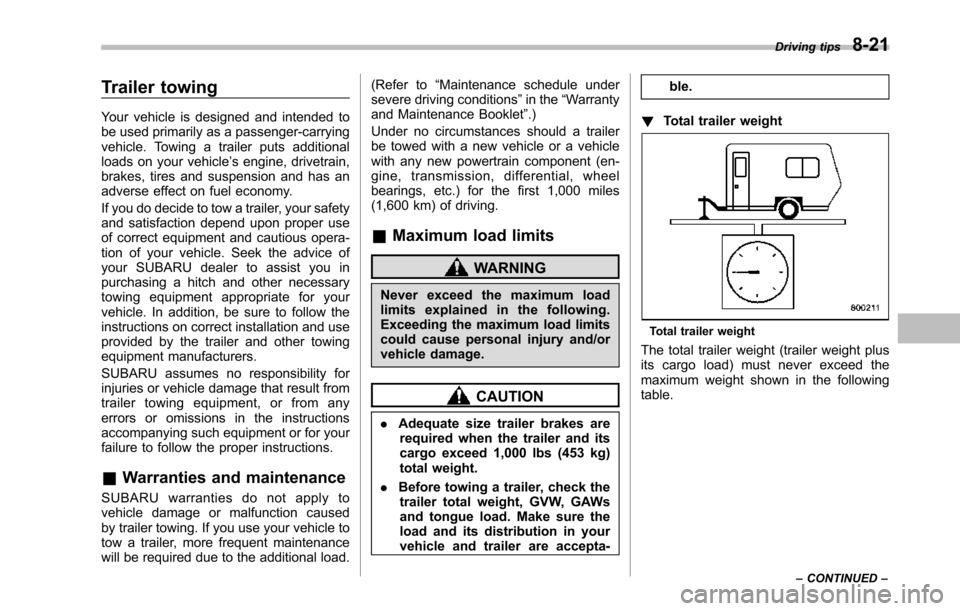
!Total trailer weight
Total trailer weight
The total trailer weight (trailer weight plusits cargo load) must never exceed themaximum weight shown in the followingtable.
Driving tips8-21
–CONTINUED–
Page 305 of 426
8-26Driving tips
blind spots occur with the vehicle’s stan-dard side mirrors, use towing mirrors thatconform with Federal, state/province and/or other applicable regulations.
!Trailer lights
CAUTION
Direct splicing or other improperconnection of trailer lights maydamage your vehicle’selectricalsystem and cause a malfunction ofyour vehicle’s lighting system.
Connection of trailer lights to your vehi-cle’s electrical system requires modifica-tions to the vehicle’s lighting circuit toincrease its capacity and accommodatewiring changes. To ensure the trailer lightsare connected properly, please consultyour SUBARU dealer. Check for properoperation of the turn signals, stop lightsand parking lights each time you hitch up.
!Tires
WARNING
Never tow a trailer when the tem-porary spare tire is used. The tem-porary spare tire is not designed tosustain the towing load. Use of thetemporary spare tire when towing
can result in failure of the spare tireand/or less stability of the vehicle.
Make sure that all the tires on your vehicleare properly inflated. Refer to“Tires”F12-8.
Trailer tire condition, size, load rating andproper inflation pressure should be inaccordance with the trailer manufacturer’sspecifications.
In the event your vehicle gets a flat tirewhen towing a trailer, ask a commercialroad service to repair the flat tire.
If you carry a regular size spare tire in yourvehicle or trailer as a precaution againstgetting a flat tire, be sure that the sparetire is firmly secured.
&Trailer towing tips
CAUTION
.Never exceed 45 mph (72 km/h)when towing a trailer in hillycountry on hot days.
.When towing a trailer, steering,stability, stopping distance andbraking performance will be dif-ferent from normal operation. Forsafety’s sake, you should employ
extra caution when towing atrailer and you should neverspeed. You should also keep thefollowing tips in mind:
!Before starting out on a trip
.Check that the vehicle and vehicle-to-hitch mounting are in good condition. Ifany problems are apparent, do not tow thetrailer.
.Check that the vehicle sits horizontallywith the trailer attached. If the vehicle istippedsharply up at the front and down atthe rear, check the total trailer weight,GVW, GAWs and tongue load again, thenconfirm that the load and its distributionare acceptable.
.Check that the tire pressures arecorrect.
.Checkthat the vehicle and trailer areconnected properly. Confirm that–the trailer tongue is connectedproperly to the hitch ball.–the trailer lights connector is con-nected properly and trailer’s stop lightsilluminate when the vehicle’s brakepedal is pressed, and that the trailer’sturn signal lights flash when thevehicle’s turn signal lever is operated.–the safety chains are connectedproperly.
Page 309 of 426
9-2In case of emergency
If you park your vehicle in an
emergency
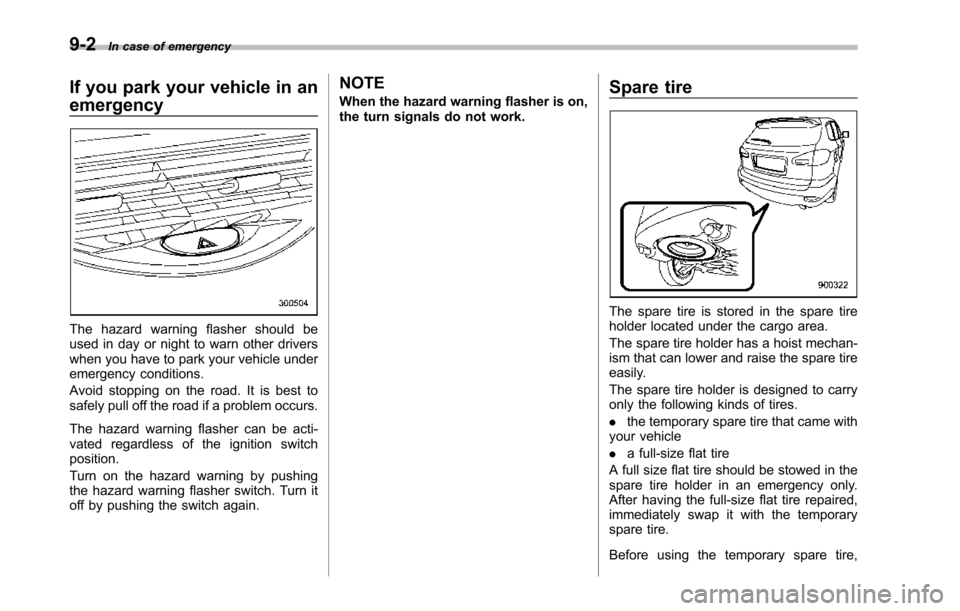
The hazard warning flasher should beused in day or night to warn other driverswhen you have to park your vehicle underemergency conditions.
Avoid stopping on the road. It is best tosafely pull off the road if a problem occurs.
The hazard warning flasher can be acti-vated regardless of the ignition switchposition.
Turn on the hazard warning by pushingthe hazard warning flasher switch. Turn itoff by pushing the switch again.
NOTE
When the hazard warning flasher is on,the turn signals do not work.
Spare tire
The spare tire is stored in the spare tireholder located under the cargo area.
The spare tire holder has a hoist mechan-ism that can lower and raise the spare tireeasily.
The sparetire holder is designed to carryonly the following kinds of tires.
.the temporary spare tire that came withyour vehicle
.a full-size flat tire
A full size flat tire should be stowed in thespare tire holder in an emergency only.After having the full-size flat tire repaired,immediately swap it with the temporaryspare tire.
Before using the temporary spare tire,
Page 311 of 426
9-4In case of emergency
and pull it through the center of thetemporary spare tire.
9. After the temporary spare tire isremoved from the cable, the cable mustbe wound up completely by turning thehoist nut shaft clockwise until you hear aclicking sound. Also visually inspect thecable to make certain that there is nolonger any slack present.
WARNING
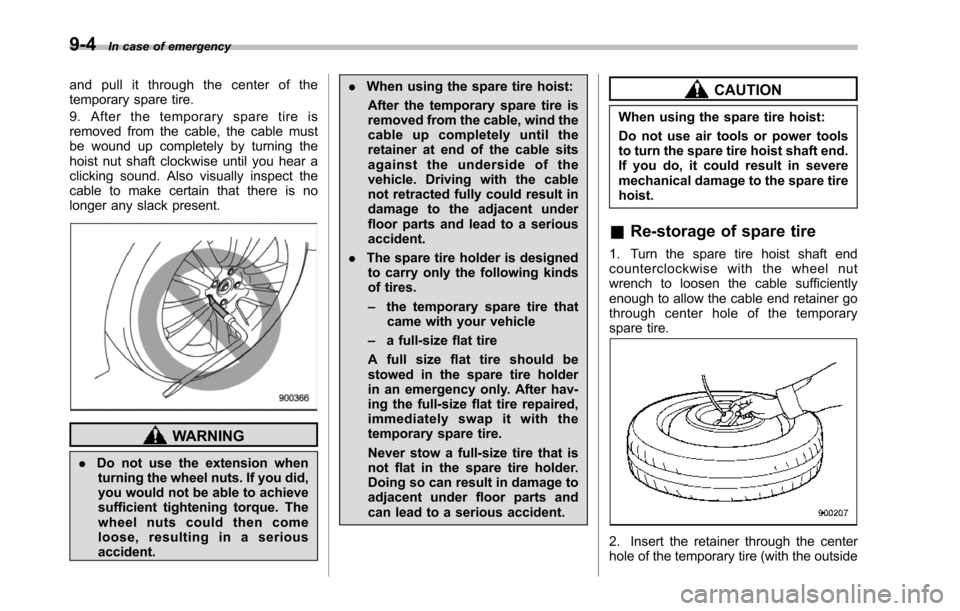
.Do not use the extension whenturning the wheel nuts. If you did,you would not be able to achievesufficient tightening torque. Thewheel nuts could then comeloose, resulting in a seriousaccident.
.When using the spare tire hoist:
After the temporary spare tire isremoved from the cable, wind thecable up completely until theretainer at end of the cable sitsagainst the underside of thevehicle. Driving with the cablenot retracted fully could result indamage to the adjacent underfloor partsand lead to a seriousaccident.
.The spare tire holder is designedto carry only the following kindsof tires.
–the temporaryspare tire thatcame with your vehicle
–a full-size flat tire
A full size flat tire should bestowed in the spare tire holderin an emergency only. After hav-ing the full-sizeflat tire repaired,immediately swap it with thetemporary spare tire.
Never stow a full-size tire that isnot flat in the spare tire holder.Doing so can result in damage toadjacent under floor parts andcan lead to a serious accident.
CAUTION
When using the spare tire hoist:
Do not use air tools or power toolsto turn the spare tire hoist shaft end.If you do, it could result in severemechanical damage to the spare tirehoist.
&Re-storage of spare tire
1. Turn the spare tire hoist shaft endcounterclockwise with the wheel nutwrench to loosen the cable sufficientlyenough to allow the cable end retainer gothrough center hole of the temporaryspare tire.
2. Insert the retainer through the centerhole of the temporary tire (with the outside
Page 312 of 426

of the tire facing up).
3. Turn the hoist shaft end clockwise withthe wheel nut wrench to wind the cable upcompletely until you hear a few clickingsounds.Confirm that the temporary sparetire holding cable has been wound upcompletely by shaking the temporary tire.
CAUTION
If the temporary spare tire is notstored securely, it could damageadjacent areas of the vehicle andmake an abnormal noise.
4. Place the wheel nut wrench andextension back into the tool bag and storethe jackand tool bag in their storagelocations.
5. Fit the lid of the cargo area.
CAUTION
.When stowing a flat tire in thespare tire holder, turn the hoistshaft end only slowly. If it isturned quickly, the wheel disc ofthe flat tire could be damaged.
.Afull-sizeflattireshouldbestowed in the spare tire holderin an emergency only. After hav-ingthe flat tire repaired, immedi-ately swap it with the temporaryspare tire.
.Remember that the tread width ofa flat tire is wider than that of thetemporary spare tire. When car-rying a flat tire stowed in thespare tire holder, make sure thetiredoes not touch any obsta-cles.
Temporary spare tire
WARNING
.Never tow a trailer when thetemporary spare tire is used.The temporary spare tire is notdesigned to sustain the towingload. Use of the temporary sparetire when towing can result infailure of the spare tire and/orless stability of the vehicle andmay lead to an accident.
.When a spare tire is mounted or awheel rim is replaced without theoriginal pressure sensor/trans-mitter being transferred, the lowtire pressure warning light willilluminate steadily after blinkingfor approximately one minute.This indicates the tire pressuremonitoring system (TPMS) is un-able to monitor all four roadwheels. Contact your SUBARUdealer as soon as possible fortire and sensor replacement and/or system resetting.
In case of emergency9-5
–CONTINUED–
Page 313 of 426
9-6In case of emergency
CAUTION
Never use any temporary spare tireother than the original. Using othersizes may result in severe mechan-ical damage to the drive train of yourvehicle.
The temporary spare tire is smaller andlighter than a conventional tire and isdesigned for emergency use only. Re-move thetemporary spare tire and re-install the conventional tire as soon aspossible because the spare tire is de-signed only for temporary use.
Check the inflation pressure of the tem-porary spare tire periodically to keep thetire ready for use. The correct pressure is60 psi (420 kPa, 4.2 kgf/cm2).
When using the temporary spare tire, notethe following.
.Do not exceed 50 mph (80 km/h).
.Do not put a tire chain on the temporaryspare tire.Because of the smaller tire size,a tire chain will not fit properly.
.Do not use two or more temporaryspare tires at the same time.
.Do not drive over obstacles. This tirehas a smaller diameter, so road clearanceis reduced.
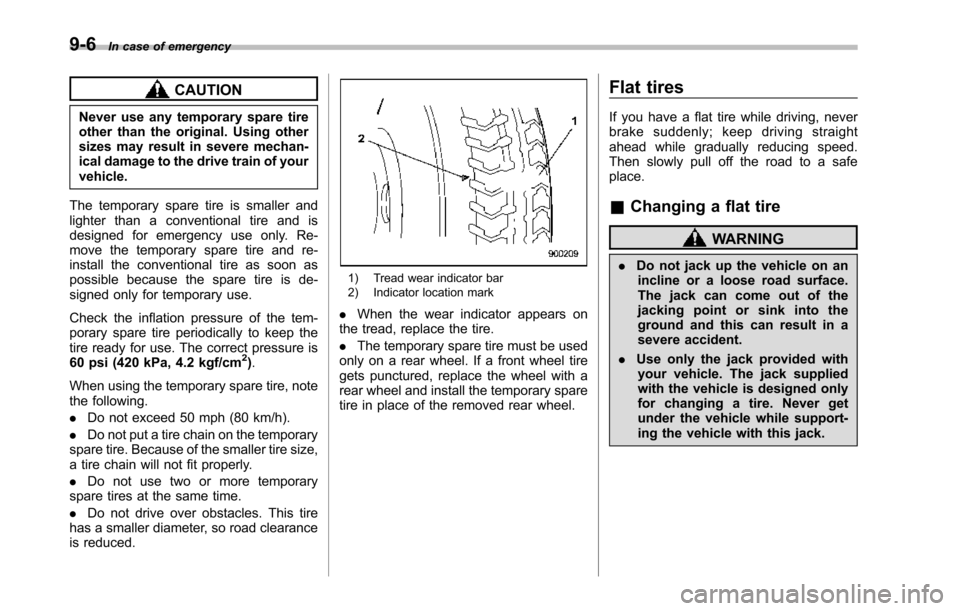
1) Tread wear indicator bar2) Indicator location mark
.When the wear indicator appears onthe tread, replace the tire.
.The temporary spare tire must be usedonly on a rear wheel. If a front wheel tiregets punctured, replace the wheel with arear wheel and install the temporary sparetire in place of the removed rear wheel.
Flat tires
If you have a flat tire while driving, neverbrake suddenly; keep driving straightahead while gradually reducing speed.Then slowly pull off the road to a safeplace.
&Changing a flat tire
WARNING
.Do not jack up the vehicle on anincline or a loose road surface.The jack can come out of thejacking point or sink into theground and this can result in asevere accident.
.Use only the jack provided withyour vehicle. The jack suppliedwith the vehicle is designed onlyfor changing a tire. Never getunder the vehicle while support-ing the vehicle with this jack.