7-16Starting and operating
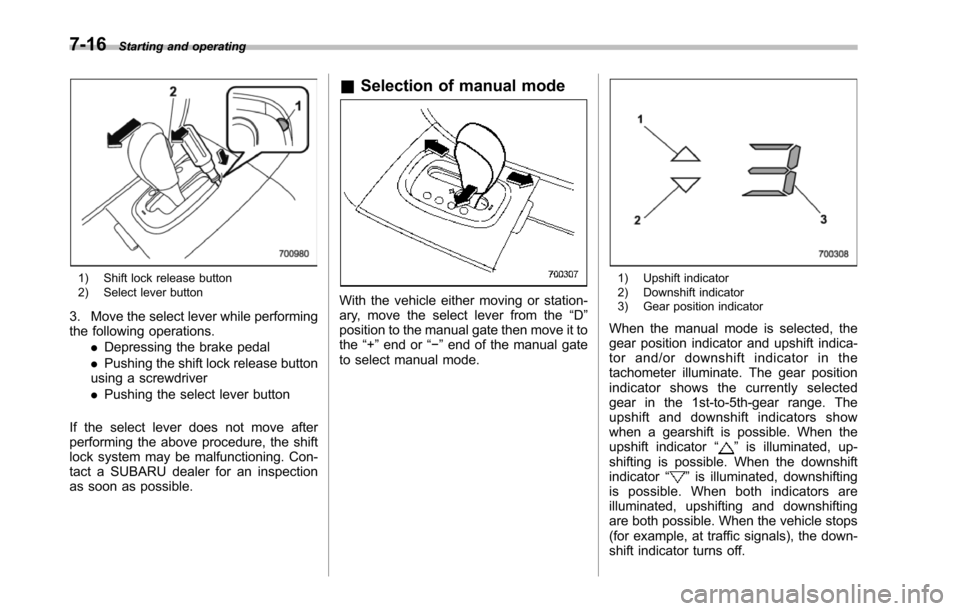
1) Shift lock release button2) Select lever button
3. Move the select lever while performingthefollowing operations..Depressing the brake pedal.Pushing the shift lock release buttonusing a screwdriver.Pushing the select lever button
If the select lever does not move afterperforming the above procedure, the shiftlock system may be malfunctioning. Con-tact a SUBARU dealer for an inspectionas soon as possible.
&Selection of manual mode
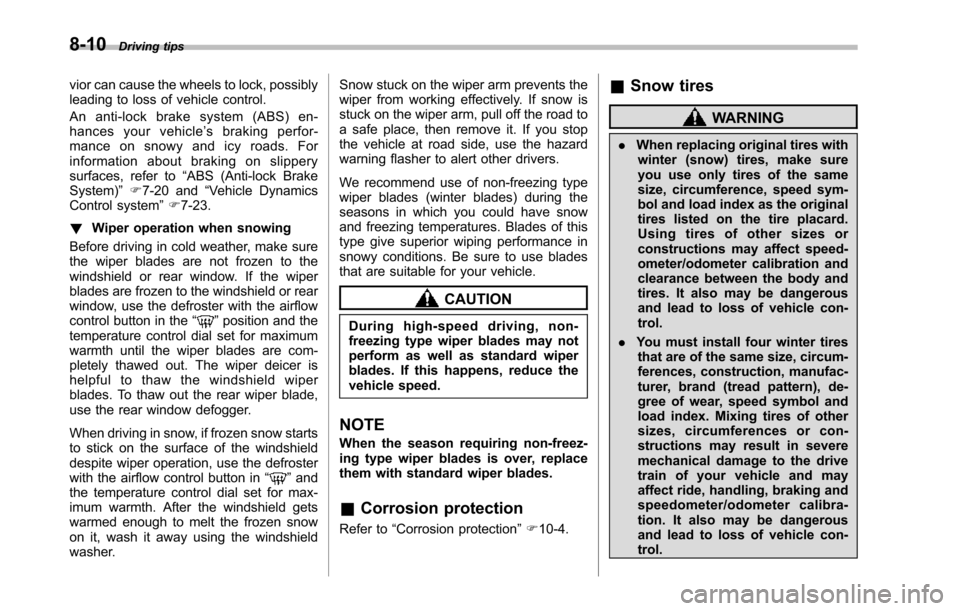
With the vehicle either moving or station-ary, move the select lever from the“D”position to the manual gate then move it tothe“+”end or“!”end of the manual gateto select manual mode.
1) Upshift indicator2) Downshift indicator3) Gear position indicator
When themanual mode is selected, thegear position indicator and upshift indica-tor and/or downshift indicator in thetachometer illuminate. The gear positionindicator shows the currently selectedgear in the 1st-to-5th-gear range. Theupshift and downshift indicators showwhen a gearshift is possible. When theupshiftindicator“”is illuminated, up-shifting is possible. When the downshiftindicator“”is illuminated, downshiftingis possible. When both indicators areilluminated, upshifting and downshiftingare both possible. When the vehicle stops(for example, at traffic signals), the down-shift indicator turns off.
8-10Driving tips
vior can cause the wheels to lock, possiblyleading to loss of vehicle control.
An anti-lock brake system (ABS) en-hances your vehicle’sbrakingperfor-mance on snowy and icy roads. Forinformation about braking on slipperysurfaces, refer to“ABS (Anti-lock BrakeSystem)”F7-20 and“Vehicle DynamicsControl system”F7-23.
!Wiper operation when snowing
Before driving in cold weather, make surethe wiper blades are not frozen to thewindshield or rear window. If the wiperblades are frozen to the windshield or rearwindow, use the defroster with the airflowcontrol button in the“”position and thetemperature control dial set for maximumwarmth until the wiper blades are com-pletely thawed out. The wiper deicer ishelpful to thaw the windshield wiperblades. To thaw out the rear wiper blade,use the rear window defogger.
When driving in snow, if frozen snow startsto stick on the surface of the windshielddespite wiper operation, use the defrosterwith the airflow control button in“”andthe temperature control dial set for max-imum warmth. After the windshield getswarmed enoughto melt the frozen snowon it, wash it away using the windshieldwasher.
Snow stuck on the wiper arm prevents thewiper from working effectively. If snow isstuck on the wiper arm, pull off the road toa safe place, then remove it. If you stopthe vehicle at road side, use the hazardwarning flasher to alert other drivers.
We recommend use of non-freezing typewiper blades (winter blades) during theseasons in which you could have snowand freezing temperatures. Blades of thistype givesuperior wiping performance insnowy conditions. Be sure to use bladesthat are suitable for your vehicle.
CAUTION
During high-speed driving, non-freezing type wiper blades may notperformas well as standard wiperblades. If this happens, reduce thevehicle speed.
NOTE
When the season requiring non-freez-ing type wiper blades is over, replacethem with standard wiper blades.
&Corrosion protection
Refer to“Corrosion protection”F10-4.
&Snow tires
WARNING
.When replacing original tires withwinter (snow) tires, make sureyou use only tires of the samesize, circumference, speed sym-bol and load index as the originaltires listed on the tire placard.Using tires of other sizes orconstructions may affect speed-ometer/odometer calibration andclearance between the body andtires. It also may be dangerousand lead to loss of vehicle con-trol.
.You must install four winter tiresthat are of the same size, circum-ferences,construction, manufac-turer, brand (tread pattern), de-gree of wear, speed symbol andload index. Mixing tires of othersizes, circumferences or con-structions may result in severemechanical damage to the drivetrain of your vehicle and mayaffect ride, handling, braking andspeedometer/odometer calibra-tion. It also may be dangerousand lead to loss of vehicle con-trol.