2014 SUBARU TRIBECA seats
[x] Cancel search: seatsPage 49 of 426
1-18Seat, seatbelt and SRS airbags
the face or neck, adjust the shoulder beltanchor height (window-side seating posi-tions only) and then if necessary move thechild closer to the belt buckle to helpprovide a good shoulder belt fit. Care mustbe taken to securely place the lap belt aslow as possible on the hips and not on thechild’s waist. If the shoulder portion of thebelt cannot be properly positioned, a childrestraint system should be used. Neverplacethe shoulder belt under the child’sarm or behind the child’s back.
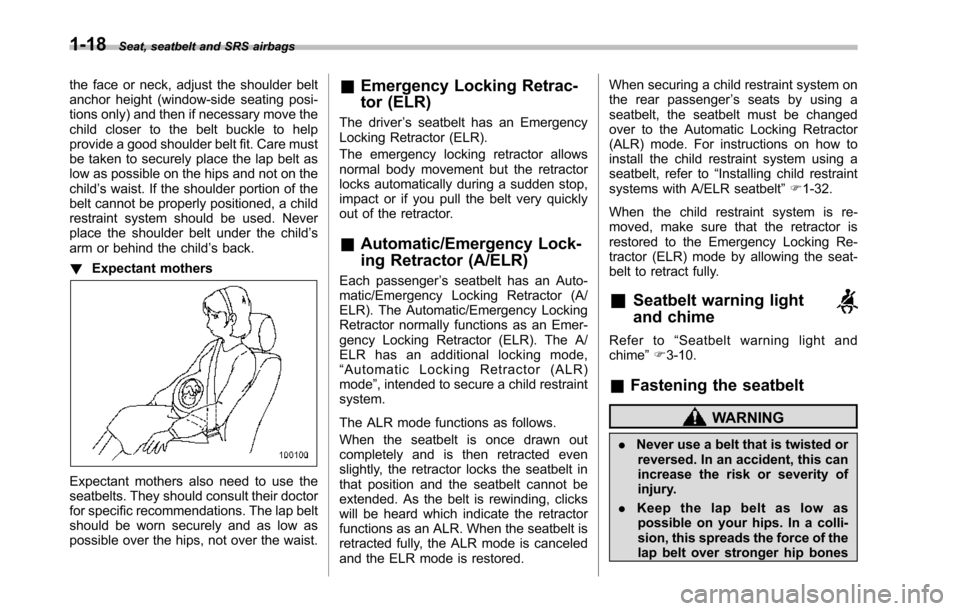
!Expectant mothers
Expectant mothers also need to use theseatbelts. They should consult their doctorfor specific recommendations. The lap beltshouldbe worn securely and as low aspossible over the hips, not over the waist.
&Emergency Locking Retrac-
tor (ELR)
The driver’s seatbelt has an EmergencyLocking Retractor (ELR).
The emergency locking retractor allowsnormal body movement but the retractorlocks automatically during a sudden stop,impact or if you pull the belt very quicklyout of the retractor.
&Automatic/Emergency Lock-
ing Retractor (A/ELR)
Each passenger’s seatbelt has an Auto-matic/Emergency Locking Retractor (A/ELR). The Automatic/Emergency LockingRetractor normally functions as an Emer-gency Locking Retractor (ELR). The A/ELR has an additional locking mode,“Automatic Locking Retractor (ALR)mode”, intended to secure a child restraintsystem.
The ALR mode functions as follows.
When the seatbelt is once drawn outcompletely and is then retracted evenslightly, the retractor locks the seatbelt inthat position and the seatbelt cannot beextended. As the belt is rewinding, clickswill be heard which indicate the retractorfunctions as an ALR. When the seatbelt isretracted fully, the ALR mode is canceledand the ELR mode is restored.
When securing a child restraint system onthe rear passenger’s seats by using aseatbelt, the seatbelt must be changedover to the Automatic Locking Retractor(ALR) mode. For instructions on how toinstall the child restraint system using aseatbelt, refer to“Installing child restraintsystems with A/ELR seatbelt”F1-32.
When the child restraint system is re-moved, make sure that the retractor isrestored to the Emergency Locking Re-tractor (ELR) mode by allowing the seat-belt to retract fully.
&Seatbelt warning light
and chime
Refer to“Seatbelt warning light andchime”F3-10.
&Fastening the seatbelt
WARNING
.Never use a belt that is twisted orreversed. In an accident, this canincrease therisk or severity ofinjury.
.Keep the lap belt as low aspossible on your hips. In a colli-sion, this spreads the force of thelap belt over stronger hip bones
Page 52 of 426

!Second-row seatbelts–excludingcenter seatbelt
1. Sit well back in the seat.
2. Pick up the tongue plate and pull thebelt out slowly. Do not let it get twisted. Ifthe belt stops before reaching the buckle,return the belt slightly and pull it out moreslowly. If the belt still cannot be unlocked,let the belt retract slightly after giving astrong pull on it, then pull it out slowlyagain.
3. Insert the tongue plate into the buckleuntil you hear a click.
4. To make the lap part tight, pull up onthe shoulder belt.
5. Place the lap belt as low as possibleon your hips, not on your waist.
!Adjusting the shoulder belt an-chor height (second-row seats)
The shoulder belt anchor height should beadjusted to the position best suited for thepassenger. Always adjust the anchorheight so that the shoulder belt passesover the middle of the shoulder withouttouching the neck.
To raise:
Slide the anchor up.
To lower:
Push the release button and slide theanchor down.
Pull down on the anchor to make sure thatit is locked in place.
Seat, seatbelt and SRS airbags1-21
–CONTINUED–
Page 60 of 426
vehicle models in this Owner’sManual.Child restraint systems
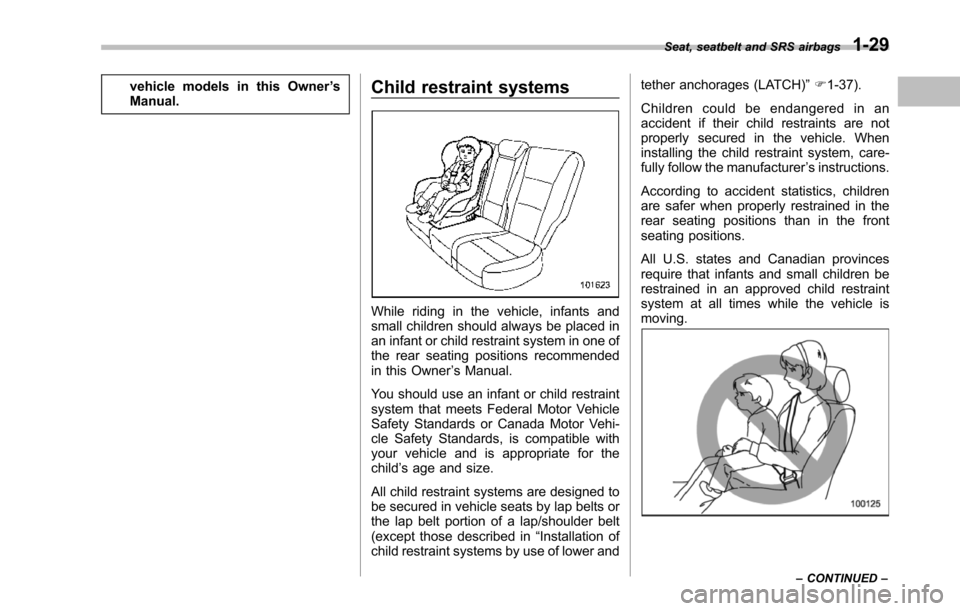
Whileriding in the vehicle, infants andsmall children should always be placed inan infant or child restraint system in one ofthe rear seating positions recommendedin this Owner’s Manual.
You should use an infant or child restraintsystem that meets Federal Motor VehicleSafetyStandards or Canada Motor Vehi-cle Safety Standards, is compatible withyour vehicle and is appropriate for thechild’s age and size.
Allchild restraint systems are designed tobe secured in vehicle seats by lap belts orthe lap belt portion of a lap/shoulder belt(except those described in“Installation ofchild restraint systems by use of lower and
tether anchorages (LATCH)”F1-37).
Children could be endangered in anaccident if their child restraints are notproperly secured in the vehicle. Wheninstalling the child restraint system, care-fully follow the manufacturer’s instructions.
According to accident statistics, childrenare safer when properly restrained in therear seating positions than in the frontseating positions.
All U.S. states and Canadian provincesrequire that infants and small children berestrained in an approved child restraintsystem at all times while the vehicle ismoving.
Seat, seatbelt and SRS airbags1-29
–CONTINUED–
Page 61 of 426
1-30Seat, seatbelt and SRS airbags
WARNING
Never let a passenger hold a childon his or her lap while the vehicle ismoving. The passenger cannot pro-tect the child from injury in a colli-sion, because the child will becaught between the passenger andobjects inside the vehicle. Addition-ally, holding a child in your lap orarms in the front seat exposes thatchild to another serious danger.Since the SRSairbag deploys withconsiderable speed and force, thechild could be injured or even killed.
WARNING
Children should be properly re-strained at all times. Never allow achild to stand up, or to kneel on anyseat. Unrestrained children will bethrown forward during sudden stopor in an accident and can be injuredseriously.
Additionally, children standing up orkneeling on or in front of the frontseat are exposed another seriousdanger. Since the SRS airbag de-ployswith considerable speed andforce, the child could be injured oreven killed.
&Where to place a child re-
straint system
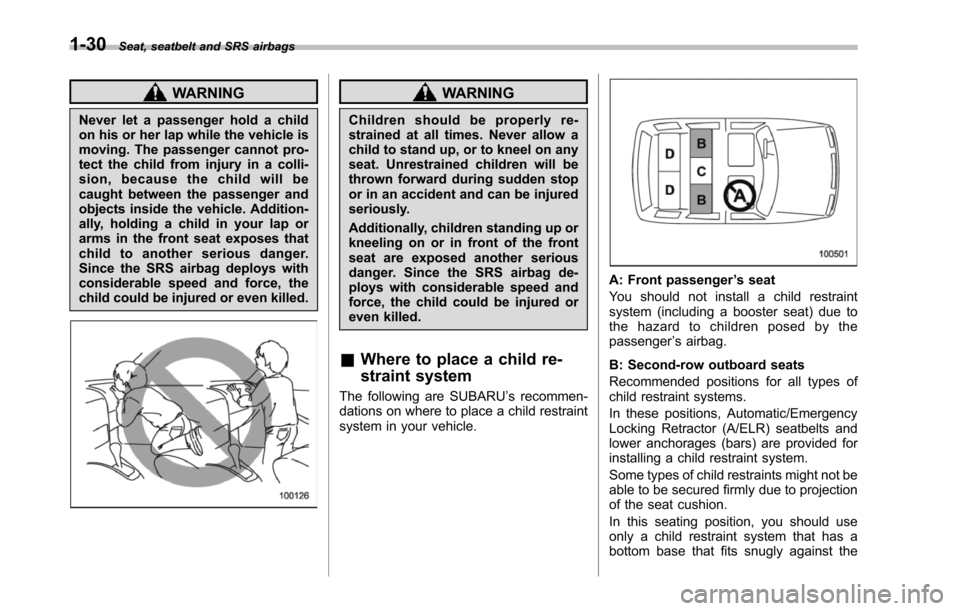
The following are SUBARU’s recommen-dations on where to place a child restraintsystem in your vehicle.
A: Front passenger’s seat
You should not install a child restraintsystem (including a booster seat) due tothe hazard to children posed by thepassenger’s airbag.
B: Second-row outboard seats
Recommended positions for all types ofchild restraint systems.
In these positions, Automatic/EmergencyLocking Retractor (A/ELR) seatbelts andlower anchorages (bars) are provided forinstalling a child restraint system.
Some types of child restraints might not beable to be secured firmly due to projectionof the seat cushion.
In this seating position, you should useonly a child restraint system that has abottom base that fits snugly against the
Page 62 of 426
contours of the seat cushion and can besecurely retained using the seatbelt.
C: Second-row center seat
Installing a child restraint system is notrecommended, although the A/ELR seat-belt and an upper anchorage (tetheranchorage) are provided in this position.
Some types of child restraints might not beable to be secured firmly due to projectionof the seat cushion.
In this seating position, you should useonly a child restraint system that has abottom base that fits snugly against thecontours of the seat cushion and can besecurelyretained using the seatbelt.
D: Third-row seat
Installing a child restraint system is notrecommended, although the A/ELR seat-belt and two upper anchorages (tetheranchorages)are provided in these posi-tions.
These seating positions are not equippedwith lower anchorages (bars) for installingLATCH system-type child restraints. How-ever, child restraint devices can be used inthese position using the A/ELR seatbeltsand upper anchorages (tether an-chorages) provided.
Some typesof child restraints might not beable to be secured firmly due to projectionof the seat cushion.
In this seating position, you should useonly a child restraint system that has abottom base that fits snugly against thecontours of the seat cushion and can besecurely retained using the seatbelt.
WARNING
Put children aged 12 and under inthe rear seat properly restrained atalltimes. The SRS airbag deployswith considerable speed and forceand can injure or even kill children,especially if they are 12 years of ageand under and are not restrained orimproperly restrained. Because chil-dren are lighter and weaker thanadults, their risk of being injuredfrom deployment is greater.
Consequently, be sure to secureALL types of child restraint devices(including forward facing childseats) in the REAR seats at all times.You should choose a restraint de-vice which is appropriate for thechild’s age, height and weight. Ac-cording to accident statistics, chil-dren are safer when properly re-strained in the rear seating posi-tions than in the front seating posi-tions.
WARNING
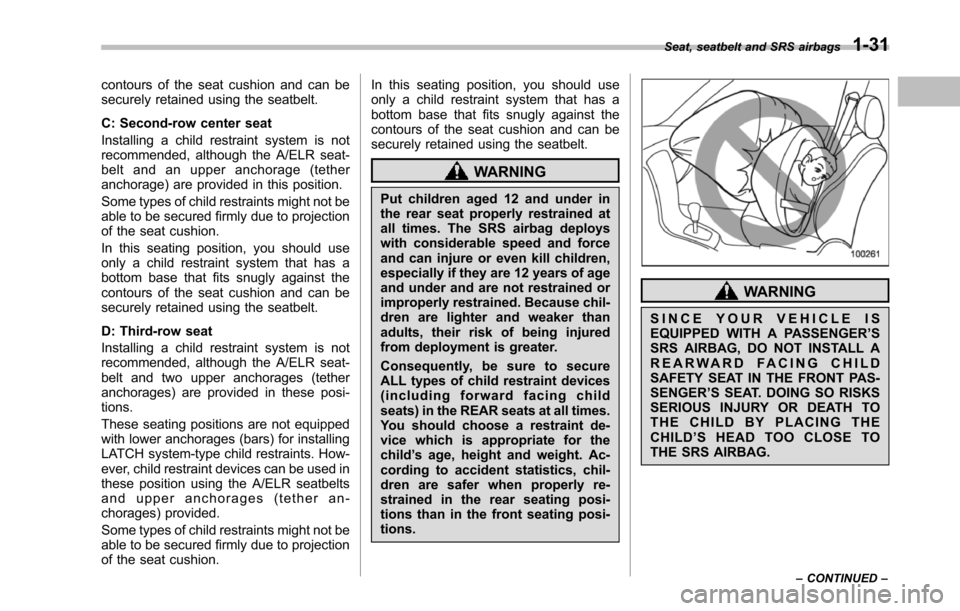
SINCE YOUR VEHICLE ISEQUIPPED WITH A PASSENGER’SSRS AIRBAG, DO NOT INSTALL AREARWARD FACING CHILDSAFETY SEAT IN THE FRONT PAS-SENGER’S SEAT. DOING SO RISKSSERIOUS INJURY OR DEATH TOTHE CHILD BY PLACING THECHILD’SHEADTOOCLOSETOTHE SRS AIRBAG.
Seat, seatbelt and SRS airbags1-31
–CONTINUED–
Page 71 of 426
1-40Seat, seatbelt and SRS airbags
6. Before seating a child in the childrestraint system, try to move seat backand forth and left and right to verify that itis held securely in position.
7. To remove the child restraint system,follow the reverse procedures of installa-tion.
If you have any question concerning thistype of child restraint system, ask yourSUBARU dealer.
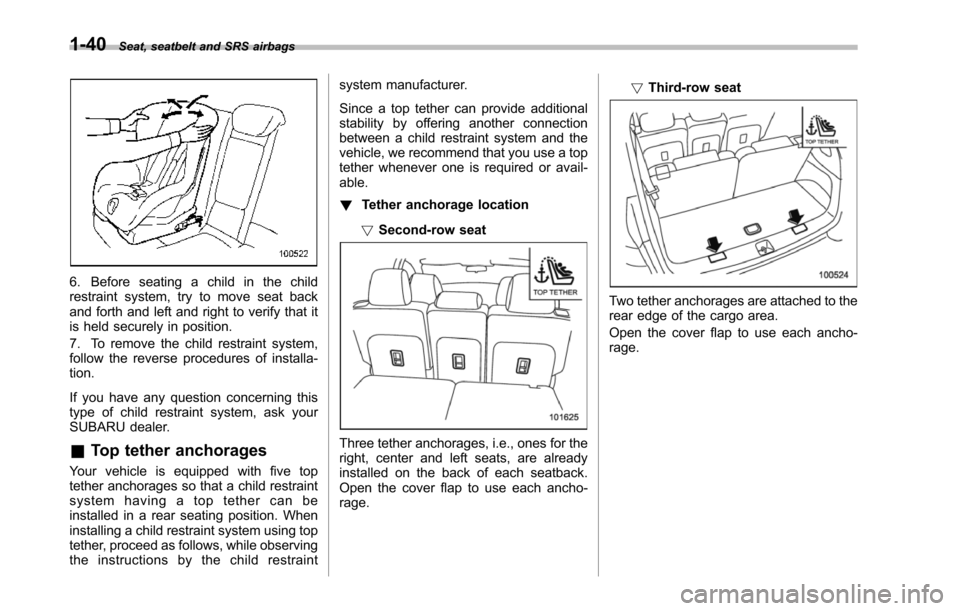
&Top tether anchorages
Your vehicle is equipped with five toptether anchorages so that a child restraintsystem having a top tether can beinstalled in a rear seating position. Wheninstalling a child restraint system using toptether, proceed as follows, while observingthe instructions by the child restraint
system manufacturer.
Since a top tether can provide additionalstability by offering another connectionbetween a child restraint system and thevehicle, we recommend that you use a toptether whenever one is required or avail-able.
!Tether anchorage location
!Second-row seat
Three tether anchorages, i.e., ones for theright, centerand left seats, are alreadyinstalled on the back of each seatback.Open the cover flap to use each ancho-rage.
!Third-row seat
Two tether anchorages are attached to therear edge of the cargo area.
Open the cover flap to use each ancho-rage.
Page 76 of 426
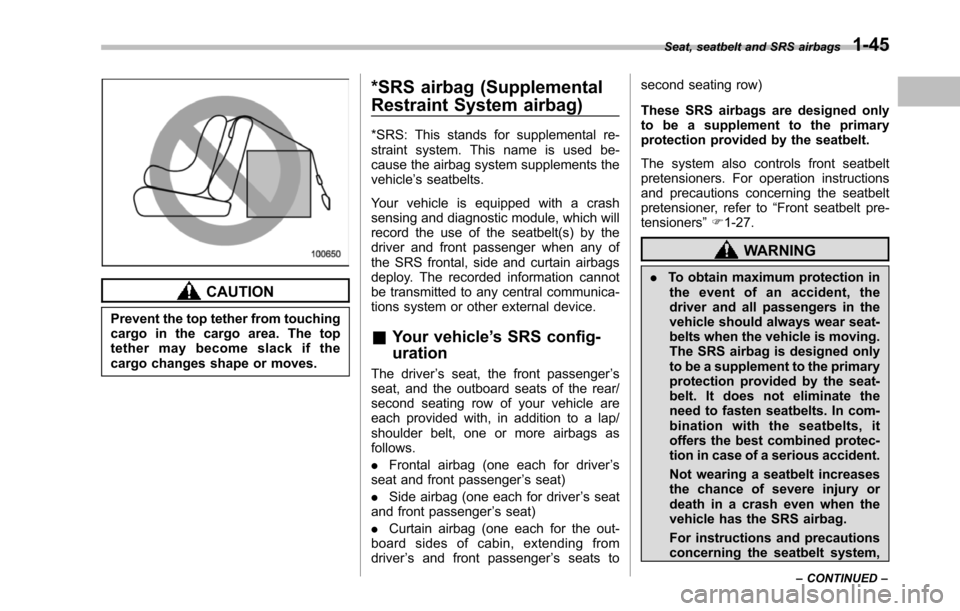
CAUTION
Prevent the top tether from touchingcargo in the cargo area. The toptether may become slack if thecargo changes shape or moves.
*SRS airbag (Supplemental
Restraint System airbag)
*SRS: This stands for supplemental re-straint system. This name is used be-cause the airbag system supplements thevehicle’s seatbelts.
Your vehicle is equipped with a crashsensing and diagnostic module, which willrecord the use of the seatbelt(s) by thedriver and front passenger when any oftheSRS frontal, side and curtain airbagsdeploy. The recorded information cannotbe transmitted to any central communica-tions system or other external device.
&Your vehicle’s SRS config-
uration
The driver’s seat, the front passenger’sseat, and the outboard seats of the rear/second seating row of your vehicle areeach provided with, in addition to a lap/shoulder belt, one or more airbags asfollows.
.Frontal airbag (one each for driver’sseat and front passenger’s seat)
.Side airbag (one each for driver’s seatand front passenger’s seat)
.Curtain airbag (one each for the out-board sides of cabin, extending fromdriver’s and front passenger’s seats to
second seating row)
These SRS airbags are designed onlyto be a supplement to the primaryprotection provided by the seatbelt.
The system also controls front seatbeltpretensioners. For operation instructionsand precautions concerning the seatbeltpretensioner, refer to“Frontseatbelt pre-tensioners”F1-27.
WARNING
.To obtain maximum protection inthe event of an accident, thedriverand all passengers in thevehicle should always wear seat-belts when the vehicle is moving.The SRS airbag is designed onlyto be a supplement to the primaryprotection provided by the seat-belt. It does not eliminate theneed to fasten seatbelts. In com-bination with the seatbelts, itoffers the best combined protec-tion in case of a serious accident.
Not wearing a seatbelt increasesthe chance of severe injury ordeath in a crash even when thevehicle has the SRS airbag.
For instructions and precautionsconcerning the seatbelt system,
Seat, seatbelt and SRS airbags1-45
–CONTINUED–
Page 77 of 426
1-46Seat, seatbelt and SRS airbags
refer to“Seatbelts”F1-17.
.Do not sit or lean unnecessarilyclose to the SRS airbag. Becausethe SRS airbag deploys withconsiderable speed–faster thanthe blink of an eye–and force toprotect in high speed collisions,the force of an airbag can injurean occupant whose body is tooclose to SRS airbag.
It is also important to wear yourseatbelt to help avoid injuriesthat can result when the SRSairbag contacts an occupant notin proper position such as onethrown forward during pre-acci-dent braking.
Even when properly positioned,there remainsa possibility thatan occupant may suffer minorinjury such as abrasions andbruises to the face or armsbecause of the SRS airbag de-ployment force.
.The SRS airbags deploy withconsiderable speed and force.Occupants who are out of properposition when the SRS airbagdeploys could suffer very seriousinjuries. Because the SRS airbagneeds enough space for deploy-
ment, the driver should alwayssit upright and well back in theseat as far from the steeringwheel as practical while stillmaintaining full vehicle controland the front passenger shouldmove the seat as far back aspossible and sit upright and wellback in the seat.
.Do not place any objects over ornear the SRS airbag cover orbetween you and the SRS airbag.If the SRS airbag deploys, thoseobjects could interfere with itsproper operation and could bepropelled inside the vehicle andcause injury.
WARNING
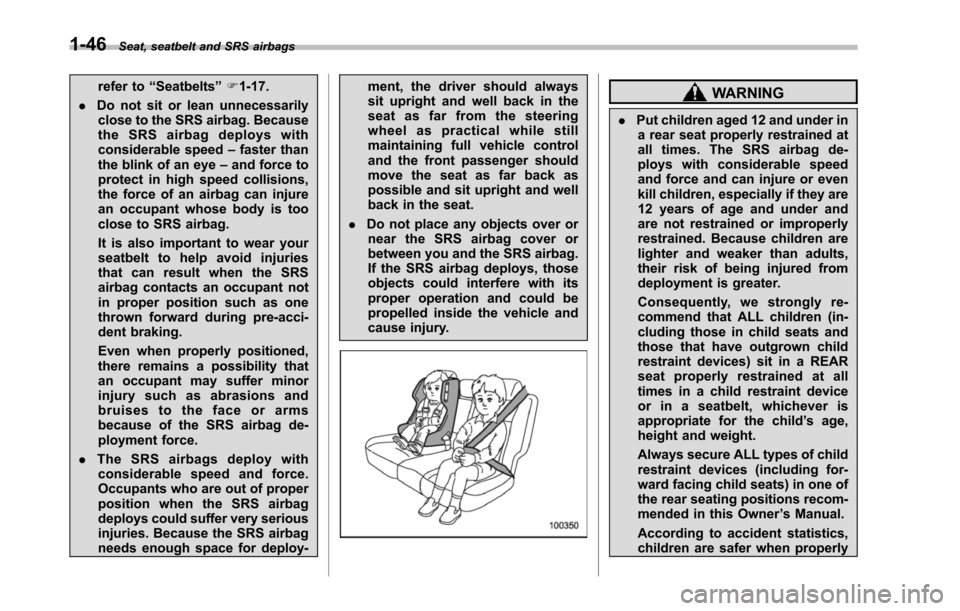
.Put children aged 12 and under ina rear seat properly restrained atall times. The SRS airbag de-ploys with considerable speedand force and can injure or evenkill children, especially if they are12 years of age and under andare not restrained or improperlyrestrained. Because children arelighter and weaker than adults,their risk of being injured fromdeployment is greater.
Consequently, we strongly re-commend that ALL children (in-cluding those in child seats andthose that have outgrown childrestraintdevices) sit in a REARseat properly restrained at alltimes in a child restraint deviceor in a seatbelt, whichever isappropriate for the child’s age,height and weight.
Always secure ALL types of childrestraint devices (including for-ward facing child seats) in one ofthe rear seating positions recom-mended in this Owner’s Manual.
According to accident statistics,children are safer when properly