2014 SUBARU TRIBECA clock
[x] Cancel search: clockPage 310 of 426
carefully read“Temporary spare tire”F9-5for instructions and precautions.
&Removing the spare tire
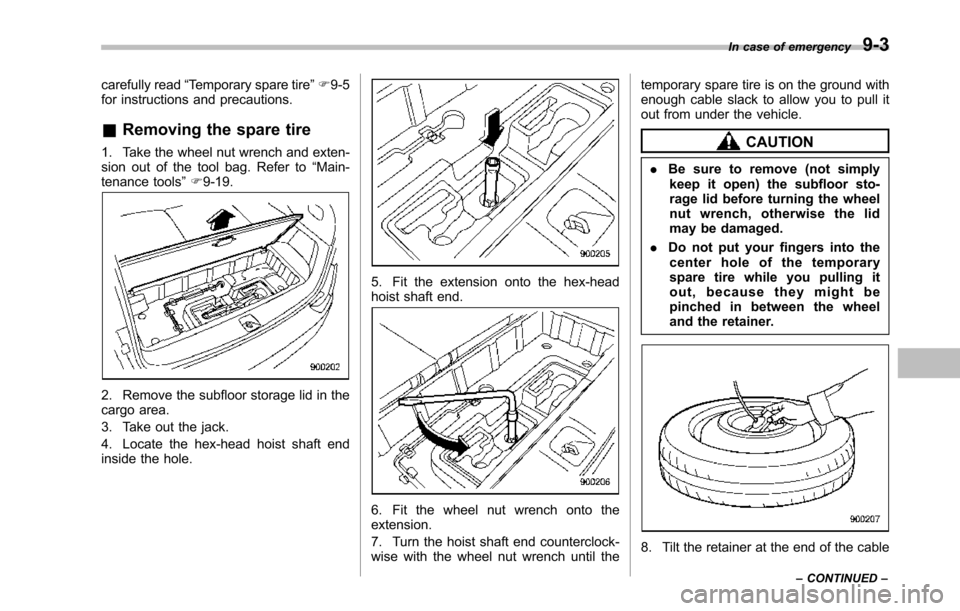
1. Take the wheel nut wrench and exten-sion out of the tool bag. Refer to“Main-tenance tools”F9-19.
2. Remove the subfloor storage lid in thecargo area.
3. Take out the jack.
4. Locate the hex-head hoist shaft endinside the hole.
5. Fit the extension onto the hex-headhoist shaft end.
6. Fit the wheel nut wrench onto theextension.
7. Turn the hoist shaft end counterclock-wise with the wheel nut wrench until the
temporary spare tire is on the ground withenough cable slack to allow you to pull itout from under the vehicle.
CAUTION
.Be sure to remove (not simplykeep it open) the subfloor sto-ragelid before turning the wheelnut wrench, otherwise the lidmay be damaged.
.Do not put your fingers into thecenter hole of the temporaryspare tire while you pulling itout, because they might bepinched in between the wheelandthe retainer.
8. Tilt the retainer at the end of the cable
In case of emergency9-3
–CONTINUED–
Page 311 of 426
9-4In case of emergency
and pull it through the center of thetemporary spare tire.
9. After the temporary spare tire isremoved from the cable, the cable mustbe wound up completely by turning thehoist nut shaft clockwise until you hear aclicking sound. Also visually inspect thecable to make certain that there is nolonger any slack present.
WARNING
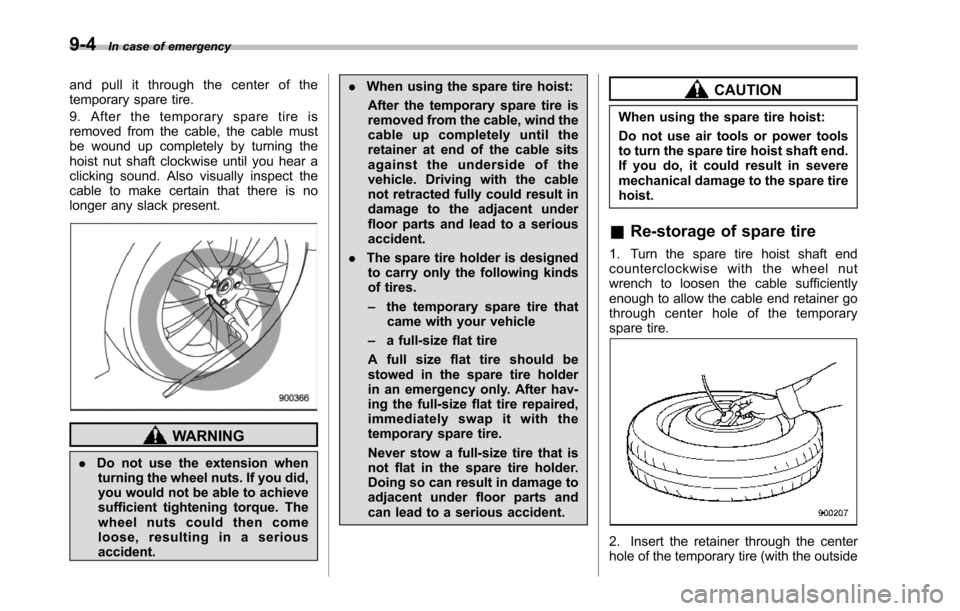
.Do not use the extension whenturning the wheel nuts. If you did,you would not be able to achievesufficient tightening torque. Thewheel nuts could then comeloose, resulting in a seriousaccident.
.When using the spare tire hoist:
After the temporary spare tire isremoved from the cable, wind thecable up completely until theretainer at end of the cable sitsagainst the underside of thevehicle. Driving with the cablenot retracted fully could result indamage to the adjacent underfloor partsand lead to a seriousaccident.
.The spare tire holder is designedto carry only the following kindsof tires.
–the temporaryspare tire thatcame with your vehicle
–a full-size flat tire
A full size flat tire should bestowed in the spare tire holderin an emergency only. After hav-ing the full-sizeflat tire repaired,immediately swap it with thetemporary spare tire.
Never stow a full-size tire that isnot flat in the spare tire holder.Doing so can result in damage toadjacent under floor parts andcan lead to a serious accident.
CAUTION
When using the spare tire hoist:
Do not use air tools or power toolsto turn the spare tire hoist shaft end.If you do, it could result in severemechanical damage to the spare tirehoist.
&Re-storage of spare tire
1. Turn the spare tire hoist shaft endcounterclockwise with the wheel nutwrench to loosen the cable sufficientlyenough to allow the cable end retainer gothrough center hole of the temporaryspare tire.
2. Insert the retainer through the centerhole of the temporary tire (with the outside
Page 312 of 426

of the tire facing up).
3. Turn the hoist shaft end clockwise withthe wheel nut wrench to wind the cable upcompletely until you hear a few clickingsounds.Confirm that the temporary sparetire holding cable has been wound upcompletely by shaking the temporary tire.
CAUTION
If the temporary spare tire is notstored securely, it could damageadjacent areas of the vehicle andmake an abnormal noise.
4. Place the wheel nut wrench andextension back into the tool bag and storethe jackand tool bag in their storagelocations.
5. Fit the lid of the cargo area.
CAUTION
.When stowing a flat tire in thespare tire holder, turn the hoistshaft end only slowly. If it isturned quickly, the wheel disc ofthe flat tire could be damaged.
.Afull-sizeflattireshouldbestowed in the spare tire holderin an emergency only. After hav-ingthe flat tire repaired, immedi-ately swap it with the temporaryspare tire.
.Remember that the tread width ofa flat tire is wider than that of thetemporary spare tire. When car-rying a flat tire stowed in thespare tire holder, make sure thetiredoes not touch any obsta-cles.
Temporary spare tire
WARNING
.Never tow a trailer when thetemporary spare tire is used.The temporary spare tire is notdesigned to sustain the towingload. Use of the temporary sparetire when towing can result infailure of the spare tire and/orless stability of the vehicle andmay lead to an accident.
.When a spare tire is mounted or awheel rim is replaced without theoriginal pressure sensor/trans-mitter being transferred, the lowtire pressure warning light willilluminate steadily after blinkingfor approximately one minute.This indicates the tire pressuremonitoring system (TPMS) is un-able to monitor all four roadwheels. Contact your SUBARUdealer as soon as possible fortire and sensor replacement and/or system resetting.
In case of emergency9-5
–CONTINUED–
Page 316 of 426
WARNING
Do not use oil or grease on thewheel studs or nuts when the sparetire is installed. This could cause thenuts to become loose and lead to anaccident.
15. Turn the jack handle counterclockwiseto lower the vehicle.
CAUTION
There are 2 types of wheel nutwrenches that apply to differentlengths.
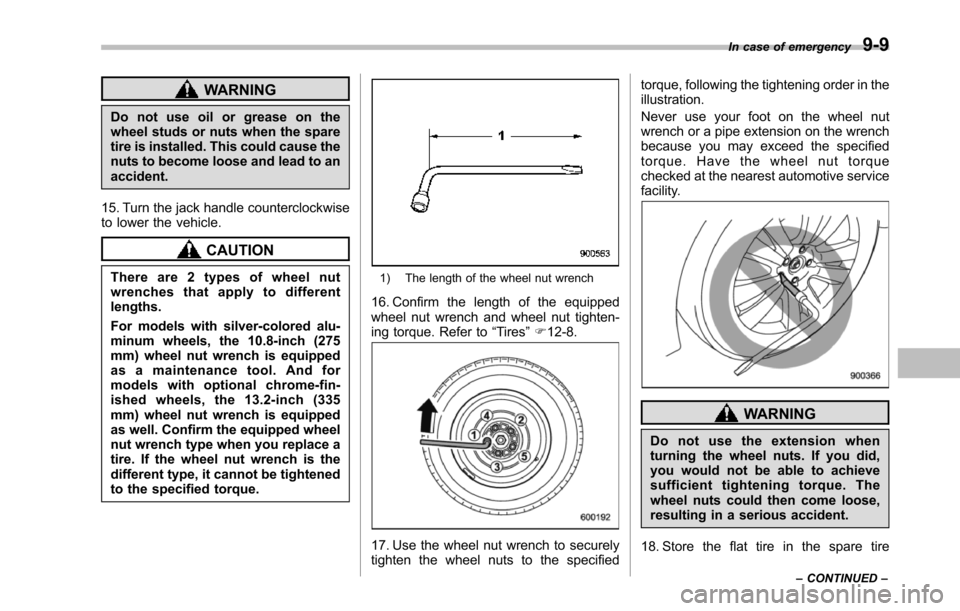
For models with silver-colored alu-minumwheels, the 10.8-inch (275mm) wheel nut wrench is equippedas a maintenance tool. And formodels with optional chrome-fin-ished wheels, the 13.2-inch (335mm) wheel nut wrench is equippedas well. Confirm the equipped wheelnut wrench type when you replace atire. If the wheel nut wrench is thedifferent type, it cannot be tightenedto the specified torque.
1) The length of the wheel nut wrench
16. Confirm the length of the equippedwheel nut wrench and wheel nut tighten-ing torque. Refer to“Tires”F12-8.
17. Use the wheel nut wrench to securelytighten thewheel nuts to the specified
torque, following the tightening order in theillustration.
Never use your foot on the wheel nutwrench or a pipe extension on the wrenchbecause you may exceed the specifiedtorque. Have the wheel nut torquechecked at the nearest automotive servicefacility.
WARNING
Do not use the extension whenturning the wheel nuts. If you did,you would not be able to achievesufficient tightening torque. Thewheel nuts could then come loose,resulting in a serious accident.
18. Store the flat tire in the spare tire
In case of emergency9-9
–CONTINUED–
Page 321 of 426
9-14In case of emergency
Engine overheating
WARNING
Never attempt to remove the radia-tor cap until the engine has beenshut off and has fully cooled down.When theengine is hot, the coolantis under pressure. Removing thecap while the engine is still hotcould release a spray of boiling hotcoolant, which could burn you veryseriously.
If the engine overheats, safely pull off theroad and stop the vehicle in a safe place.
&If steam is coming from the
engine compartment
Turn off the engine and get everyoneaway from the vehicle until it cools down.
&If no steam is coming from
the engine compartment
NOTE
For details about how to check thecoolant level or how to add coolant,refer to“Engine coolant”F11-11.
1. Keep the engine running at idlingspeed.
2. Open the hood to ventilate the enginecompartment. Refer to“Engine hood”F11-4.
Confirm that the cooling fan is turning. Ifthe fan is not turning, immediately turn offthe engine and contact your authorizeddealer for repair.
3. After the engine coolant temperaturehas dropped, turn off the engine.
If the temperature gauge stays at theoverheated zone, turn off the engine.
4. After the engine has fully cooled down,check the coolant level in the reservetank.
If the coolant level is below the“LOW”mark, add coolant up to the“FULL”mark.
5. If there is no coolant in the reservetank, add coolant to the reserve tank.Then remove the radiator cap and fill theradiator with coolant.
If you remove the radiator cap from a hotradiator, first wrap a thick cloth around theradiator cap, then turn the cap counter-clockwise slowly without pressing downuntil it stops. Release the pressure fromthe radiator. After the pressure has beenfully released, remove the cap by pressingdown and turning it.
Towing
WARNING
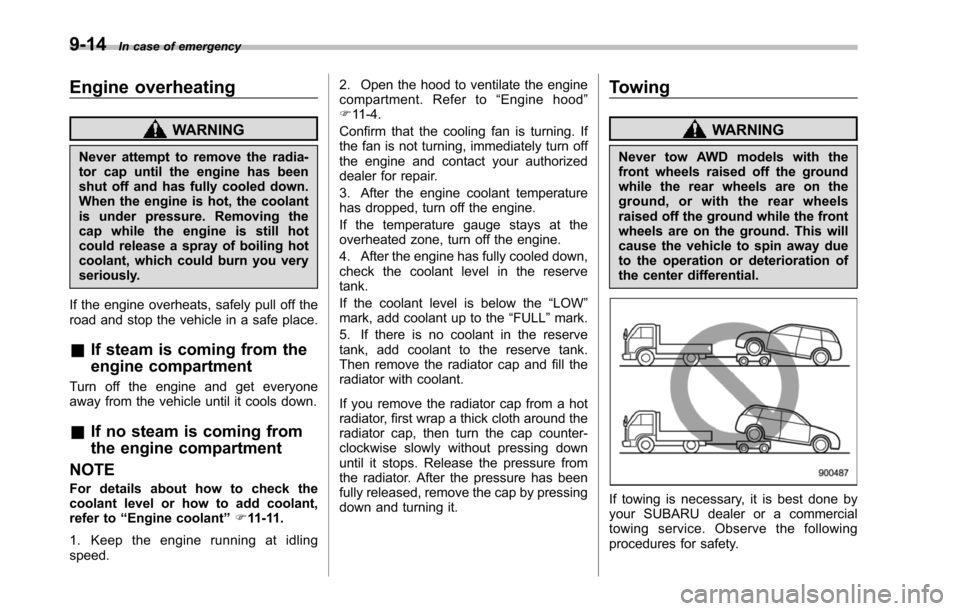
Never tow AWD models with thefront wheels raised off the groundwhile the rear wheels are on theground, or with the rear wheelsraised off the ground while the frontwheels are on the ground. This willcause the vehicle to spin away dueto the operation or deterioration ofthe centerdifferential.
If towing is necessary, it is best done byyour SUBARU dealer or a commercialtowing service. Observe the followingprocedures for safety.
Page 341 of 426
11-8Maintenance and service
.Be careful not to spill engine oilwhen adding it. If oil touches theexhaust pipe, it may cause a badsmell, smoke, and/or a fire. Ifengine oil gets on the exhaustpipe, be sure to wipe it off.
If you check the oil level just after stoppingthe engine, wait a few minutes for the oil todrain back into the oil pan before checkingthe level.
To prevent overfilling the engine oil, do notadd any additional oil above the full levelwhen the engine is cold.
&Changing the oil and oil filter
CAUTION
.If you change your own oil, besure to drain all the oil from thefilter before disposal.
.Do not dispose of used engine oilby placing it in the trash, or bypouring it onto the ground, intosewers, or into any body of water.Check with your local govern-ment office for the proper dis-posal options available to you.
Change the oil and oil filter according tothe maintenance schedule in the“War-
ranty and Maintenance Booklet”.
The engine oil and oil filter must bechanged more frequently than listed inthe maintenance schedule when drivingon dusty roads, when short trips arefrequently made, or when driving inextremely cold weather.
1. Warm up the engine by letting theengine idle for approximately 10 minutesto ease draining the engine oil.
2. Park the vehicle on a level surface andstop the engine.
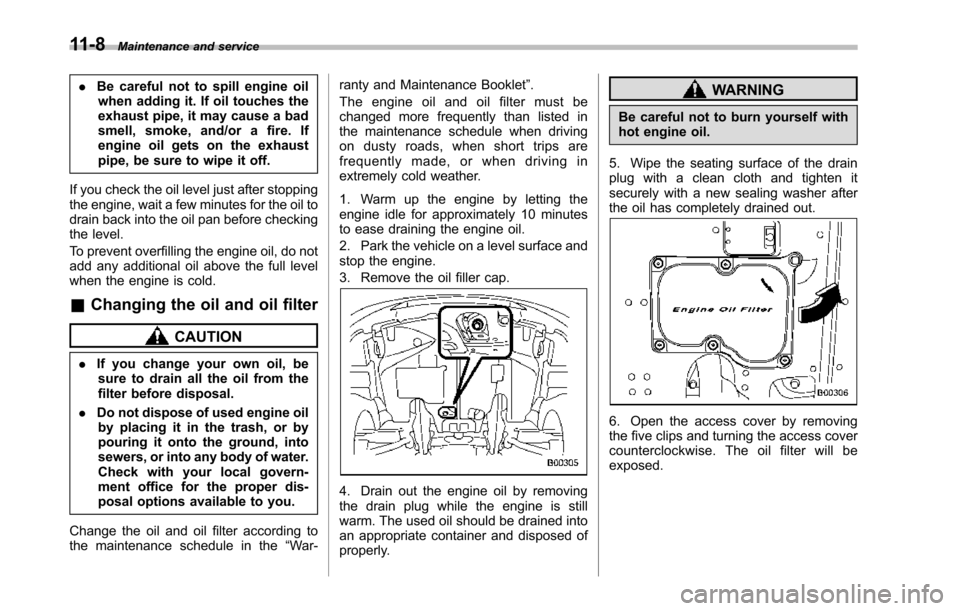
3. Remove the oil filler cap.
4. Drain out the engine oil by removingthe drain plug while the engine is stillwarm. The used oil should be drained intoan appropriate container and disposed ofproperly.
WARNING
Be careful not to burn yourself withhot engine oil.
5. Wipe the seating surface of the drainplug with a clean cloth and tighten itsecurely with a new sealing washer afterthe oil has completely drained out.
6. Open the access cover by removingthe five clips and turning the access covercounterclockwise. The oil filter will beexposed.
Page 364 of 426
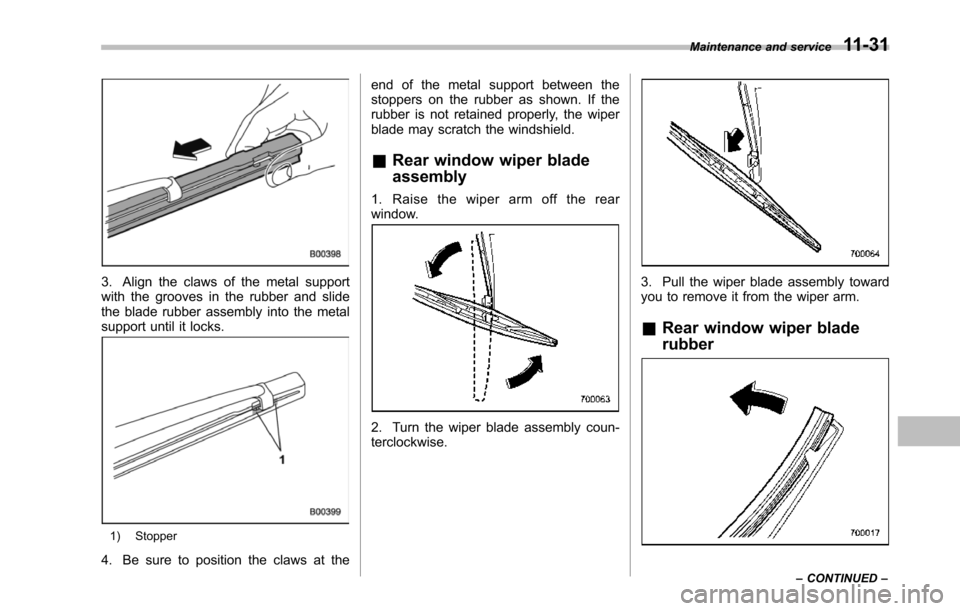
3. Align the claws of the metal supportwith the grooves in the rubber and slidethe blade rubber assembly into the metalsupport until it locks.
1) Stopper
4. Be sure to position the claws at the
end of the metal support between thestoppers on the rubber as shown. If therubber is not retained properly, the wiperblade may scratch the windshield.
&Rear window wiper blade
assembly
1. Raise the wiper arm off the rearwindow.
2. Turn the wiper blade assembly coun-terclockwise.
3. Pull the wiper blade assembly towardyou to remove it from the wiper arm.
&Rear window wiper blade
rubber
Maintenance and service11-31
–CONTINUED–
Page 371 of 426
11-38Maintenance and service
Left-hand side
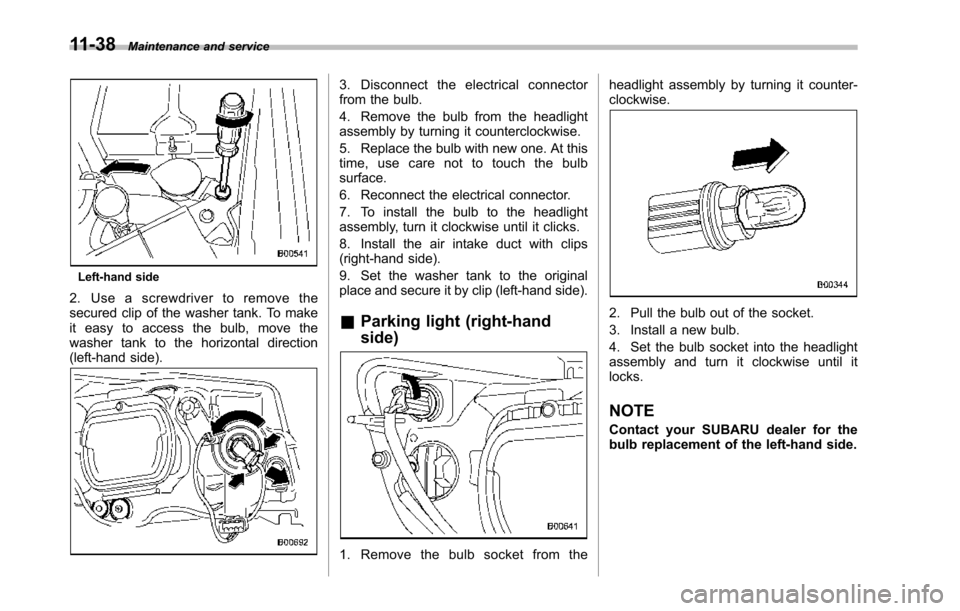
2. Use a screwdriver to remove thesecured clip of the washer tank. To makeit easy to access the bulb, move thewasher tank to the horizontal direction(left-hand side).
3. Disconnect the electrical connectorfrom the bulb.
4. Remove the bulb from the headlightassembly by turning it counterclockwise.
5. Replace the bulb with new one. At thistime, use care not to touch the bulbsurface.
6. Reconnect the electrical connector.
7. To install the bulb to the headlightassembly, turn it clockwise until it clicks.
8. Install the air intake duct with clips(right-hand side).
9. Set the washer tank to the originalplace andsecure it by clip (left-hand side).
&Parking light (right-hand
side)
1. Remove the bulb socket from the
headlight assembly by turning it counter-clockwise.
2. Pull the bulb out of the socket.
3. Install a new bulb.
4. Set the bulb socket into the headlightassembly and turn it clockwise until itlocks.
NOTE
Contact your SUBARU dealer for thebulb replacement of the left-hand side.