2014 SUBARU TRIBECA check oil
[x] Cancel search: check oilPage 249 of 426
7-2Starting and operating
Fuel
CAUTION
Use of a fuel which is low in qualityor use of an inappropriate fueladditive may cause engine damage.
&Fuel requirements
The engine is designed to operate usingunleaded gasolinewith an octane ratingof87 AKI (90 RON) or higher.
!Fuel octane rating
This octane rating is the average of theResearch Octane and Motor Octanenumbers andis commonly referred to asthe Anti Knock Index (AKI).
Using a gasoline with a lower octanerating can causepersistent and heavyknocking, which can damage the engine.Do not be concerned if your vehiclesometimes knocks lightly when you driveup a hill or when you accelerate. Contactyour SUBARU dealer if you use a fuel withthe specified octane rating and yourvehicle knocks heavily or persistently.
!Unleaded gasoline
The neck of the fuel filler pipe is designedto accept only an unleaded gasoline filler
nozzle. Under no circumstances shouldleaded gasoline be used because it willdamage the emission control system andmay impair driveability and fuel economy.
!California fuel
If your vehicle was certified to CaliforniaEmission Standards as indicated on theunderhood tune-up label, it is designed tooptimize engine and emission controlsystem performance with gasoline thatmeets the clean burning low-sulfur Cali-fornia gasoline specifications. If you live inany other state than California, yourvehicle will operate on gasoline meetingFederal specifications. Gasoline sold out-side California is permitted to have highersulfur levels, which may affect the perfor-mance of your vehicle’s catalytic converterand may produce a sulfur exhaust odor orsmell. SUBARU recommends that you trya different brand of unleaded gasolinehaving lower sulfur to determine if theproblem is fuel related before returningyour vehicle to an authorized dealer forservice. The CHECK ENGINE warninglight/Malfunction indicator light may alsoilluminate. If this occurs, return to yourauthorized SUBARU dealer for diagnosis.If it is determined that the condition iscausedby the type of fuel used, repairsmay not be covered by your warranty.
!MMT
Some gasoline contains an octane-en-hancing additive called MMT (Methylcy-clopentadienyl Manganese Tricarbonyl). Ifyou use such fuels, your emission controlsystem performance may deteriorate andthe CHECK ENGINE warning light/Mal-function indicator light may illuminate. Ifthis happens, return to your authorizedSUBARU dealer for service. If it isdetermined that the condition is causedby the type of fuel used, repairs may notbe covered by your warranty.
!Gasoline for cleaner air
CAUTION
Do not let fuel spill on the exteriorsurfaces of the vehicle. Fuels con-taining alcohol may cause paintdamage, which is not covered underthe SUBARU Limited Warranty.
Yo u r u s e o f g a s o l i n e w i t h d e t e r g e n tadditives will help prevent deposits fromforming in your engine and fuel system.This helps keepyour engine in tune andyour emission control system workingproperly, and is a way of doing your partfor cleaner air. If you continuously use ahigh quality fuel with the proper detergentand other additives, you should never
Page 254 of 426
Preparing to drive
You should perform the following checksand adjustments every day before youstart driving.
1. Check that all windows, mirrors, andlights are clean and unobstructed.
2. Check the appearance and conditionof the tires. Also check tires for properinflation.
3. Look under the vehicle for any sign ofleaks.
4. Check that the hood and rear gate arefully closed.
5. Check the adjustment of the seat.
6. Check the adjustment of the insideand outside mirrors.
7. Fasten your seatbelt. Check that yourpassengers have fastened their seatbelts.
8. Check the operation of the warningand indicator lights when the ignitionswitch is turned to the“ON”position.
9. Check the gauges, indicator and warn-ing lights after starting the engine.
NOTE
Engine oil, engine coolant, brake fluid,washer fluid and other fluid levelsshould be checked daily, weekly or atfuel stops.
Starting the engine
CAUTION
.Do not operate the starter motorcontinuously for more than 10seconds. If the engine fails tostart after operating the starterfor 5 to 10 seconds, wait for 10seconds or more before tryingagain.
.If you restart the engine while thevehicle is moving, shift the selectlever into the“N”position. Donot attempt to place the selectlever of a moving vehicle into the“P”position.
1. Apply the parking brake.
2. Turn off unnecessary lights and ac-cessories.
3. Shift the select lever to the“P”or“N”position (preferably“P”position). Thestarter will only operate when the selectlever is at the“P”or“N”position.
4. Turn the ignition switch to the“ON”position and check the operation of thewarning and indicator lights. Refer to“Warning and indicator lights”F3-9.
5. Turn the ignition switch to the“START”positionwithoutdepressing the accelera-
tor pedal. Release the key immediatelyafter the engine has started.
If the engine does not start, try thefollowing.(1) Turn the ignition switch to the“LOCK”position and wait for at least10 seconds. After checking that theparking brake is firmly set, turn theignition switch to the“START”positionwhile depressing the accelerator pedalslightly (approximately a quarter of thefull stroke).Release the acceleratorpedal as soon as the engine starts.(2) If this fails to start the engine, turnthe ignition switch back to the“LOCK”position and wait for at least 10seconds.Then fully depress the accel-erator pedal and turn the ignitionswitch to the“START”position. If theengine starts, quickly release theaccelerator pedal.(3) If this fails to start the engine, turnthe ignition switch again to the“LOCK”position.After waiting for 10 secondsor longer, turn the ignition switch to the“START”position without depressingthe accelerator pedal.(4) If the engine still refuses to start,contact your nearest SUBARU dealerfor assistance.
6. Confirm that all warning and indicatorlights have turned off after the engine has
Starting and operating7-7
–CONTINUED–
Page 286 of 426
depth of the water and the bottom of thestream bed for firmness and ensure thatthe bed of the stream is flat. Drive slowlyand completely through the stream. Thewater should be shallow enough that itdoes not reach the vehicle’s undercar-riage. Water entering the engine air intakeor the exhaust pipe or water splashingonto electrical parts may damage yourvehicle and may cause it to stall. Neverattempt to drive through rushing water;regardless of its depth, it can wash awaythe ground from under your tires, resultingin possible loss of traction and evenvehicle rollover.
.Always check your brakes for effec-tiveness immediately after driving in sand,mud or water. Do this by driving slowlyand stepping on the brake pedal. Repeatthat process several times to dry out thebrake discsand brake pads.
.Do not drive or park over or nearflammable materials such as dry grass orfallen leaves,as they may burn easily. Theexhaust system is very hot while theengine is running and right after enginestops. This could create a fire hazard.
.After driving through tall grass, mud,rocks, sand, rivers, etc., check that thereis no grass, bush, paper, rags, stones,sand, etc. adhering to or trapped on theunderbody. Clear off any such matter from
the underbody. If the vehicle is used withthese materials trapped or adhering to theunderbody, a mechanical breakdown orfire could occur.
.Secure all cargo carried inside thevehicle and make certain that it is notpiled higher than the seatbacks. Duringsudden stops or jolts, unsecured cargocould be thrown around in the vehicle andcause injury. Do not pile heavy loads onthe roof. Those loads raise the vehicle’scenter of gravity and make it more proneto tip over.
.If you must rock the vehicle to free itfrom sand or mud, depress the acceleratorpedal slightly andmove the select leverback and forth between“D”and“R”repeatedly. Do not race the engine. Forthe best possible traction, avoid spinningthe wheels when trying to free the vehicle.
.When the road surface is extremelyslippery, you can obtain better traction bystarting the vehicle with the transmissionin 2nd than 1st.
.Never equip your vehicle with tireslarger than thosespecified in this manual.
.Wash the vehicle’s underbody after off-road driving. Suspension components areparticularly prone to dirt buildup, so theyneed to be washed thoroughly.
.Frequent driving of an AWD modelunder hard-driving conditions such as
rough roads or off roads will necessitatemore frequent replacement of engine oil,brake fluid and transmission oil than thatspecified in the maintenance scheduledescribed in the“Warranty and Mainte-nance Booklet”.
Remember that damage done to yourSUBARU while operating it off-road andnot using common sense precautionssuch as those listed above is not eligiblefor warranty coverage.
Driving tips8-7
Page 287 of 426
8-8Driving tips
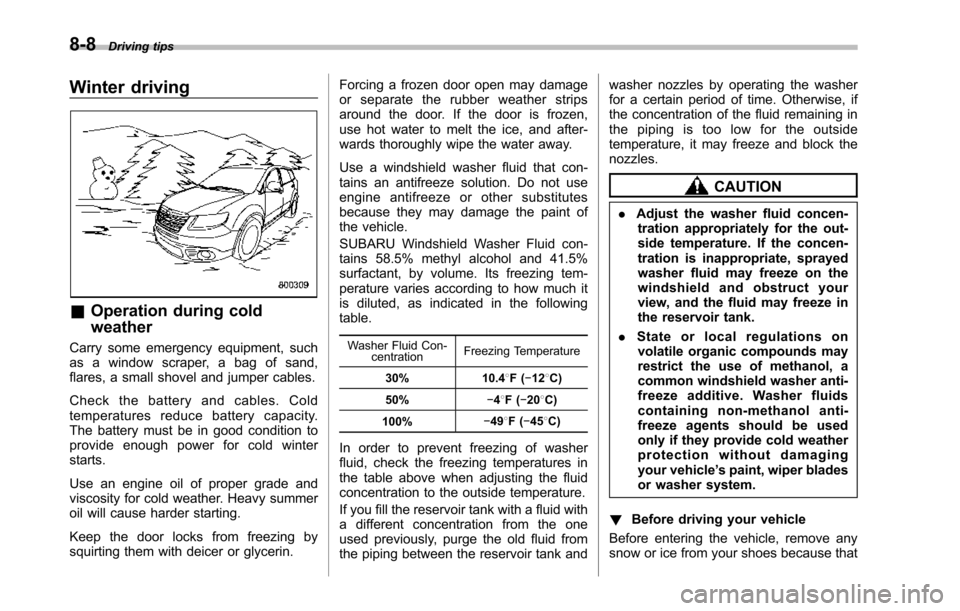
Winter driving
&Operation during cold
weather
Carry some emergency equipment, suchas a window scraper, a bag of sand,flares, a small shovel and jumper cables.
Check the battery and cables. Coldtemperatures reduce battery capacity.The battery must be in good condition toprovide enough power for cold winterstarts.
Use an engine oil of proper grade andviscosity for cold weather. Heavy summeroil will cause harder starting.
Keep the door locks from freezing bysquirting them with deicer or glycerin.
Forcing a frozen door open may damageor separate the rubber weather stripsaround the door. If the door is frozen,use hot water to melt the ice, and after-wards thoroughly wipe the water away.
Use a windshield washer fluid that con-tains an antifreeze solution. Do not useengine antifreeze or other substitutesbecause they may damage the paint ofthe vehicle.
SUBARU Windshield Washer Fluid con-tains 58.5% methyl alcohol and 41.5%surfactant, by volume. Its freezing tem-perature varies according to how much itis diluted, as indicated in the followingtable.
Washer Fluid Con-centrationFreezing Temperature
30% 10.48F(!128C)
50%!48F(!208C)
100%!498F(!458C)
In order to prevent freezing of washerfluid, check the freezing temperatures inthe table above when adjusting the fluidconcentration to the outside temperature.
If you fill the reservoir tank with a fluid witha different concentration from the oneused previously, purge the old fluid fromthe piping between the reservoir tank and
washer nozzles by operating the washerfor a certain period of time. Otherwise, ifthe concentration of the fluid remaining inthe piping is too low for the outsidetemperature, it may freeze and block thenozzles.
CAUTION
.Adjust the washer fluid concen-tration appropriately for the out-side temperature. If the concen-tration is inappropriate, sprayedwasher fluid may freeze on thewindshield and obstruct yourview, and the fluid may freeze inthe reservoir tank.
.State or local regulations onvolatile organic compounds mayrestrict the use of methanol, acommon windshield washer anti-freeze additive. Washer fluidscontaining non-methanol anti-freeze agents should be usedonly if they provide cold weatherprotection without damagingyour vehicle’s paint, wiper bladesor washer system.
!Before driving your vehicle
Before entering the vehicle, remove anysnow or ice from your shoes because that
Page 316 of 426
WARNING
Do not use oil or grease on thewheel studs or nuts when the sparetire is installed. This could cause thenuts to become loose and lead to anaccident.
15. Turn the jack handle counterclockwiseto lower the vehicle.
CAUTION
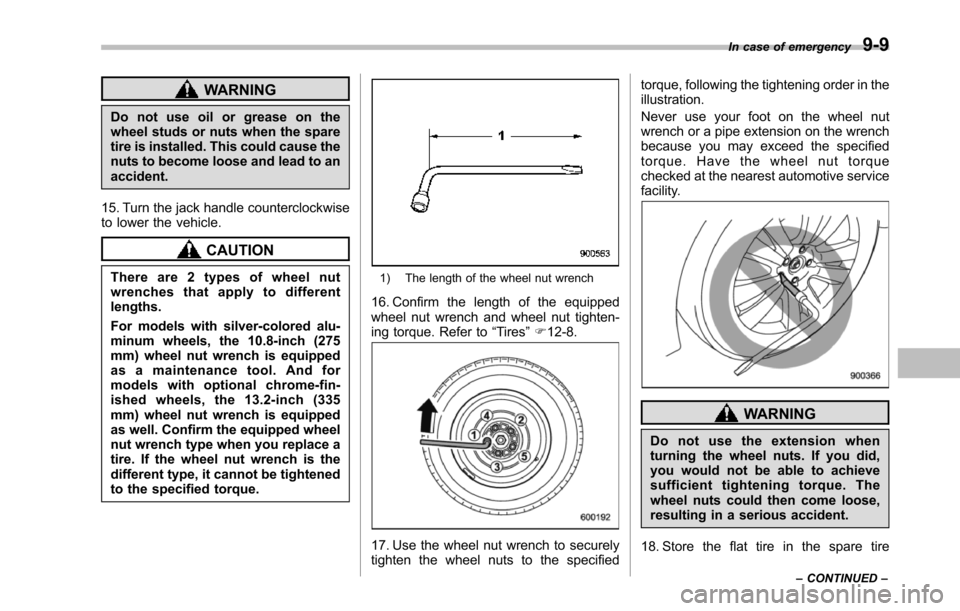
There are 2 types of wheel nutwrenches that apply to differentlengths.
For models with silver-colored alu-minumwheels, the 10.8-inch (275mm) wheel nut wrench is equippedas a maintenance tool. And formodels with optional chrome-fin-ished wheels, the 13.2-inch (335mm) wheel nut wrench is equippedas well. Confirm the equipped wheelnut wrench type when you replace atire. If the wheel nut wrench is thedifferent type, it cannot be tightenedto the specified torque.
1) The length of the wheel nut wrench
16. Confirm the length of the equippedwheel nut wrench and wheel nut tighten-ing torque. Refer to“Tires”F12-8.
17. Use the wheel nut wrench to securelytighten thewheel nuts to the specified
torque, following the tightening order in theillustration.
Never use your foot on the wheel nutwrench or a pipe extension on the wrenchbecause you may exceed the specifiedtorque. Have the wheel nut torquechecked at the nearest automotive servicefacility.
WARNING
Do not use the extension whenturning the wheel nuts. If you did,you would not be able to achievesufficient tightening torque. Thewheel nuts could then come loose,resulting in a serious accident.
18. Store the flat tire in the spare tire
In case of emergency9-9
–CONTINUED–
Page 321 of 426
9-14In case of emergency
Engine overheating
WARNING
Never attempt to remove the radia-tor cap until the engine has beenshut off and has fully cooled down.When theengine is hot, the coolantis under pressure. Removing thecap while the engine is still hotcould release a spray of boiling hotcoolant, which could burn you veryseriously.
If the engine overheats, safely pull off theroad and stop the vehicle in a safe place.
&If steam is coming from the
engine compartment
Turn off the engine and get everyoneaway from the vehicle until it cools down.
&If no steam is coming from
the engine compartment
NOTE
For details about how to check thecoolant level or how to add coolant,refer to“Engine coolant”F11-11.
1. Keep the engine running at idlingspeed.
2. Open the hood to ventilate the enginecompartment. Refer to“Engine hood”F11-4.
Confirm that the cooling fan is turning. Ifthe fan is not turning, immediately turn offthe engine and contact your authorizeddealer for repair.
3. After the engine coolant temperaturehas dropped, turn off the engine.
If the temperature gauge stays at theoverheated zone, turn off the engine.
4. After the engine has fully cooled down,check the coolant level in the reservetank.
If the coolant level is below the“LOW”mark, add coolant up to the“FULL”mark.
5. If there is no coolant in the reservetank, add coolant to the reserve tank.Then remove the radiator cap and fill theradiator with coolant.
If you remove the radiator cap from a hotradiator, first wrap a thick cloth around theradiator cap, then turn the cap counter-clockwise slowly without pressing downuntil it stops. Release the pressure fromthe radiator. After the pressure has beenfully released, remove the cap by pressingdown and turning it.
Towing
WARNING
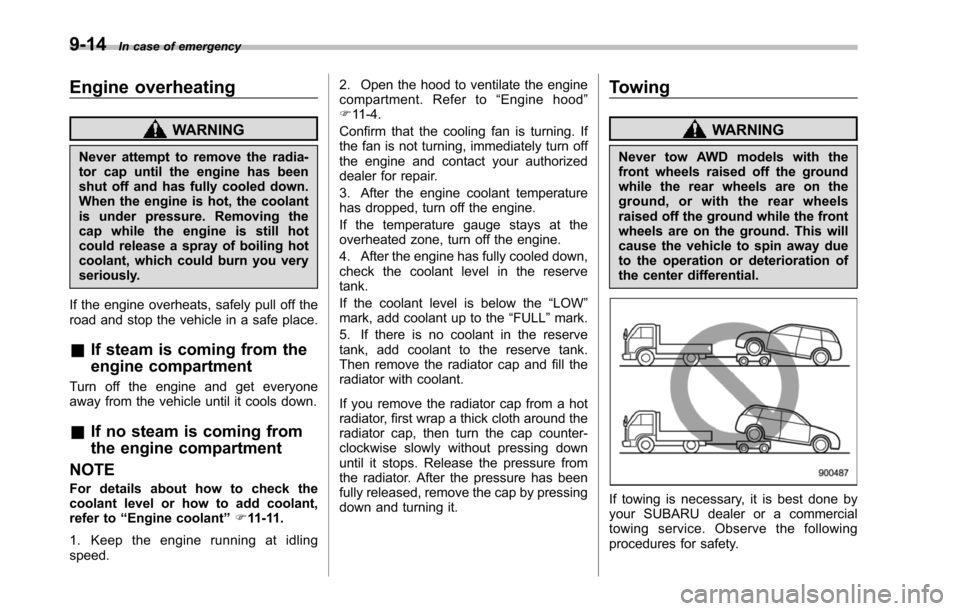
Never tow AWD models with thefront wheels raised off the groundwhile the rear wheels are on theground, or with the rear wheelsraised off the ground while the frontwheels are on the ground. This willcause the vehicle to spin away dueto the operation or deterioration ofthe centerdifferential.
If towing is necessary, it is best done byyour SUBARU dealer or a commercialtowing service. Observe the followingprocedures for safety.
Page 334 of 426

Maintenance schedule....................................... 11-3
Maintenance precautions................................... 11-3Before checking or servicing in the enginecompartment.................................................... 11-4When you do checking or servicing in the enginecompartment while the engine is running.......... 11-4
Engine hood....................................................... 11-4
Engine compartment overview.......................... 11-6
Engine oil............................................................ 11-7Checking the oil level......................................... 11-7Changing the oil and oil filter.............................. 11-8Recommendedgrade and viscosity.................... 11-9Synthetic oil....................................................... 11-9
Cooling system................................................ 11-10Hose and connections...................................... 11-10Engine coolant................................................. 11-11
Air cleaner element.......................................... 11-12Replacing the air cleaner element..................... 11-12
Spark plugs...................................................... 11-13Recommended spark plugs.............................. 11-13
Drive belts........................................................ 11-13
Automatic transmission fluid.......................... 11-14Checking the fluid level.................................... 11-14Recommended fluid......................................... 11-15
Front differential gear oil................................. 11-15Checking the oil level....................................... 11-15Recommended grade and viscosity.................. 11-16
Rear differential gear oil.................................. 11-16Recommended grade and viscosity.................. 11-16
Power steering fluid........................................ 11-16Checking the fluid level.................................... 11-16Recommended fluid......................................... 11-17
Brake fluid........................................................ 11-17Checking the fluid level.................................... 11-17Recommended brake fluid............................... 11-18
Brakebooster.................................................. 11-18
Brake pedal...................................................... 11-19Checking the brake pedal free play.................. 11-19Checking the brake pedal reserve distance....... 11-19
Replacement of brake pad and lining............ 11-19Breaking-in of new brake pads and linings....... 11-20
Parking brake stroke....................................... 11-20
Tires and wheels.............................................. 11-21Types of tires................................................... 11-21Tire pressure monitoring system (TPMS).......... 11-21Tire inspection................................................. 11-22Tire pressuresand wear.................................. 11-23Wheel balance................................................. 11-25Wear indicators............................................... 11-25Tire rotation direction mark.............................. 11-25Tire rotation..................................................... 11-26Tire replacement.............................................. 11-26Wheel replacement.......................................... 11-27
Aluminum wheels............................................ 11-27
Windshield washer fluid.................................. 11-28
Replacement of wiper blades......................... 11-29Windshield wiper blade assembly..................... 11-30Windshield wiper blade rubber ......................... 11-30Rear window wiper blade assembly.................. 11-31
Maintenance and service
11
Page 337 of 426
11-4Maintenance and service
guard against getting oil or fluidsin your eyes. If something doesget in your eyes, thoroughlywash them out with clean water.
.Do not tamper with the wiring ofthe SRS airbag system or seat-belt pretensioner system, or at-tempt to take its connectorsapart, as that may activate thesystem or it can render it inop-erative. NEVER use a circuittester for these wiring. If yourSRS airbag or seatbelt preten-sioner needs service, consultyour nearest SUBARU dealer.
&Before checking or servicing
in the engine compartment
WARNING
.Always stop the engine and setthe parking brake firmly to pre-vent the vehicle from moving.
.Always let the engine cool down.Engine parts become very hotwhen the engine is running andremain hot for some time afterthe engine is stopped.
.Do not spill engine oil, enginecoolant, brake fluid or any other
fluid on hot engine components.This may cause a fire.
.Always remove the key from theignition switch. When the ignitionswitch is in the“ON”position,the cooling fan may operatesuddenly even when the engineis stopped.
&When you do checking or
servicing in the engine com-
partment while the engine is
running
WARNING
A running engine can be dangerous.Keep your fingers, hands, clothing,hair and tools away from the coolingfan, belts and any other movingengine parts. Removing rings,watches and ties is advisable.
Engine hood
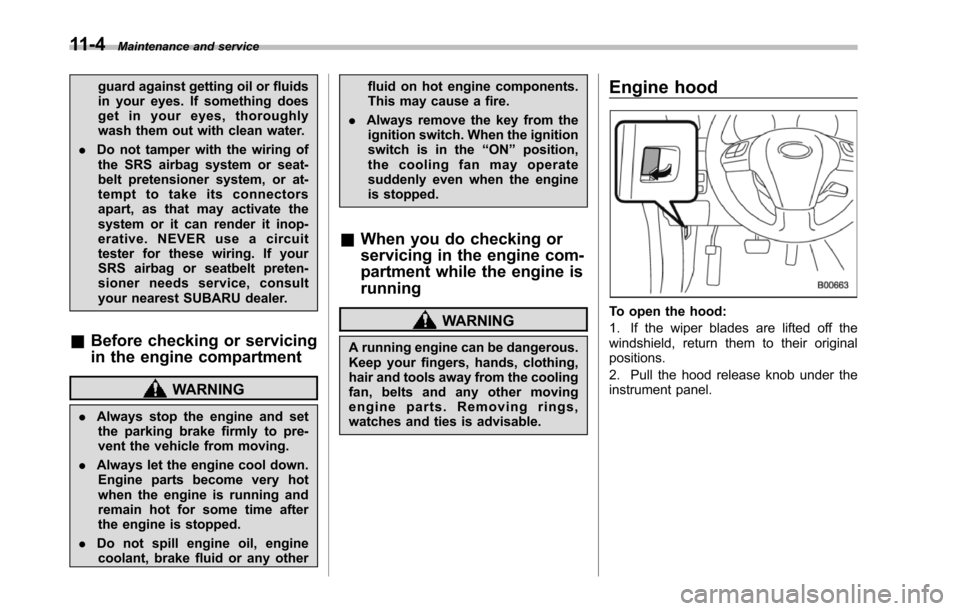
To open the hood:
1. If the wiper blades are lifted off thewindshield, return them to their originalpositions.
2. Pull the hood release knob under theinstrument panel.