2014 SKODA FABIA child
[x] Cancel search: childPage 23 of 216

WARNING (Continued)■The installation of impermissible accessories in the vicinity of the head
airbags can considerably impair the protection offered by the head airbag in
the event of it being deployed. When the deployed head airbag is inflated,
parts of the fitted accessories could be thrown into the interior of the car
and injure the occupants.■
The sun visors must not be swivelled towards the side windows in the
deployment area of the head airbags if any objects, such as ball-point pens,
etc. are attached to them. This might result in injuries to the occupants if
the head airbag is deployed.
■
There must not be any further persons, animals or objects positioned be-
tween the seated occupants and the deployment area of the airbag. In ad-
dition, none of the occupants should lean their head out of the window
when driving, or extend their arms and hands out of the window.
Note
In vehicles with head airbags, the lettering can be seen on the B column
cladding.
Deactivating airbags
Introduction
This chapter contains information on the following subjects:
Deactivating airbags
20
Switching off the front passenger airbag
21
Deactivating airbags
Deactivating an airbag should, for example, be considered only in the
following cases.
› When using a child seat on the front passenger seat, in which the child has
its back to the vehicle's direction of travel (in some countries this must be in
the direction of travel due to different legal regulations applying)
» page 22 , Transporting children safely .
› If it is not possible to maintain a distance of at least 25 cm between the mid-
dle of the steering wheel and chest, despite the driver's seat being correctly
adjusted.
› If special attachments are required in the area of the steering wheel because
of a physical disability.
› If other seats have been installed (e.g. orthopaedic seats without side air-
bags).
The front passenger airbag can be switched off with the key-operated switch
» page 21 .
We recommend that you ask a ŠKODA Service Partner to switch off any other
airbags.
Monitoring the airbag system
The operational capability of the airbag system is monitored electronically,
even if one of the airbags is switched off.
Airbag was switched off using diagnostic equipment
› The
warning light lights up for approximately 4 seconds after the ignition
is switched on and then flashes again for approximately 12 seconds.
Front passenger airbag switched off with the key switch in the storage com-
partment
› The
warning light comes on for about 4 seconds after the ignition has
been switched on.
› The indicator light
under the text
» Fig. 12
on page 21 -
lights up after switching on the ignition.
Note
■
The national regulations for switching off airbags must be observed.■A ŠKODA Service Partner will be able to inform you which airbags in your ve-
hicle can/must be deactivated.20Safety
Page 25 of 216

Transporting children safely
Child seat
Introduction
This chapter contains information on the following subjects:
Use of a child seat on the front passenger seat
23
Use of the child seat on the front passenger seat
24
Child safety and side airbag
24
Classification of child seats
24
Use of child seats fastened with a seat belt
24
Children are generally safer on the rear seats than on the front passenger
seat.
In contrast to adults, the muscles and bone structure of children are not yet
fully developed. Children are thus exposed to increased risk of injury.
Children should be transported in accordance with the relevant statutory pro-
visions.
Child seats that comply with the ECE-R 44 standard must be used. The ECE-R
standard stands for: Economic Commission for Europe - Regulation.
The child seats are marked with a non-detachable Certification in accordancewith Standard ECE-R 44: large E within a circle and below the test number.
WARNING■ National legal requirements must be observed when using child seats.■You should never carry children - including babies! - on your lap.■
Never leave children unattended in the vehicle. Certain outside climatic
conditions can cause life-threatening temperatures in the vehicle.
■
The child must be secured in the vehicle throughout the journey! Other-
wise, in the event of an accident, the child would be thrown through the
vehicle and as a result may suffer fatal injuries and also injure other occu-
pants.
WARNING (Continued)■ Children are exposed to an increased risk of injury in the event of an acci-
dent if they lean forward or adopt an incorrect seated position when the
vehicle is moving. This particularly applies to children who are transported
on the front passenger seat, as they can suffer severe, or even fatal, inju-
ries if the airbag system is deployed!■
Pay particular attention to the information provided by the manufacturer
of the child safety seat regarding the correct routing of the belt. Seat belts
which are not correctly adjusted can themselves cause injuries, even in mi-
nor accidents.
■
Safety belts must be checked to ensure that they are positioned properly.
Care should also be taken to ensure that the belt is not damaged by sharp-
edged fittings.
■
It is essential to switch off the front passenger airbag if using a child seat
on the front passenger seat in which the child is carried with its back facing
the direction of travel. Further information » page 23, Use of a child seat
on the front passenger seat .
■
When installing a child seat in which the child faces forward, adjust the
head restraints so that they are as high as possible.
■
If the head restraints still prevent the child seat from being installed,
even in the highest position, you will need to remove them » page 72. Af-
ter removing the child seat, re-install the head restraints.
■
When installing the child seat on the back seat, the corresponding front
seat must be adjusted so that there is no contact between the front seat
and the child seat or the child being transported in a child seat.
Note
We recommend that you use child seats from ŠKODA Original Accessories.
These child seats were developed and also tested for use in ŠKODA vehicles.
They meet the ECE-R 44 standard.22Safety
Page 26 of 216

Use of a child seat on the front passenger seat
Does not apply to TaiwanFig. 13
Sticker on the B column on the
front passenger side
Fig. 14
Front passenger sun visor / label
Read and observe
on page 22 first.
Never use a rearward-facing child restraint system on a seat which is protec-
ted by an active airbag installed in front of it. This could cause serious injury
to the child or even death.
For safety reasons, we recommend that you install child seats on the rear
seats whenever possible.
The following advice must be heeded when using a child seat in which the
child is carried on the front passenger seat.
› It is essential to switch off the front passenger airbag if using a child seat in
which the child is carried with its back facing the direction of travel »
.
› Set the front passenger seat back as vertically as possible so that there is
firm contact between the passenger seat back and the child seat back.
› Where possible, move the front passenger seat back so that there is no con-
tact between the front seat and the child seat behind.
› In the case of Group 2 or 3 child seats, make sure that the deflector pulley
mounted on the child seat headrest is in front of or level with the pulley on
the B-pillar on the passenger side.
› Set the height-adjustable front passenger seat as high up as possible.
› Set the front passenger seat belt as high up as possible.
› Place and fasten the child seat on the seat and the child in the child seat ac-
cording to the specifications in the manufacturer's user manual of the child
seat .WARNING■ It is essential to switch off the front passenger airbag if you are using a
child seat on the front passenger seat in which the child is carried with its
back facing the direction of travel » page 20, Deactivating airbags .■
Never use a child safety seat on the front passenger seat in which the
child is seated with its back facing the direction of travel, if the airbag is
switched on. This child safety seat is positioned in the deployment area of
the front passenger airbag. The airbag may cause the child severe, or even
fatal, injuries in the event of it being deployed.
■
This fact is also indicated by the label that can be found in one of the fol-
lowing locations. ■ On the B-column on the front passenger side » Fig. 13. The sticker is
visible when opening the front passenger door.
■ On the front passenger's sun visor. In some countries, the sticker is lo-
cated on the front seat passenger's sun visor » Fig. 14.
■
In the case of Group 2 or 3 child seats, make sure that the deflector pulley
mounted on the child seat headrest is in front of or level with the pulley on
the B-pillar on the passenger side.
■
The front passenger airbag should be switched on again once the child
seat, in which the child is transported with their back to the direction of
travel, is no longer in use on the passenger seat.
23Transporting children safely
Page 27 of 216

Use of the child seat on the front passenger seat
Applies to TaiwanFig. 15
Front passenger sun visor label
Read and observe
on page 22 first.
No babies, infants or children are to be carried on the passenger seat.
A label to this effect can also be found on the passenger's sun visor » Fig. 15.
Child safety and side airbag
Fig. 16
Incorrect seated position of a
child who is not properly secured
– risk from the side airbag/Child
properly protected by safety seat
Read and observe on page 22 first.
The child must not be positioned in the area into which the side airbag will de- ploy » Fig. 16 -
.
There must be sufficient room between the child and the area into which the
side airbag will deploy to allow the airbag to provide as much protection as
possible » Fig. 16 -
.
WARNING■
Children must never be seated with their head in the deployment area of
the side airbag – there is a risk of injury!■
Do not place any objects within the deployment area of the side airbags –
there is a risk of injury!
Classification of child seats
Read and observe
on page 22 first.
Classification of child seats according to the ECE-R 44 standard.
GroupWeight of the childApproximate age0up to 10 kgup to 9 months0+up to 13 kgup to 18 months19-18 kgup to 4 years215-25 kgup to 7 years322-36 kgover 7 years
Use of child seats fastened with a seat belt Read and observe
on page 22 first.
Overview of the use of child seats fastened with a seat belt on each of the
seats in accordance with the ECE-R 16 standard.
GroupFront passenger seatRear seatsExternalRear seat Centre0
up to 10 kgUUU0+
up to 13 kgUUU1
9-18 kgUUU 24Safety
Page 28 of 216

GroupFront passengerseatRear seatsExternalRear seat Centre2
15-25 kgUUU a)3
22-36 kgUUU a)a)
If the middle rear seat is not provided with a headrest, then a child seat of Group 2 or 3 is only to be used
if this has its own built-in headrest. If the child seat of Group 2 or 3 does not have its own built-in head-
rest, the child seat must be attached to the outer rear seat.
“Universal” child seat category - a child seat designed for fastening on
the seat with the seat belt.
Fastening systems
Introduction
This chapter contains information on the following subjects:
Attachment points of the -system
25
Use of child seats with the
-system
25
Attachment points of the
-system
26
Attachment points of the -system
Fig. 17
Rear seat:
U
represents a system for the fast and secure attachment of a child seat.
There are two locking eyes between the rear exterior seats for fixing the child
in place using the
-system » Fig. 17.WARNING■
Always refer to the instructions from the manufacturer of the child seat
when installing and removing a child seat with the -system.■
Never attach other child seats, belts or objects to the attachment points
eyes intended for the installation of a child seat with the
-system – risk
of death!
Note
■ A child seat fitted with the -system can only be mounted in a vehicle fit-
ted with an -system if the child seat has been approved for this type of ve-
hicle. Further information is available from a ŠKODA Partner.■
Child seats with the
-system can be purchased from ŠKODA Original Ac-
cessories.
Use of child seats with the -system
Overview of the usefulness of child seats fastened with the -system on
each of the seats in accordance with the ECE-R 16 standard. 25Transporting children safely
Page 29 of 216

GroupSize class
of the child seat a)Front passenger seatOuter rear seatsRear seat middle0
up to 10 kgEXIL-SUX0+
up to 13 kgE
XIL-SUX
DC
1
9-18 kg
D
XIL-SU IUFX
CBB1A2
15-25 kg XIL-SUX3
22-36 kg XIL-SUXa)
The size category is shown on the label attached to the child seat.
The seat is suited for installation of a -child seat with the “Semi-
Universal” approval. The “Semi-Universal” category means that the child
seat is approved for use with the
-system. Note the information in
the list of vehicles which comes with the child seat.
The seat is suitable for the installation of a
-child seat with the ap-
proval “Universal” and attachment with the TOP TETHER securing belt.
The seat is not fitted with
-system attachment points.
Attachment points of the -system
Fig. 18
Attachment points of the
-system
IL-SUIUFX represents a fastening system that restricts movements of the upper
part of the child seat.
The anchor eyelets for attaching the belt for a child seat with the
-sys-
tem are located on the rear side of the outer rear seat backrests » Fig. 18.
Some country-specific models can also be equipped with a hitch point on the
back of the middle rear seat backrest.WARNING■ Always refer to the instructions from the manufacturer of the child seat
when installing and removing a child seat with the -system.■
Only use child seats with the
-system on the seats equipped with
the locking eyes.
■
Only ever attach one belt from the child seat to a locking eye.
■
On no account should you modify your vehicle yourself, e.g. assemble
screws or other anchorage points.
26Safety
Page 52 of 216

Resetting the service interval display
We recommend that the display be reset by a specialist garage.
We recommend that you do not reset the service interval display yourself. In-
correctly setting the service interval display could cause problems to the vehi-
cle.
Variable service interval
For vehicles with variable service intervals, after resetting the oil change serv-
ice display in a specialist garage, the values of the new service interval are dis-
played, which are based on the previous operating conditions of the vehicle.
These values are then continuously matched according to the actual operating
conditions of the vehicle.Unlocking and opening
Unlocking and locking
Introduction
This chapter contains information on the following subjects:
Locking/unlocking using the key via the lock cylinder
50
Unlocking/locking with the remote control key
50
Opening/closing the door
51
Unlocking / locking - KESSY
52
SafeLock
52
Individual settings
53
Locking/unlocking the vehicle with the central locking button
53
Child safety lock
54
Malfunctions
54
Your car is equipped with a central locking system.
The central locking system allows you to lock and unlock all doors, the fuel fill-
er flap and boot lid at the same time.
Depending on the equipment configuration, the following is true after
unlocking
› The turn signal lights flash twice as confirmation that the vehicle has been
unlocked.
› The doors, the boot lid and the fuel filler flap are unlocked.
› The interior light, which is switched by the door contact, comes on.
› The SafeLock system is switched off.
› The warning icon in the driver door stops flashing.
› The anti-theft alarm system is deactivated.
If you unlock the vehicle and do not open a door or the boot lid within the next
45 seconds, the vehicle will lock again automatically and the SafeLock system
or anti-theft alarm system will be switched on. This function is intended to
prevent the car being unlocked unintentionally.
Depending on the equipment configuration, the following is true after
locking
› The turn signal lights flash once as confirmation that the vehicle has been
locked.
› The doors, the boot lid and the fuel filler flap are locked.
49Unlocking and opening
Page 53 of 216
›The interior light switched by the door contact goes off.
› The SafeLock system is switched on.
› The warning light in the driver door begins flashing.
› The anti-theft alarm system is activated.
If the doors or the boot lid remain open after the vehicle doors have been
locked, the turn signal lights do not flash until they have been closed.WARNING■ Never leave the key in the vehicle when you exit the vehicle. Unauthor-
ized persons, such as children, for example, could lock the car, turn on the
ignition or start the engine - danger of injury and accidents!■
When leaving the vehicle, never leave people who are not completely in-
dependent, such as children, unattended in the vehicle. The children might,
for example, release the handbrake or take the vehicle out of gear. The ve-
hicle could then start to move – risk of accident! These individuals would
possibly not be able to leave the vehicle on their own or to help them-
selves. At very high or very low temperatures can be fatal!
CAUTION
■ Each key contains electronic components; therefore it must be protected
against moisture and severe shocks.■
Keep the groove of the keys absolutely clean. Impurities (textile fibres, dust,
etc.) impair the function of the locking cylinder and ignition lock.
■
The battery must be replaced if the central locking or anti-theft alarm system
does react to the remote control at less than approx. 3 metres away
» page 179 .
■
Always check that the vehicle is locked before leaving it.
■
If the driver's door has been opened, the vehicle cannot be locked.
Note
In the event of an accident in which the airbags are deployed, the locked doors
are automatically unlocked in order to enable rescuers to gain access to the
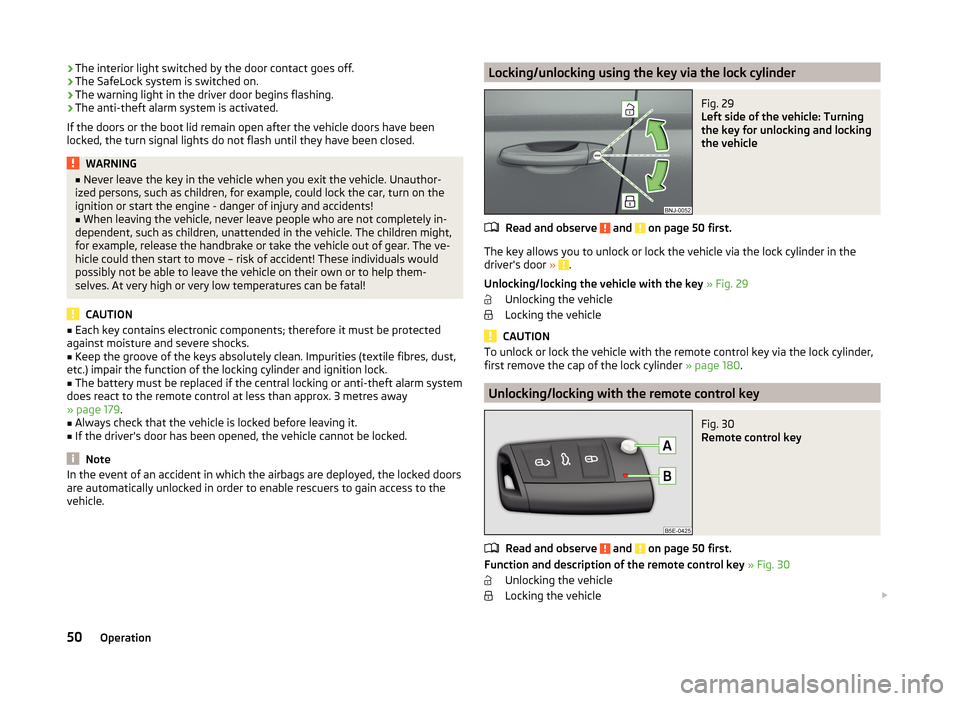
vehicle.Locking/unlocking using the key via the lock cylinderFig. 29
Left side of the vehicle: Turning
the key for unlocking and locking
the vehicle
Read and observe and on page 50 first.
The key allows you to unlock or lock the vehicle via the lock cylinder in the
driver's door » .
Unlocking/locking the vehicle with the key » Fig. 29
Unlocking the vehicle
Locking the vehicle
CAUTION
To unlock or lock the vehicle with the remote control key via the lock cylinder,
first remove the cap of the lock cylinder » page 180.
Unlocking/locking with the remote control key
Fig. 30
Remote control key
Read and observe and on page 50 first.
Function and description of the remote control key » Fig. 30
Unlocking the vehicle
Locking the vehicle
50Operation