2014 SKODA CITIGO warning
[x] Cancel search: warningPage 104 of 164

Wiper bladesRead and observe
and on page 98 first.
Clean the wiper blades regularly with a glass cleaner. The wiper blades should
be cleaned with a sponge or cloth if they are heavily soiled by insect residues,
for example.
The wiper blades can become soiled with wax residues after washing in auto-
matic vehicle wash systems for example » page 97.
Interior care
Introduction
This chapter contains information on the following subjects:
Natural leather
101
Artificial leather, materials and Alcantara ®
102
Seat covers
102
Safety belts
103
We recommend using vehicle care products from ŠKODA Original Accessories.
These are available from ŠKODA Partners. The usage instructions on the pack-
age must be observed.
WARNING■ Vehicle care products may be harmful to your health if not used according
to the instructions.■
Always keep the vehicle care products safe from people who are not com-
pletely independent, e.g. children - there is a danger of poisoning!
■
Air fresheners and scents can be hazardous to heath when the tempera-
ture inside the vehicle is high.
CAUTION
■ Be sure to check clothing for colourfastness to avoid any damage or visible
stains on the material (leather), panels and textiles.■
Remove fresh stains such as those from ball-point pens, ink, lipstick, shoe
polish, etc., from the material (leather), panels and textiles as quickly as possi-
ble.
■
Do not attach scents or air fresheners to the dash panel – there is a risk of
damage to the dash panel.
■ Do not attach any stickers to the filaments or glass antenna - there is risk of
damage.■
Do not clean the roof panelling with a brush – risk of damage to the surface
of the panelling.
■
Cleaner that contain solvents can damage the material being cleaned.
■
Apply only a small amount of the cleaning and care product.
For the sake of the environment
Used vehicle care product cans represent hazardous waste that is harmful to the environment. These must be disposed of in accordance with national legal
regulations.
Note
Due to the special tools and knowledge required, and to avoid any potential
problems with the cleaning and care of the interior of your vehicle, we recom-
mend that cleaning and care of the interior of your vehicle be carried out by a
ŠKODA service partner.
Natural leather
Read and observe
and on page 101 first.
The leather needs, depending on the strain placed on it, regular cleaning andmaintenance.
Dust and dirt in pores and creases cause abrasions on the surface and lead to
premature embrittlement of the leather surface. Therefore, they must be re-
moved regularly at short intervals with a cloth or vacuum cleaner.
Clean soiled leather surfaces with a water-dampened cotton or woollen cloth and then dry with a clean, dry cloth »
.
Clean severely soiled areas with a cloth soaked in a mild soap solution (2 ta-
blespoons of neutral soap to 1 litre of water).
To remove stains , use a cleaning agent specially designed for this purpose.
Treat the leather periodically with a suitable leather protector and use a skin
care cream with light blocker and impregnation after each cleaning.
101Care and maintenance
Page 106 of 164

■Electrically heated seats must not be dried after cleaning by switching on the
heater.■
Do not sit on wet seats - risk of seat deformation.
■
Always clean the seats “from seam to seam”.
Safety belts
Read and observe
and on page 101 first.
Wash dirty seat belts with mild soapy water.
Remove coarse dirt with a soft brush.
WARNING■ The seat belts must not be removed for cleaning.■Never clean the seat belts chemically as chemical cleaning products could
destroy the fabric.■
The seat belts must not be allowed to come into contact with corrosive
liquids (e.g. acids).
■
The seat belts must be fully dried before being rolled up.
Inspecting and replenishing
Fuel
Introduction
This chapter contains information on the following subjects:
Petrol Refuelling
104
Lead-free petrol
104
Refuelling CNG (compressed natural gas)
105
CNG
106
The correct fuel grades for your vehicle are specified on the inside of the fuel
filler flap » Fig. 92 on page 104 .
WARNING■
Observe the local regulations regarding fuel handling.■The operating instructions of the refuelling system must always be fol-
lowed.■
Do not smoke when refuelling and do not use a mobile phone.
■
Fuel vapours are explosive - can be fatal!
CAUTION
■ Never drive until the fuel tank is completely empty! The irregular supply of
fuel can cause misfiring, which can result in damage to parts of the engine and
the exhaust system.■
Immediately remove any fuel that has spilled onto the vehicle's paintwork –
risk of paint damage!
■
If the vehicle was not purchased in the country where it was intended to be
operated, you should check whether the fuel specified by the manufacturer is
offered in the country where the vehicle will be operated. You should also per-
haps check whether the manufacturer has recommended a different fuel for
operation of the vehicle in the corresponding country. If no prescribed fuel is
available, then you must check whether it is permitted by the manufacturer to
operate the vehicle with another fuel type.
103Inspecting and replenishing
Page 107 of 164

Petrol RefuellingFig. 92
Fuel filler
Read and observe and on page 103 first.
Refuelling can be done if the following conditions are met.The vehicle is unlocked.
The engine and the ignition are switched off.
›
Open the fuel filler flap.
›
Hold the fuel tank cap firmly and unlock with the key counter-clockwise.
›
Unscrew the filler cap by turning it in a counter-clockwise direction and place
the cap onto the top of the fuel filler flap » Fig. 92.
›
Insert the pump nozzle into the fuel filler tube as far as it will go.
The fuel tank is full just as soon as the pump nozzle switches off for the first
time »
.
›
Remove the pump nozzle from the fuel filler tube and put it back in the
pump.
›
Turn the filler cap to the right until it audibly clicks into place.
›
Hold the fuel cap hold firmly, lock with the key clockwise and remove the
key.
›
Close the filler cap.
WARNINGInstructions for filling the reserve canister■Never fill the reserve can inside the vehicle.■
Never place the reserve can on the vehicle.
■
Always place the reserve can on the floor.
WARNING (Continued)■ The national legal requirements must be observed if carrying a spare can-
ister in the vehicle.■
We do not recommend carrying any fuel canisters in your vehicle for safe-
ty reasons. in the event of an accident, these canisters can become dam-
aged and fuel may escape – risk of fire!
CAUTION
■ The fuel tank is full just as soon as the pump nozzle switches off for the first
time, provided the nozzle has been operated properly. Not continue refuelling.■
Be careful when filling diesel fuel from the spare canister and then do this
slowly and cautiously – danger of contaminating the body.
Note
The fuel tank has a capacity of about 35 litres, including a reserve of approx.
4 litres .
Lead-free petrol
Read and observe
and on page 103 first.
The vehicle can only be operated with unleaded petrol that meets the EN 2281)
standard.
All petrol engines can be operated using petrol that contains at most 10% bio-
ethanol (E10).
Prescribed fuel – unleaded petrol min. 95 RON
Use unleaded fuel with the octane rating 95 RON or higher.
If unleaded gasoline is not available with the octane number 95 RON, in an
emergency petrol with the octane rating of 91, 92 and 93 RON can be used to
fill the tank, but this leads to a slight loss of performance and a slightly in-
creased fuel consumption »
.
Fuel additives
Unleaded petrol in accordance with the EN 228 standard 1)
meets all the condi-
tions for a smooth-running engine. We therefore recommend that no fuel ad-
ditives are used. This can result in considerable damage to parts of the engine
or the exhaust system.
1)
In Germany, DIN 51626-1 or E10 for unleaded gasoline with octane number 95 and 91.
104General Maintenance
Page 109 of 164

The natural gas refuelling systems have an overfill protection relating to the
outdoor temperature. At very high outside temperatures, it may happen that
the gas tank may not be fully refuelled.
The natural gas system of your vehicle is suitable both for “slow fuelling” (fuel-
ling from small compressors) and for “quick fuelling” (fuelling from natural gas
stations with large compressors).
If the vehicle is parked for a longer period of time immediately after refuelling,
the situation may arise in which the pointer of the fuel tank gauge does not
indicate exactly the same level as was the case immediately after refuelling
when the engine is restarted. This is not due to any system leakages but a
drop in pressure in the natural gas fuel tank due to technical reasons after a
cooling phase directly after refuelling.
The maximum lifetime of the gas tank is 20 years.
The capacity of the natural gas fuel tank is about 11 litres, of which about 1.5
litres are in reserve.
The capacity of the gasoline fuel tank is about 10 litres, of which about 5 litres
are in reserve.WARNING■ When refuelling, never get into the vehicle. If you have to get into your
vehicle in exceptional cases, touch a metal surface before you touch the
filling coupling again. This will avoid electrostatic discharges, which may
generate sparks. Sparks can cause a fire during refuelling.■
Natural gas is highly explosive and highly flammable.
Note
During the filling process sounds are heard which are harmless. If you are un-
sure which service station staff to use, ask the petrol station staff.CNGFig. 94
CNG label
Fig. 95
Position of the CNG label
Read and observe and on page 103 first.
A natural gas vehicle (hereinafter referred to as CNG) may be operated with
CNG and gasoline.
In some countries, national legislation requires that vehicles with CNG opera-
tion be identified by one of the listed labels » Fig. 94.
Position of the CNG label » Fig. 95.
Natural gas quality and consumption
Depending on the natural gas supplier, the natural gas quality (heating value)
may vary. The engine control unit adjusts automatically to the natural gas
quality.
106General Maintenance
Page 110 of 164

Automatically switching over from natural gas mode to petrol mode
The vehicle automatically switches from natural gas to petrol, for example, if one of the following cases occurs.
› With an empty gas tank or not enough pressure in the tank.
› After refuelling with natural gas.
› At very low surrounding temperatures.
Gas smell
If you smell gas proceed as follows.
› Stop the vehicle.
› Put out cigarettes.
› Switch off the ignition.
› Open doors and the boot lid to ventilate the vehicle sufficiently.
› Remove any spark producing or incendiary items from the car and immedi-
ately switch off.
› Do not continue if the odour persists.
Seek help from a specialist garage to correct the gas system fault.
Regular gas system checks must be carried out in a specialist workshop on
natural gas-powered vehicles.WARNINGWhen operating a CNG-powered vehicle, the national legal requirements
must be observed.WARNINGDo not underestimate the smell of gas in the car or when refuelling - it may
result in fire, explosion and injury.
Engine compartment
Introduction
This chapter contains information on the following subjects:
Opening and closing the bonnet
108
Engine compartment overview
109
Radiator fan
109
Windscreen washer system
109WARNINGInjuries or scolding or risks of accident or fire may occur when working in
the engine compartment. For this reason, it is essential to comply with the
warning instructions outlined below and with the general applicable safety
rules. The engine compartment of your car is a hazardous area!WARNINGInstructions before beginning work in the engine compartment■Turn off the engine and withdraw the ignition key.■
Firmly apply the handbrake.
■
For vehicles with manual transmission the lever into the neutral position.
■
For vehicles with automated manual transmission, shift the lever to posi-
tion N.
■
Allow the engine to cool.
■
Never open the bonnet if you can see steam or coolant escaping from the
engine compartment – risk of scalding! Wait until no more steam or coolant
is escaping.
WARNINGInformation for working in the engine compartment■Keep all people, especially children, away from the engine compartment.■
Never touch the radiator fan while the engine is still warm. The fan might
suddenly start running!
■
Do not touch any hot engine parts – risk of burns!
WARNINGInformation for working in the engine compartment with the engine run-
ning■
Pay particular attention to moving engine parts, e.g. V-ribbed belt, gener-
ator, radiator fan - danger to life!
■
Never touch the electric wiring on the ignition system.
■
Avoid short circuits in the electrical system – particularly on the vehicle's
battery.
■
Always make sure that no jewellery, loose clothing or long hair can get
caught in rotating engine parts – risk to life! Always remove any jewellery,
tie back long hair and wear tight fitting clothing before completing any
work.
107Inspecting and replenishing
Page 111 of 164
WARNINGInformation for working on the fuel system or the electrical system■Always disconnect the vehicle battery from the electrical system.■
Do not smoke.
■
Never work near open flames.
■
Always have a functioning fire extinguisher nearby.
WARNING■Read and observe the information and warning instructions on the fluid
containers.■
Keep the working fluids in sealed original containers and safe from peo-
ple who are not completely independent, e.g. children.
■
Never spill operating fluids over the hot engine - risk of fire.
■
If you intend to work underneath the vehicle, you must secure the vehicle
from rolling away and support it with suitable supporting blocks; the car
jack is not sufficient – risk of injury!
CAUTION
Always top up using the correct specification of fluids. This may result in major
operating problems and also vehicle damage!
For the sake of the environment
In view of the requirements for the environmentally friendly disposal of fluids and the special tools and knowledge required for such work, we recommend
that fluids be changed by a specialist garage.
Note
■ Please consult a specialist garage for any questions relating to fluids.■Fluids with the proper specifications can be purchased from the ŠKODA Origi-
nal Accessories or from the ŠKODA Genuine Parts ranges.Opening and closing the bonnetFig. 96
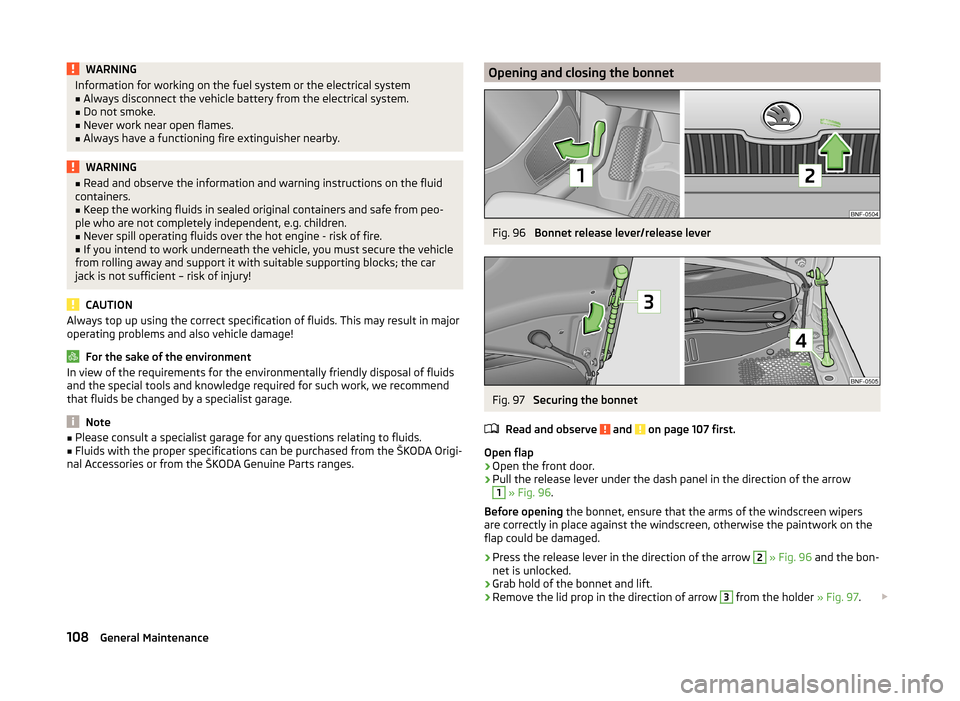
Bonnet release lever/release lever
Fig. 97
Securing the bonnet
Read and observe
and on page 107 first.
Open flap
›
Open the front door.
›
Pull the release lever under the dash panel in the direction of the arrow
1
» Fig. 96 .
Before opening the bonnet, ensure that the arms of the windscreen wipers
are correctly in place against the windscreen, otherwise the paintwork on the
flap could be damaged.
›
Press the release lever in the direction of the arrow
2
» Fig. 96 and the bon-
net is unlocked.
›
Grab hold of the bonnet and lift.
›
Remove the lid prop in the direction of arrow
3
from the holder » Fig. 97.
108General Maintenance
Page 112 of 164

›Secure the open flap by inserting the end of the post into opening 4.
Close the flap›
Lift the bonnet.
›
Decouple the bonnet support and press into the holder designed to hold it.
›
Let the bonnet drop into the lock carrier lock from a height of around 20 cm – do not push it in .
WARNING■
Check that the bonnet is closed properly.■If you notice that the lock is not properly engaged while driving, stop the
vehicle immediately and close the bonnet – risk of accident!■
Make sure that when closing the bonnet, no body parts are crushed -
there is danger of injury!
CAUTION
Never open the bonnet by the locking lever » Fig. 96.
Engine compartment overview
Fig. 98
Principle sketch: Engine compartment
Read and observe
and on page 107 first.
Arrangement in the engine compartment » Fig. 98
Engine oil dipstick
110
Engine oil filler opening
111
Coolant expansion reservoir
112123Brake fluid reservoir113
Vehicle battery
113
Windscreen washer fluid reservoir
109
Radiator fan
Read and observe
and on page 107 first.
The radiator fan is powered by an electric motor. Operation is controlled ac-
cording to the temperature of the coolant.
WARNINGAfter switching off the ignition, the fan may intermittently continue to op-
erate for approx. 10 minutes.
Windscreen washer system
Fig. 99
Windscreen washer fluid reser-
voir
Read and observe and on page 107 first.
The windscreen washer fluid reservoir is located in the engine compart-
ment » Fig. 99 .
The cleaning fluid is provided for the cleaning of the front and rear window.
The capacity of the tank is about 3 litres.
Water alone is not sufficient to intensively clean the windscreen. We recom- mend using clean water together with a screen cleaner from the range of
ŠKODA Original Accessories (with antifreeze in winter), which will remove any
stubborn dirt.
456109Inspecting and replenishing
Page 113 of 164

Under exceptional circumstances, methylated spirits can also be used if no
screen cleaner with antifreeze is available. The concentration of methylated
spirits must not be more than 15 %. The freeze protection at this concentration
is sufficient only to -5 °C.
CAUTION
■ Under no circumstances must radiator antifreeze or other additives be added
to the windscreen washer fluid.■
Do not remove the filter from the windscreen washer fluid reservoir when re-
filling, as this may cause contamination of the liquid transportation system,
leading in turn to a windscreen washer system malfunction.
Engine oil
Introduction
This chapter contains information on the following subjects:
Specification
110
Checking the oil level
110
Replenishing
111
The engine has been factory-filled with a high-grade oil that can be use
throughout the year - except in extreme climate zones.
The engine oils are undergoing continuous further development. Thus the in- formation stated in this Owner's Manual is only correct at the time of publica-
tion.
ŠKODA Service Partners are informed about the latest changes by the manu-
facturer. We therefore recommend that the oil change be completed by a
ŠKODA Service Partner.
The specifications (VW standards) stated in the following can be indicated sep-
arately or together with other specifications on the bottle.
The engine oil should be changed after specified service intervals » page 30.
WARNINGThe engine compartment of your car is a hazardous area. The following
warning instructions must be followed at all times when working in the en-
gine compartment » page 107.CAUTIONDo not pour any additives into the engine oil – risk of serious damage to the
engine parts!
Note
■ Before a long drive we recommend that you purchase and carry with you en-
gine oil which complies with the specification for your vehicle.■
We recommend that you use oils from ŠKODA Original Accessories.
■
If your skin has come into contact with oil, it must be washed thoroughly.
Specification
Read and observe
and on page 110 first.
Specification
EngineSpecification1.0 ltr./44 kW MPIVW 502 00, VW 504 00 a)1.0 ltr./55 kW MPIVW 502 00, VW 504 00a)1.0 l/50 kW MPI G-TECVW 502 00a)
Optional engine oil specifications.
Checking the oil level
Fig. 100
Principle sketch: Dipstick
Read and observe and on page 110 first.
The dipstick indicates the engine oil level .
Dipstick » Fig. 100
The oil level must be within this range.
A110General Maintenance