2014 Peugeot 308 warning
[x] Cancel search: warningPage 72 of 400
70
Access
308_EN_CHAP02_OUVERTURES_ED02-2013
Reinitialising the electric
windows
Always remove the key when leaving the vehicle, even for a short time. In the event of contact during operation of the windows, you must reverse the movement of the window. To do this, press the switch concerned. When operating the passenger electric window switches, the driver must ensure that no one is preventing correct closing of the windows. The driver must ensure that the passengers use the electric windows c o r r e c t l y. Be aware of children when operating the windows.
Following reconnection of the battery, the safety anti-pinch function must be reinitialised. The safety anti-pinch is not active during these operations:
- lower the window completely, then raise it, it will rise in steps of a few centimetres each time the switch is pressed. Repeat the operation until the window closes completely, - press and hold the switch upwards for at least one second after reaching this position, window closed.
For the safety of your children, press switch 5 to prevent operation of the windows of the rear doors, irrespective of their position.
Deactivating the rear
window controls
With the warning lamp on, the rear switches are deactivated. With the warning lamp off, the switches are active.
Page 75 of 400
73
2
Access
308_EN_CHAP02_OUVERTURES_ED02-2013
Low fuel level
When the low fuel level in the tank is reached, this warning lamp comes on in the instrument panel, accompanied by an audible warning and a message.
Fuel supply cut-off
Your vehicle is equipped with a safety device which cuts off the fuel supply in the event of a collision.
It is still possible to use a fuel can to fill the tank but this must be done slowly. In order to ensure a good flow of fuel, do not place the nozzle of the fuel can in direct contact with the flap of the misfuel prevention device.
Diesel misfuel prevention
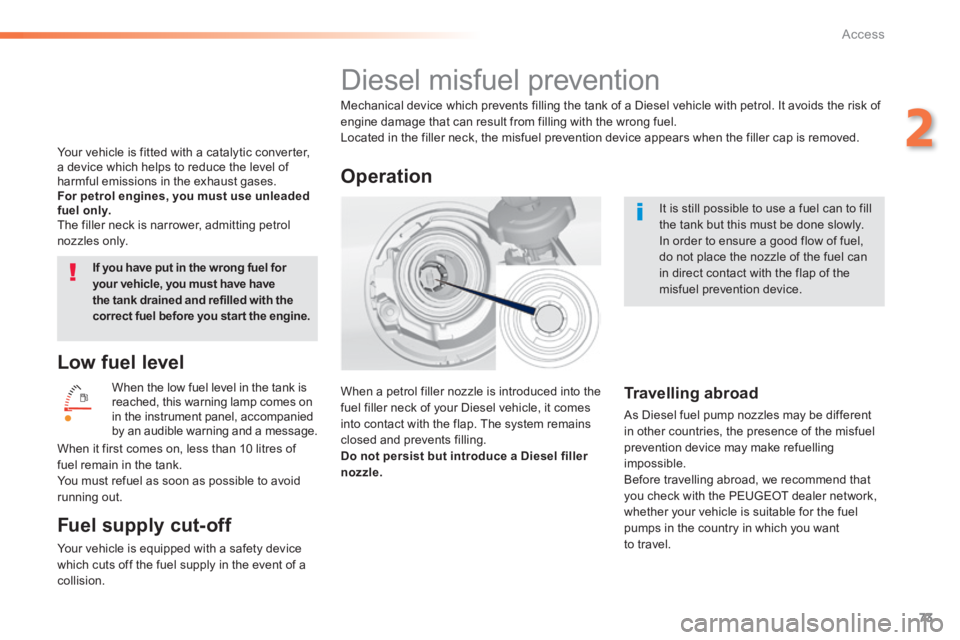
Mechanical device which prevents filling the tank of a Diesel vehicle with petrol. It avoids the risk of engine damage that can result from filling with the wrong fuel. Located in the filler neck, the misfuel prevention device appears when the filler cap is removed.
When a petrol filler nozzle is introduced into the fuel filler neck of your Diesel vehicle, it comes into contact with the flap. The system remains
closed and prevents filling. Do not persist but introduce a Diesel filler nozzle.
Operation
Travelling abroad
As Diesel fuel pump nozzles may be different in other countries, the presence of the misfuel prevention device may make refuelling impossible. Before travelling abroad, we recommend that you check with the PEUGEOT dealer network, whether your vehicle is suitable for the fuel pumps in the country in which you want to travel.
When it first comes on, less than 10 litres of fuel remain in the tank. You must refuel as soon as possible to avoid running out.
If you have put in the wrong fuel for your vehicle, you must have have the tank drained and refilled with the correct fuel before you star t the engine.
Your vehicle is fitted with a catalytic converter, a device which helps to reduce the level of harmful emissions in the exhaust gases. For petrol engines, you must use unleaded fuel only. The filler neck is narrower, admitting petrol nozzles only.
Page 90 of 400
88
Comfort
308_EN_CHAP03_CONFORT_ED02-2013
230 V / 50 Hz power socket
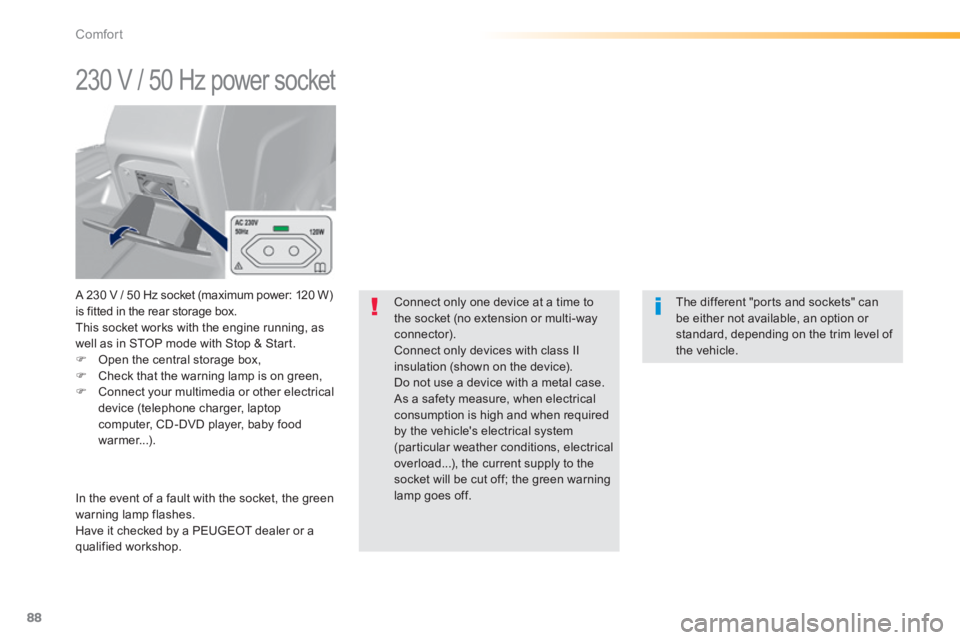
A 230 V / 50 Hz socket (maximum power: 120 W) is fitted in the rear storage box. This socket works with the engine running, as well as in STOP mode with Stop & Start. Open the central storage box, Check that the warning lamp is on green, Connect your multimedia or other electrical device (telephone charger, laptop computer, CD-DVD player, baby food warmer...).
In the event of a fault with the socket, the green warning lamp flashes. Have it checked by a PEUGEOT dealer or a qualified workshop.
Connect only one device at a time to the socket (no extension or multi-way connector). Connect only devices with class II insulation (shown on the device). Do not use a device with a metal case. As a safety measure, when electrical consumption is high and when required
by the vehicle's electrical system (particular weather conditions, electrical overload...), the current supply to the socket will be cut off; the green warning lamp goes off.
The different "ports and sockets" can be either not available, an option or standard, depending on the trim level of the vehicle.
Page 96 of 400
94
Comfort
308_EN_CHAP03_CONFORT_ED02-2013
Warning triangle (stowing)
Before getting out of your vehicle to assemble the triangle and place it on the road, put on your high visibility vest.
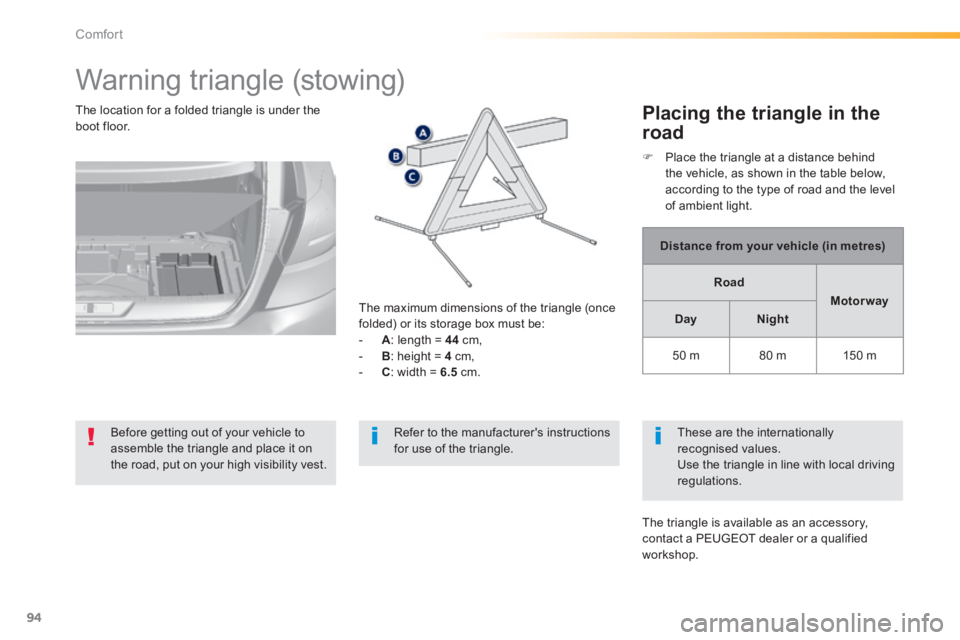
The maximum dimensions of the triangle (once folded) or its storage box must be: - A : length = 44 cm, - B : height = 4 cm, - C : width = 6.5 cm.
The location for a folded triangle is under the boot floor. Placing the triangle in the
road
Distance from your vehicle (in metres)
Road
Motor way
DayNight
50 m 80 m 150 m
These are the internationally recognised values. Use the triangle in line with local driving regulations.
The triangle is available as an accessory, contact a PEUGEOT dealer or a qualified workshop.
Place the triangle at a distance behind the vehicle, as shown in the table below, according to the type of road and the level of ambient light.
Refer to the manufacturer's instructions for use of the triangle.
Page 111 of 400
109
4
Driving
308_EN_CHAP04_CONDUITE_ED02-2013
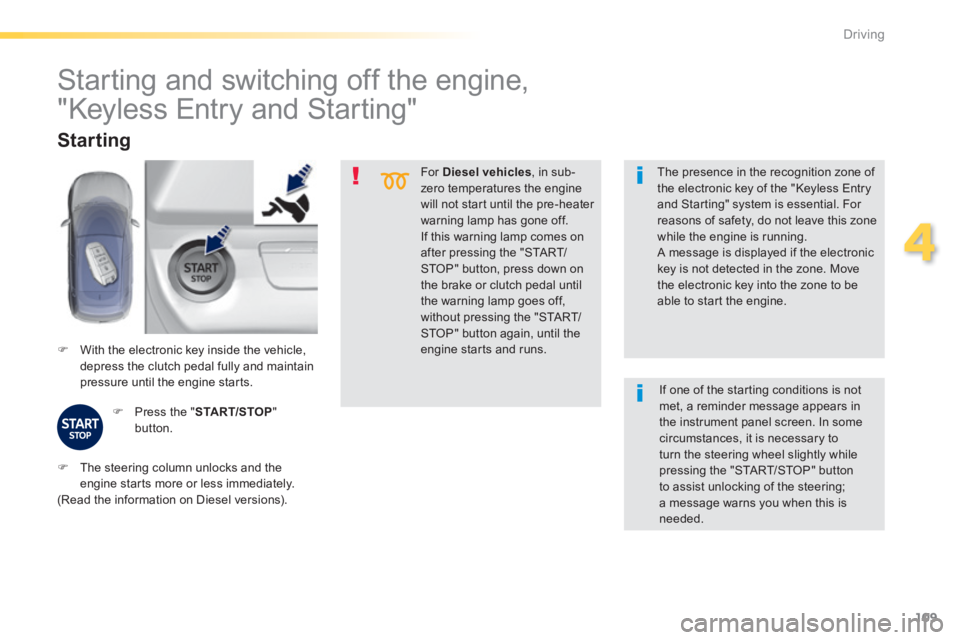
For Diesel vehicles , in sub-zero temperatures the engine will not start until the pre-heater warning lamp has gone off.
If this warning lamp comes on after pressing the "START/STOP" button, press down on the brake or clutch pedal until the warning lamp goes off, without pressing the "START/STOP" button again, until the engine starts and runs. With the electronic key inside the vehicle, depress the clutch pedal fully and maintain pressure until the engine starts.
Starting
Press the " START/STOP " button.
The presence in the recognition zone of the electronic key of the "Keyless Entry and Starting" system is essential. For reasons of safety, do not leave this zone
while the engine is running. A message is displayed if the electronic key is not detected in the zone. Move the electronic key into the zone to be able to start the engine.
Starting and switching off the engine,
"Keyless Entry and Starting"
The steering column unlocks and the engine starts more or less immediately. (Read the information on Diesel versions).
If one of the starting conditions is not met, a reminder message appears in the instrument panel screen. In some circumstances, it is necessary to turn the steering wheel slightly while pressing the "START/STOP" button to assist unlocking of the steering; a message warns you when this is needed.
Page 115 of 400
113
4
Driving
308_EN_CHAP04_CONDUITE_ED02-2013
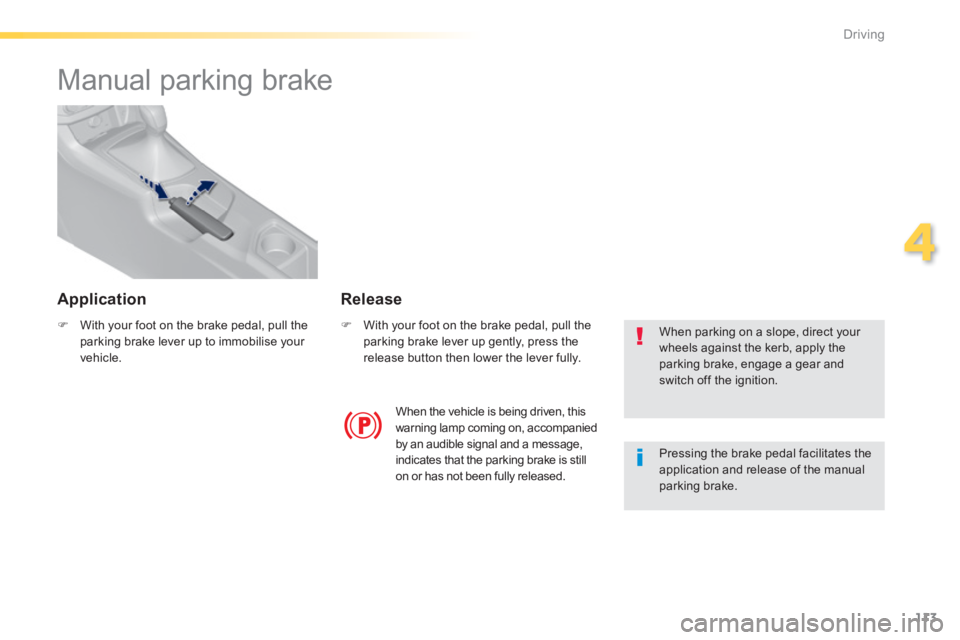
Manual parking brake
With your foot on the brake pedal, pull the parking brake lever up to immobilise your vehicle.
With your foot on the brake pedal, pull the parking brake lever up gently, press the release button then lower the lever fully.
When parking on a slope, direct your wheels against the kerb, apply the parking brake, engage a gear and switch off the ignition.
When the vehicle is being driven, this warning lamp coming on, accompanied by an audible signal and a message, indicates that the parking brake is still on or has not been fully released.
Pressing the brake pedal facilitates the application and release of the manual parking brake.
Release Application
Page 120 of 400
118
Driving
308_EN_CHAP04_CONDUITE_ED02-2013
Emergency braking
In the event of a failure of the main service brake or in an exceptional situation (e.g. driver taken ill, under instruction, etc) a continuous pull on the control lever will brake the vehicle. Braking takes place while the control lever is being pulled. It is interrupted if the control lever is released. The ABS and DSC systems provide stability of the vehicle during emergency braking. If the emergency braking malfunctions, the message "Parking brake control faulty" will be displayed.
The emergency braking should only be used in an exceptional situation.
Repeat this procedure to reactivate automatic operation. Reactivation of automatic operation is confirmed by the indicator lamp in the instrument panel going off.
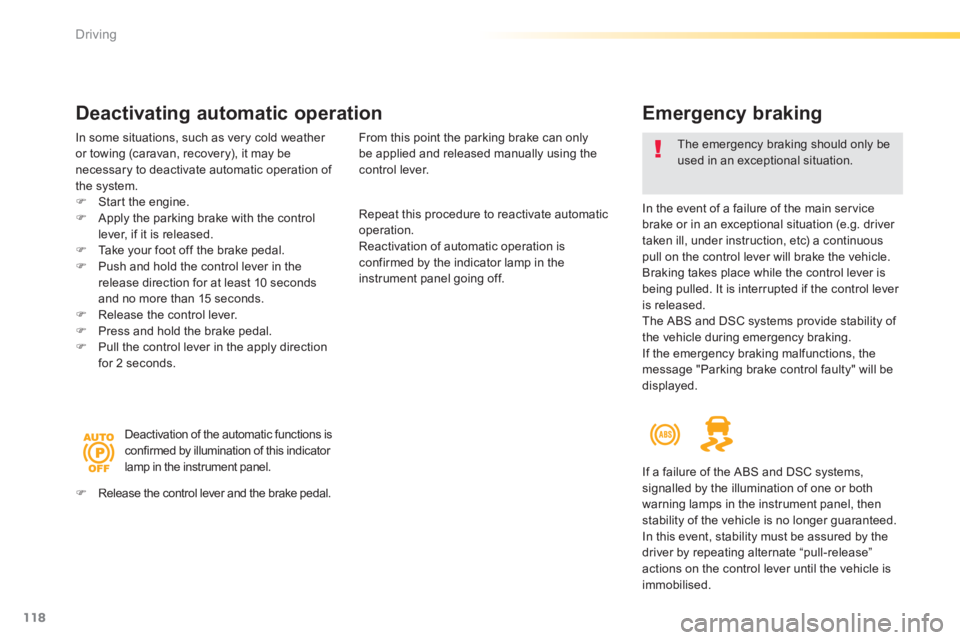
Deactivating automatic operation
In some situations, such as very cold weather or towing (caravan, recovery), it may be necessary to deactivate automatic operation of the system. Start the engine. Apply the parking brake with the control
lever, if it is released. Take your foot off the brake pedal. Push and hold the control lever in the release direction for at least 10 seconds and no more than 15 seconds. Release the control lever. Press and hold the brake pedal. Pull the control lever in the apply direction for 2 seconds.
Deactivation of the automatic functions is confirmed by illumination of this indicator lamp in the instrument panel.
Release the control lever and the brake pedal.
From this point the parking brake can only be applied and released manually using the control lever.
If a failure of the ABS and DSC systems, signalled by the illumination of one or both warning lamps in the instrument panel, then stability of the vehicle is no longer guaranteed. In this event, stability must be assured by the driver by repeating alternate “pull-release” actions on the control lever until the vehicle is
immobilised.
Page 121 of 400
119
4
Driving
308_EN_CHAP04_CONDUITE_ED02-2013
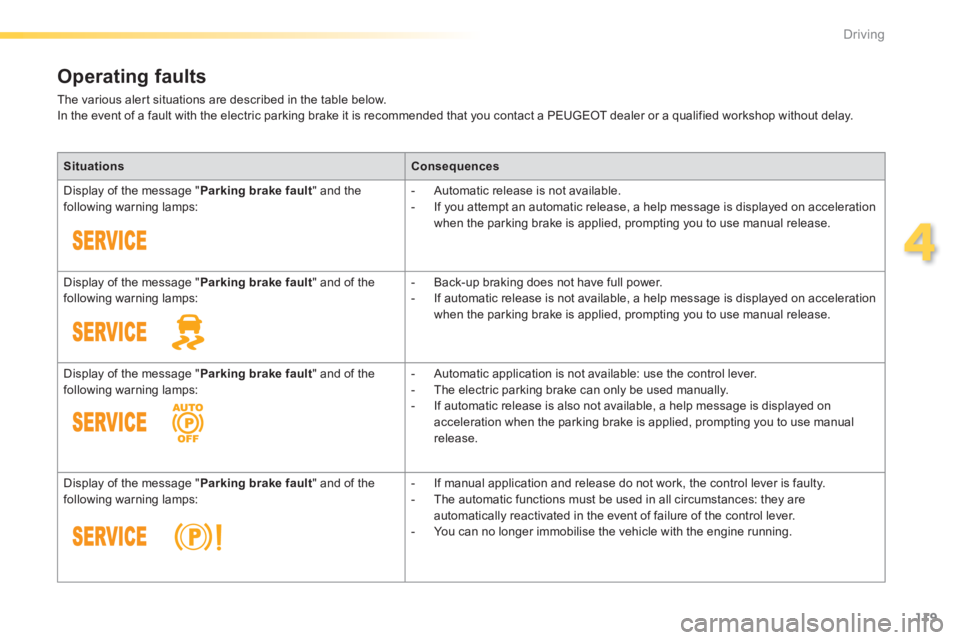
Operating faults
The various alert situations are described in the table below. In the event of a fault with the electric parking brake it is recommended that you contact a PEUGEOT dealer or a qualified workshop without delay.
SituationsConsequences
Display of the message " Parking brake fault " and the following warning lamps: - Automatic release is not available. - If you attempt an automatic release, a help message is displayed on acceleration when the parking brake is applied, prompting you to use manual release.
Display of the message " Parking brake fault " and of the following warning lamps: - Back-up braking does not have full power. - If automatic release is not available, a help message is displayed on acceleration when the parking brake is applied, prompting you to use manual release.
Display of the message " Parking brake fault " and of the following warning lamps: - Automatic application is not available: use the control lever. - The electric parking brake can only be used manually. - If automatic release is also not available, a help message is displayed on acceleration when the parking brake is applied, prompting you to use manual release.
Display of the message " Parking brake fault " and of the following warning lamps: - If manual application and release do not work, the control lever is faulty. - The automatic functions must be used in all circumstances: they are automatically reactivated in the event of failure of the control lever. - You can no longer immobilise the vehicle with the engine running.