Page 35 of 378
.Hybrid system33
View hybrid fl ow information
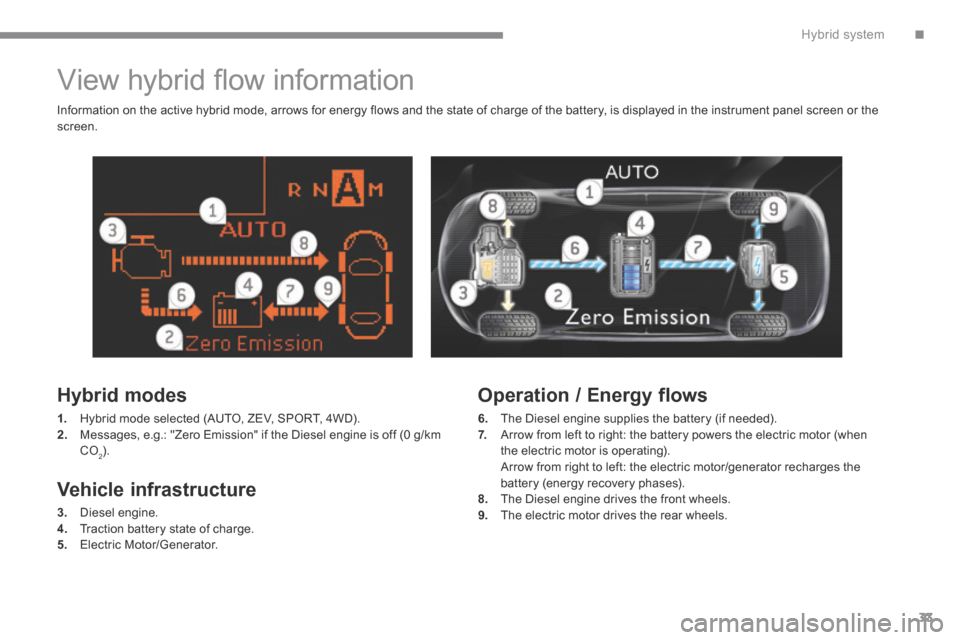
Hybrid modes
1. Hybrid mode selected (AUTO, ZEV, SPORT, 4WD). 2. Messages, e.g.: "Zero Emission" if the Diesel engine is off (0 g/km CO2).
Operation / Energy flows
6. The Diesel engine supplies the battery (if needed). 7. Arrow from left to right: the battery powers the electric motor (when the electric motor is operating). Arrow from right to left: the electric motor/generator recharges the battery (energy recovery phases). 8. The Diesel engine drives the front wheels. 9. The electric motor drives the rear wheels.
Vehicle infrastructure
3. Diesel engine. 4. Traction battery state of charge. 5. Electric Motor/Generator.
Information on the active hybrid mode, arrows for energy flows and the state of charge of the battery, is displayed in the instrument panel screen or the screen.
Page 36 of 378
Hybrid system
34
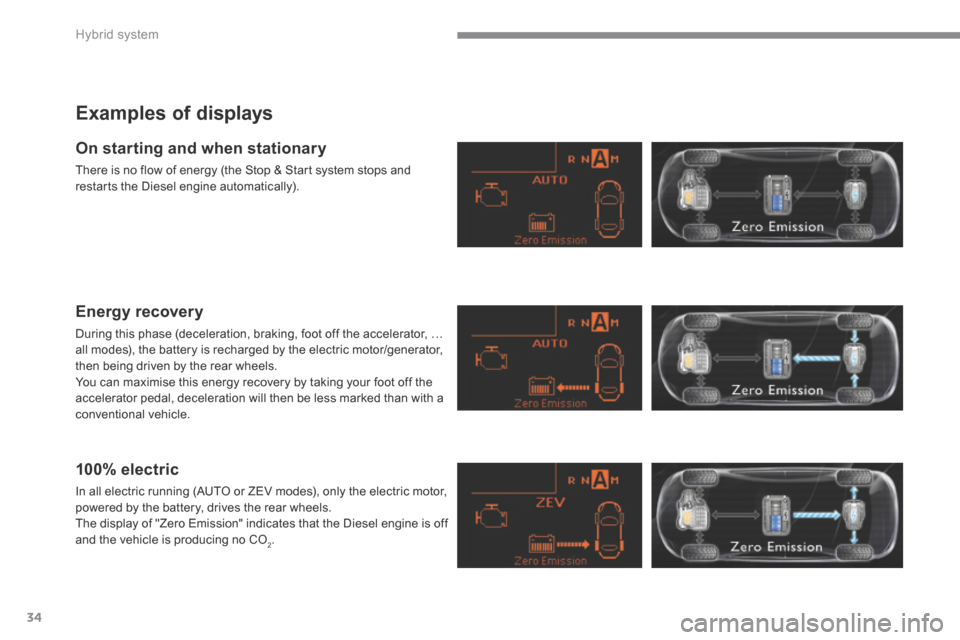
Examples of displays
On starting and when stationary
There is no flow of energy (the Stop & Start system stops and restarts the Diesel engine automatically).
Energy recovery
During this phase (deceleration, braking, foot off the accelerator, … all modes), the battery is recharged by the electric motor/generator, then being driven by the rear wheels. You can maximise this energy recovery by taking your foot off the accelerator pedal, deceleration will then be less marked than with a conventional vehicle.
100% electric
In all electric running (AUTO or ZEV modes), only the electric motor, powered by the battery, drives the rear wheels. The display of "Zero Emission" indicates that the Diesel engine is off
and the vehicle is producing no CO2.
Page 39 of 378
.Hybrid system37
HYbrid4 frequently asked questions
ZEV (Zero Emissions Vehicle) mode
QuestionAnswer
Why is it not always possible for me to put the vehicle into ZEV (Zero Emissions Vehicle) mode even though the battery is well charged?
This situation is temporary. Certain conditions will occasionally prevent the change to ZEV mode, even if the battery has sufficient charge, such as, for example, very cold conditions, altitude, demisting, high demand for
heating or air conditioning, regeneration of the particle emissions filter (PEF).
Why do I sometimes see an alert message "Electric mode not available: PEF regeneration in progress"?
This is an message relating to the regeneration of the particle emissions filter (PEF). This is a completely normal process that takes place every 240 or 300 miles (400 or 500 km) (or more frequently in prolonged urban use), as on a conventional HDi vehicle. This process is not generally noticed by the driver. On the other hand, in the case of a hybrid, this phenomenon may be noticeable (in urban use) as temporarily the HDi engine will not stop and this message will be displayed at intervals while regeneration is in progress.
Why is it not possible for me to put the vehicle into ZEV mode, even though I had just been running electrically in Auto mode?
The management of ZEV is different from Auto mode. Changing to ZEV mode is only possible with a battery charge of at least 4 bars, in order to assure sufficient range. In Auto mode, the system alone manages the conditions for changing temporarily to electric
mode, for shorter periods and with a lower state of charge of the battery.
Why is the range in ZEV (Zero Emissions Vehicle) mode lower when climbing? The vehicle needs more energy when climbing than when running on the level. So it is better to stay in Auto mode, which will favour operation of the Diesel engine.
Why is it that the system makes me come out of ZEV (Zero Emissions Vehicle) mode; it does not return to ZEV automatically when the conditions allow?
It is not intended to give preference to ZEV running at any cost, as it is not always the most economical mode. So the system returns automatically to Auto mode.
Page 40 of 378
Hybrid system
38
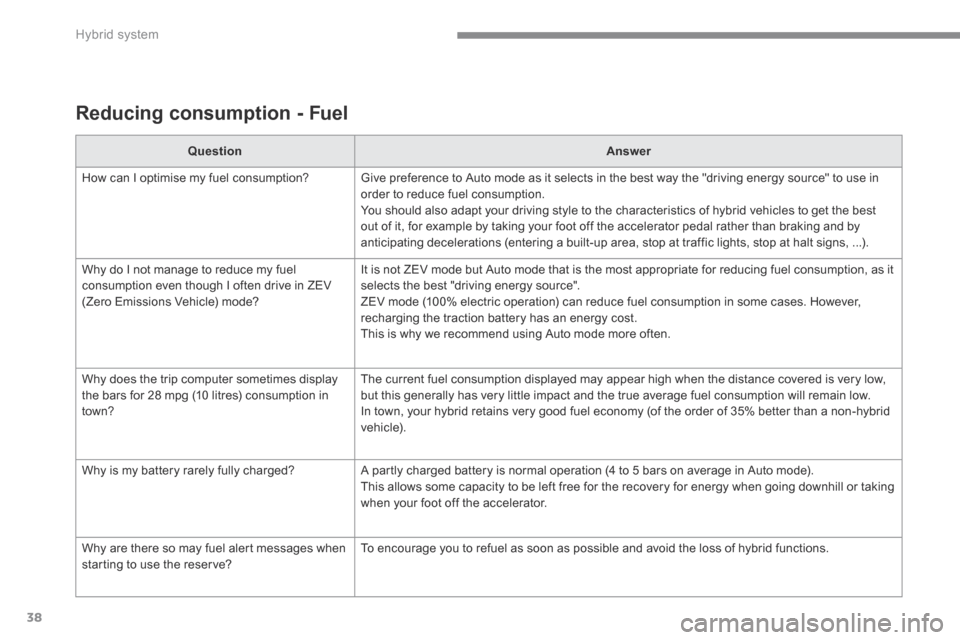
Reducing consumption - Fuel
QuestionAnswer
How can I optimise my fuel consumption? Give preference to Auto mode as it selects in the best way the "driving energy source" to use in order to reduce fuel consumption. You should also adapt your driving style to the characteristics of hybrid vehicles to get the best out of it, for example by taking your foot off the accelerator pedal rather than braking and by anticipating decelerations (entering a built-up area, stop at traffic lights, stop at halt signs, ...).
Why do I not manage to reduce my fuel consumption even though I often drive in ZEV (Zero Emissions Vehicle) mode?
It is not ZEV mode but Auto mode that is the most appropriate for reducing fuel consumption, as it selects the best "driving energy source". ZEV mode (100% electric operation) can reduce fuel consumption in some cases. However, recharging the traction battery has an energy cost. This is why we recommend using Auto mode more often.
Why does the trip computer sometimes display the bars for 28 mpg (10 litres) consumption in town?
The current fuel consumption displayed may appear high when the distance covered is very low, but this generally has very little impact and the true average fuel consumption will remain low. In town, your hybrid retains very good fuel economy (of the order of 35% better than a non-hybrid vehicle).
Why is my battery rarely fully charged? A partly charged battery is normal operation (4 to 5 bars on average in Auto mode). This allows some capacity to be left free for the recovery for energy when going downhill or taking when your foot off the accelerator.
Why are there so may fuel alert messages when starting to use the reserve? To encourage you to refuel as soon as possible and avoid the loss of hybrid functions.
Page 44 of 378
Hybrid system
42
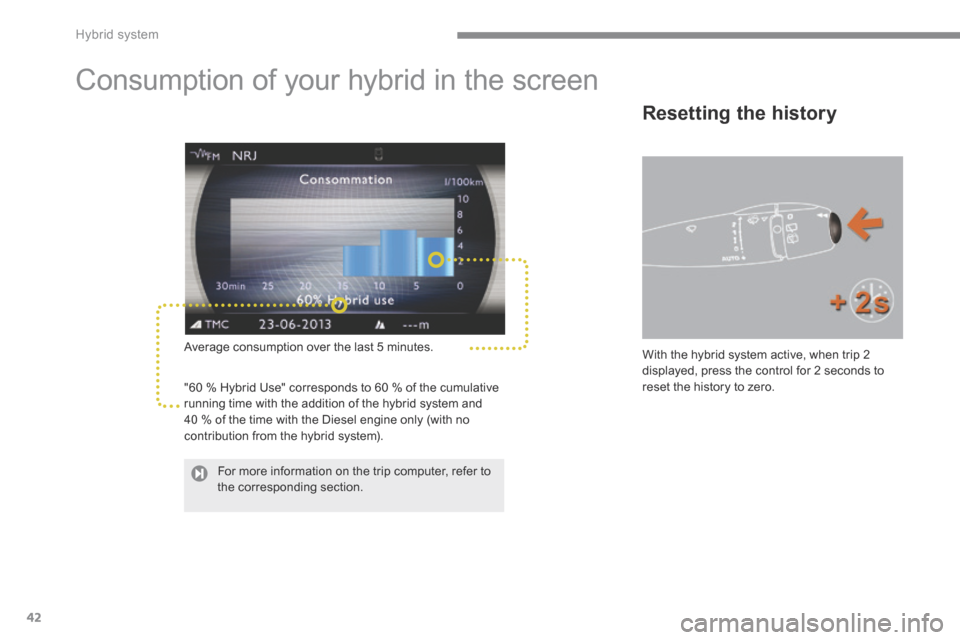
Consumption of your hybrid in the screen
Average consumption over the last 5 minutes.
"60 % Hybrid Use" corresponds to 60 % of the cumulative running time with the addition of the hybrid system and 40 % of the time with the Diesel engine only (with no
contribution from the hybrid system).
With the hybrid system active, when trip 2 displayed, press the control for 2 seconds to reset the history to zero.
Resetting the history
For more information on the trip computer, refer to the corresponding section.
Page 45 of 378
.Hybrid system43
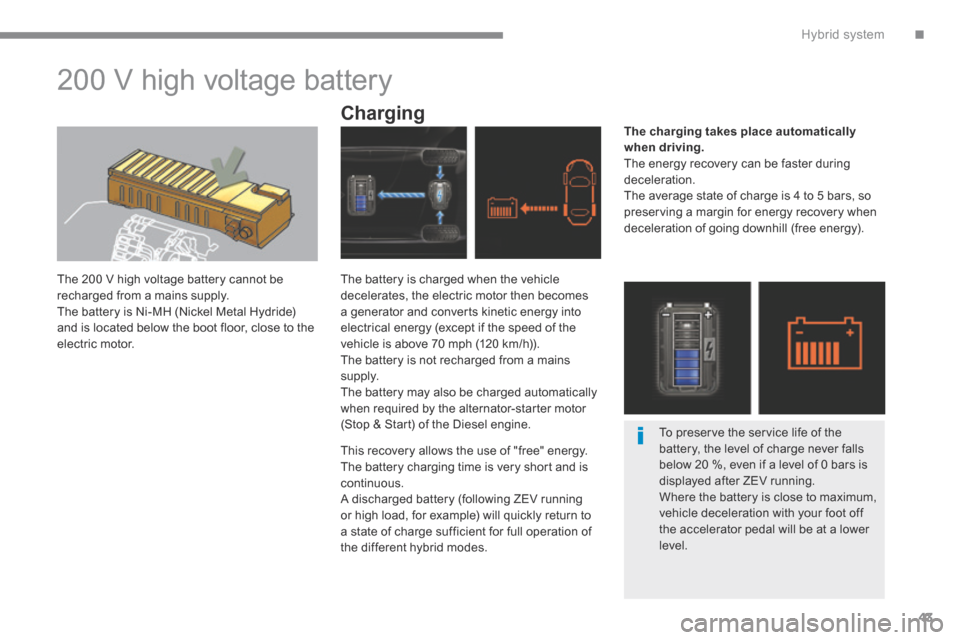
200 V high voltage battery
The 200 V high voltage battery cannot be recharged from a mains supply. The battery is Ni-MH (Nickel Metal Hydride) and is located below the boot floor, close to the electric motor.
Charging The charging takes place automatically when driving . The energy recovery can be faster during deceleration. The average state of charge is 4 to 5 bars, so preserving a margin for energy recovery when deceleration of going downhill (free energy).
The battery is charged when the vehicle decelerates, the electric motor then becomes a generator and converts kinetic energy into electrical energy (except if the speed of the vehicle is above 70 mph (120 km/h)). The battery is not recharged from a mains supply. The battery may also be charged automatically when required by the alternator-starter motor (Stop & Start) of the Diesel engine.
This recovery allows the use of "free" energy. The battery charging time is very short and is continuous. A discharged battery (following ZEV running or high load, for example) will quickly return to a state of charge sufficient for full operation of the different hybrid modes.
To preserve the service life of the battery, the level of charge never falls below 20 %, even if a level of 0 bars is displayed after ZEV running. Where the battery is close to maximum, vehicle deceleration with your foot off the accelerator pedal will be at a lower
level.
Page 50 of 378

Monitoring
48
Panel grouping together the vehicle operation indication dials and warning lamps.
Instrument panels
Dials
4. Speedometer. Indicates the current speed of the moving vehicle (mph or km/h). 5. Screen.6. Display zero reset or ser vice indicatorrepeat button. Resets the selected function to zero (trip distance recorder or service indicator) or displays the service indicator again.
1. Power meter Power meter Power meter Indicates the power available as a percentage . For more information refer to the "Hybrid" section. 2. Coolant temperature gauge. Indicates the temperature of the engine coolant (degrees Celsius). 3. Fuel gauge.
Indicates the quantity of fuel remaining in the tank.
For more information, refer to the corresponding section on the button or function and its associated display.
7. Instrument panel lighting dimmer. Adjusts the brightness of the lighting of the instruments and controls, if the vehicle lighting is on. 8. Ready lamp Indicates that the vehicle is ready to move off.
Page 51 of 378

1
Monitoring49
Screen(s)
A. Speed limiter ed limiter ed limiter or Cruise control. (mph or km/h) B. Trip distance recorder. (miles or km) C. Service indicator. (miles or km) or, Engine oil level indicator. or Distance recorder. (miles or km) D. Gear selected in the electronic gearbox.E.- Electrical flow or Electrical flow or Electrical flow or - Warning messages and function status messages or or or - Trip computer or - Trip computer or - Trip computer or- Satellite navigation information or Satellite navigation information or Satellite navigation information or- Menus (with PEUGEOT Connect Media Navigation (NG4 3D)).
Instrument panel navigator
This group of buttons permits: - When stationary , configuration of the When stationary , configuration of the When stationaryvehicle's equipment and the screen settings (languages, units...), - While driving , scrolling of the active functions (trip computer, navigation...).
Controls
There are four buttons to control the screen in the instrument panel: 1. Access the main menu, confirm the selection. 2. Move up through the menu. 3. Move down through the menu. 4. Return to the previous display, exit from the menu.