Page 24 of 442
20. Vehicle Dynamic Control (VDC) OFFswitch (P. 2-40)
Sport mode switch (P. 2-40)
Power liftgate switch (if so equipped)
(P.3-23)
Power liftgate main switch
(if so equipped) (P. 3-26)
Warning systems switch (if so
equipped) (P.2-42)
All-Wheel Drive (AWD) lock switch
(if so equipped) (P.2-40)
Hill descent control switch
(if so equipped) (P.2-41)
21. Instrument brightness control
(P. 2-37)/Twin trip odometer reset
switch (P. 2-4)
*: Refer to the separate Navigation System Own-
er’s Manual (if so equipped) .
See the page number indicated in paren-
theses for operating details.
Illustrated table of contents0-7
Page 26 of 442
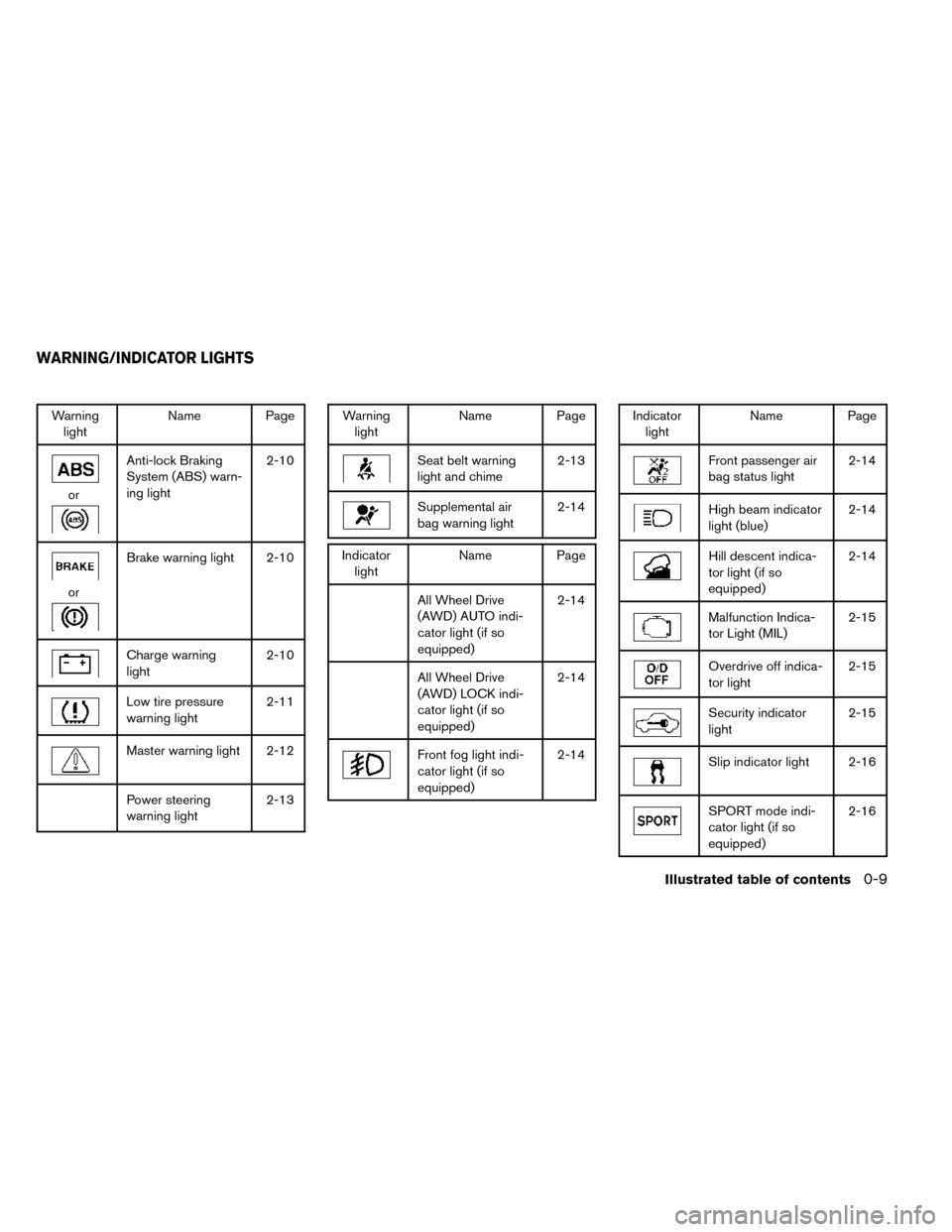
Warninglight Name Page
or
Anti-lock Braking
System (ABS) warn-
ing light 2-10
or
Brake warning light 2-10
Charge warning
light
2-10
Low tire pressure
warning light2-11
Master warning light 2-12
Power steering
warning light2-13
Warning
light Name Page
Seat belt warning
light and chime 2-13
Supplemental air
bag warning light2-14
Indicator
light Name Page
All Wheel Drive
(AWD) AUTO indi-
cator light (if so
equipped) 2-14
All Wheel Drive
(AWD) LOCK indi-
cator light (if so
equipped)2-14
Front fog light indi-
cator light (if so
equipped)
2-14
Indicator
light Name Page
Front passenger air
bag status light 2-14
High beam indicator
light (blue)2-14
Hill descent indica-
tor light (if so
equipped)2-14
Malfunction Indica-
tor Light (MIL)
2-15
Overdrive off indica-
tor light2-15
Security indicator
light2-15
Slip indicator light 2-16
SPORT mode indi-
cator light (if so
equipped)2-16
WARNING/INDICATOR LIGHTS
Illustrated table of contents0-9
Page 29 of 442
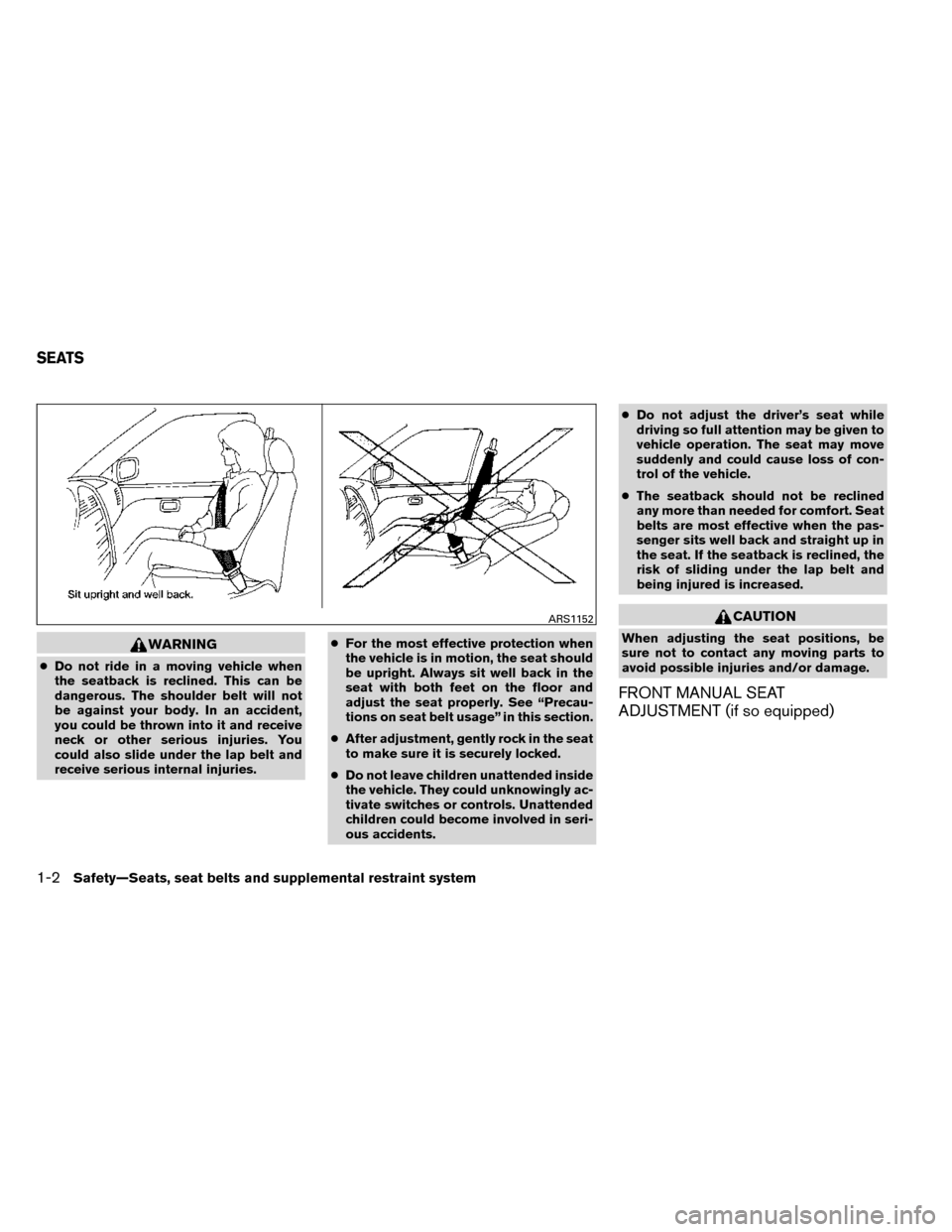
WARNING
●Do not ride in a moving vehicle when
the seatback is reclined. This can be
dangerous. The shoulder belt will not
be against your body. In an accident,
you could be thrown into it and receive
neck or other serious injuries. You
could also slide under the lap belt and
receive serious internal injuries. ●
For the most effective protection when
the vehicle is in motion, the seat should
be upright. Always sit well back in the
seat with both feet on the floor and
adjust the seat properly. See “Precau-
tions on seat belt usage” in this section.
● After adjustment, gently rock in the seat
to make sure it is securely locked.
● Do not leave children unattended inside
the vehicle. They could unknowingly ac-
tivate switches or controls. Unattended
children could become involved in seri-
ous accidents. ●
Do not adjust the driver’s seat while
driving so full attention may be given to
vehicle operation. The seat may move
suddenly and could cause loss of con-
trol of the vehicle.
● The seatback should not be reclined
any more than needed for comfort. Seat
belts are most effective when the pas-
senger sits well back and straight up in
the seat. If the seatback is reclined, the
risk of sliding under the lap belt and
being injured is increased.
CAUTION
When adjusting the seat positions, be
sure not to contact any moving parts to
avoid possible injuries and/or damage.
FRONT MANUAL SEAT
ADJUSTMENT (if so equipped)
ARS1152
SEATS
1-2Safety—Seats, seat belts and supplemental restraint system
Page 30 of 442
Forward and backward
Pull the center of the bar up and hold it while you
slide the seat forward or backward to the desired
position. Release the bar to lock the seat in
position.
Reclining
To recline the seatback, pull the lever up and lean
back. To bring the seatback forward, pull the lever
up and lean your body forward. Release the lever
to lock the seatback in position.
The reclining feature allows adjustment of the
seatback for occupants of different sizes for
added comfort and to help obtain proper seat
belt fit. For additional information, refer to “Pre-
cautions on seat belt usage” in this section. Also,
the seatback can be reclined to allow occupants
to rest when the vehicle is stopped and the shift
lever is in the P (Park) position.
Seat lifter (if so equipped for driver’s
seat)
Pull up or push down the adjusting lever to adjust
the seat height until the desired position is
achieved.
LRS2160LRS2161LRS2202
Safety—Seats, seat belts and supplemental restraint system1-3
Page 32 of 442
Seat lifter (driver’s seat)
Push the switch up or down to achieve desired
seat height.
Lumbar support (driver’s seat)
The lumbar support feature provides adjustable
lower back support to the driver. Move the switch
forward or backward to adjust the seatback lum-
bar area.2ND ROW BENCH SEAT
ADJUSTMENT
Forward and backward
Pull the center of the bar�1up and hold it while
you slide the seat forward or backward to the
desired position. Release the bar to lock the seat
in position.
Reclining
To recline the seatback, pull up on the lever�2
and lean back. To bring the seatback forward, pull
the lever
�2up and lean your body forward.
Release the lever to lock the seatback in position.
LRS2131LRS2270
Outboard seats
LRS2364
Safety—Seats, seat belts and supplemental restraint system1-5
Page 33 of 442
The recline feature allows adjustment of the seat-
back for occupants of different sizes for added
comfort and to help obtain proper seat belt fit. For
additional information, refer to “Precautions on
seat belt usage” in this section. Also, the seat-
back can be reclined to allow occupants to rest
when the vehicle is stopped and the shift lever is
in P (Park) .
WARNING
●After adjustment, gently rock in the seat
to make sure it is securely locked.
● Do not ride in a moving vehicle when
the seatback is reclined. This can be
dangerous. The shoulder belt will not
be against your body. In an accident,
you could be thrown into it and receive
neck or other serious injuries. You
could also slide under the lap belt and
receive serious internal injuries.
● For the most effective protection when
the vehicle is in motion, the seat should
be upright. Always sit well back in the
seat and adjust the seat belt properly.
See “Precautions on seat belt usage” in
this section.
HEAD RESTRAINTS/HEADRESTS
WARNING
Head restraints/headrests supplement
the other vehicle safety systems. They may
provide additional protection against in-
jury in certain rear end collisions. Adjust-
able head restraints/headrests must be
adjusted properly, as specified in this sec-
tion. Check the adjustment after someone
else uses the seat. Do not attach anything
to the head restraint/headrest stalks or
remove the head restraint/headrest. Do
not use the seat if the head
restraint/headrest has been removed. If
the head restraint/headrest was removed,
reinstall and properly adjust the head
restraint/headrest before an occupant
uses the seating position. Failure to fol-
low these instructions can reduce the ef-
fectiveness of the head
restraints/headrests. This may increase
the risk of serious injury or death in a
collision.
2nd row seating
LRS2403
1-6Safety—Seats, seat belts and supplemental restraint system
Page 34 of 442
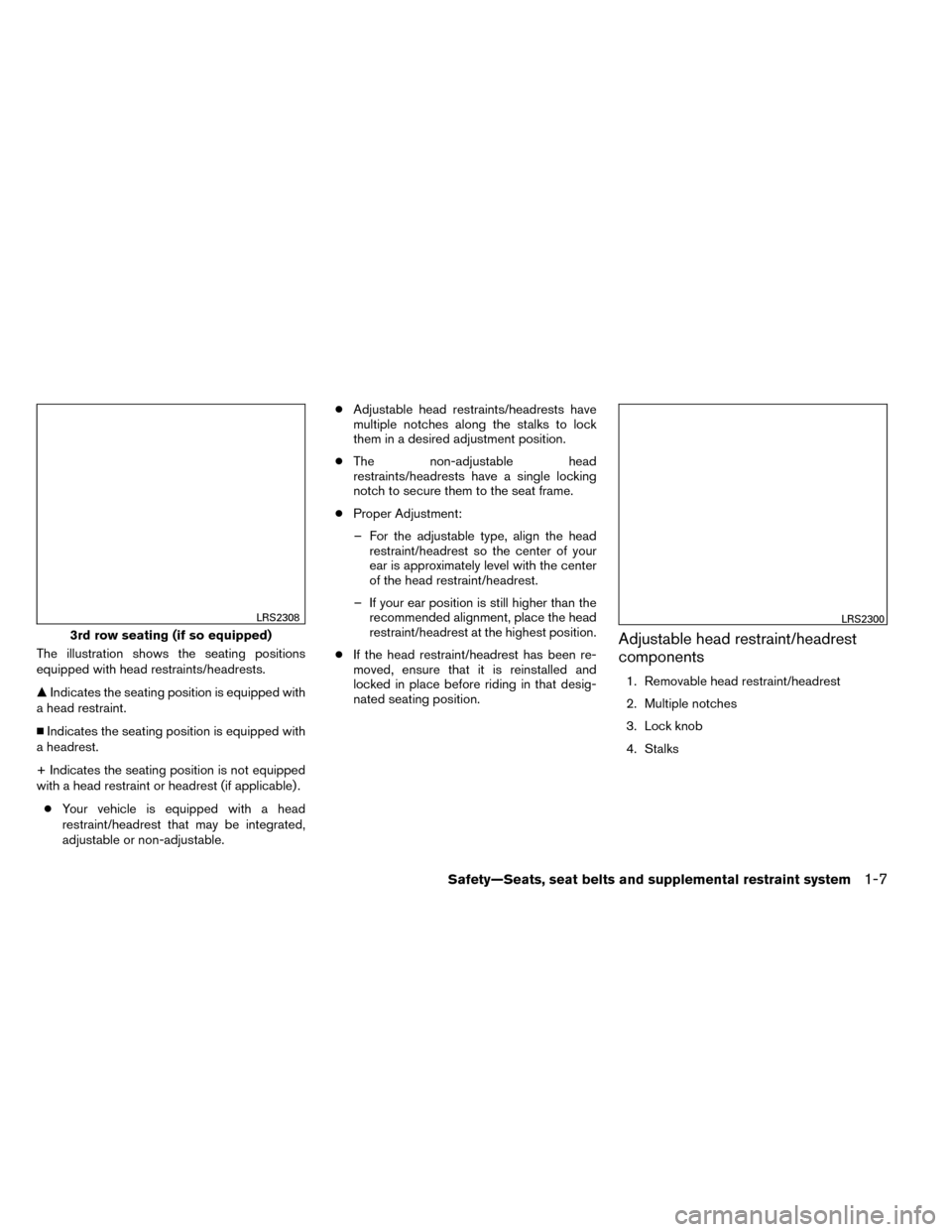
The illustration shows the seating positions
equipped with head restraints/headrests.
�Indicates the seating position is equipped with
a head restraint.
� Indicates the seating position is equipped with
a headrest.
+ Indicates the seating position is not equipped
with a head restraint or headrest (if applicable) .
● Your vehicle is equipped with a head
restraint/headrest that may be integrated,
adjustable or non-adjustable. ●
Adjustable head restraints/headrests have
multiple notches along the stalks to lock
them in a desired adjustment position.
● The non-adjustable head
restraints/headrests have a single locking
notch to secure them to the seat frame.
● Proper Adjustment:
– For the adjustable type, align the head restraint/headrest so the center of your
ear is approximately level with the center
of the head restraint/headrest.
– If your ear position is still higher than the recommended alignment, place the head
restraint/headrest at the highest position.
● If the head restraint/headrest has been re-
moved, ensure that it is reinstalled and
locked in place before riding in that desig-
nated seating position.Adjustable head restraint/headrest
components
1. Removable head restraint/headrest
2. Multiple notches
3. Lock knob
4. Stalks
3rd row seating (if so equipped)
LRS2308LRS2300
Safety—Seats, seat belts and supplemental restraint system1-7
Page 35 of 442
Non-adjustable head restraint/
headrest components
1. Removable head restraint/headrest
2. Single Notch
3. Lock knob
4. Stalks
Remove
Use the following procedure to remove the head
restraint/headrest.1. Pull the head restraint/headrest up to the highest position.
2. Push and hold the lock knob.
3. Remove the head restraint/headrest from the seat.
4. Store the head restraint/headrest properly in a secure place so it is not loose in the
vehicle. 5. Reinstall and properly adjust the head
restraint/headrest before an occupant uses
the seating position.
LRS2299LRS2302
1-8Safety—Seats, seat belts and supplemental restraint system