2014 MITSUBISHI OUTLANDER SPORT tow
[x] Cancel search: towPage 15 of 388
Plug-in Hybrid EV System2-6 General information
2
•Open the windows, doors and tailgate.•Put the operation mode in OFF.•Turn on the hazard warning flashers.• Move the key away from the vehicle toprevent unintended start-up of the sys-tem by inadvertent contact with a switchor impact from the crash.
zNever touch high-voltage wiring, connec-tors, and other high-vol
tage parts, such as
the inverter unit and drive battery. Anelectric shock may occur if exposed elec-tric wires are visible when viewed frominside or outside of
your vehicle. For their
locations, see “High-
voltage components”
on page 2-7.zIf the vehicle receives a strong impact tothe floor while driving, stop the vehicle ina safe place and
check the floor.
zNever start the plug-in hybrid EV systemif you found the leak
of a liquid (except
water of the air conditioner) while check-ing the outside of the vehicle because thereis possibility the fuel system has beendamaged and causing of fire or exploding.In such case, immediately contact yourMITSUBISHI MOTORS Authorized Ser-vice Point.WA R N I N G
zLeaks or damage to the drive battery mayresult in a fire. If you discover them, con-tact emergency services immediately.Since the fluid leak may be lithium man-ganite from the Lithium-ion battery, nevertouch any fluid leaking from the inside oroutside of the vehicle. If the fluid contactsyour skin or eyes, wash
it off immediately
with a large amount of water and receiveimmediate medical attention to help avoidserious injury.zIf you are unable to safely assess the vehi-cle due to vehicle damage, do not touchthe vehicle. Leave the vehicle and contactemergency services. Advise emergencyresponders that this is a Plug-in Hybridvehicle.zIf a fire occurs in this vehicle, leave thevehicle as soon as possible and contactemergency services. Do not attempt toextinguish a fire by yourself. If the fireinvolves a lithium-ion battery, it willrequire large, sustained volumes of waterfor extinguishment. Using a small amountof water or the incorrect fire extinguishercan result in serious injury or death fromelectrical shock.zWhen you leave the vehicle, if possible,open the windows, doors and tailgate toprevent accumulation of poisonous/com-bustible gasses. This will
also assist in the
rescue and fire fighting process.WA R N I N G
zAs with any vehicle fire, the byproducts ofcombustion can be toxic. Do not inhalesmoke, vapors, or gas from the vehicle.Move to a safe distance upwind and uphillfrom the vehicle fire and out of the way ofany oncoming traffic while awaiting thearrival of emergency responders.zIf you detect leaking fluids, sparks, smoke,flames, gurgling, popping or hissing noisesoriginating from the high voltage batterycompartment, contact emergency servicesimmediately. This may result in a fire.zPhysical damage to the vehicle or highvoltage battery may result in immediate ordelayed release of toxic and/or flammablegases and fire.zIf your vehicle needs to be towed, trans-port the vehicle on a
flatbed truck or tow
the vehicle with all wheels off the ground.If the any wheels are on the ground whentowing, this may cause damage to the elec-tric motors. This may also cause a fire, ifwiring in the electric motor unit roombecomes damaged. Refer to “Towing” onpage 9-19.zDo not attempt to repair a damaged Plug-in Hybrid vehicle by yourself. Please con-tact a MITSUBISHI MOTORS Author-ised Service Point for service.WA R N I N G
BK0203201EN.book 6 ページ 2013年11月19日 火曜日 午前11時50分
Page 33 of 388
Normal charging (charging method with rated AC 240 V outlet)3-8 Charging
3
2. Wipe off all the detergent with a soft clothdipped in fresh water and thoroughlywrung out.3. Wipe all moisture off and dry in a shaded,well-ventilated area.
E08300901080
WA R N I N GzWhen cleaning, be sure to remove thecharging cable plug and the normalcharge connector from the outlet. Do notconnect or disconnect the plug and theconnector with wet hand. Doing so couldcause an electric shock.zDo not expose the metal terminal of thenormal charge connect
or or the charging
cable plug to water or neutral detergent.Using in wet with water could cause a fireor an electric shock.CAUTIONzNever use benzine, petr
ol, or other organic
solvents, or acid or alkaline solvents. Doingso could cause deform
ation, discolour, or
malfunction. Also, these substances may bepresent in various cleaners, so check care-fully before using.
Normal charging (charging method with rated AC 240 V outlet)
WA R N I N GzFor safety, do not allow children or peoplewho are not familiar with charging tocharge for themselves. Also, do not use thenormal charge connector within reach ofchildren.zPersons who use electro-medical appara-tus such as implantable cardiac pace-maker or implantable cardioverter-defibrillator must check effect fromcharging with the manufacturer of elec-tro-medical apparatus. Electro-medicalapparatus operations could be affected bycharging.zIf you use any medica
l electric devices, be
careful the following precautions.•Keep away from the charge connector orcontrol box.•Do not stay inside of the vehicle.•Do not get on inside of the vehicle, forexample to remove or place an item inthe passenger compartment.•Do not open the rear hatch, for exampleto remove or place an item in the cargoarea.Charging may affect the operation of elec-tric medical devices and result in seriouspersonal inju
ry or death.
zDo not charge when the EV chargingcable is coiled up.Doing so the cable may be heated andresulting in a fire.zBefore charging, make sure that there isno foreign matter such as dust at the nor-mal charge port and the normal chargeconnector.At this time, do not touch the normalcharge port.zWhen foreign substances, such as dust,have entered, please contact a MITSUBI-SHI MOTORS Authorised Service Point.zWhen the normal charge connector is con-nected to the charge port, prevent foreignmatter such as water or dust from enter-ing in the connection.Connection with foreign matter such aswater or dust may cause a fire or an elec-tric shock. Do not perform charging ifthere is possibility of strong exposure towater at the connection.zWhen you deal with
charge apparatus, be
careful of the following points. It couldcause a fire, an electric shock and a shortcircuit.•Never pull the cable to remove the plug.•Never submerge the EV charging con-nector, control box, or plug in water.
zPlease observe the following in order toprevent accidents during charging such aselectrocution.WA R N I N G
BK0203201EN.book 8 ページ 2013年11月19日 火曜日 午前11時50分
Page 44 of 388
MITSUBISHI Remote Control*
Charging 3-19
3
•Due to the characteristics of radio waves,communication speed tends to decrease asthe communication distance increases. Useyour wireless LAN devi
ce at a short dis-
tance from the vehicle for better response.•When a microwave oven or ISM (indus-trial, scientific and medical) equipment isbeing used, the communication speed andrange of wireless
LAN devices may
decrease. Use your wireless LAN deviceaway from these appliances and equipment.•If a wireless LAN de
vice and Bluetooth
(registered trademark of Bluetooth SIG,Inc.) are used simultaneously, the commu-nication speed and range of each devicemay decrease. Use your wireless LANdevice away from Bluetooth devices.
zWireless LAN de
vices may not communicate
with the vehicle, or may not operate nor-mally or stably in the following environmentor situations. Check th
at the device can com-
municate with your vehicle before use.•There is an obstructi
on such as a concrete
or metal wall between the vehicle and wire-less LAN device.•The vehicle is surrounded by tall vehiclesin a parking lot.•There are facilities nearby that emit strongradio waves, such as a TV tower, trans-former substation, br
oadcasting station or
airport.NOTE
•There is a communication device such as amobile phone or radio, or an electric devicesuch as a personal computer near the wire-less LAN device.•The wireless
LAN device is in contact with
or covered by a metal object.•The battery of the wireless LAN device hasrun down.
zThe MITSUBISHI Remote Control cannotbe used under the following conditions:•The wireless LAN device is turned off.•The MITSUBISHI Re
mote Control appli-
cation software is not installed.•The MITSUBISHI Re
mote Control appli-
cation software is not running.•The wireless LAN devi
ce is not registered
on the vehicle or it is not connected to thevehicle.•The wireless LAN devi
ce is out of the com-
munication range.•The wireless
LAN device is
connected to
other wirele
ss LAN device.
•The wireless LAN devi
ce has failed, or its
battery has run out.
zSome charging facilities have a timer func-tion that turns the power on or off at a spe-cific time of the day. When charging at afacility with a timer function, make sure thatthe charging timer is set within the timeperiod when the power in the charging facil-ity is on.NOTE
zThe auxiliary battery is automatically andperiodically charged using electrical powerstored in the drive battery.zWhile the remote climate control is operatingor the charging, the cooling fan or air condi-tioner compressor may start operating and itssound may be heard.
This is normal.
zThe remote climate control operates in itsown mode based on the mode selected on thewireless LAN device,
regardless of the
switch setting of the vehicle’s air condi-tioner.zAir conditioning perform
ance may deterio-
rate or the remaining quantity of the drivebattery may decrease under the followingconditions:•In extremely hot weather.•In hot sunshine.•In extremely cold weather.zIf the remote climate control is started duringcharging, the time until full charge mayextend or the charging rate may decrease.zWhen the remaining quantity of the drivebattery is decreased, the remote climate con-trol does not operate
or it may stop on the
way.NOTE
BK0203201EN.book 19 ページ 2013年11月19日 火曜日 午前11時50分
Page 59 of 388
Doors4-14 Locking and unlocking
4
E00300402291
Pull the inside door handle towards you toopen the door.
NOTE
zOnly use the emergency key for emergen-cies. If the keyless operation key batterywears out, replace it as
quickly as possible so
that you can use the keyless operation key.zAfter using the emergency key, always returnit into the keyless operation key.
Doors
CAUTIONzMake sure the doors ar
e closed: dr
iving with
doors not completely closed is dangerous.zNever leave children in the vehicle unat-tended.zBe careful not to lock the doors while thekey is inside the vehicle.NOTE
zTo p r e v e n t t h e k e y f r o m b e i n g l o c k e d i n s i d ethe vehicle, neither the lock knob on thedriver’s door nor the key can be used to lockthe driver’s door when it is open.
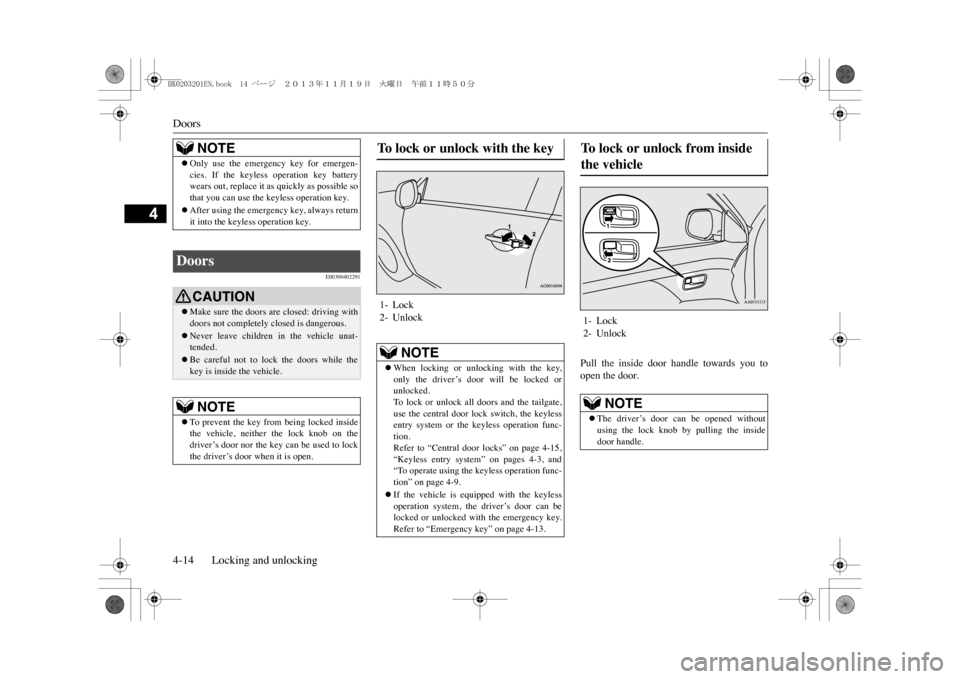
To lock or unlock with the key 1- Lock2- Unlock
NOTE
zWhen locking or unlocking with the key,only the driver’s door will be locked orunlocked.To l o c k o r u nl o c k a l l d o o r s a n d t h e t a i l g a t e ,use the central door lock switch, the keylessentry system or the keyless operation func-tion.Refer to “Central door locks” on page 4-15,“Keyless entry system” on pages 4-3, and“To operate using the
keyless operation func-
tion” on page 4-9.zIf the vehicle is equipped with the keylessoperation system, the driver’s door can belocked or unlocked with the emergency key.Refer to “Emergency key” on page 4-13.
To l o c k o r u n l o c k f r o m i n s i d e the vehicle 1- Lock2- Unlock
NOTE
zThe driver’s door can be opened withoutusing the lock knob by pulling the insidedoor handle.
BK0203201EN.book 14 ページ 2013年11月19日 火曜日 午前11時50分
Page 90 of 388
Seat belts
Seat and seat belts 5-11
5
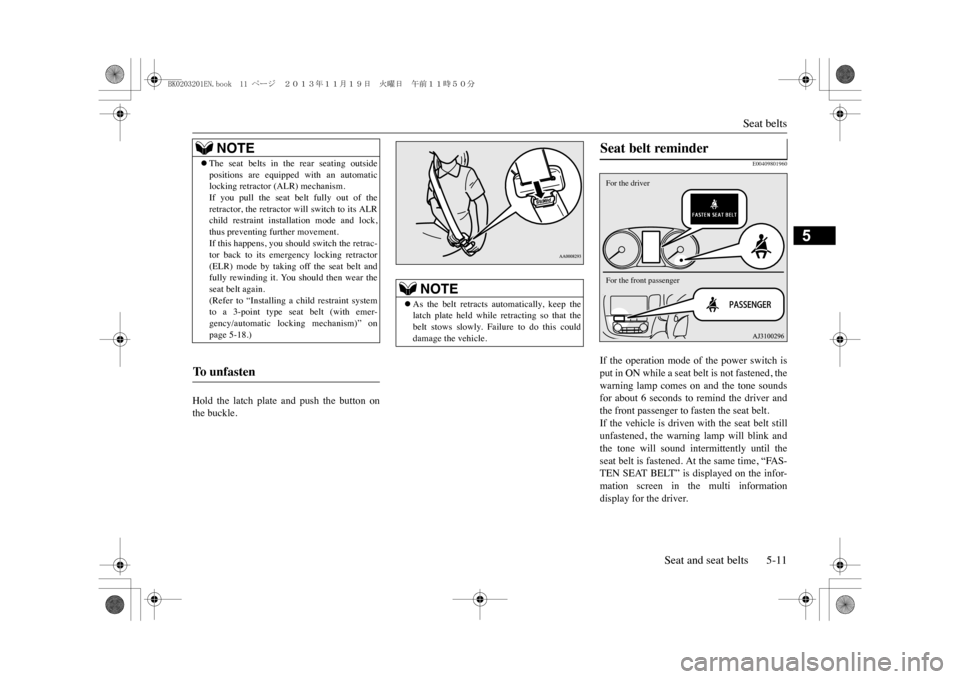
Hold the latch plate and push the button onthe buckle.
E00409801960
If the operation mode of the power switch isput in ON while a seat belt is not fastened, thewarning lamp comes on and the tone soundsfor about 6 seconds to remind the driver andthe front passenger to fasten the seat belt.If the vehicle is driven with the seat belt stillunfastened, the warning lamp will blink andthe tone will sound intermittently until theseat belt is fastened. At the same time, “FAS-TEN SEAT BELT” is displayed on the infor-mation screen in the multi informationdisplay for the driver.
NOTE
zThe seat belts in the rear seating outsidepositions are equipped with an automaticlocking retractor (ALR) mechanism.If you pull the seat belt fully out of theretractor, the retractor will switch to its ALRchild restraint installation mode and lock,thus preventing further movement.If this happens, you s
hould switch the retrac-
tor back to its emergency locking retractor(ELR) mode by taking off the seat belt andfully rewinding it. You should then wear theseat belt again.(Refer to “Installing a child restraint systemto a 3-point type seat belt (with emer-gency/automatic locking mechanism)” onpage 5-18.)
To u n f a s t e n
NOTE
zAs the belt retracts au
tomatically, keep the
latch plate held while retracting so that thebelt stows slowly. Failure to do this coulddamage the vehicle.
Seat belt reminder For the driverFor the front passenger
BK0203201EN.book 11 ページ 2013年11月19日 火曜日 午前11時50分
Page 92 of 388
Seat belts
Seat and seat belts 5-13
5
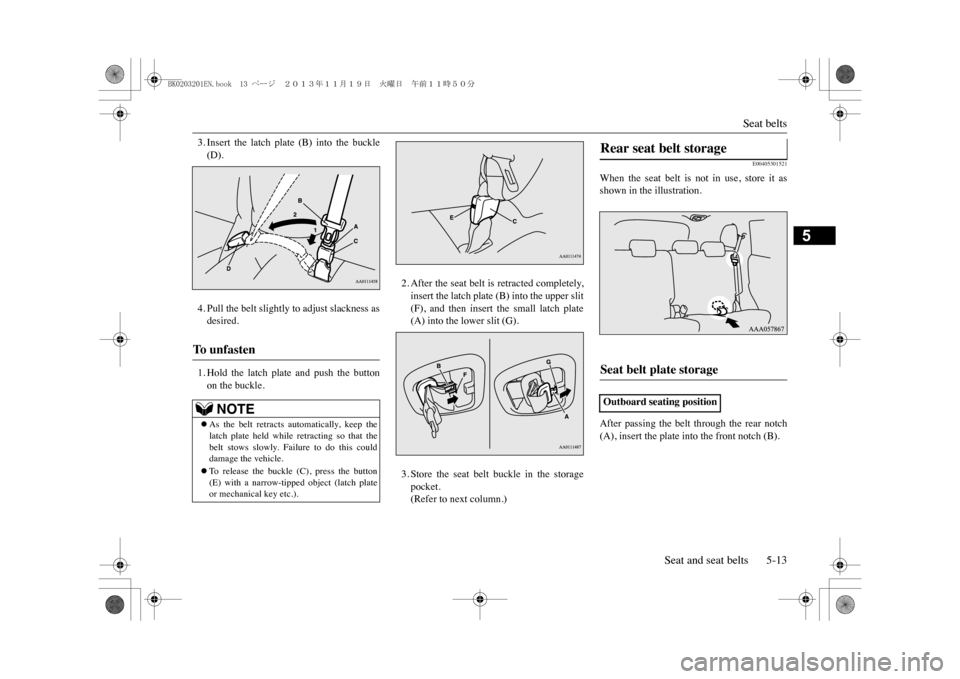
3. Insert the latch plate (B) into the buckle(D).4. Pull the belt slightly to adjust slackness asdesired.1. Hold the latch plate and push the buttonon the buckle.
2. After the seat belt is retracted completely,insert the latch plate (B) into the upper slit(F), and then insert the small latch plate(A) into the lower slit (G).3. Store the seat belt buckle in the storagepocket.(Refer to next column.)
E00405301521
When the seat belt is not in use, store it asshown in the illustration.After passing the belt through the rear notch(A), insert the plate into the front notch (B).
To u n f a s t e n
NOTE
zAs the belt retracts au
tomatically, keep the
latch plate held while retracting so that thebelt stows slowly. Failure to do this coulddamage the vehicle.zTo r e l e a s e t h e b u c k l e ( C ) , p r e s s t h e b u t t o n(E) with a narrow-tipped object (latch plateor mechanical key etc.).
Rear seat belt storage Seat belt plate storage Outboard seating position
BK0203201EN.book 13 ページ 2013年11月19日 火曜日 午前11時50分
Page 93 of 388
Pregnant women restraint5-14 Seat and seat belts
5
E00405600077
E00405701323
The driver’s seat and front passenger’s seateach have a seat belt equipped with a pre-ten-sioner system and
force limiter system.
E00405802259
When the operation mode of the powerswitch is in ON, if there is a frontal impact ora side impact severe enough to injure theand/or front passenger, the pre-tensioner sys-tem will retract their respective seat beltsinstantaneously, thus maximizing the seatbelt’s effectiveness.
E00405900360
The same warning lamp/display is shared bythe SRS airbags and the pre-tensioner seatbelts.Refer to “SRS warning lamp/display” onpage 5-30 .
Pregnant women restraint
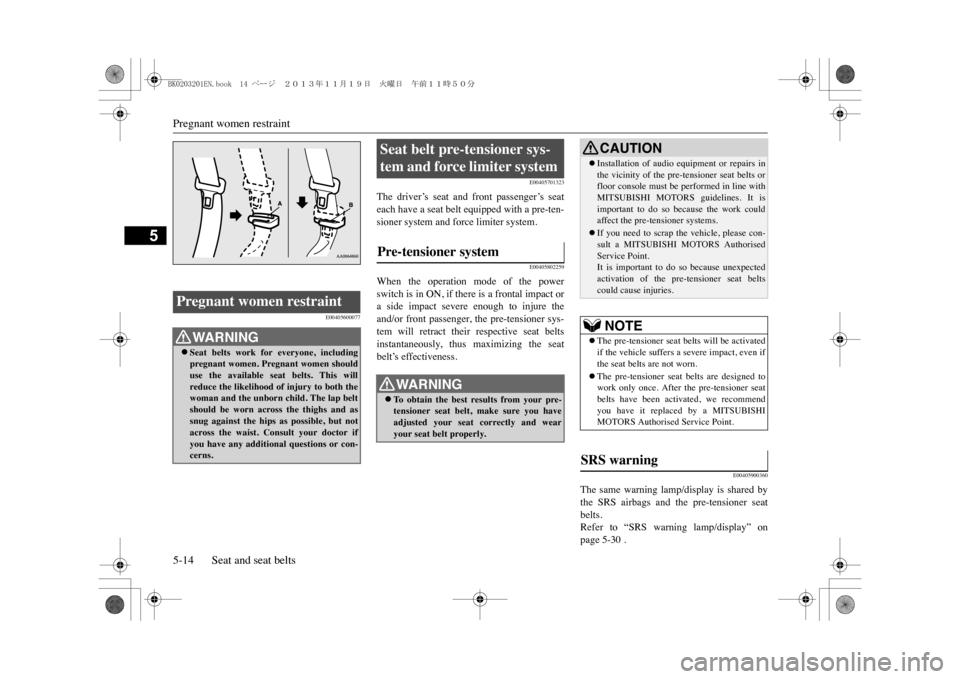
WA R N I N GzSeat belts work for everyone, includingpregnant women. Pregnant women shoulduse the available seat belts. This willreduce the likelihood of injury to both thewoman and the unborn child. The lap beltshould be worn across the thighs and assnug against the hips as possible, but notacross the waist. Consult your doctor ifyou have any addition
al questions or con-
cerns.
Seat belt pre-tensioner sys-tem and force limiter system Pre-tensioner system
WA R N I N GzTo o b t a i n t h e b e s t r e s u l t s f r o m y o u r p r e -tensioner seat belt, make sure you haveadjusted your seat correctly and wearyour seat belt properly.
CAUTIONzInstallation of audio e
quipment or repairs in
the vicinity of the pre-tensioner seat belts orfloor console must be
performed in line with
MITSUBISHI MOTORS
guidelines. It is
important to do so because the work couldaffect the pre-tensioner systems.zIf you need to scrap the vehicle, please con-sult a MITSUBISHI MOTORS AuthorisedService Point.It is important to do so because unexpectedactivation of the pre-tensioner seat beltscould cause injuries.NOTE
zThe pre-tensioner seat belts will be activatedif the vehicle suffers a severe impact, even ifthe seat belts are not worn.zThe pre-tensioner seat belts are designed towork only once. After the pre-tensioner seatbelts have been activated, we recommendyou have it replaced by a MITSUBISHIMOTORS Authorised Service Point.
SRS warning
BK0203201EN.book 14 ページ 2013年11月19日 火曜日 午前11時50分
Page 96 of 388
Child restraint
Seat and seat belts 5-17
5
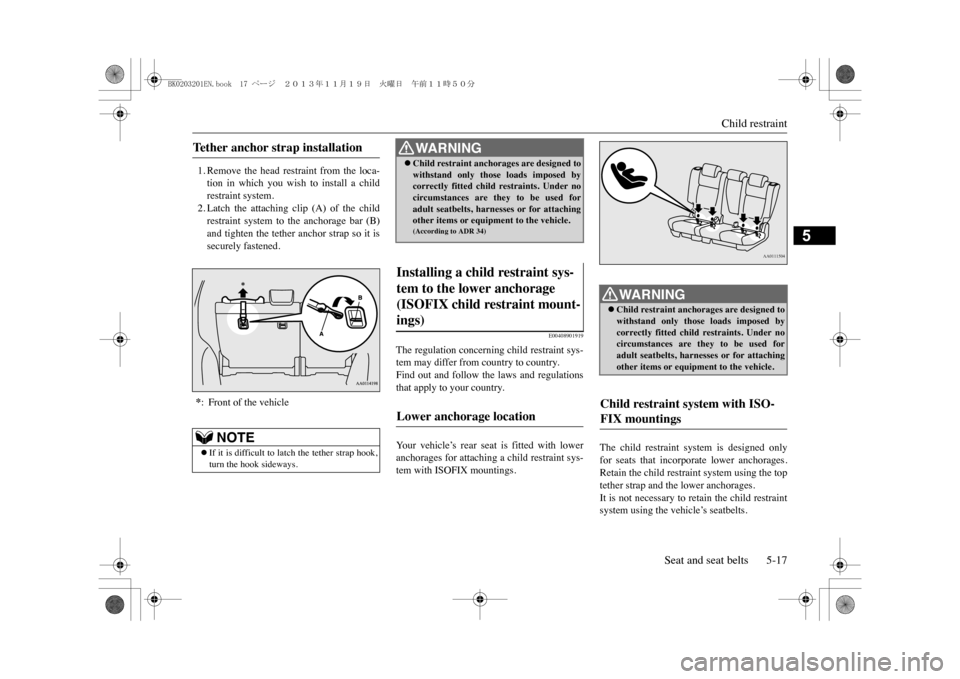
1. Remove the head restraint from the loca-tion in which you wish to install a childrestraint system.2. Latch the attaching clip (A) of the childrestraint system to the anchorage bar (B)and tighten the tether anchor strap so it issecurely fastened.
E00408901919
The regulation concerning child restraint sys-tem may differ from country to country.Find out and follow the laws and regulationsthat apply to your country.Yo u r v e h i c l e ’s r e a r s e a t i s f i t t e d w i t h l o w e ranchorages for attaching a child restraint sys-tem with ISOFIX mountings.
The child restraint system is designed onlyfor seats that incorporate lower anchorages.Retain the child restrain
t system using the top
tether strap and the lower anchorages.It is not necessary to retain the child restraintsystem using the vehicle’s seatbelts.
Te t h e r a n c h o r s t r a p i n s t a l l a t i o n *: Front of the vehicle
NOTE
zIf it is difficult to latch the tether strap hook,turn the hook sideways.
WA R N I N GzChild restraint anchorages are designed towithstand only those loads imposed bycorrectly fitted child restraints. Under nocircumstances are they to be used foradult seatbelts, harnesses or for attachingother items or equipment to the vehicle.(According to ADR 34)
Installing a child restraint sys-tem to the lower anchorage (ISOFIX child restraint mount-ings) Lower anchorage location
WA R N I N GzChild restraint anchorages are designed towithstand only those loads imposed bycorrectly fitted child restraints. Under nocircumstances are they to be used foradult seatbelts, harnesses or for attachingother items or equipment to the vehicle.
Child restraint system with ISO-FIX mountings
AA0111504
BK0203201EN.book 17 ページ 2013年11月19日 火曜日 午前11時50分