2014 MITSUBISHI OUTLANDER ECU
[x] Cancel search: ECUPage 43 of 451
Making a flat seat 4-16 Seat and restraint systems
4
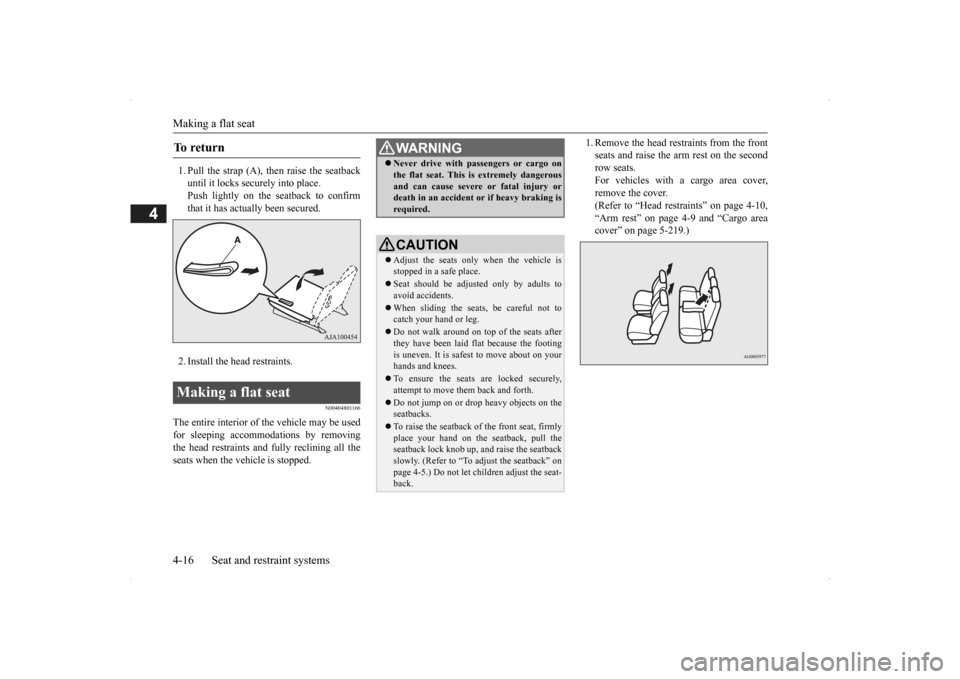
1. Pull the strap (A), then raise the seatback until it locks securely into place. Push lightly on the seatback to confirm that it has actually been secured. 2. Install the head restraints.
N00404801166
The entire interior of the vehicle may be used for sleeping accomm
odations by removing
the head restraints and fully reclining all the seats when the vehicle is stopped.
1. Remove the head re
straints from the front
seats and raise the arm rest on the secondrow seats. For vehicles with a cargo area cover, remove the cover.(Refer to “Head restraints” on page 4-10, “Arm rest” on page 4-9 and “Cargo area cover” on page 5-219.)
To r e t u r n Making a flat seat
WA R N I N G Never drive with passengers or cargo on the flat seat. This is extremely dangerousand can cause severe or fatal injury ordeath in an accident
or if heavy braking is
required.CAUTION Adjust the seats only
when the vehicle is
stopped in a safe place. Seat should be adjusted only by adults to avoid accidents. When sliding the seat
s, be careful not to
catch your hand or leg. Do not walk around on t
op of the seats after
they have been laid fl
at because the footing
is uneven. It is safe
st to move about on your
hands and knees. To ensure the seats are locked securely, attempt to move them back and forth. Do not jump on or drop heavy objects on the seatbacks. To raise the seatback of the front seat, firmly place your hand on the
seatback, pull the
seatback lock knob up,
and raise the seatback
slowly. (Refer to “To adjust the seatback” onpage 4-5.) Do not let children adjust the seat- back.
BK0200500US.book 16 ページ 2013年2月12日 火曜日 午前9時46分
Page 46 of 451
Seat belts
Seat and restraint systems 4-19
4
1. Occupants shoul
d always sit back in their
seats with their backs against the uprightseatback. To reduce the risk of serious injury or death during deployment of the airbag, adjust the driver’s seat as far backas possible while ma
intaining a position
that still enables you to fully apply the pedals, easily contro
l the steering wheel,
and safely operate the vehicle. The front passenger seat should
also be moved as
far back as possible. Refer to “Supple- mental Restraint Syst
em (SRS) - airbag”
on page 4-33. Also refe
r to “To adjust the
seat forward or backward” on page 4-5.
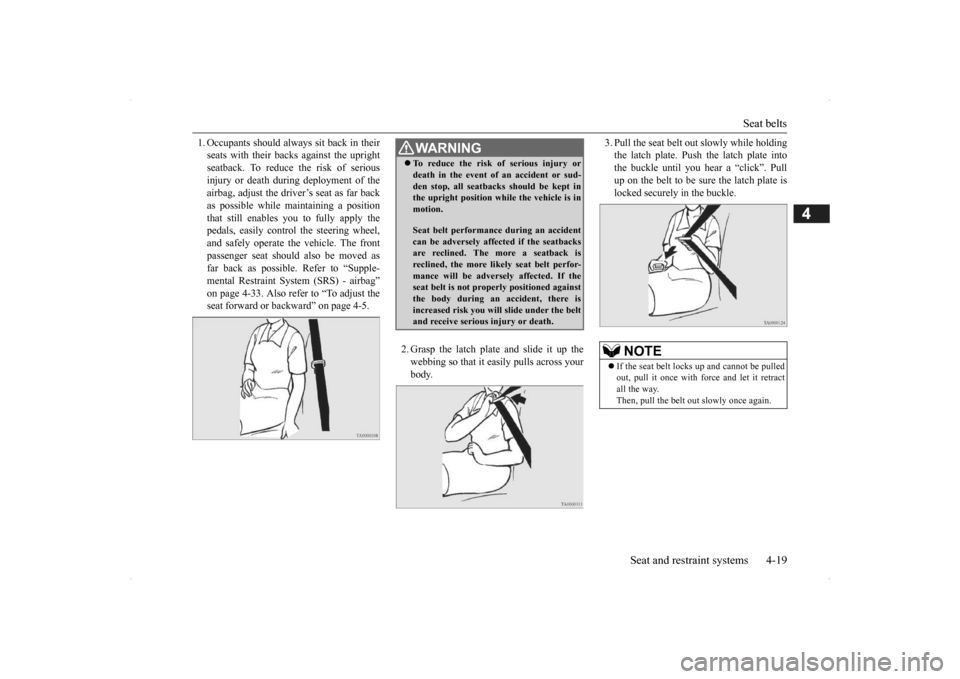
2. Grasp the latch plate and slide it up the webbing so that it ea
sily pulls across your
body.
3. Pull the seat belt out
slowly while holding
the latch plate. Push the latch plate intothe buckle until you he
ar a “click”. Pull
up on the belt to be sure the latch plate is locked securely in the buckle.
WA R N I N G To reduce the risk of serious injury or death in the event of
an accident or sud-
den stop, all seatbacks should be kept inthe upright position while the vehicle is in motion. Seat belt performance during an accident can be adversely affect
ed if the seatbacks
are reclined. The more a seatback isreclined, the more likely seat belt perfor- mance will be advers
ely affected. If the
seat belt is not proper
ly positioned against
the body during an accident, there is increased risk you will slide under the belt and receive serious
injury or death.
NOTE
If the seat belt lock
s up and cannot be pulled
out, pull it once with fo
rce and let it retract
all the way. Then, pull the belt out
slowly once again.
BK0200500US.book 19 ページ 2013年2月12日 火曜日 午前9時46分
Page 49 of 451

Seat belts 4-22 Seat and restraint systems
4
N00418401394
A tone and warning light are used to remind the driver to fasten the seat belt. If the ignition switch is turned to the “ON” position or the operation mode is put in ONwithout the driver’s seat belt being fastened, a
warning light will come on and a tone will sound for approximately 6 seconds to remindyou to fasten your seat belt. If the vehicle is driven with the seat belt still unfastened, the warning light will blink andthe tone will sound inte
rmittently until the
seat belt is fastened. At the same time, “FAS- TEN SEAT BELT” is displayed on the infor-mation screen in the multi information display (Type 1 only).
N00418301247
The front passenger seat
belt warning light is
located in the instrument panel. When the ignition switch is turned to the “ON” position or the ope
ration mode is put in
ON, this indicator
normally comes on and
goes off a few seconds later.The light comes on when a person sits on the front passenger seat but does not fasten the seat belt. It goes off wh
en the seat belt is sub-
sequently fastened.
Driver’s seat belt reminder/warning light and display Type 1 Type 2
WA R N I N G In order to reduce the risk of serious injury or death in an accident, always fas- ten your own seat belt. Do not allow any-one to ride in your ve
hicle unless he or she
is also seated and fastening a seat belt. Children should additi
onally be restrained
in a secure child restraint system.NOTE
If the seat belt subs
equently remains unfas-
tened, the warning li
ght and the tone will
issue further warnings
each time the vehicle
starts moving from a stop.
Front passenger seat belt warn- ing light
BK0200500US.book 22 ページ 2013年2月12日 火曜日 午前9時46分
Page 50 of 451
Seat belts
Seat and restraint systems 4-23
4
N00406301354
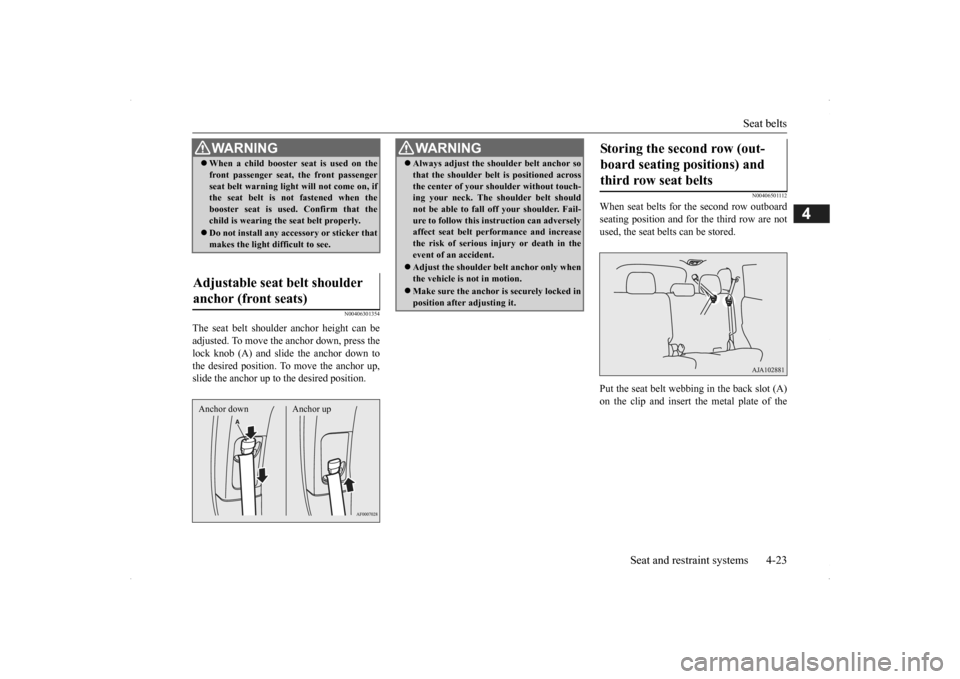
The seat belt shoulder
anchor height can be
adjusted. To move the anchor down, press thelock knob (A) and slide the anchor down to the desired position. To
move the anchor up,
slide the anchor up to the desired position.
N00406501112
When seat belts for the second row outboardseating position and for the third row are not used, the seat belts can be stored. Put the seat belt webbing in the back slot (A) on the clip and insert the metal plate of the
WA R N I N G When a child booster se
at is used on the
front passenger seat, the front passengerseat belt warning ligh
t will not come on, if
the seat belt is not fastened when the booster seat is used
. Confirm that the
child is wearing the seat belt properly. Do not install any acce
ssory or sticker that
makes the light difficult to see.
Adjustable seat belt shoulder anchor (front seats) Anchor down Anchor up
WA R N I N G Always adjust the shou
lder belt anchor so
that the shoulder belt
is positioned across
the center of your shoulder without touch-ing your neck. The sh
oulder belt should
not be able to fall off your shoulder. Fail- ure to follow this instruction can adverselyaffect seat belt performance and increase the risk of serious in
jury or death in the
event of an accident. Adjust the shoulder be
lt anchor only when
the vehicle is not in motion. Make sure the anchor is securely locked in position after adjusting it.
Storing the second row (out- board seating positions) and third row seat belts
BK0200500US.book 23 ページ 2013年2月12日 火曜日 午前9時46分
Page 55 of 451
Child restraint systems 4-28 Seat and restraint systems
4
N00418801167
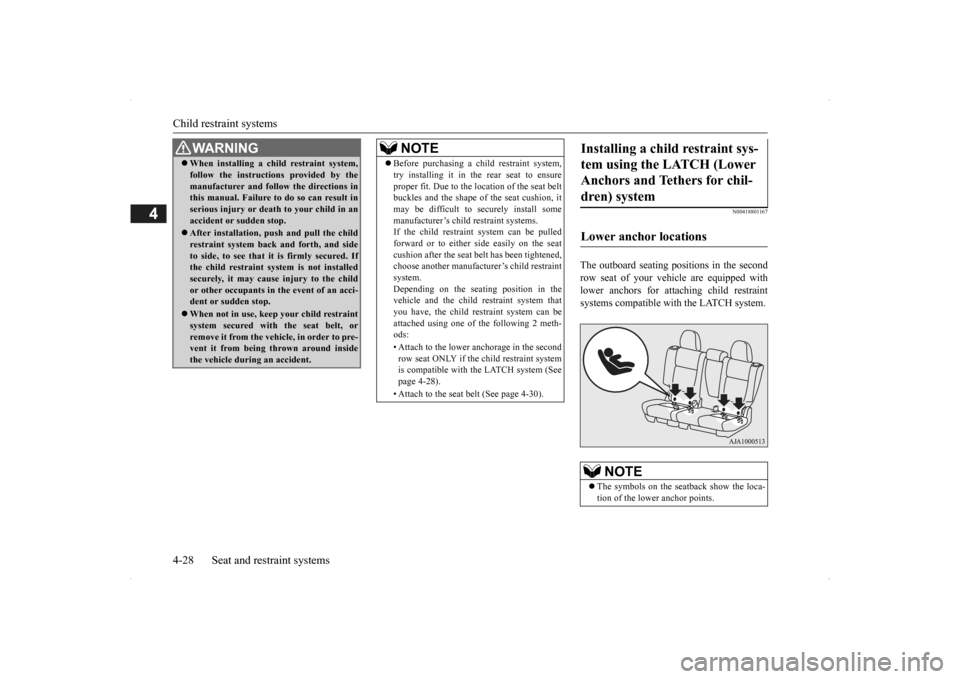
The outboard seating pos
itions in the second
row seat of your vehi
cle are equipped with
lower anchors for attaching child restraint systems compatible with the LATCH system.
When installing a child restraint system, follow the instructions provided by themanufacturer and follow the directions inthis manual. Failure to do so can result in serious injury or deat
h to your child in an
accident or
sudden stop.
After installation, push
and pull the child
restraint system back and forth, and sideto side, to see that it is firmly secured. If the child restraint system is not installed securely, it may cause injury to the childor other occupants in
the event of an acci-
dent or sudden stop. When not in use, keep your child restraint system secured with the seat belt, or remove it from the vehi
cle, in order to pre-
vent it from being
thrown around inside
the vehicle during an accident.WA R N I N G
NOTE
Before purchasing a child restraint system, try installing it in the rear seat to ensureproper fit. Due to the location of the seat beltbuckles and the shape of the seat cushion, it may be difficult to
securely install some
manufacturer’s child restraint systems.If the child restraint system can be pulled forward or to either side easily on the seat cushion after the seat be
lt has been tightened,
choose another ma
nufacturer’s child restraint
system. Depending on the seating position in thevehicle and the child restraint system that you have, the child restraint system can be attached using one of the following 2 meth-ods: • Attach to the lower anchorage in the second row seat ONLY if the child restraint system is compatible with the LATCH system (See page 4-28). • Attach to the seat
belt (See page 4-30).
Installing a child restraint sys- tem using the LATCH (Lower Anchors and Tethers for chil- dren) system Lower anchor locations
NOTE
The symbols on the seatback show the loca- tion of the lower anchor points.
BK0200500US.book 28 ページ 2013年2月12日 火曜日 午前9時46分
Page 56 of 451
Child restraint systems
Seat and restraint systems 4-29
4
N00418901201
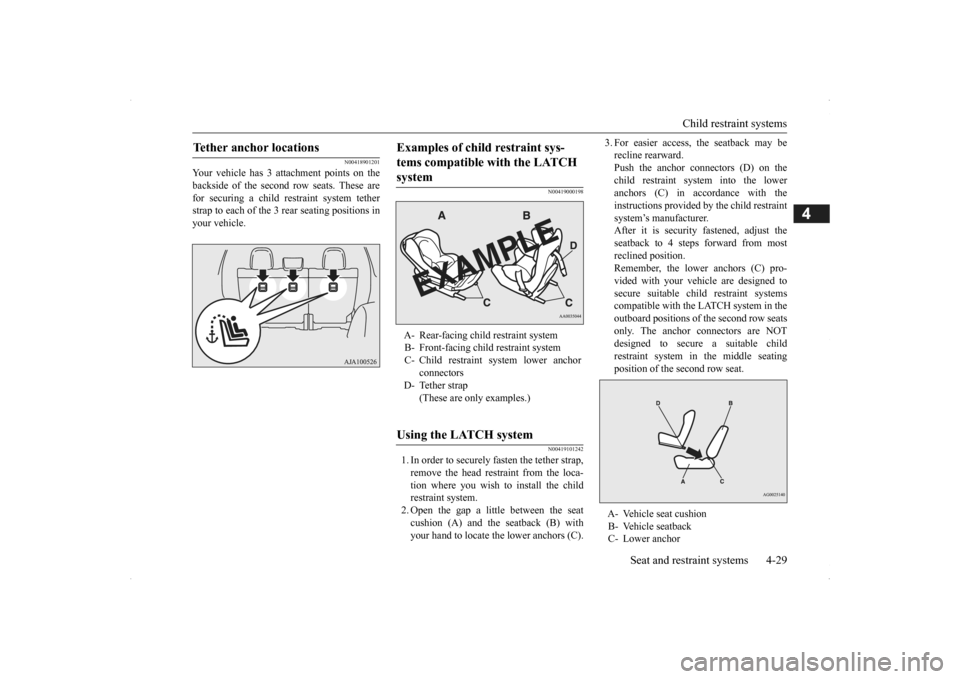
Your vehicle has 3 at
tachment points on the
backside of the second row seats. These are for securing a child restraint system tetherstrap to each of the 3 rear seating positions in your vehicle.
N00419000198 N00419101242
1. In order to securely
fasten the tether strap,
remove the head restraint from the loca- tion where you wish to install the child restraint system.2. Open the gap a little between the seat cushion (A) and the seatback (B) with your hand to locate the lower anchors (C).
3. For easier access, the seatback may be recline rearward.Push the anchor connectors (D) on the child restraint system into the lower anchors (C) in accordance with theinstructions provided by the child restraint system’s manufacturer. After it is security fastened, adjust theseatback to 4 steps forward from most reclined position. Remember, the lower anchors (C) pro- vided with your vehicle are designed to secure suitable child restraint systemscompatible with the LATCH system in the outboard positions of the second row seats only. The anchor connectors are NOTdesigned to secure a suitable child restraint system in the middle seating position of the second row seat.
Tether anchor locations
Examples of child restraint sys- tems compatible with the LATCH system A- Rear-facing child restraint system B- Front-facing child restraint system C- Child restraint system lower anchor
connectors
D- Tether strap
(These are only examples.)
Using the LATCH system
A- Vehicle seat cushionB- Vehicle seatback C- Lower anchor
BK0200500US.book 29 ページ 2013年2月12日 火曜日 午前9時46分
Page 57 of 451
Child restraint systems 4-30 Seat and restraint systems
4
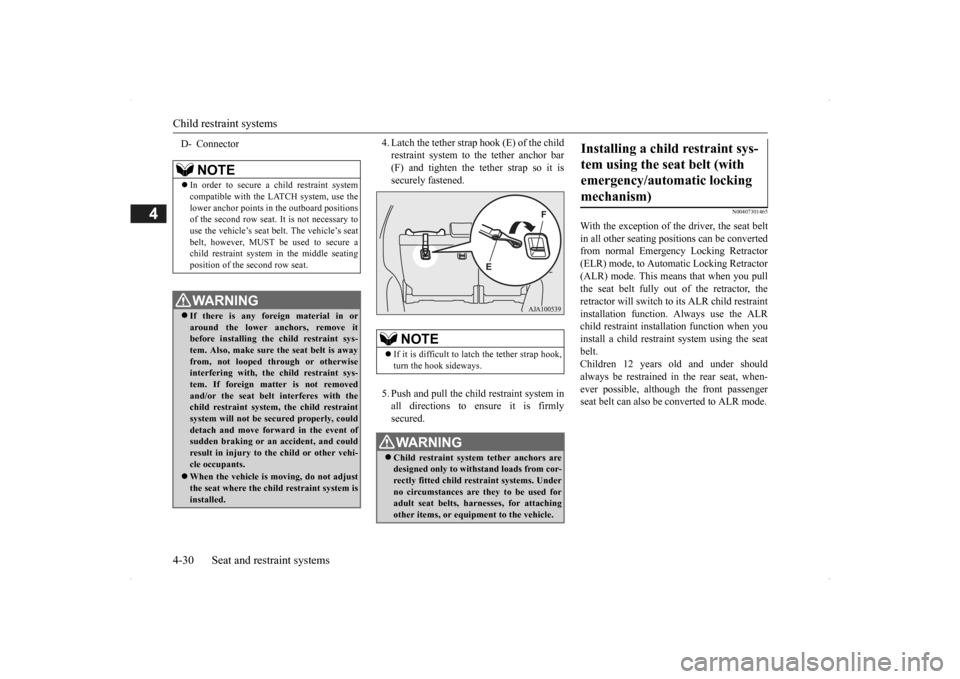
4. Latch the tether strap hook (E) of the child restraint system to the tether anchor bar(F) and tighten the tether strap so it is securely fastened. 5. Push and pull the child restraint system in all directions to en
sure it is firmly
secured.
N00407301465
With the exception of the driver, the seat belt in all other seating po
sitions can be converted
from normal Emergency Locking Retractor(ELR) mode, to Automatic Locking Retractor (ALR) mode. This mean
s that when you pull
the seat belt fully out of the retractor, the retractor will switch to its ALR child restraint installation function.
Always use the ALR
child restraint instal
lation function when you
install a child restraint system using the seat belt.Children 12 years old and under should always be restrained in the rear seat, when- ever possible, although the front passengerseat belt can also be
converted to ALR mode.
D- Connector
NOTE
In order to secure a child restraint system compatible with the LATCH system, use thelower anchor points in the outboard positions of the second row seat.
It is not necessary to
use the vehicle’s seat
belt. The vehicle’s seat
belt, however, MUST be
used to secure a
child restraint system in the middle seating position of the second row seat.WA R N I N G If there is any foreign material in or around the lower anchors, remove it before installing the child restraint sys- tem. Also, make sure the seat belt is awayfrom, not looped through or otherwise interfering with, the child restraint sys- tem. If foreign matter is not removedand/or the seat belt
interferes with the
child restraint system, the child restraint system will not be secured properly, coulddetach and move forward in the event of sudden braking or an
accident, and could
result in injury to the child or other vehi-cle occupants. When the vehicle is
moving, do not adjust
the seat where the child restraint system isinstalled.
NOTE
If it is difficult to
latch the tether strap hook,
turn the hook sideways.WA R N I N G Child restraint system tether anchors are designed only to with
stand loads from cor-
rectly fitted child restraint systems. Underno circumstances are they to be used for adult seat belts, harnesses, for attaching other items, or equipment to the vehicle.
Installing a child restraint sys- tem using the seat belt (with emergency/auto
matic locking
mechanism)
BK0200500US.book 30 ページ 2013年2月12日 火曜日 午前9時46分
Page 58 of 451
Child restraint systems
Seat and restraint systems 4-31
4
1. Place the child restraint system in the rear seating position.
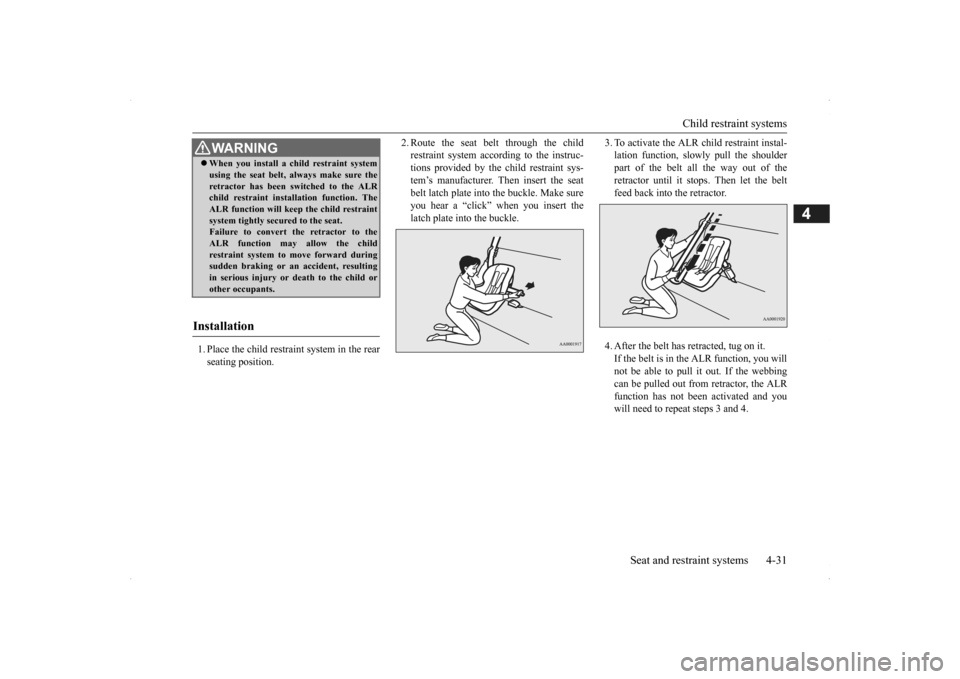
2. Route the seat belt through the child restraint system according to the instruc-tions provided by the child restraint sys- tem’s manufacturer. Then insert the seat belt latch plate into
the buckle. Make sure
you hear a “click” when you insert the latch plate into the buckle.
3. To activate the ALR child restraint instal- lation function, slow
ly pull the shoulder
part of the belt all the way out of the retractor until it stops. Then let the belt feed back into the retractor. 4. After the belt has retracted, tug on it. If the belt is in the ALR function, you will not be able to pull it out. If the webbingcan be pulled out from retractor, the ALR function has not been activated and you will need to repeat steps 3 and 4.
WA R N I N G When you install a child restraint system using the seat belt, al
ways make sure the
retractor has been switched to the ALRchild restraint installation function. The ALR function will keep the child restraint system tightly secured to the seat.Failure to convert the retractor to the ALR function may allow the child restraint system to move forward duringsudden braking
or an accide
nt, resulting
in serious injury or
death to the child or
other occupants.
Installation
BK0200500US.book 31 ページ 2013年2月12日 火曜日 午前9時46分