2014 MITSUBISHI LANCER EVOLUTION Front
[x] Cancel search: FrontPage 29 of 338
Front seats 4-4 Seat and restraint systems
4
N00435600365
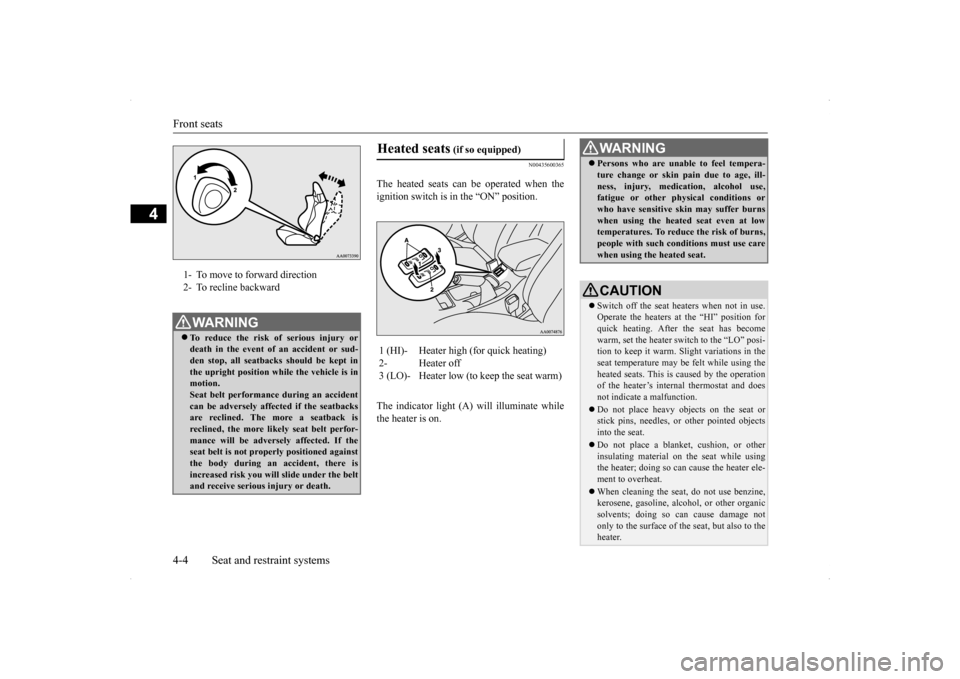
The heated seats can be operated when the ignition switch is in the “ON” position. The indicator light (A) will illuminate while the heater is on.
1- To move to forward direction 2- To recline backwardWA R N I N G To reduce the risk of serious injury or death in the event of an accident or sud- den stop, all seatbacks should be kept inthe upright position while the vehicle is in motion. Seat belt performance during an accidentcan be adversely affected if the seatbacks are reclined. The more a seatback is reclined, the more likely seat belt perfor-mance will be adversely affected. If the seat belt is not properly positioned against the body during an accident, there isincreased risk you will slide under the belt and receive serious injury or death.
ç
Heated seats
(if so equipped)
1 (HI)- Heater high (for quick heating) 2- Heater off3 (LO)- Heater low (to keep the seat warm)ç
WA R N I N G Persons who are unable to feel tempera- ture change or skin pain due to age, ill- ness, injury, medication, alcohol use, fatigue or other physical conditions or who have sensitive skin may suffer burnswhen using the heated seat even at low temperatures. To reduce the risk of burns, people with such conditions must use carewhen using the heated seat.CAUTION Switch off the seat heaters when not in use. Operate the heaters at the “HI” position forquick heating. After the seat has become warm, set the heater switch to the “LO” posi- tion to keep it warm. Slight variations in theseat temperature may be felt while using the heated seats. This is caused by the operation of the heater’s internal thermostat and doesnot indicate a malfunction. Do not place heavy objects on the seat or stick pins, needles, or other pointed objects into the seat. Do not place a blanket,
cushion, or other
insulating material on the seat while using the heater; doing so can cause the heater ele- ment to overheat. When cleaning the seat, do not use benzine, kerosene, gasoline, alcohol, or other organic solvents; doing so can cause damage notonly to the surface of th
e seat, but also to the
heater.
BK0200800US.bo
ok 4 ページ 2013年2月14日 木曜日 午後2時28分
Page 30 of 338
Rear seats
Seat and restraint systems 4-5
4
N00402500029 N00403000281
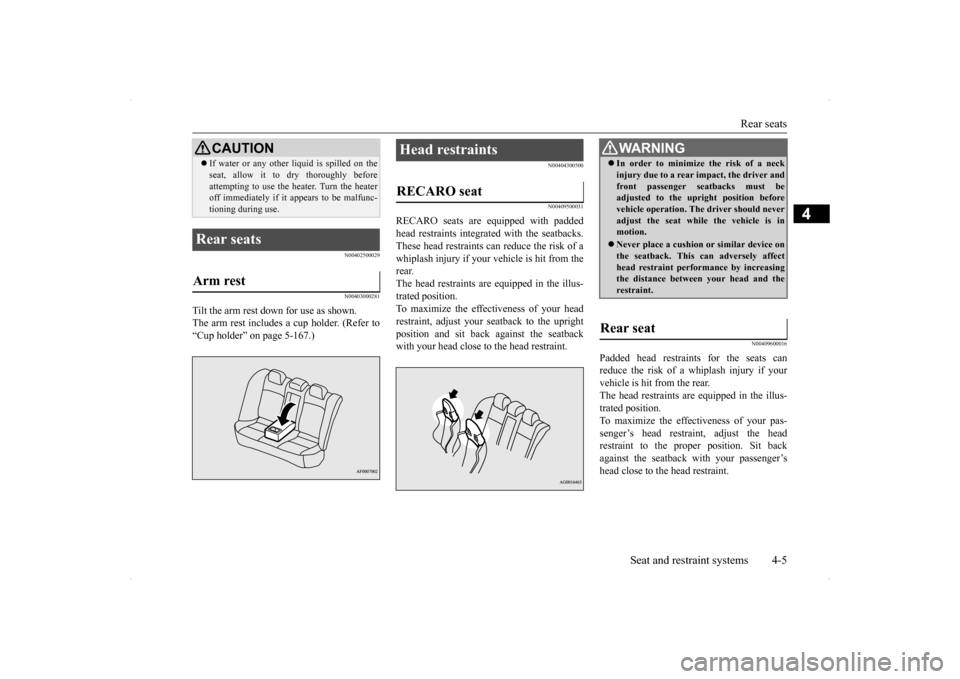
Tilt the arm rest down for use as shown. The arm rest includes a cup holder. (Refer to“Cup holder” on page 5-167.)
N00404300500 N00409500031
RECARO seats are equipped with padded head restraints integrated with the seatbacks.These head restraints can reduce the risk of a whiplash injury if your vehicle is hit from the rear.The head restraints are equipped in the illus-trated position. To maximize the effectiveness of your head restraint, adjust your seatback to the uprightposition and sit back against the seatback with your head close to the head restraint.
N00409600016
Padded head restraints for the seats canreduce the risk of a whiplash injury if your vehicle is hit from the rear. The head restraints are equipped in the illus- trated position. To maximize the effectiveness of your pas-senger’s head restraint, adjust the head restraint to the proper position. Sit back against the seatback with your passenger’shead close to the head restraint.
If water or any other li
quid is spilled on the
seat, allow it to dry thoroughly before attempting to use the heater. Turn the heater off immediately if it appears to be malfunc- tioning during use.
Rear seats Arm rest
CAUTION
Head restraints RECARO seat
WA R N I N G In order to minimize the risk of a neck injury due to a rear impact, the driver and front passenger seatbacks must be adjusted to the upright position before vehicle operation. The driver should neveradjust the seat while the vehicle is in motion. Never place a cushion or similar device on the seatback. This can adversely affect head restraint performance by increasingthe distance between your head and the restraint.
Rear seat
BK0200800US.bo
ok 5 ページ 2013年2月14日 木曜日 午後2時28分
Page 32 of 338
Seat belts
Seat and restraint systems 4-7
4
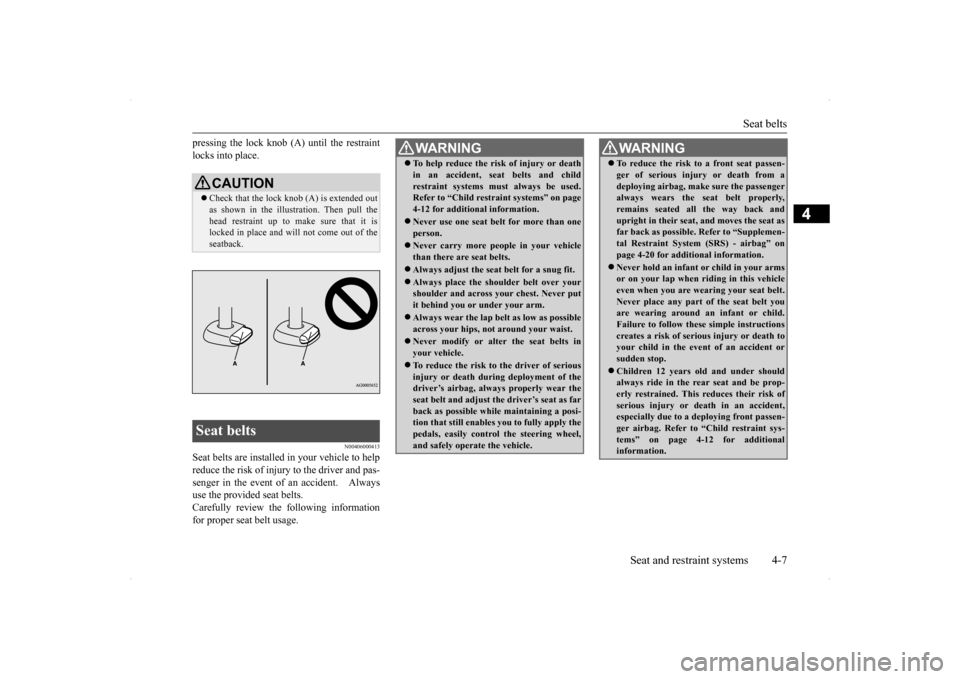
pressing the lock knob (A) until the restraint locks into place.
N00406000413
Seat belts are installed in your vehicle to helpreduce the risk of injury to the driver and pas-senger in the event of an accident. Always use the provided seat belts. Carefully review the following informationfor proper seat belt usage.
CAUTION Check that the lock knob (A) is extended out as shown in the illustration. Then pull the head restraint up to make sure that it islocked in place and will not come out of the seatback.
Seat belts
WA R N I N G To help reduce the risk of injury or death in an accident, seat belts and child restraint systems must always be used. Refer to “Child restraint systems” on page 4-12 for additional information. Never use one seat belt for more than one person. Never carry more people in your vehicle than there are seat belts. Always adjust the seat belt for a snug fit.Always place the shoulder belt over your shoulder and across your chest. Never put it behind you or under your arm. Always wear the lap belt as low as possible across your hips, not around your waist. Never modify or alter the seat belts in your vehicle. To reduce the risk to the driver of serious injury or death during deployment of thedriver’s airbag, always properly wear the seat belt and adjust th
e driver’s seat as far
back as possible while maintaining a posi-tion that still enables
you to fully apply the
pedals, easily control the steering wheel, and safely operate the vehicle.
To reduce the risk to a front seat passen- ger of serious injury or death from a deploying airbag, make sure the passenger always wears the seat belt properly, remains seated all the way back andupright in their seat, and moves the seat as far back as possible. Refer to “Supplemen- tal Restraint System (SRS) - airbag” onpage 4-20 for additional information. Never hold an infant or child in your arms or on your lap when riding in this vehicle even when you are wearing your seat belt. Never place any part of the seat belt youare wearing around an infant or child. Failure to follow these simple instructions creates a risk of serious injury or death toyour child in the event of an accident or sudden stop. Children 12 years old and under should always ride in the rear seat and be prop- erly restrained. This reduces their risk ofserious injury or death in an accident, especially due to a deploying front passen- ger airbag. Refer to “Child restraint sys-tems” on page 4-12 for additional information.WA R N I N G
BK0200800US.bo
ok 7 ページ 2013年2月14日 木曜日 午後2時28分
Page 33 of 338
Seat belts 4-8 Seat and restraint systems
4
N00406201483
All seats are equipped with a seat belt which uses one combined lap-and-shoulder belt withan emergency locking retractor. This system is designed to provide both com- fort and safety. It permits full extension and automatic retraction of the belts during nor-mal vehicle operation. A sensing device inside the belt retractor is designed to lock the retractor in the event of a sudden change inthe vehicle’s motion.
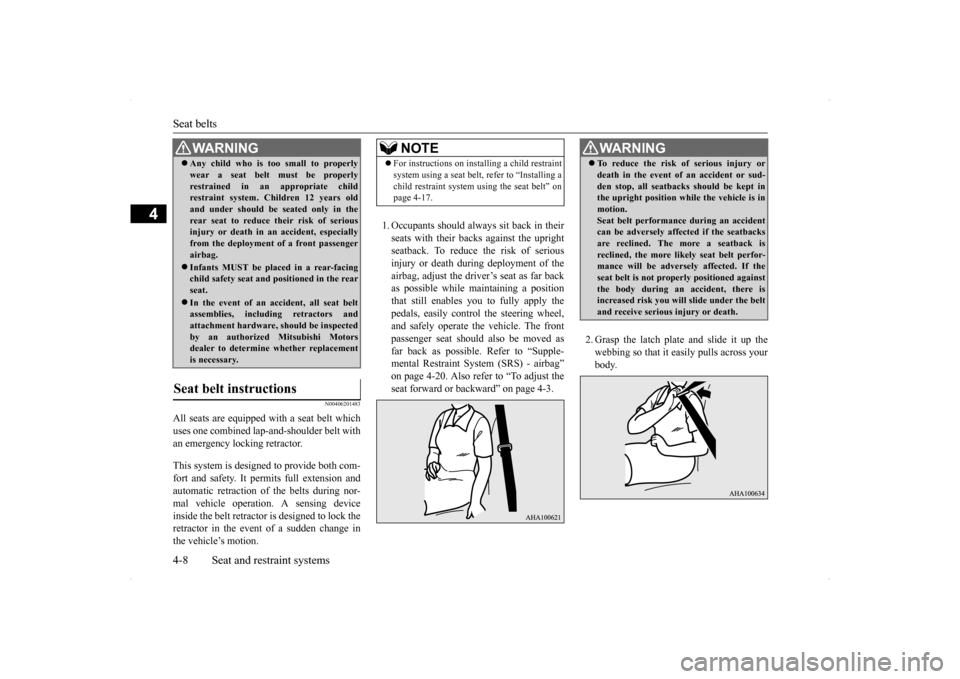
1. Occupants should always sit back in their seats with their backs against the upright seatback. To reduce the risk of seriousinjury or death during deployment of theairbag, adjust the driver’s seat as far back as possible while maintaining a position that still enables you to fully apply thepedals, easily control the steering wheel, and safely operate the vehicle. The front passenger seat should also be moved asfar back as possible. Refer to “Supple- mental Restraint System (SRS) - airbag” on page 4-20. Also refer to “To adjust theseat forward or backward” on page 4-3.
2. Grasp the latch plate and slide it up the webbing so that it easily pulls across yourbody.
Any child who is too small to properly wear a seat belt must be properly restrained in an appropriate child restraint system. Children 12 years old and under should be seated only in therear seat to reduce their risk of serious injury or death in an accident, especially from the deployment of a front passengerairbag. Infants MUST be placed in a rear-facing child safety seat and positioned in the rear seat. In the event of an accident, all seat belt assemblies, including retractors and attachment hardware, should be inspectedby an authorized Mitsubishi Motors dealer to determine whether replacement is necessary.
Seat belt instructions
WA R N I N G
NOTE
For instructions on installing a child restraint system using a seat belt, refer to “Installing a child restraint system using the seat belt” on page 4-17.
WA R N I N G To reduce the risk of serious injury or death in the event of an accident or sud- den stop, all seatbacks should be kept in the upright position while the vehicle is in motion.Seat belt performance during an accident can be adversely affected if the seatbacks are reclined. The more a seatback isreclined, the more likely seat belt perfor- mance will be adversely affected. If the seat belt is not properly positioned againstthe body during an accident, there is increased risk you will slide under the belt and receive serious injury or death.
BK0200800US.bo
ok 8 ページ 2013年2月14日 木曜日 午後2時28分
Page 35 of 338

Seat belts 4-10 Seat and restraint systems
4
Warning display A tone and warning light are used to remind the driver to fasten the seat belt. If the ignition switch is turned to the “ON”position without the driver’s seat belt being fastened, a warning light will come on and a tone will sound for approximately 6 secondsto remind you to fasten your seat belt. If you then drive with the seat belt unfastened for longer than a minute from when the igni-tion switch was turned to the “ON” position, the warning light will come on and blink repeatedly and the tone will sound intermit-tently. The warning light and the tone will stop after approximately 90 seconds.If you then repeatedly stop and start your vehicle with the seat belt unfastened, the warning light/display and tone will remindyou to fasten your seat belt every time thevehicle starts moving. You will also be reminded to fasten your seat belt in this way when you remove your seat belt while driv-ing. The warning light and the tone go off when the seat belt is fastened.
N00418300178
The front passenger seat belt warning light is located in the instrument panel.
When the ignition switch is turned to the “ON” position, this indicator normally comes on and goes off a few seconds later. The light comes on when a person sits on thefront passenger seat but does not fasten the seat belt. It goes off when the seat belt is sub- sequently fastened.
N00406300269
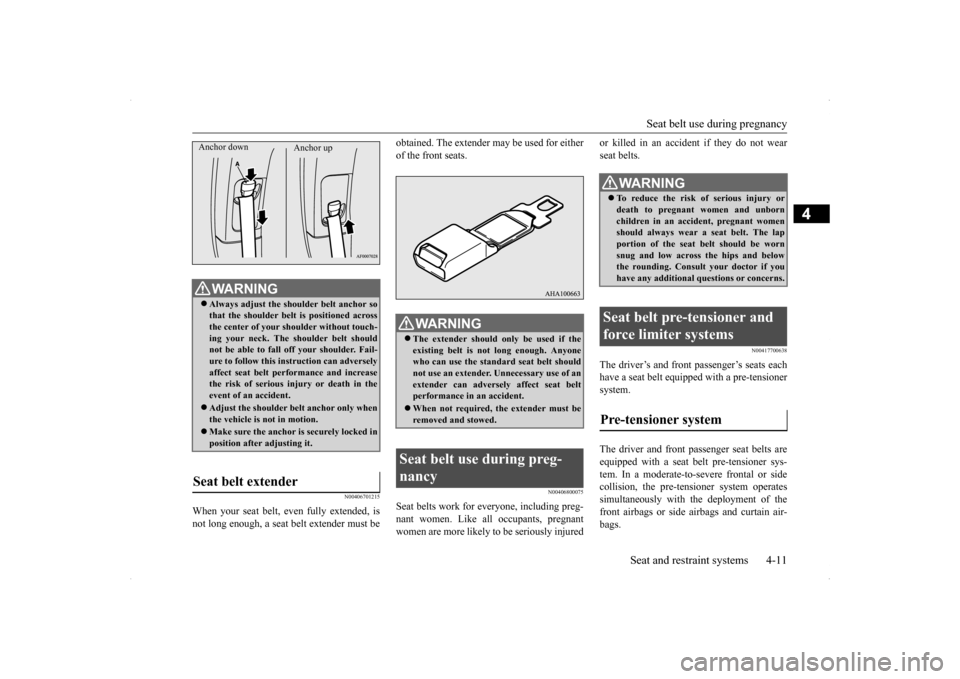
To move the anchor down, press the lock knob (A) and slide the anchor down to the desired position.To move the anchor up, slide the anchor up to the desired position.
WA R N I N G In order to reduce the risk of serious injury or death in an accident, always wear your own seat belt. Do not allow any- one to ride in your vehicle unless he or she is also seated and wearing a seat belt.Children should additionally be restrained in a secure child restraint system.NOTE
At the same time, “FASTEN SEAT BELT” will be displayed on the information screen in the multi-information display.
Front passenger seat belt warn- ing light
WA R N I N G Do not install any accessory or sticker that makes the light difficult to see.
Adjustable seat belt shoulder anchor (front seats)
BK0200800US.bo
ok 10 ページ 2013年2月14日 木曜日 午後2時28分
Page 36 of 338
Seat belt use during pregnancy
Seat and restraint systems 4-11
4
N00406701215
When your seat belt, even fully extended, is not long enough, a seat belt extender must be
obtained. The extender may be used for either of the front seats.
N00406800075
Seat belts work for ev
eryone, including preg-
nant women. Like all occupants, pregnant women are more likely to be seriously injured
or killed in an accident if they do not wear seat belts.
N00417700638
The driver’s and front passenger’s seats each have a seat belt equipped with a pre-tensioner system. The driver and front passenger seat belts are equipped with a seat belt pre-tensioner sys-tem. In a moderate-to-severe frontal or side collision, the pre-tensioner system operates simultaneously with the deployment of thefront airbags or side airbags and curtain air- bags.
WA R N I N G Always adjust the shoulder belt anchor so that the shoulder belt is positioned across the center of your shoulder without touch- ing your neck. The shoulder belt shouldnot be able to fall off your shoulder. Fail- ure to follow this instruction can adversely affect seat belt performance and increasethe risk of serious injury or death in the event of an accident. Adjust the shoulder belt anchor only when the vehicle is not in motion. Make sure the anchor is securely locked in position after adjusting it.
Seat belt extender Anchor down
Anchor up
WA R N I N G The extender should only be used if the existing belt is not long enough. Anyone who can use the standard seat belt should not use an extender. Unnecessary use of anextender can adversely affect seat belt performance in an accident. When not required, the extender must be removed and stowed.
Seat belt use during preg- nancy
WA R N I N G To reduce the risk of serious injury or death to pregnant women and unborn children in an accident, pregnant womenshould always wear a seat belt. The lap portion of the seat belt should be worn snug and low across the hips and belowthe rounding. Consult your doctor if you have any additional questions or concerns.
Seat belt pre-tensioner and force limiter systems Pre-tensioner system
BK0200800US.bo
ok 11 ページ 2013年2月14日 木曜日 午後2時28分
Page 37 of 338

Child restraint systems 4-12 Seat and restraint systems
4
The seat belt pre-tensioners are located within the seat belt retractors (A). When activated, the pre-tensioners quickly draw back seat belt webbing and increase seat belt performance. The seat belt pre-tensioner system includes the following components:
The airbag control unit monitors the readiness of the electronic parts of the system whenever the ignition switch is in the “ON” or “START” position. These include all of theitems listed above and all related wiring. The pre-tensioner seat belt system will oper- ate only when the ignition switch is in the“ON” or “START” position.When the seat belt pre-tensioners activate, some smoke is released and a loud noise will be heard. The smoke is not harmful, but careshould be taken not to intentionally inhale it, as it may cause some temporary irritation to people with respiratory problems.The pre-tensioners activate in the event of moderate-to-severe frontal or side impact, even if the seat belt is not being worn. Theseat belt pre-tensioners may not activate in certain types of collisions, even though the vehicle may appear to be severely damaged.Such non-activation does not mean some- thing is wrong with the seat belt pre-tensioner system, but rather that the collision forceswere not severe enough or not of the type to activate the system.
N00408700108
This warning tells you if there is a probleminvolving the SRS airbags and the pre-ten- sioner seat belts. Refer to “SRS warninglight/display” on page 4-25.
N00408900113
In the event of an accident, the seat belt forcelimiter system will help reduce the force applied to the driver and front seat passenger.
N00407100642
When transporting infants or small childrenin your vehicle, an appropriate child restraint system must always be used. This is requiredby law in the U.S. and Canada.
1- SRS warning light 2- Front impact sensors 3- Seat belt pre-tensioners
4- Airbag control unit 5- Side impact sensors
WA R N I N G The seat belt pre-tensioner system is designed to work only once. After the seat belt pre-tensioners have been activated, they will not work again. They must promptly be replaced and the entire seatbelt pre-tensioner system inspected by an authorized Mitsubishi Motors dealer.
SRS warning Force limiter system Child restraint systems
BK0200800US.bo
ok 12 ページ 2013年2月14日 木曜日 午後2時28分
Page 38 of 338
Child restraint systems
Seat and restraint systems 4-13
4
Child restraint systems specifically designed for infants and small children are offered by several manufacturers. Choose only a child restraint system with a label certifying that itcomplies with Federal Motor Vehicle Safety Standard 213 (FMVSS 213) or Motor Vehicle Restraint Systems and Booster CushionsSafety Regulations (RSSR). Look for the manufacturer’s statement of compliance on the box and child restraint system itself. The child restraint system should be appropri- ate for your child’s weight and height, andshould properly fit your vehicle’s seat. For detail information, refer to the instruction manual accompanying the child restraint sys-tem. All children should be properly restrained in a restraint device that offers the maximum protection for their size and age.Be sure to check local, state, or provincial requirements for child size and age that may vary from the recommendations listed below. Children less than 1 year old and children less than 20 pounds (9 kg) MUST ride in a rear-facing child safety seat that MUST ONLY be used in the rear seat.
Children older than 1
year of age and who
weigh less than 40 pounds (18 kg) or who are less than 40 inches (100 cm) tall must be in a forward-facing restraint used onlyin the rear seat. Children who weigh more than 40 pounds (18 kg) or who are more than 40 inches(100 cm) tall, regardless of age, should use a suitable child seat or a booster seat (including a booster cushion) in the rearseat until the vehicle’s lap/shoulder beltfits them properly.
Guidelines for child restraint system selection
WA R N I N G All children must be seated in the rear seat, and properly restrained. Accident statistics show that children of all sizes and ages are safer when properlyrestrained in the rear seat, rather than in the front seat.
Any child who is too large to use a child restraint system should ride in the rear seat and wear the lap and shoulder belt properly. The shoulder belt must be posi- tioned over the shoulder and across thechest, not across their neck, and with the lap belt positioned low on the child’s hips, not across their stomach. If necessary, abooster seat (including a booster cushion) should be used to help achieve a proper seat belt fit. Follow the booster seat(including a booster cushion) manufac- turer’s instructions. Only use a booster seat (including a booster cushion) that iscertified as complying with Federal Motor Vehicle Safety Standards or Motor Vehicle Restraint Systems and Booster CushionsSafety Regulations. Never hold an infant or child in your arms or on your lap when riding in this vehicle, even when you are wearing your seat belt. Never place any part of the seat belt youare wearing around an infant or child. Failure to follow these simple instructions creates a risk of serious injury or death toyour child in the event of an accident or sudden stop.WA R N I N G
BK0200800US.bo
ok 13 ページ 2013年2月14日 木曜日 午後2時28分