2014 MERCEDES-BENZ B-CLASS SPORTS weight
[x] Cancel search: weightPage 327 of 360
X
Step 4: The resulting figure equalst he
available amount of cargo and luggagel oad
capacity. For example, if the "XXX" amount
equals1 400 lbs and there are five
occupants in the vehicle each with aweight
of 150 lbs, the amount of available cargo
and luggagel oad capacity is 650 lbs (1400
000F 750 (5 x150) =650 lbs).
X Step 5: Determine the combined weight of
luggagea nd cargo being loaded on the
vehicle. That weight may not safely exceed
the available cargo and luggagel oad
capacity calculated in step 4.
X Step 6(if applicable): If your vehicle will
be towing atrailer, load from your trailer
will be transferred to your vehicle. Refer to
this Operator's Manual to determine how
this reduces the available cargo and
luggagel oad capacity of your vehicle
(Y page 327). Loading the vehicle
325Wheels and tires Z
Page 328 of 360
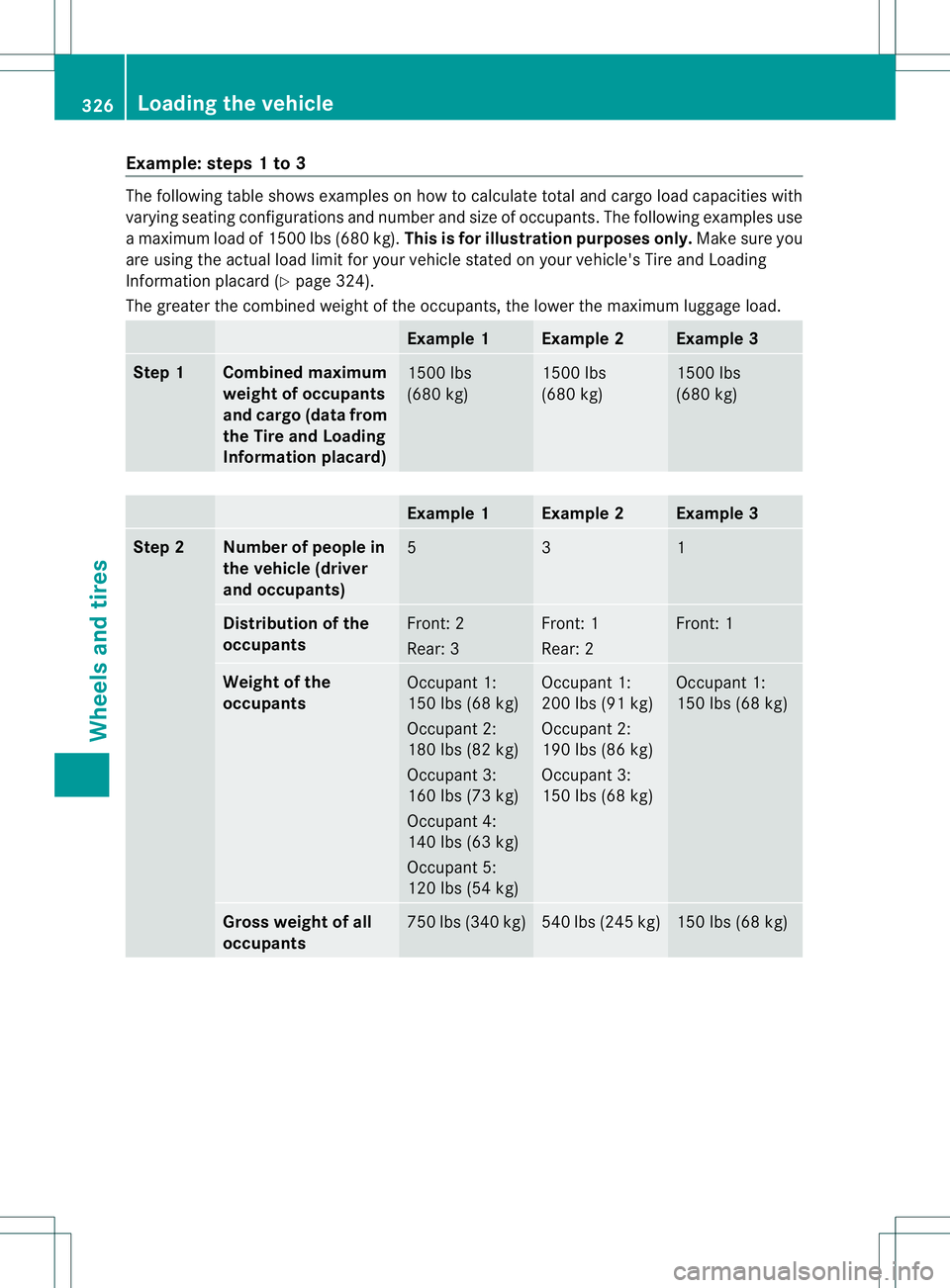
Example: steps
1to3The followin
gtable show sexamples on how to calculate total and cargo load capacities with
varying seating configurations and number and siz eofoccupants. The followin gexamples use
am aximum load of 1500 lbs (68 0kg). This is fo rillustration purposes only. Make sure you
are using the actual load limit for your vehicle stated on your vehicle's Tire and Loading
Information placard (Y page 324).
The greater the combined weight of the occupants, the lower the maximum luggage load. Example 1 Example 2 Example 3
Step 1 Combined maximum
weight of occupants
and carg
o(data from
the Tire and Loading
Information placard) 1500 lbs
(680 kg) 1500 lbs
(680 kg) 1500 lbs
(680 kg)
Example 1 Example 2 Example 3
Step 2 Numbe
rofpeople in
the vehicle (driver
and occupants) 5 3 1
Distributio
nofthe
occupants Front: 2
Rear: 3 Front: 1
Rear: 2 Front: 1
Weight of the
occupants
Occupant 1:
150 lb
s(68 kg)
Occupant 2:
180 lb s(82 kg)
Occupant 3:
160 lb s(73 kg)
Occupant 4:
140 lb s(63 kg)
Occupant 5:
120 lb s(54 kg) Occupant 1:
200 lb
s(91 kg)
Occupant 2:
190 lb s(86 kg)
Occupant 3:
150 lb s(68 kg) Occupant 1:
150 lb
s(68 kg) Gros
sweigh tofa ll
occupants 750 lb
s(340 kg) 540 lbs (245 kg) 150 lbs (68 kg)326
Loading the vehicleWheels and tires
Page 329 of 360
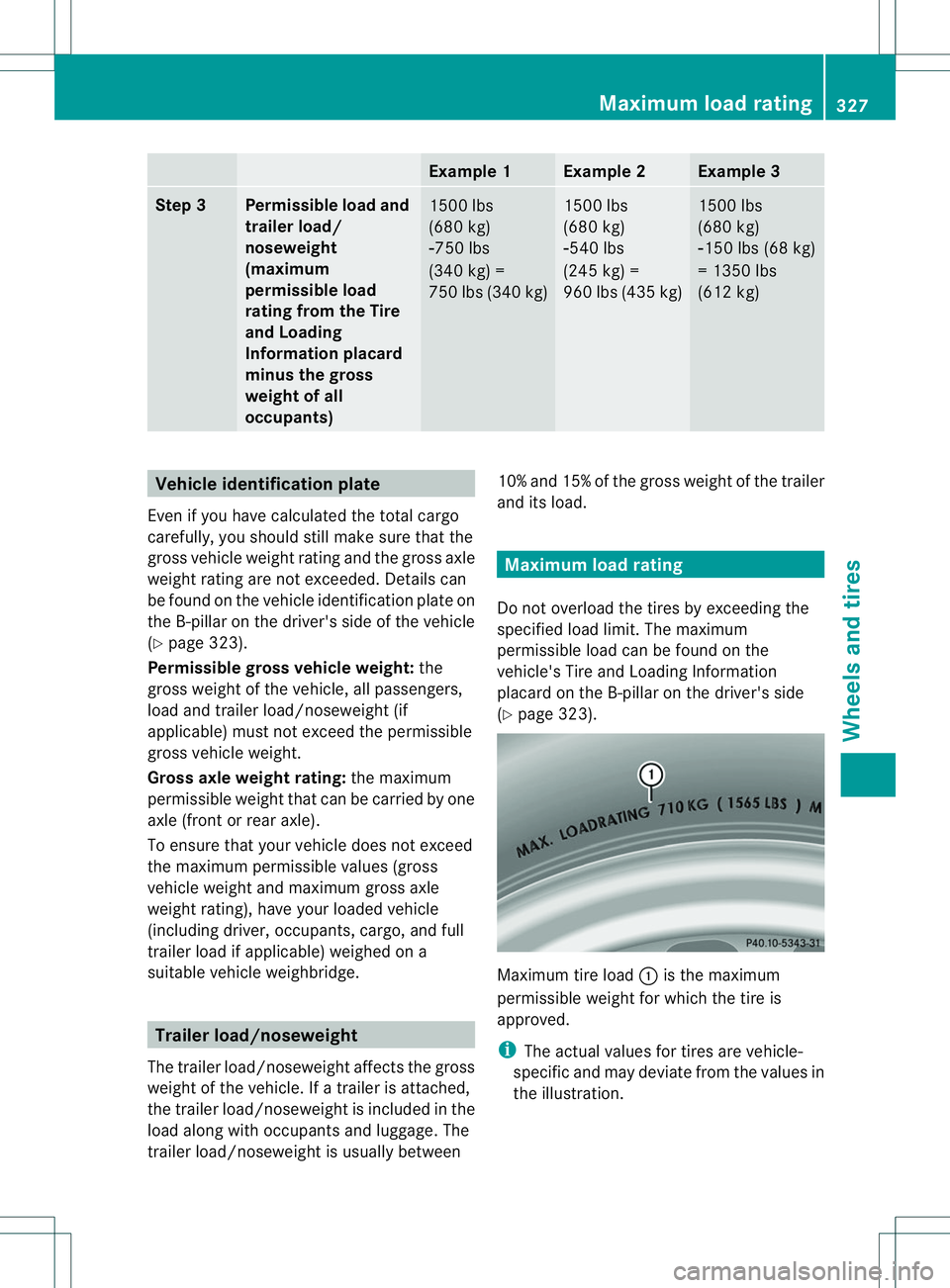
Example 1 Example 2 Example 3
Step 3 Permissible load and
trailer load/
noseweight
(maximum
permissible load
ratin gfromt heTire
and Loading
Information placard
minus th egross
weight of all
occupants) 1500 lbs
(68
0kg)
000F 75 0lbs
(34 0kg) =
75 0lbs (34 0kg) 1500 lbs
(68
0kg)
000F 54 0lbs
(24 5kg) =
96 0lbs (43 5kg) 1500 lbs
(68
0kg)
000F 15 0lbs (68 kg)
=1 350lbs
(61 2kg) Vehicle identification plate
Even if you have calculate dthe total cargo
carefully, you should still mak esure that the
gross vehicle weight rating and th egross axle
weight rating are no texceeded. Detail scan
be found on the vehicl eide ntificatio nplate on
the B-pillar on the driver's side of the vehicle
(Y page 323).
Permissible gross vehicle weight: the
gros sweight of the vehicle, all passengers,
load and trailer load/noseweigh t(if
applicable) must not exceed the permissible
gros svehicle weight.
Gross axle weight rating: the maximum
permissible weight that can be carried by one
axle (front or rear axle).
To ensure that your vehicle does not exceed
the maximum permissible values (gross
vehicle weight and maximum gros saxle
weight rating), have your loaded vehicle
(including driver, occupants, cargo, and full
trailer load if applicable) weighed on a
suitable vehicle weighbridge. Trailer load/noseweight
The trailer load/noseweigh taffects the gross
weight of the vehicle. If atrailer is attached,
the trailer load/noseweight is included in the
loa da long with occupants and luggage. The
trailer load/noseweight is usually between 10% and 15% of the gross weight of the trailer
and its load. Maximum load rating
Do not overload the tires by exceeding the
specified loa dlimit. The maximum
permissible loa dcan be found on the
vehicle's Tire and Loading Information
placard on the B-pillar on the driver's side
(Y pag e323). Maximum tire load
001Ais the maximum
permissible weight for which the tire is
approved.
i The actua lvalues for tires are vehicle-
specific and may deviate from the values in
the illustration. Maximum load rating
327Wheels and tires Z
Page 335 of 360
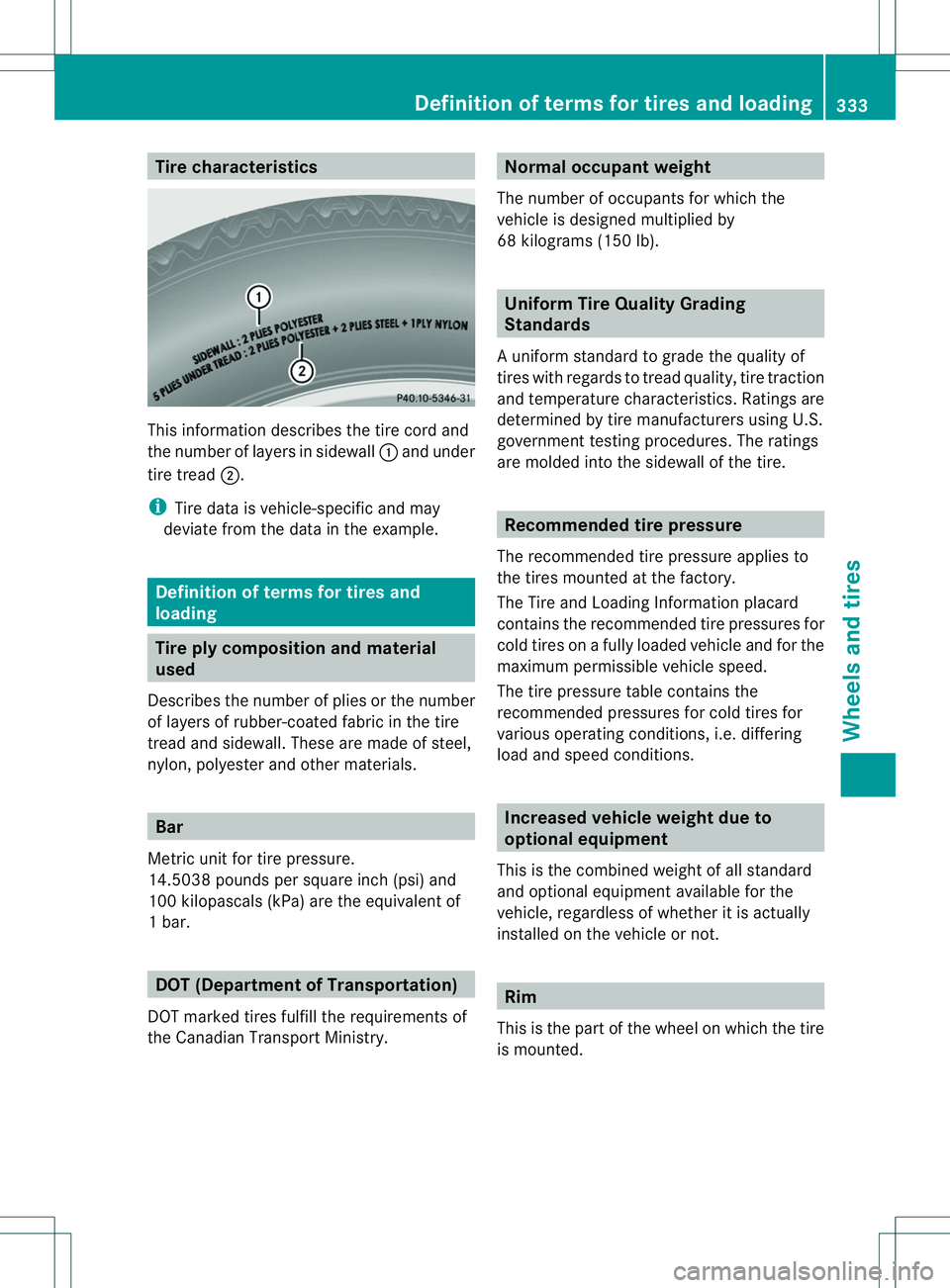
Tire characteristics
Thi
sinformatio ndescribes the tire cord and
the number of layers in sidewall 001Aand under
tire tread 0010.
i Tire data is vehicle-specific and may
deviate from the data in the example. Definition of term
sfor tires and
loading Tirep
ly composition and material
used
Describes the number of plies or the number
of layers of rubber-coated fabric in the tire
tread and sidewall. These are made of steel,
nylon, polyester and other materials. Bar
Metric unit for tire pressure.
14.5038p ounds per square inch (psi) and
100 kilopascals (kPa) are the equivalent of
1b ar. DOT (Department of Transportation)
DOT marked tires fulfill the requirements of
the Canadia nTransport Ministry. Normal occupant weight
The number of occupants for which the
vehicl eisdesigned multiplied by
68 kilograms (150 lb). Uniform Tire Quality Grading
Standards
Au niform standard to grade the quality of
tire swithr egards to trea dquali ty,tire traction
and temperatur echaracteristics. Rating sare
determine dbytire manufacturer susing U.S.
government testing procedures. The ratings
ar em olde dinto the sidewall of the tire. Recommende
dtire pressure
The recommende dtire pressure applie sto
the tire smounted at the factory.
The Tire and Loading Informatio nplacard
contain sthe recommende dtirep ressures for
cold tires on afully loaded vehicle and for the
maximum permissible vehicle speed.
The tir epressure table contain sthe
recommende dpressures for cold tires for
various operating conditions, i.e. differing
load and speed conditions. Increased vehicle weight du
eto
optional equipment
This is the combined weight of all standard
and optional equipmen tavailablef or the
vehicle, regardless of whethe ritisactually
installed on the vehicle or not. Rim
This is the part of the wheel on which the tire
is mounted. Definition of termsf
or tires and loading
333Wheels and tires Z
Page 336 of 360
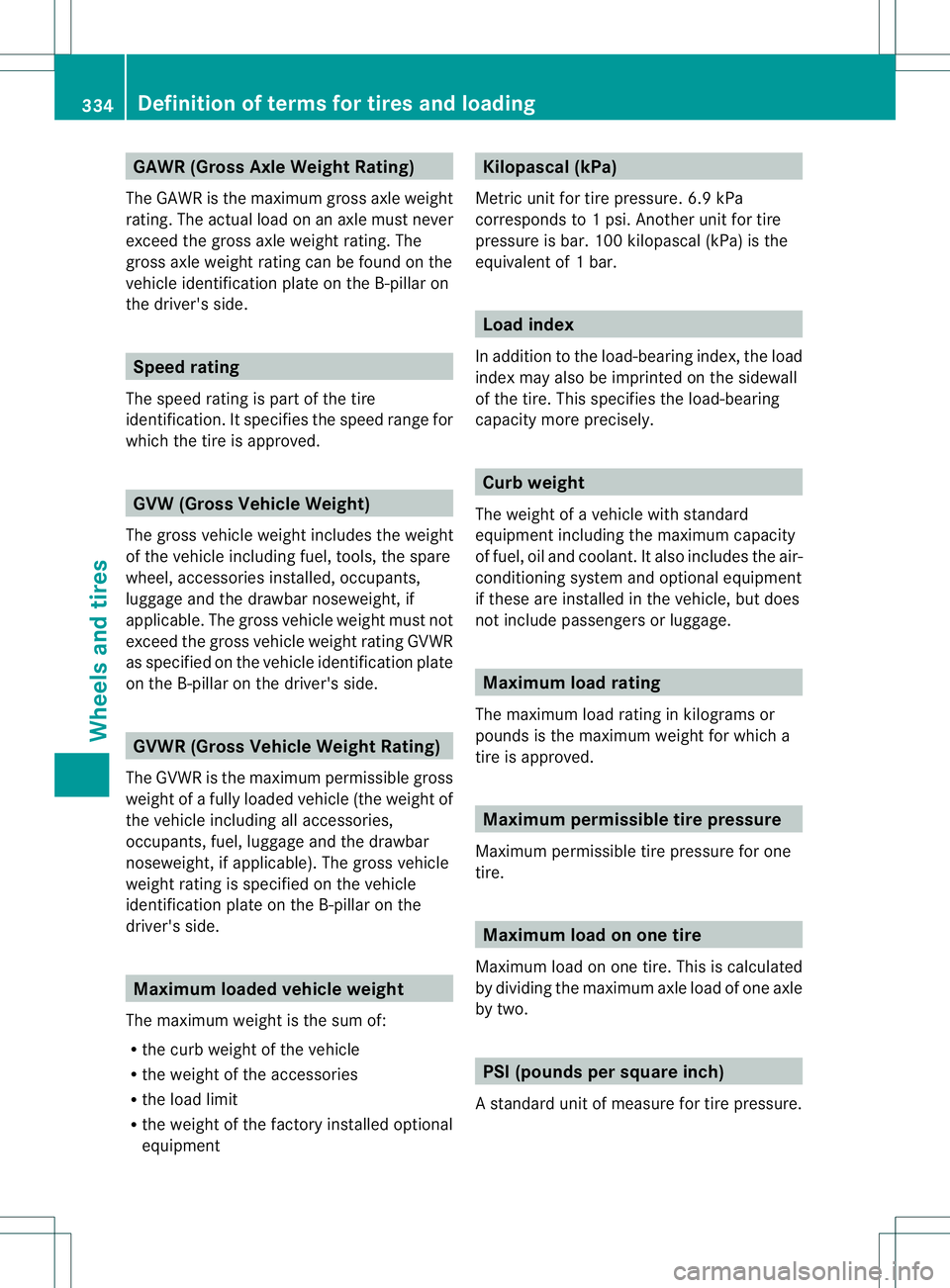
GAWR (Gross AxleW
eight Rating)
The GAWR is the maximu mgross axle weight
rating. The actua lloa donana xle must never
exceed the gross axle weight rating. The
gross axle weight rating can be found on the
vehicl eidentification plate on the B-pillar on
the driver's side. Speed rating
The spee drating is part of the tire
identification. It specifies the spee drange for
which the tire is approved. GVW (Gross Vehicle Weight)
The gross vehicl eweight includes the weight
of the vehicl eincluding fuel ,tools, the spare
wheel, accessories installed, occupants,
luggage and the drawbar noseweight, if
applicable.T he gross vehicle weight must not
exceed the gross vehicle weight rating GVWR
as specified on the vehicle identification plate
on the B-pillar on the driver's side. GVWR (Gross Vehicle Weight Rating)
The GVWR is the maximum permissible gross
weight of afully loaded vehicle (the weight of
the vehicle including all accessories,
occupants, fuel, luggage and the drawbar
noseweight, if applicable). The gross vehicle
weight rating is specified on the vehicle
identification plate on the B-pillar on the
driver's side. Maximum loaded vehicle weight
The maximum weight is the sum of:
R the curb weight of the vehicle
R the weight of the accessories
R the load limit
R the weight of the factory installed optional
equipment Kilopascal (kPa)
Metric unit for tire pressure. 6.9 kPa
corresponds to 1psi. Another unit for tire
pressure is bar. 100 kilopascal (kPa) is the
equivalent of 1bar. Load index
In addition to th eload-bearing index ,the load
index may also be imprinted on th esidewall
of th etire. This specifie sthe load-bearing
capacity more precisely. Curb weight
The weight of avehicle with standard
equipment including the maximum capacity
of fuel, oil and coolant. It also includes the air-
conditioning system and optional equipment
if these are installed in the vehicle, but does
not include passengers or luggage. Maximum load rating
The maximum load rating in kilograms or
pounds is the maximum weight for which a
tire is approved. Maximum permissible tire pressure
Maximum permissible tire pressure for one
tire. Maximum load on one tire
Maximum load on one tire. This is calculated
by dividing the maximum axle load of one axle
by two. PSI (pounds per squarei
nch)
As tandar dunitofm easure for tire pressure. 334
Definition of terms for tires and loadingWheels and tires
Page 337 of 360
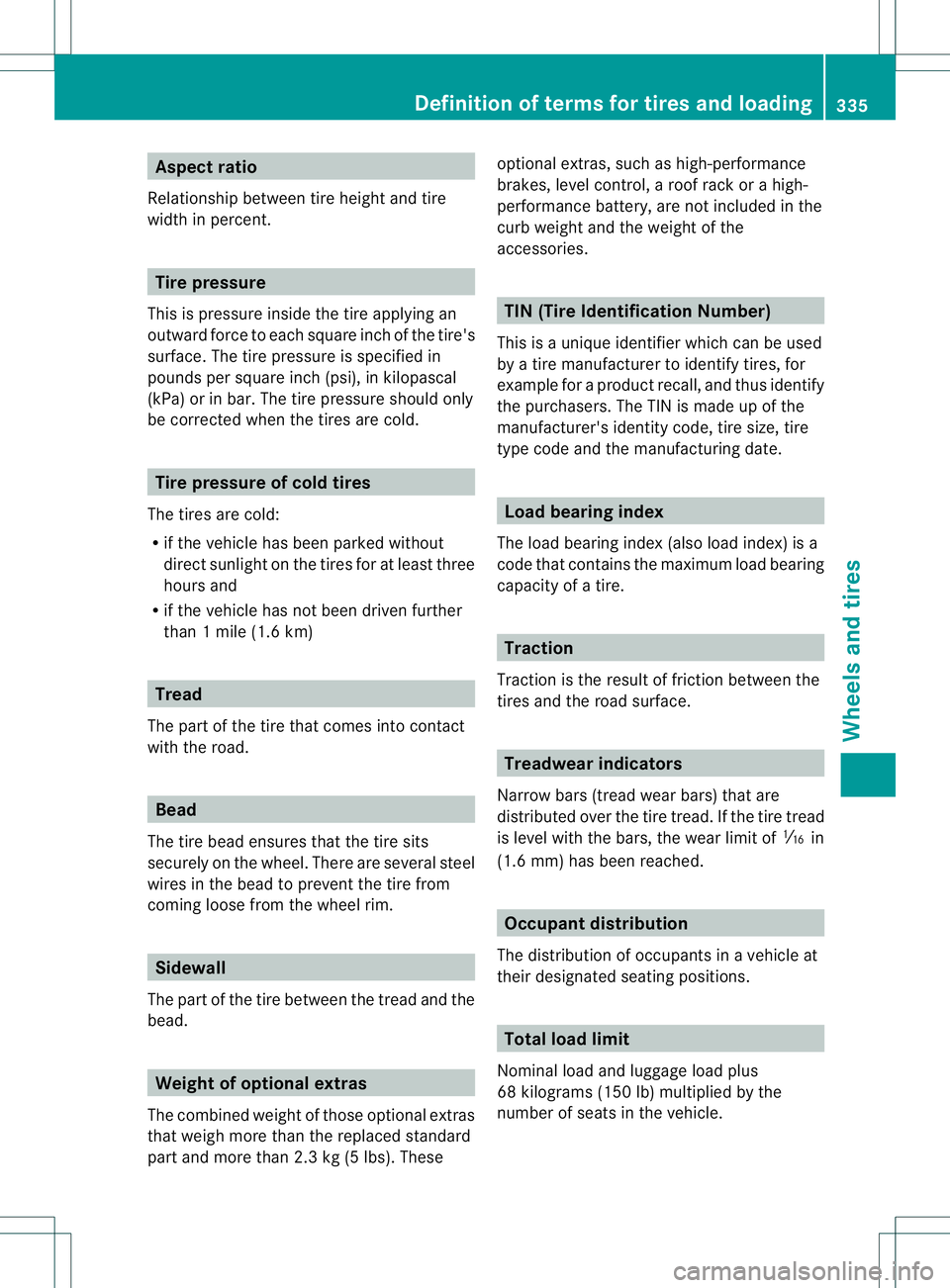
Aspect ratio
Relationship between tire height and tire
widt hinp ercent. Tire pressure
This is pressur einside th etirea pplyin gan
outward force to eac hsquar einc hoft hetire's
surface. The tire pressur eisspecifie din
pounds per squar einc h( psi), in kilopascal
(kPa) or in bar. The tire pressur eshould only
be correcte dwhen th etires are cold. Tire pressure of cold tires
The tires are cold:
R if th evehicl ehas been parked without
direct sunligh tonthe tires for at least three
hours and
R if the vehicle has not been driven further
than 1mile (1.6 km) Tread
The part of the tire that comes into contact
with the road. Bead
The tire bead ensures that the tire sits
securely on the wheel. There are several steel
wires in the bead to prevent the tire from
coming loose from the wheel rim. Sidewall
The part of the tire between the tread and the
bead. Weight of optional extras
The combined weight of those optional extras
that weigh more than the replaced standard
part and more than 2.3 kg (5 lbs). These optional extras, such as high-performance
brakes, level control,
aroof rack or ahigh-
performance battery, are not included in the
curb weight and the weight of the
accessories. TIN (Tire Identification Number)
This is aunique identifier which can be used
by atire manufacturer to identify tires, for
example for aproduct recall, and thus identify
the purchasers. The TIN is made up of the
manufacturer's identity code, tire size, tire
type code and the manufacturing date. Load bearing index
The load bearing index (also load index) is a
code that contains the maximum load bearing
capacity of atire. Traction
Traction is the result of friction between the
tires and the road surface. Treadwear indicators
Narrow bars (tread wear bars) that are
distributed over the tire tread. If the tire tread
is level with the bars, the wear limit of 0003in
(1.6 mm) has been reached. Occupant distribution
The distribution of occupants in avehicle at
their designated seating positions. Total load limit
Nominal load and luggage load plus
68 kilograms (150 lb) multiplied by the
number of seats in the vehicle. Definition of termsf
or tires and loading
335Wheels and tires Z
Page 355 of 360
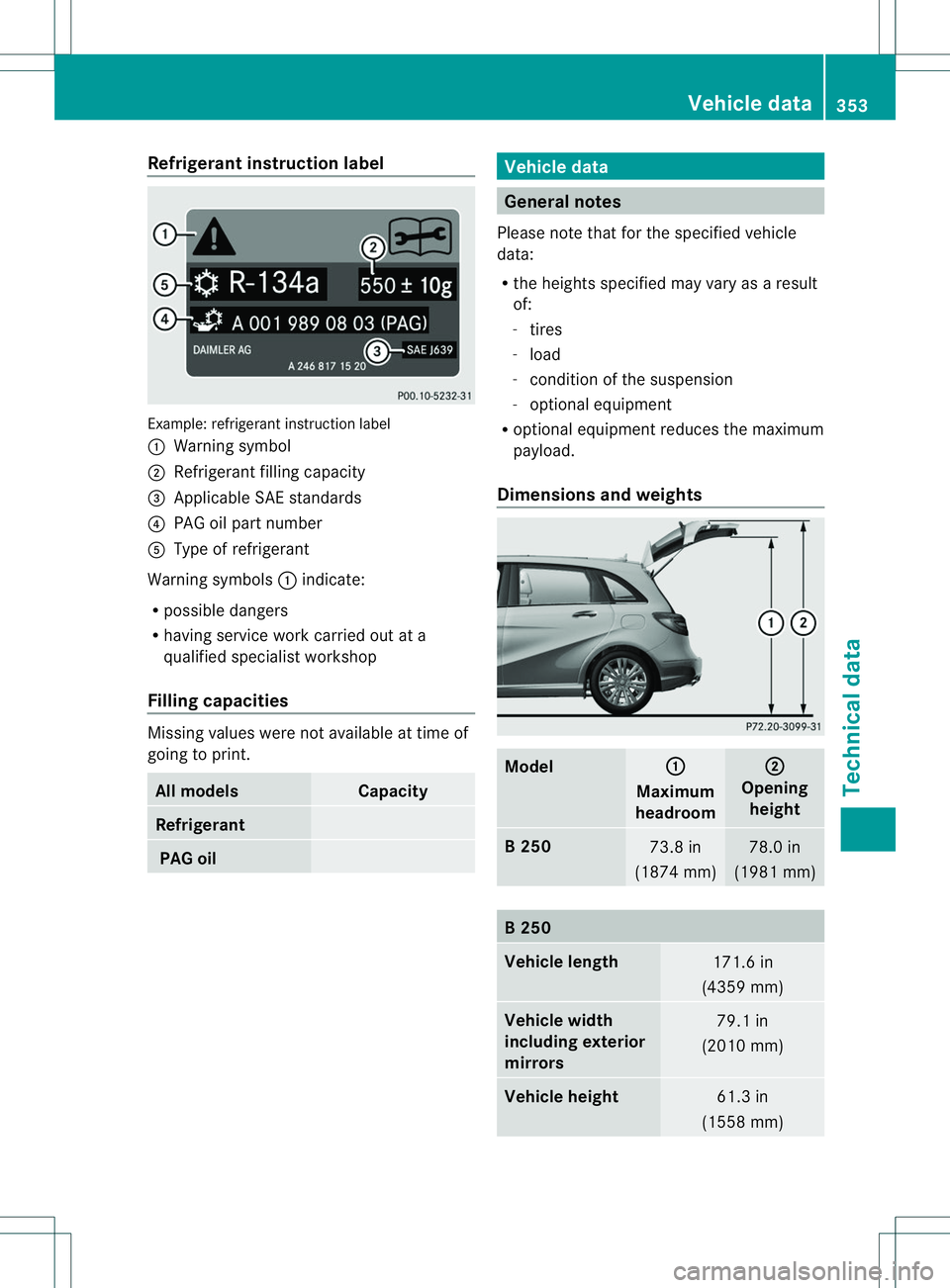
Refrigerant instructio
nlabel Example
:refrigerant instruction label
001A Warning symbol
0010 Refrigerant filling capacity
0023 Applicabl eSAE standards
0021 PAG oi lpartn umber
001E Type of refrigerant
Warning symbols 001Aindicate:
R possible dangers
R having service work carrie doutat a
qualified specialist workshop
Fillin gcapacities Missing value
sweren ot available at time of
going to print. Al
lm odels Capacity
Refrigerant
PA
Go il Vehicle data
Genera
lnotes
Please not ethat for the specified vehicle
data:
R the height sspecified may vary as aresult
of:
- tires
- load
- condition of the suspension
- optional equipment
R optional equipmen treduces the maximum
payload.
Dimensions and weights Model 001A
Maximum
headroom 0010
Opening
height B2
50 73.
8in
(187 4mm) 78.
0in
(198 1mm) B2
50 Vehicle length
171.6 in
(435 9mm) Vehicle width
including exterior
mirrors
79.
1in
(201 0mm) Vehicle height
61.
3in
(155 8mm) Vehicle data
353Technical data Z