2014 LINCOLN MKZ warning
[x] Cancel search: warningPage 30 of 468

The LATCH system is composed of
three vehicle anchor points: two lower
anchors located where seat back and
seat cushion meet (called the seat
bight) and one top tether anchor
located behind that seating position.
LATCH compatible child safety seats
have two rigid or webbing mounted
attachments that connect to the two
lower anchors at the LATCH equipped
seating positions in your vehicle. This
type of attachment method
eliminates the need to use safety
belts to attach the child seat, however
the safety belt can still be used to
attach the child seat. For
forward-facing child seats, the top
tether strap must also be attached to
the proper top tether anchor, if a top
tether strap has been provided with
your child seat.
E142535
Your vehicle has LATCH lower
anchors for child seat installation at
the seating positions marked with the
child seat symbol.
E144054
The LATCH anchors are located at the
rear section of the rear seat between
the cushion and seat back below the
symbols as shown. Follow the child
seat manufacturer's instructions to
properly install a child seat with
LATCH attachments. Follow the
instructions on attaching child safety
seats with tether straps.
Attach LATCH lower attachments of
the child seat only to the anchors
shown.
Use of Inboard Lower Anchors
from the Outboard Seating
Positions (Center Seating Use)
WARNING
The standardized spacing for
LATCH lower anchors is 11 inches
(28 centimeters) center to center. Do
not use LATCH lower anchors for the
center seating position unless the
child seat manufacturer's instructions
permit and specify using anchors
spaced at least as far apart as those
in this vehicle.
27
Child Safety
Page 34 of 468

PRINCIPLE OF OPERATION
WARNINGS
Always drive and ride with your
seat back upright and the lap
belt snug and low across the hips.
To reduce the risk of injury, make
sure children sit where they can
be properly restrained.
Never let a passenger hold a
child on his or her lap while your
vehicle is moving. The passenger
cannot protect the child from injury in
a crash.
All occupants of your vehicle,
including the driver, should
always properly wear their safety
belts, even when an airbag
supplemental restraint system is
provided. Failure to properly wear your
safety belt could seriously increase
the risk of injury or death.
It is extremely dangerous to ride
in a cargo area, inside or outside
of a vehicle. In a crash, people riding
in these areas are more likely to be
seriously injured or killed. Do not allow
people to ride in any area of your
vehicle that is not equipped with seats
and safety belts. Be sure everyone in
your vehicle is in a seat and using a
safety belt properly.
In a rollover crash, an unbelted
person is significantly more likely
to die than a person wearing a safety
belt.
WARNINGS
Each seating position in your
vehicle has a specific safety belt
assembly which is made up of one
buckle and one tongue that are
designed to be used as a pair. 1) Use
the shoulder belt on the outside
shoulder only. Never wear the
shoulder belt under the arm. 2) Never
swing the safety belt around your neck
over the inside shoulder. 3) Never use
a single belt for more than one person.
When possible, all children 12
years old and under should be
properly restrained in a rear seating
position. Failure to follow this could
seriously increase the risk of injury or
death.
Safety belts and seats can
become hot in a vehicle that has
been closed up in sunny weather; they
could burn a small child. Check seat
covers and buckles before you place
a child anywhere near them.
Front and rear seat occupants,
including pregnant women,
should wear safety belts for optimum
protection in an accident.
All seating positions in your vehicle
have lap and shoulder safety belts. All
occupants of the vehicle should
always properly wear their safety
belts, even when an airbag
supplemental restraint system is
provided.
31
Safety Belts
Page 35 of 468

The safety belt system consists of:
• lap and shoulder safety belts.
• shoulder safety belt withautomatic locking mode, (except
driver safety belt).
• height adjuster at the front outboard seating positions.
• safety belt pretensioner at the front outboard seating positions.
• belt tension sensor at the front outboard passenger seating
position.
• Safety belt warning light andchime.
• Crash sensors and monitoringsystem with readiness indicator.
The safety belt pretensioners at the
front seating positions are designed
to tighten the safety belts when
activated. In frontal and near-frontal
crashes, the safety belt pretensioners
may be activated alone or, if the crash
is of sufficient severity, together with
the front airbags. The pretensioners
may also activate when a side curtain
airbag is deployed.
FASTENING THE SAFETY
BELTS
Standard belts shown, inflatable
belts similar The front outboard and rear safety
restraints in the vehicle are
combination lap and shoulder belts.
E142587
1. Insert the belt tongue into the
proper buckle (the buckle closest
to the direction the tongue is
coming from) until you hear a snap
and feel it latch. Make sure you
securely fasten the tongue in the
buckle.
E142588
2. To unfasten, press the releasebutton and remove the tongue
from the buckle.
32
Safety Belts
Page 36 of 468

Restraint of Pregnant Women
WARNING
Always ride and drive with your
seatback upright and the safety
belt properly fastened. The lap portion
of the safety belt should fit snug and
be positioned low across the hips. The
shoulder portion of the safety belt
should be positioned across the chest.
Pregnant women should also follow
this practice. See the following figure.
E142590
Pregnant women should always wear
their safety belt. The lap belt portion
of a combination lap and shoulder
belt should be positioned low across
the hips below the belly and worn as
tight as comfort will allow. The
shoulder belt should be positioned to
cross the middle of the shoulder and
the center of the chest.
Safety Belt Locking Modes
WARNINGS
After any vehicle crash, the
safety belt system at all
passenger seating positions must be
checked by an authorized dealer to
verify that the automatic locking
retractor feature for child seats is still
functioning properly. In addition, all
safety belts should be checked for
proper function.
Belt and retractor assembly
must be replaced if the safety
belt assembly automatic locking
retractor feature or any other safety
belt function is not operating properly
when checked by an authorized
dealer. Failure to replace the belt and
retractor assembly could increase the
risk of injury in crashes.
All safety restraints in the vehicle are
combination lap and shoulder belts.
The driver safety belt has the first type
of locking mode, and the front
outboard passenger and rear seat
safety belts have both types of locking
modes described as follows:
Vehicle Sensitive Mode
This is the normal retractor mode,
which allows free shoulder belt length
adjustment to your movements and
locking in response to vehicle
movement. For example, if the driver
brakes suddenly or turns a corner
33
Safety Belts
Page 38 of 468
3. Allow the belt to retract. As thebelt retracts, you will hear a
clicking sound. This indicates the
safety belt is now in the automatic
locking mode.
How to Disengage the Automatic
Locking Mode
Unbuckle the combination lap and
shoulder belt and allow it to retract
completely to disengage the
automatic locking mode and activate
the vehicle sensitive (emergency)
locking mode.
Rear Inflatable Safety Belt (If
Equipped)
WARNING
Do not attempt to service, repair,
or modify the rear inflatable
safety belt.
The rear inflatable safety belts are
fitted in the shoulder portion of the
safety belts of the second-row
outboard seating positions.
Note: The rear inflatable safety belts
are compatible with most infant and
child safety car seats and belt
positioning booster seats when
properly installed. This is because they
are designed to fill with a cooled gas
at a lower pressure and at a slower rate
than traditional airbags. After inflation,
the shoulder portion of the safety belt
remains cool to the touch. The rear inflatable safety belt consists
of the following:
• An inflatable bag located in the
shoulder safety belt webbing.
• Lap safety belt webbing with automatic locking mode.
• The same warning light, electronic control and diagnostic unit as used
for the front safety belts.
• Impact sensors located in various parts of the vehicle.
How does the rear inflatable safety
belt system work?
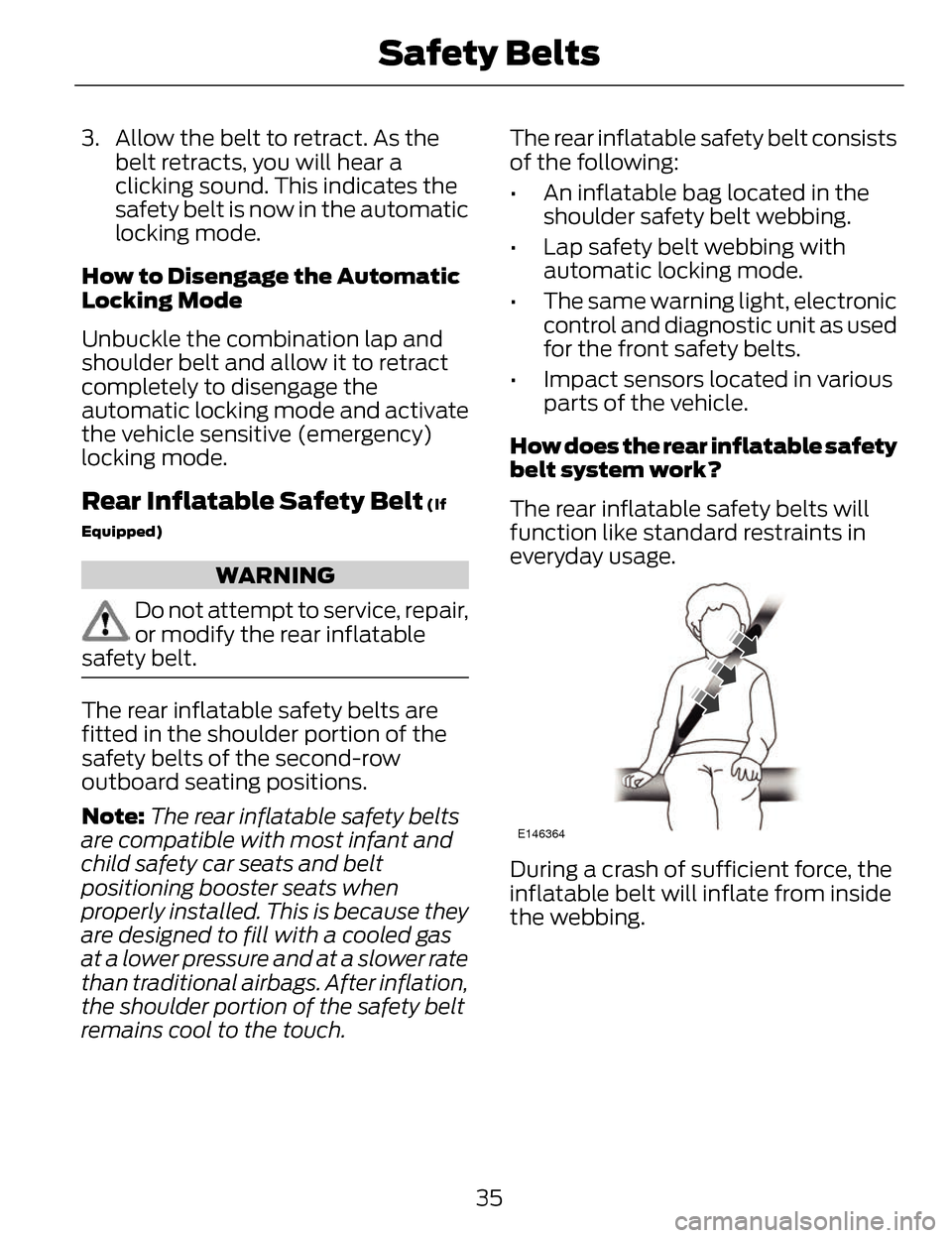
The rear inflatable safety belts will
function like standard restraints in
everyday usage.
E146364
During a crash of sufficient force, the
inflatable belt will inflate from inside
the webbing.
35
Safety Belts
Page 39 of 468

E146365
The fully inflated belt's increased
diameter more effectively holds the
occupant in the appropriate seating
position, and spreads crash forces
over more area of the body than
regular safety belts. This helps reduce
pressure on the chest and helps
control head and neck motion for
passengers.
WARNING
If the rear inflatable safety belt
has deployed, it will not function
again. The rear inflatable safety belt
system must be replaced by an
authorized dealer.
The rear inflatable safety belts are
designed to inflate in frontal or
near-frontal crashes and some side
impact crashes. The fact that the rear
inflatable safety belt did not inflate in
a crash does not mean that
something is wrong with the system.
Rather, it means the forces were not
of the type sufficient to cause
activation.
Safety Belt Extension
Assembly
WARNINGS
Do not use extensions to change
the fit of the shoulder belt across
the torso.
Do not use extensions with an
inflatable safety belt.
If the safety belt is too short when
fully extended, a safety belt extension
assembly can be obtained from an
authorized dealer.
Use only extensions manufactured by
the same supplier as the safety belt.
Manufacturer identification is located
at the end of the webbing on the label.
A safety belt extension is not available
for the inflatable safety belt. Also, use
the safety belt extension only if the
safety belt is too short for you when
fully extended.
SAFETY BELT HEIGHT
ADJUSTMENT
WARNING
Position the safety belt height
adjusters so that the belt rests
across the middle of your shoulder.
Failure to adjust the safety belt
properly could reduce the
effectiveness of the safety belt and
increase the risk of injury in a crash.
Adjust the height of the shoulder belt
so the belt rests across the middle of
your shoulder.
36
Safety Belts
Page 40 of 468

E146191
To adjust the shoulder belt height:
1. Press the button and slide theheight adjuster up or down. 2. Release the button and pull down
on the height adjuster to make
sure it is locked in place.
SAFETY BELT WARNING
LAMP AND INDICATOR
CHIME
This lamp illuminates and an
audible warning will sound if
the driver's safety belt has
not been fastened when the vehicle's
ignition is turned on.
Conditions of operation
Then...
If...
The safety belt warning light illumin-
ates 1-2 minutes and the warning chime sounds 4-8 seconds.
The driver's safety belt is not buckled
before the ignition switch is turned to the on position...
The safety belt warning light andwarning chime turn off.
The driver's safety belt is buckled
while the indicator light is illuminated and the warning chime is sounding...
The safety belt warning light andindicator chime remain off.
The driver's safety belt is buckled
before the ignition switch is turned to the on position...
37
Safety Belts
Page 41 of 468

SAFETY BELT MINDER
Belt-Minder®
This feature supplements the safety
belt warning function by providing
additional reminders by intermittently
sounding a chime and illuminating the
safety belt warning light when the
driver seat or front passenger seat is
occupied and the safety belt is
unbuckled.The system uses information from the
front passenger sensing system to
determine if a front seat passenger is
present and therefore potentially in
need of a warning. To avoid activating
the Belt-Minder feature for objects
placed in the front passenger seat,
warnings will only be given to front
seat occupants as determined by the
front passenger sensing system.
If the Belt-Minder warnings have
expired (warnings for about five
minutes) for one occupant (driver or
front passenger), the other occupant
can still activate the Belt-Minder
feature.
Then...
If...
The Belt-Minder feature will not
activate.
The driver's and front passenger's
safety belts are buckled before the
ignition is turned on or less than 1-2
minutes have elapsed since the igni- tion has been turned on...
The Belt-Minder feature is activated -the safety belt warning light illumin-ates and the warning chime sounds for six seconds every 25 seconds,
repeating for about five minutes or until the safety belts are buckled.
The driver's or front passenger's safety
belt is not buckled when the vehicle
has reached at least 6 mph (9.7 km/
h) and 1-2 minutes have elapsed since the ignition has been turned on...
The Belt-Minder feature is activated -the safety belt warning light illumin-ates and the warning chime sounds for six seconds every 25 seconds,
repeating for about five minutes or until the safety belts are buckled.
The driver's or front passenger's safety
belt becomes unbuckled for about one
minute while the vehicle is traveling at
least 6 mph (9.7 km/h) and more than
1-2 minutes have elapsed since the ignition has been turned on...
38
Safety Belts