Page 372 of 469
371
uuMaintenance Under the Hood uEngine Coolant
Continued
Maintenance
Engine CoolantThis coolant is premixed with 50% antifreeze and 50% water. Do not add any
straight antifreeze or water.
We recommend you check the engine coolant level every time you refuel. Check the
reserve tank first. If it is completely empty, also check the coolant level in the
radiator. Add the engine coolant accordingly.
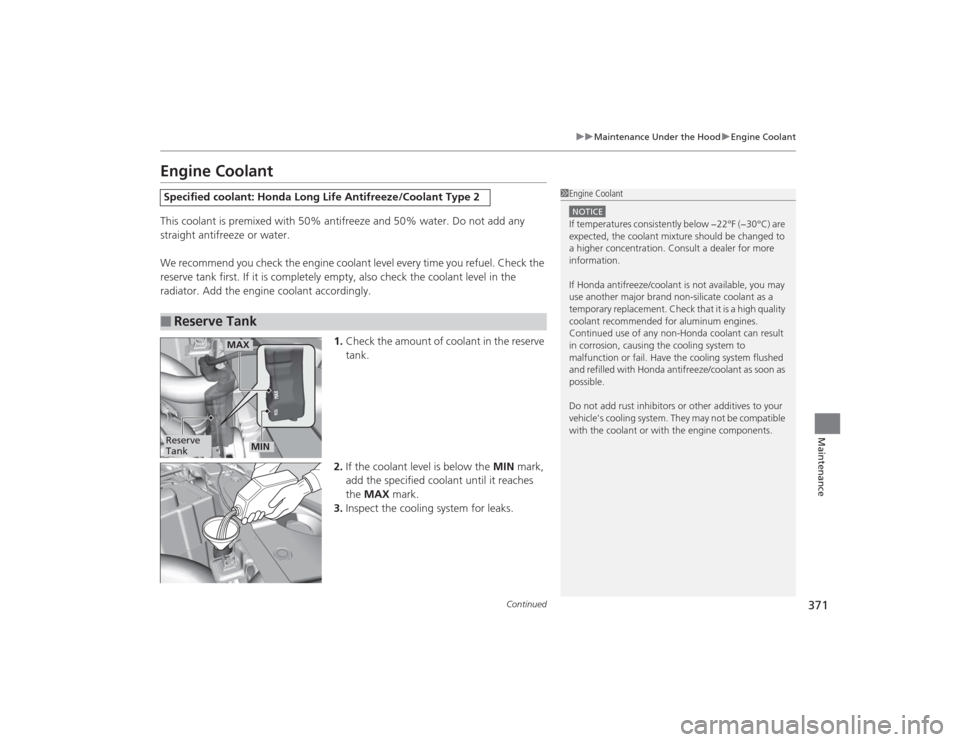
1.Check the amount of coolant in the reserve
tank.
2. If the coolant level is below the MIN mark,
add the specified coolant until it reaches
the MAX mark.
3. Inspect the cooling system for leaks.Specified coolant: Honda Long Life Antifreeze/Coolant Type 2■
Reserve Tank
1Engine CoolantNOTICEIf temperatures consistently below −22°F (−30°C) are
expected, the coolant mixture should be changed to
a higher concentration. Consult a dealer for more
information.
If Honda antifreeze/coolant is not available, you may
use another major brand non-silicate coolant as a
temporary replacement. Check that it is a high quality
coolant recommended for aluminum engines.
Continued use of any non-Honda coolant can result
in corrosion, causing the cooling system to
malfunction or fail. Have the cooling system flushed
and refilled with Honda antifreeze/coolant as soon as
possible.
Do not add rust inhibitors or other additives to your
vehicle's cooling system. They may not be compatible
with the coolant or with the engine components.
MAX
MIN
Reserve
Tank
Page 373 of 469
uuMaintenance Under the Hood uEngine Coolant
372Maintenance
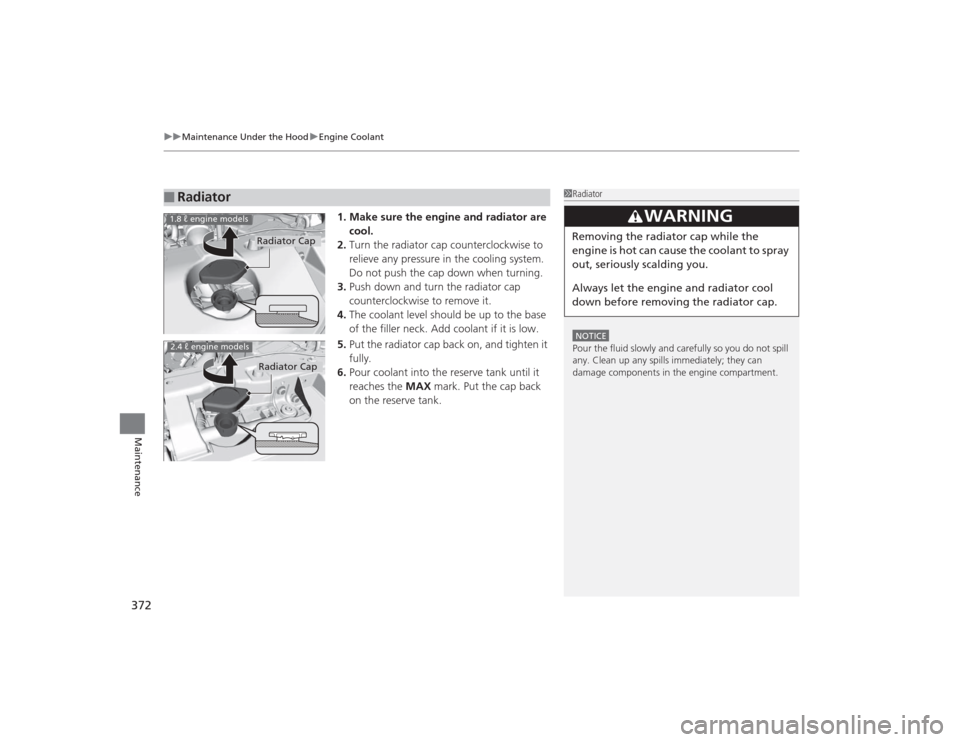
1. Make sure the engine and radiator are
cool.
2. Turn the radiator cap counterclockwise to
relieve any pressure in the cooling system.
Do not push the cap down when turning.
3. Push down and turn the radiator cap
counterclockwise to remove it.
4. The coolant level should be up to the base
of the filler neck. Add coolant if it is low.
5. Put the radiator cap back on, and tighten it
fully.
6. Pour coolant into the reserve tank until it
reaches the MAX mark. Put the cap back
on the reserve tank.
■
Radiator
1 RadiatorNOTICEPour the fluid slowly and carefully so you do not spill
any. Clean up any spills immediately; they can
damage components in the engine compartment.
3
WARNING
Removing the radiator cap while the
engine is hot can cause the coolant to spray
out, seriously scalding you.
Always let the engine and radiator cool
down before removing the radiator cap.
Radiator Cap
1.8 ℓ engine models2.4 ℓ engine models
Radiator Cap
Page 376 of 469
375
uuMaintenance Under the Hood uRefilling Window Washer Fluid
Maintenance
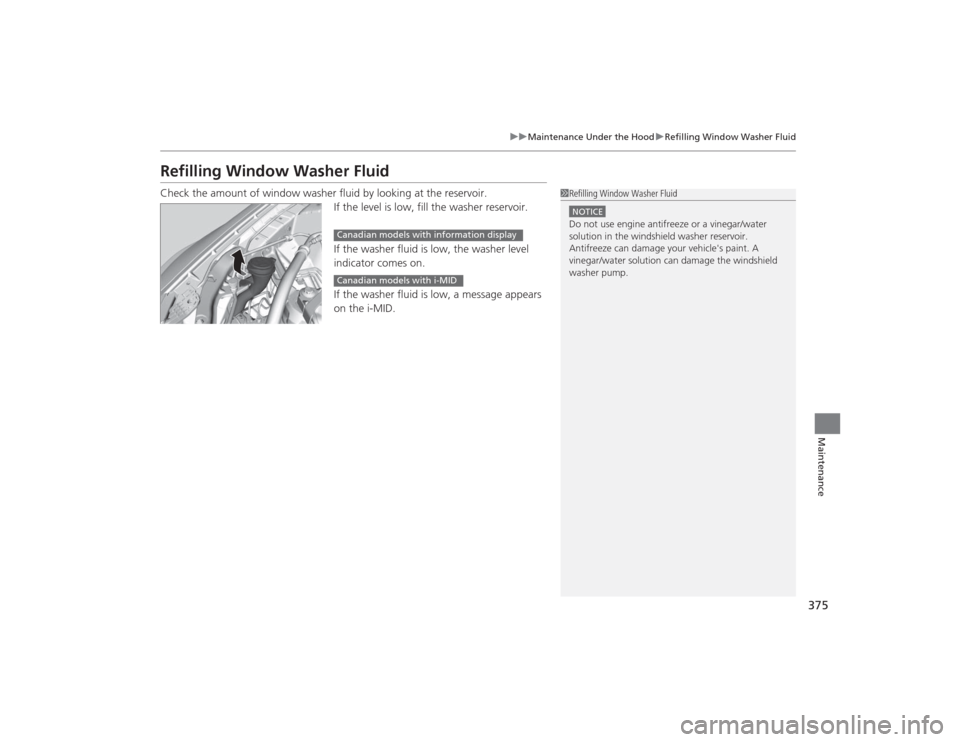
Refilling Window Washer FluidCheck the amount of window washer fluid by looking at the reservoir.
If the level is low, fill the washer reservoir.
If the washer fluid is low, the washer level
indicator comes on.
If the washer fluid is low, a message appears
on the i-MID.
1Refilling Window Washer FluidNOTICEDo not use engine antifreeze or a vinegar/water
solution in the windshield washer reservoir.
Antifreeze can damage your vehicle's paint. A
vinegar/water solution can damage the windshield
washer pump.
Canadian models with information displayCanadian models with i-MID
Page 378 of 469
Continued
377
uuReplacing Light Bulbs uHeadlight Bulbs
Maintenance
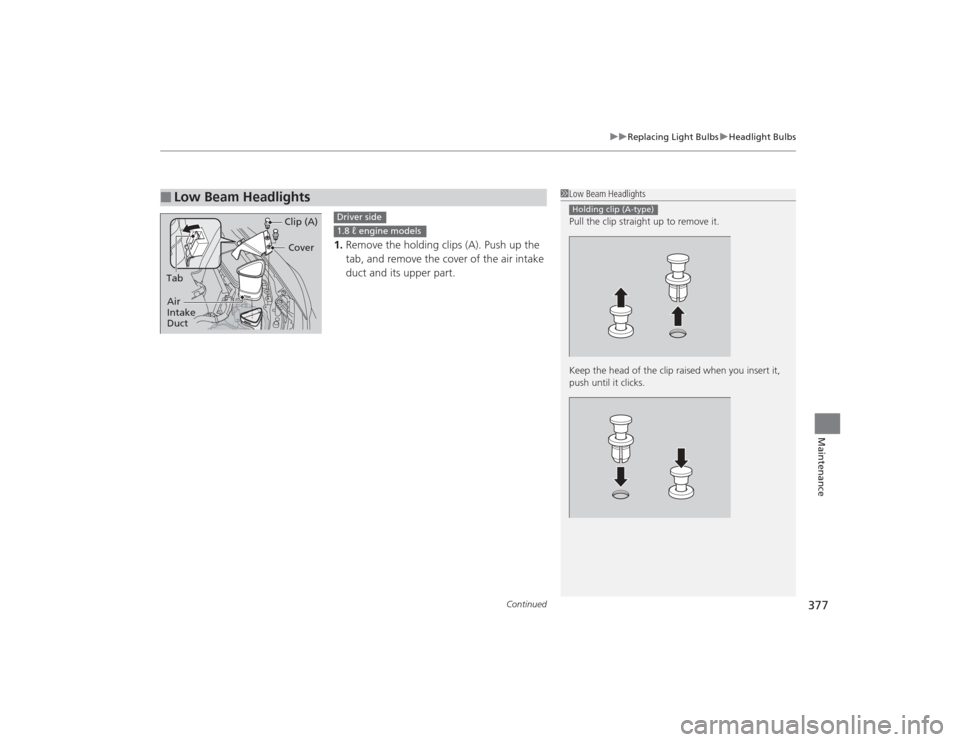
1. Remove the holding clips (A). Push up the
tab, and remove the cover of the air intake
duct and its upper part.
■
Low Beam Headlights
1Low Beam Headlights
Pull the clip straight up to remove it.
Keep the head of the clip raised when you insert it,
push until it clicks.Holding clip (A-type)
Cover
Tab Clip (A)
Air
Intake
Duct
Driver side1.8 ℓ engine models
Page 379 of 469
uuReplacing Light Bulbs uHeadlight Bulbs
378Maintenance
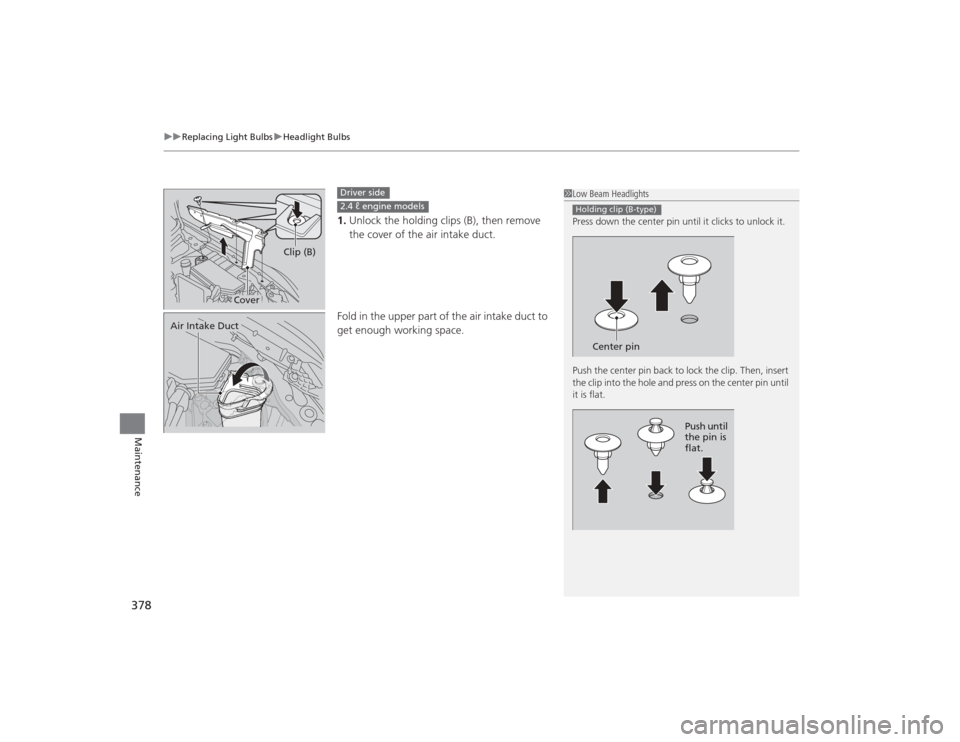
1. Unlock the holding clips (B), then remove
the cover of the air intake duct.
Fold in the upper part of the air intake duct to
get enough working space.
1 Low Beam Headlights
Press down the center pin until it clicks to unlock it.
Push the center pin back to lock the clip. Then, insert
the clip into the hole and press on the center pin until
it is flat.Holding clip (B-type)
Center pin
Push until
the pin is
flat.
Cover Clip (B)
Driver side2.4 ℓ engine models
Air Intake Duct
Page 384 of 469
383
uuReplacing Light Bulbs uFront Turn Signal/Parking/Side Marker Light Bulbs
Continued
Maintenance
Front Turn Signal/Parking/Side Marker Light BulbsWhen replacing, use the following bulbs.
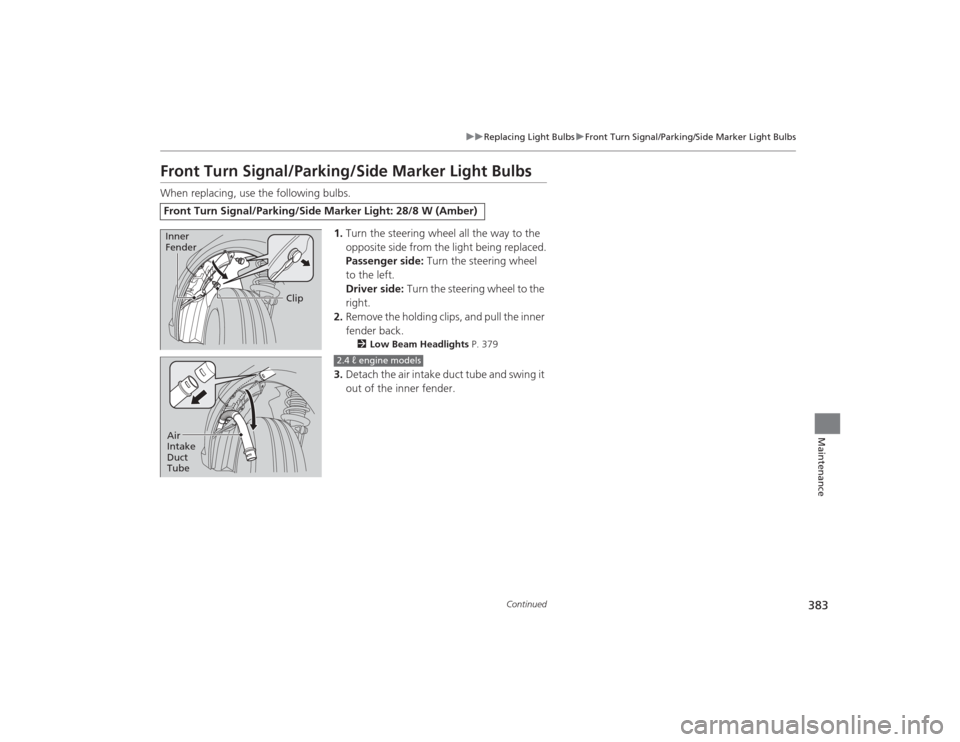
1.Turn the steering wheel all the way to the
opposite side from the light being replaced.
Passenger side: Turn the steering wheel
to the left.
Driver side: Turn the steering wheel to the
right.
2. Remove the holding clips, and pull the inner
fender back.
2 Low Beam Headlights P. 379
3.Detach the air intake duct tube and swing it
out of the inner fender.
Front Turn Signal/Parking/Side Marker Light: 28/8 W (Amber)
Clip
Inner
Fender
Air
Intake
Duct
Tube
2.4 ℓ engine models
Page 389 of 469
388
uuReplacing Light Bulbs uHigh-Mount Brake Light Bulb
Maintenance
High-Mount Brake Light BulbWhen replacing, use the following bulb.
1.Open the trunk.
2. Turn the socket to the left and remove it.
3. Remove the old bulb a nd insert a new bulb.
High-mount brake light bulbs are LED type. Have an authorized Honda dealer
inspect and replace the light assembly.High-Mount Brake Light: 21 W1.8 ℓ engine models
BulbSocket
2.4 ℓ engine models
Page 407 of 469
406
uuCleaning uExterior Care
Maintenance
Exterior CareDust off the vehicle body after you drive.
Regularly inspect your vehicle for scratches on painted surfaces. A scratch on a
painted surface can result in body rust. If you find a scratch, promptly repair it.
Wash the vehicle regularly. Wash more frequently when driving in the following
conditions:
• If driving on roads with road salt.
• If driving in coastal areas.
• If tar, soot, bird droppings, insects, or tree sap are stuck to painted surfaces.
Fold in the door mirrors. Make sure to follow the instructions indicated on the
automated car wash.
• Keep sufficient distance between the cleaning nozzle and the vehicle body.
• Take particular care around the windows. Standing too close may cause water to
enter the vehicle interior.
• Do not spray high pressure water directly into the engine compartment. Instead,
use low pressure water and a mild detergent.■
Washing the Vehicle
■
Using an Automated Car Wash
■
Using High Pressure Cleaners
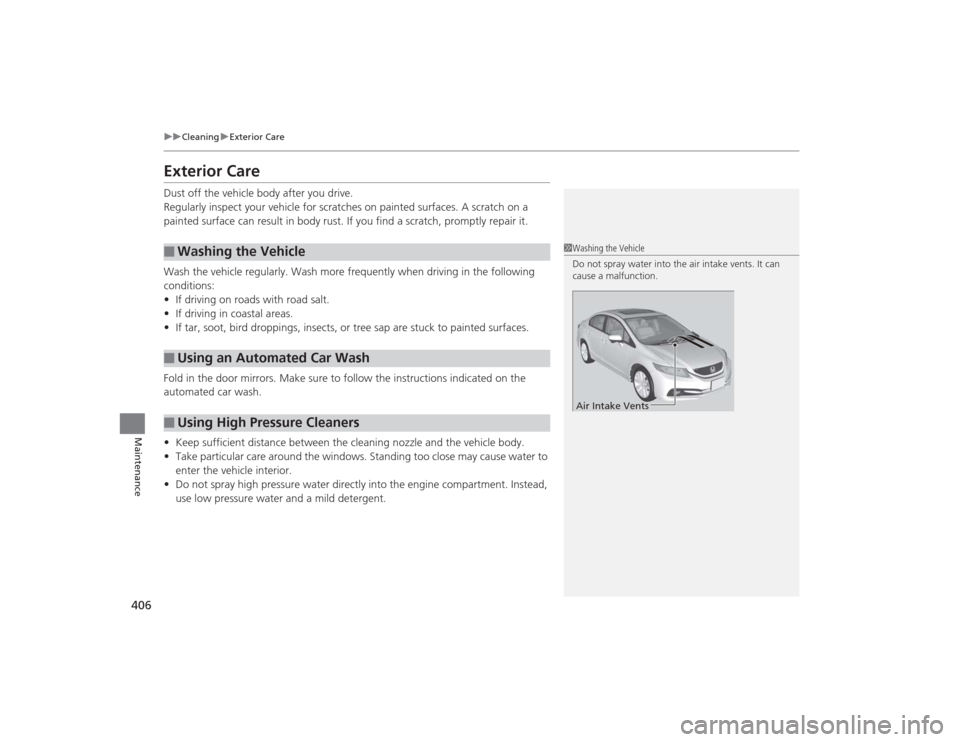
1Washing the Vehicle
Do not spray water into the air intake vents. It can
cause a malfunction.Air Intake Vents