Page 384 of 469
383
uuReplacing Light Bulbs uFront Turn Signal/Parking/Side Marker Light Bulbs
Continued
Maintenance
Front Turn Signal/Parking/Side Marker Light BulbsWhen replacing, use the following bulbs.
1.Turn the steering wheel all the way to the
opposite side from the light being replaced.
Passenger side: Turn the steering wheel
to the left.
Driver side: Turn the steering wheel to the
right.
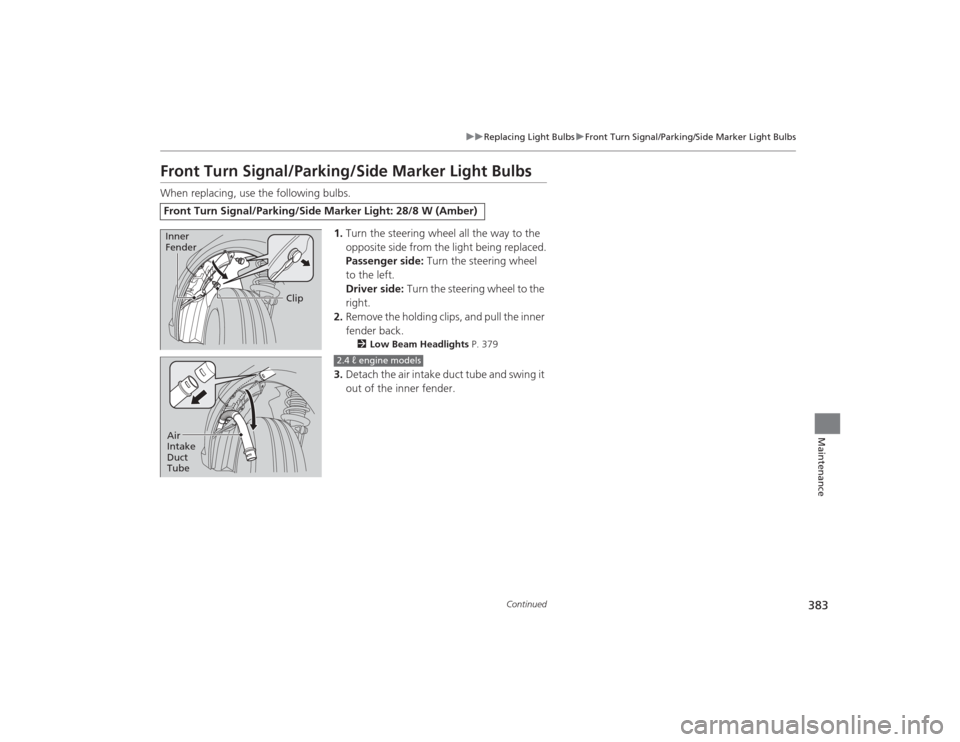
2. Remove the holding clips, and pull the inner
fender back.
2 Low Beam Headlights P. 379
3.Detach the air intake duct tube and swing it
out of the inner fender.
Front Turn Signal/Parking/Side Marker Light: 28/8 W (Amber)
Clip
Inner
Fender
Air
Intake
Duct
Tube
2.4 ℓ engine models
Page 385 of 469
384
uuReplacing Light Bulbs uFront Turn Signal/Parking/Side Marker Light Bulbs
Maintenance
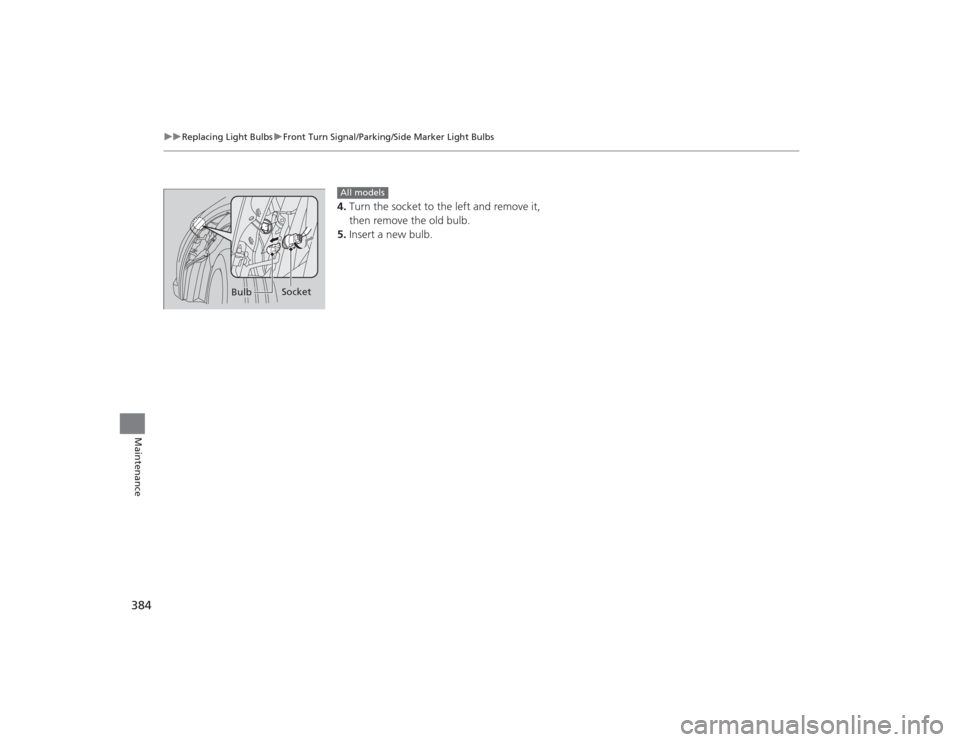
4. Turn the socket to the left and remove it,
then remove the old bulb.
5. Insert a new bulb.
Bulb Socket
All models
Page 386 of 469
385
uuReplacing Light Bulbs uBrake/Taillight, Rear Turn Signal Light and Rear Side Marker Light Bulbs
Maintenance
Brake/Taillight, Rear Turn Signal Light and Rear Side Marker Light BulbsWhen replacing, use the following bulbs.
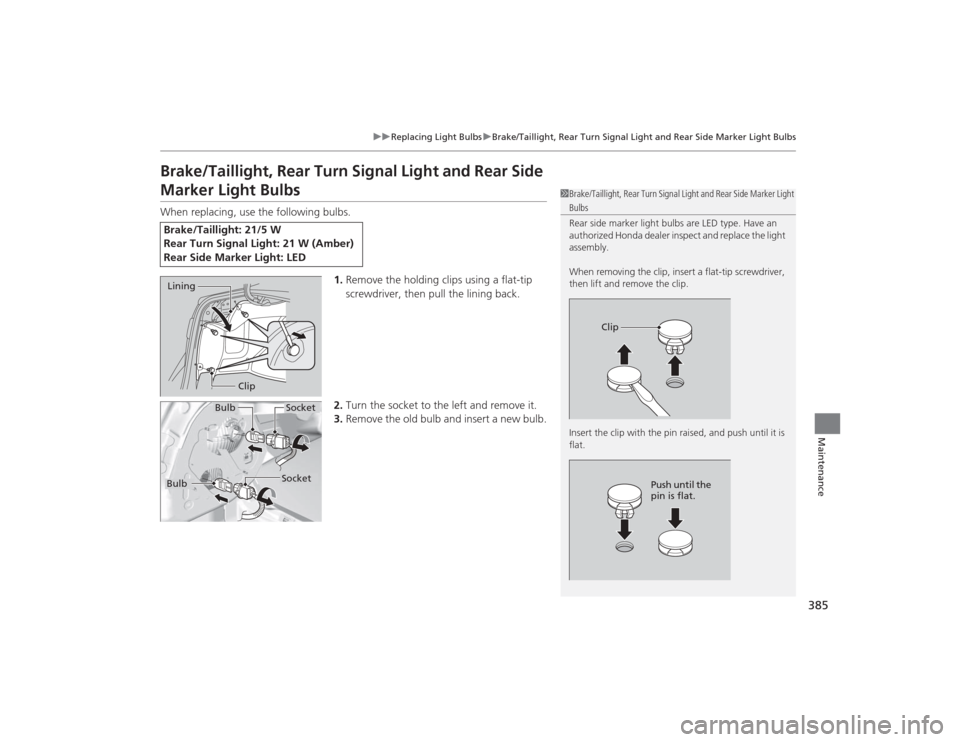
1.Remove the holding clips using a flat-tip
screwdriver, then pull the lining back.
2. Turn the socket to the left and remove it.
3. Remove the old bulb and insert a new bulb.Brake/Taillight: 21/5 W
Rear Turn Signal Light: 21 W (Amber)
Rear Side Marker Light: LED
1Brake/Taillight, Rear Turn Signal Light and Rear Side Marker Light Bulbs
Rear side marker light bulbs are LED type. Have an
authorized Honda dealer inspect and replace the light
assembly.
When removing the clip, insert a flat-tip screwdriver,
then lift and remove the clip.
Insert the clip with the pin raised, and push until it is
flat.
Clip
Push until the
pin is flat.
Lining
Clip
Bulb
Socket
Bulb
Socket
Page 387 of 469
386
uuReplacing Light Bulbs uTaillight and Back-Up Light Bulbs
Maintenance
Taillight and Back-Up Light BulbsWhen replacing, use the following bulbs.
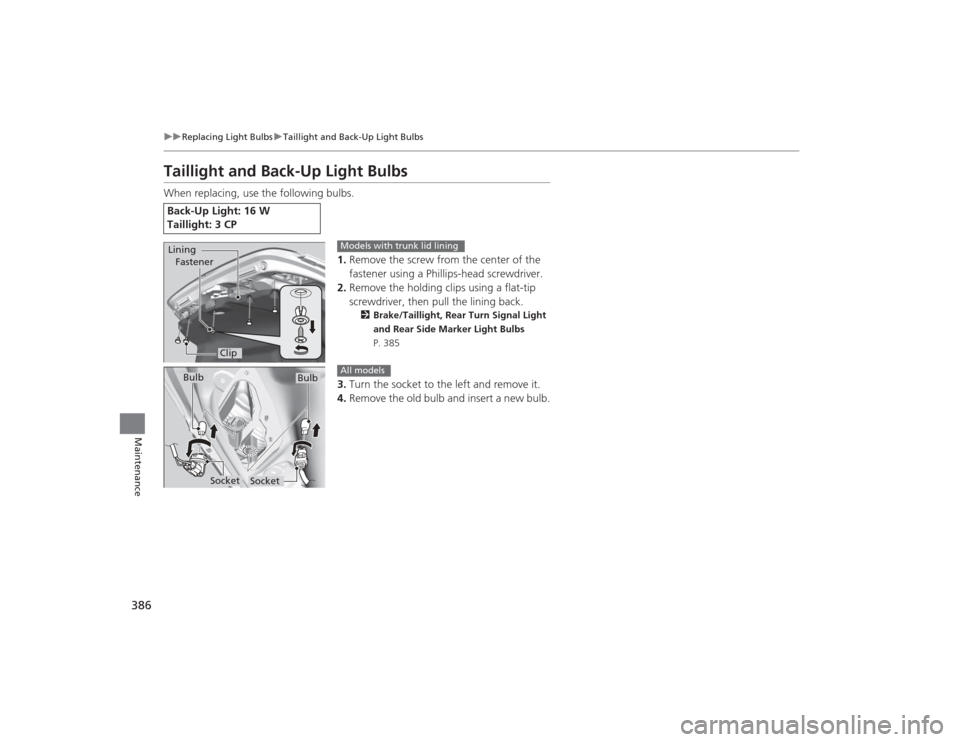
1.Remove the screw from the center of the
fastener using a Phillips-head screwdriver.
2. Remove the holding clips using a flat-tip
screwdriver, then pull the lining back.
2 Brake/Taillight, Rear Turn Signal Light
and Rear Side Marker Light Bulbs
P. 385
3. Turn the socket to the left and remove it.
4. Remove the old bulb a nd insert a new bulb.
Back-Up Light: 16 W
Taillight: 3 CPLining
Fastener
Clip
Models with trunk lid lining
Bulb
Socket
Bulb
Socket
All models
Page 388 of 469
387
uuReplacing Light Bulbs uRear License Plate Light Bulbs
Maintenance
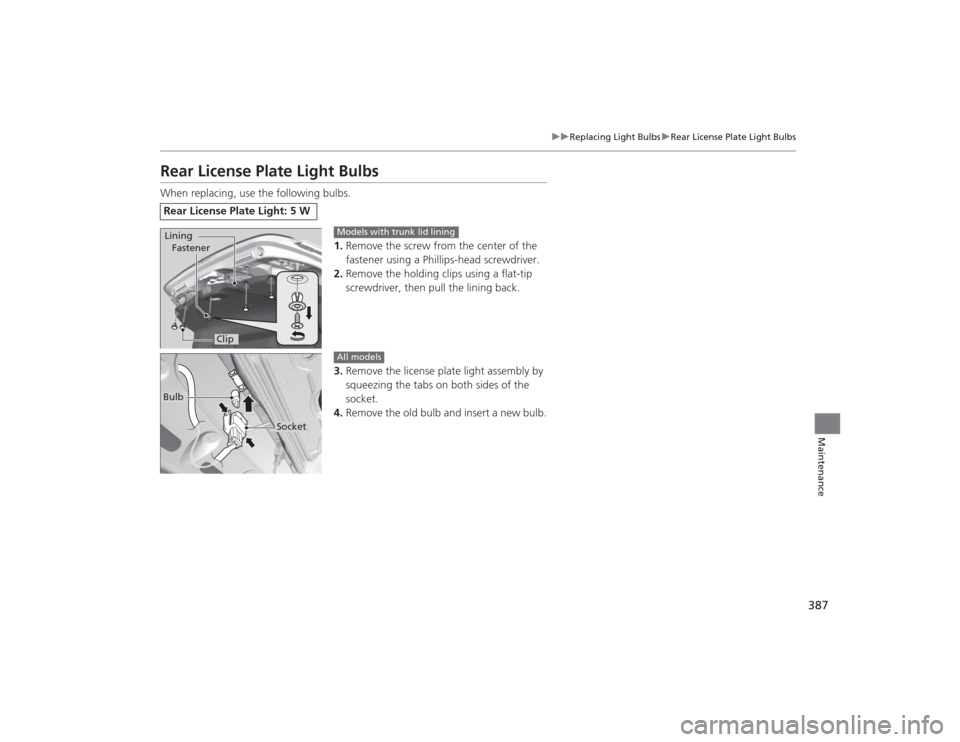
Rear License Plate Light BulbsWhen replacing, use the following bulbs.
1.Remove the screw from the center of the
fastener using a Phillips-head screwdriver.
2. Remove the holding clips using a flat-tip
screwdriver, then pull the lining back.
3. Remove the license plate light assembly by
squeezing the tabs on both sides of the
socket.
4. Remove the old bulb and insert a new bulb.Rear License Plate Light: 5 W Lining
Fastener
Clip
Models with trunk lid lining
Bulb
Socket
All models
Page 389 of 469
388
uuReplacing Light Bulbs uHigh-Mount Brake Light Bulb
Maintenance
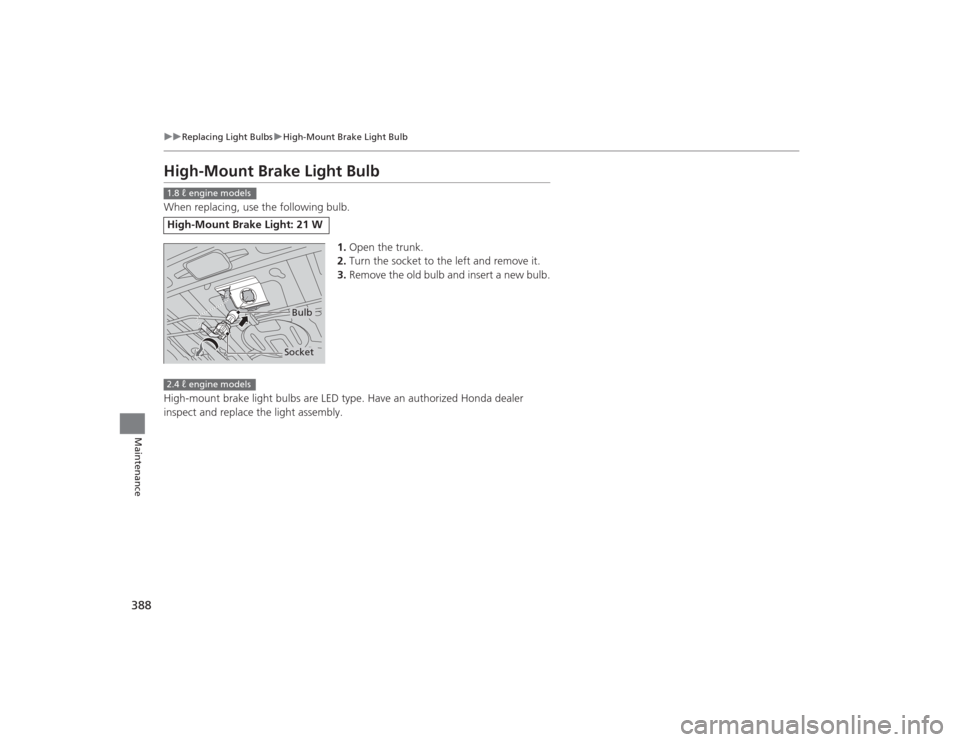
High-Mount Brake Light BulbWhen replacing, use the following bulb.
1.Open the trunk.
2. Turn the socket to the left and remove it.
3. Remove the old bulb a nd insert a new bulb.
High-mount brake light bulbs are LED type. Have an authorized Honda dealer
inspect and replace the light assembly.High-Mount Brake Light: 21 W1.8 ℓ engine models
BulbSocket
2.4 ℓ engine models
Page 409 of 469
408
uuCleaning uExterior Care
Maintenance
The inside lenses of exterior lights (headlights, brake lights, etc.) may fog temporarily
if you have driven in the rain, or after the vehicle has been run through a car wash.
Dew condensation also may build up inside the lenses when there is a significant
enough difference between the ambient and inside lens temperatures (similar to
vehicle windows fogging up in rainy conditions). These conditions are natural
processes, not structural design problems in the exterior lights.
Lens design characteristics may result in moisture developing on the light lens frame
surfaces. This also is not a malfunction.
However, if you see large amounts of water accumulation, or large water drops
building up inside the lenses, have your vehicle inspected by a dealer.■
Fogged Exterior Light Lenses
Page 412 of 469

411
Continued
Handling the Unexpected
If a Tire Goes FlatChanging a Flat TireIf a tire goes flat while driving, grasp the steering wheel firmly, and brake gradually
to reduce speed. Then, stop in a safe place. Replace the flat tire with a compact
spare tire. Go to a dealer as soon as possible to have the full-size tire repaired or
replaced.
1.Park the vehicle on firm, level, and non-slippery surface, and apply the parking
brake.
2. Put the shift lever in
(P
.
2. Put the shift lever in
(R
.
3. Turn on the hazard warning lights and turn the ignition switch to LOCK
(0
*1.
*1: Models with the smart entry system have an ENGINE START/STOP button instead of an
ignition switch.Models with compact spare tire
1 Changing a Flat Tire
Periodically check the tire pressure of the compact
spare. It should be set to the specified pressure.
Specified Pressure: 60 psi (420 kPa, 4.2 kgf/cm
2)
When driving with the compact spare tire, keep the
vehicle speed under 50 mph (80 km/h). Replace with
a full-size tire as soon as possible.
The compact spare tire and wheel in your vehicle are
specifically for this model. Do not use them with
another vehicle. Do not use another type of compact
spare tire or wheel with your vehicle.
Do not mount tire chains on a compact spare tire.
If a chain-mounted front tire goes flat, remove one of
the full-size rear tires and replace it with the compact
spare tire. Remove the flat front tire and replace it
with the full-size tire that was removed from the rear.
Mount the tire chains on the front tire.
Automatic transmission (CVT) modelsManual transmission modelsAll models