2014 HONDA ACCORD HYBRID center
[x] Cancel search: centerPage 15 of 561

14
Quick Reference Guide
Drive Cycle Score/Lifetime Points ●Comes on when the power mode is in VEHICLE OFF (LOCK).
Eco Drive Display (P99)
● Keep the vehicle icon near the center of the circle.
Aggressive
Deceleration
Fuel economy is:
Best
Drive
Cycle
Score
Lifetime Points
Worse Worse
Better Better
Moderate
Deceleration Slow
Acceleration/
Deceleration Aggressive
Acceleration
Moderate
Acceleration
Main Menu
Page 20 of 561
19
Quick Reference Guide
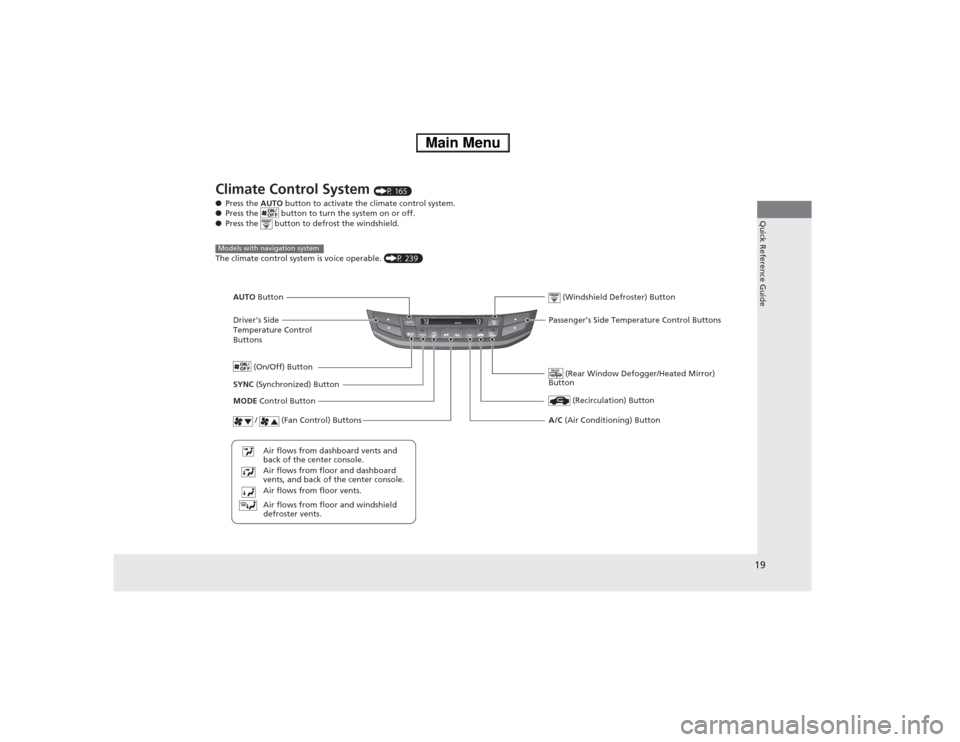
Climate Control System (P 165)
● Press the AUTO button to activate the climate control system.
● Press the button to turn the system on or off.
● Press the button to defrost the windshield.
The climate control system is voice operable. (P 239)
Models with navigation system
Driver’s Side
Temperature Control
Buttons
(Rear Window Defogger/Heated Mirror)
Button
(Windshield Defroster) Button
SYNC (Synchronized) Button
Air flows from floor and windshield
defroster vents.
Air flows from floor vents.
Air flows from floor and dashboard
vents, and back of the center console.
Air flows from dashboard vents and
back of the center console.
AUTO
Button
(On/Off) Button
(Recirculation) ButtonMODE Control Button
/ (Fan Control) Buttons
A/C (Air Conditioning) Button
Passenger’s Side Temperature Control Buttons
Main Menu
Page 36 of 561

35
uuFor Safe DrivinguYour Vehicle's Safety Features
Safe DrivingFor the safety of you and your passengers, make a habit of checking these items
each time before you drive. •After everyone has entered the vehicle, be sure all doors are closed and locked.
Locking the doors helps prevent an occupant from being ejected and an outsider
from unexpectedly opening a door.
2 Locking/Unlocking the Doors from the Inside P. 118
• Adjust your seat to a position suitable for driving. Be sure the front seats are
adjusted as far to the rear as possible while allowing the driver to control the
vehicle. Sitting too close to a front airbag can result in serious or fatal injury in a crash.
2 Adjusting the Seats P. 148
• Adjust head restraints to the proper position. Head restraints are most effective
when the center of the head restraint aligns with the center of your head. Taller
persons should adjust their head restraint to the highest position.
2 Adjusting the Head Restraints P. 151
• Always wear your seat belt, and make sure you wear it properly. Confirm that any
passengers are properly belted as well.
2 Fastening a Seat Belt P. 39
• Protect children by using seat belts or child seats according to a child's age, height
and weight.
2 Child Safety P. 56
■Safety CheckList1Safety CheckList
If the Door Open or Door And Trunk Open
message appears on the multi-information display, a
door and/or the trunk is not completely closed. Close
all doors and the trunk tightly until the message diappears. 2 Multi-Information Display Warning and
Information Messages P. 84
Table of ContentsMain Menu
Page 41 of 561
uuSeat BeltsuFastening a Seat Belt
40
Safe Driving
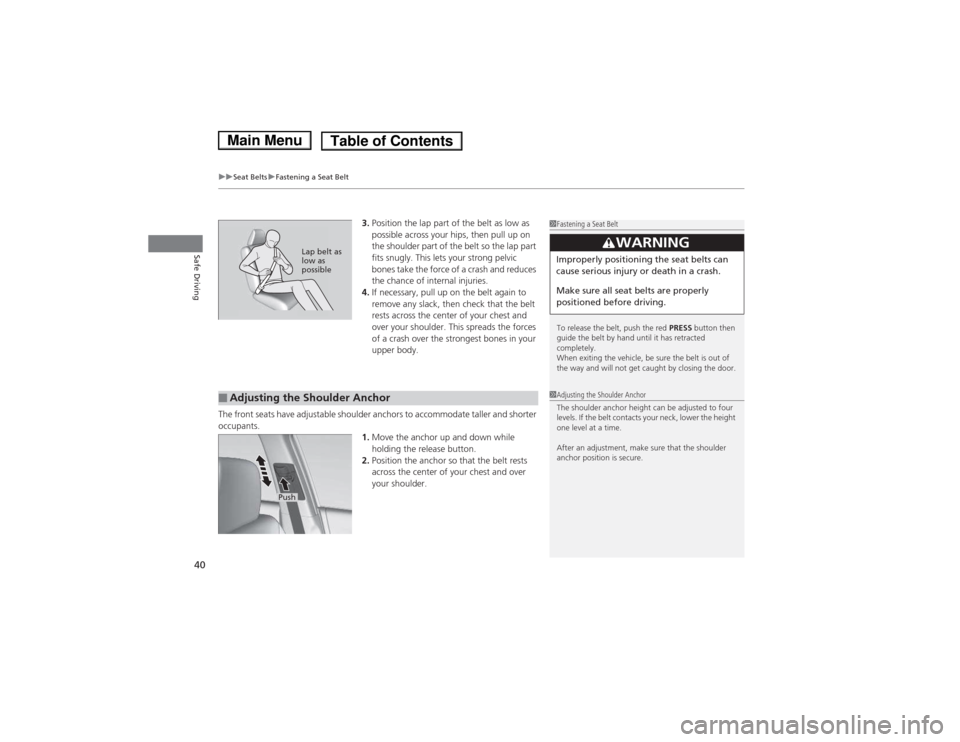
3. Position the lap part of the belt as low as
possible across your hips, then pull up on
the shoulder part of the belt so the lap part
fits snugly. This lets your strong pelvic
bones take the force of a crash and reduces
the chance of internal injuries.
4. If necessary, pull up on the belt again to
remove any slack, then check that the belt
rests across the center of your chest and
over your shoulder. This spreads the forces
of a crash over the strongest bones in your
upper body.
The front seats have adjustable shoulder anchors to accommodate taller and shorter
occupants. 1.Move the anchor up and down while holding the release button.
2. Position the anchor so that the belt rests
across the center of your chest and over
your shoulder.1Fastening a Seat Belt
To release the belt, push the red PRESS button then
guide the belt by hand until it has retracted completely.
When exiting the vehicle, be sure the belt is out of
the way and will not get caught by closing the door.
3WARNING
Improperly positioning the seat belts can
cause serious injury or death in a crash.
Make sure all seat belts are properly
positioned before driving.Lap belt as
low as
possible
■Adjusting the Shoulder Anchor1Adjusting the Shoulder Anchor
The shoulder anchor height can be adjusted to four
levels. If the belt contacts your neck, lower the height
one level at a time.
After an adjustment, make sure that the shoulder
anchor position is secure.
Push
Table of ContentsMain Menu
Page 45 of 561

44
uuAirbagsuAirbag System Components
Safe Driving
The front, front side, and side curtain
airbags are deployed according to the
direction and severity of impact. Both side
curtain airbags are deployed in a rollover.
The airbag system includes:
aTwo SRS (Supplemental Restraint System)
front airbags. The driver's airbag is stored
in the center of the steering wheel; the
front passenger's airbag is stored in the
dashboard. Both are marked SRS
AIRBAG .
bTwo side airbags, one for the driver and
one for a front passenger. The airbags are
stored in the outer edges of the seat-
backs. Both are marked SIDE AIRBAG.
cTwo side curtain airbags, one for each
side of the vehicle. The airbags are stored
in the ceiling, above the side windows.
The front and rear pillars are marked
SIDE CURTAIN AIRBAG .
dAn electronic control unit that continually
monitors and records information about
the sensors, the airbag activators, the
seat belt tensioners, and driver and front
passenger seat belt use when the power
mode is in ON.
eAutomatic front seat belt tensioners. The
driver's and front passenger's seat belts
incorporate sensors that detect whether
or not they are fastened.
fA driver's seat position sensor. If the seat
is too far forward, the airbag will inflate
with less force.
gWeight sensors in the front passenger's
seat. The front passenger's airbag will be
turned off if the weight on the seat is 65
lbs (29 kg) or less (the weight of an infant
or small child).
hImpact sensors that can detect a
moderate-to-severe front or side impact.
iAn indicator on the dashboard that alerts
you that the front passenger's front
airbag has been turned off.
jAn indicator on the instrument panel that
alerts you to a possible problem with your
airbag system or seat belt tensioners.
kSafing Sensor
lA rollover sensor that detects whether
the vehicle is about to roll over.
Table of ContentsMain Menu
Page 47 of 561
46
uuAirbagsuTypes of Airbags
Safe Driving
Types of Airbags
Your vehicle is equipped with three types of airbags: •Front airbags: Airbags in front of the driver's and front passenger's seats.
• Side airbags: Airbags in the driver's and front passenger's seat-backs.
• Side curtain airbags: Airbags above the side windows.
Each is discussed in the following pages.
Front Airbags (SRS)
The front SRS airbags inflate in a moderate-to-severe frontal collision to help protect
the head and chest of the driver and/or front passenger.
SRS (Supplemental Restraint System) indicates that the airbags are designed to
supplement seat belts, not replace them. Seat belts are the occupant's primary restraint system.
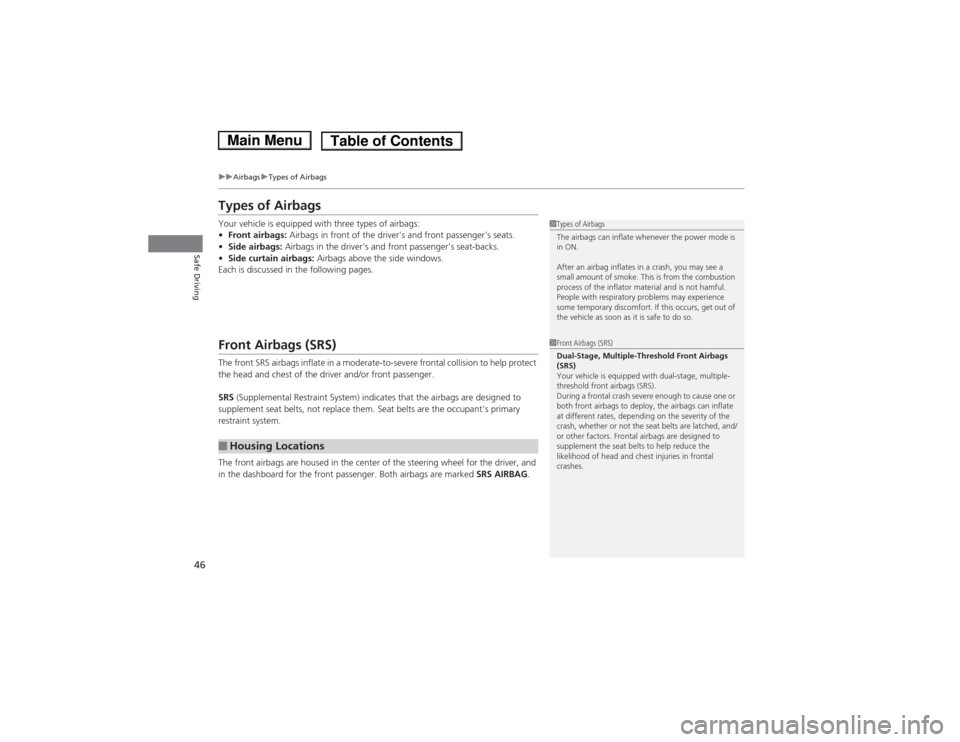
The front airbags are housed in the center of the steering wheel for the driver, and
in the dashboard for the front passenger. Both airbags are marked SRS AIRBAG.
■Housing Locations
1Types of Airbags
The airbags can inflate whenever the power mode is in ON.
After an airbag inflates in a crash, you may see a
small amount of smoke. This is from the combustion
process of the inflator material and is not hamful.
People with respiratory problems may experience
some temporary discomfort. If this occurs, get out of
the vehicle as soon as it is safe to do so.
1Front Airbags (SRS)
Dual-Stage, Multiple-Threshold Front Airbags (SRS)
Your vehicle is equipped with dual-stage, multiple-
threshold front airbags (SRS).
During a frontal crash severe enough to cause one or
both front airbags to deploy, the airbags can inflate
at different rates, depending on the severity of the
crash, whether or not the seat belts are latched, and/
or other factors. Frontal airbags are designed to
supplement the seat belts to help reduce the
likelihood of head and chest injuries in frontal crashes.
Table of ContentsMain Menu
Page 66 of 561
65
uuChild SafetyuSafety of Infants and Small Children
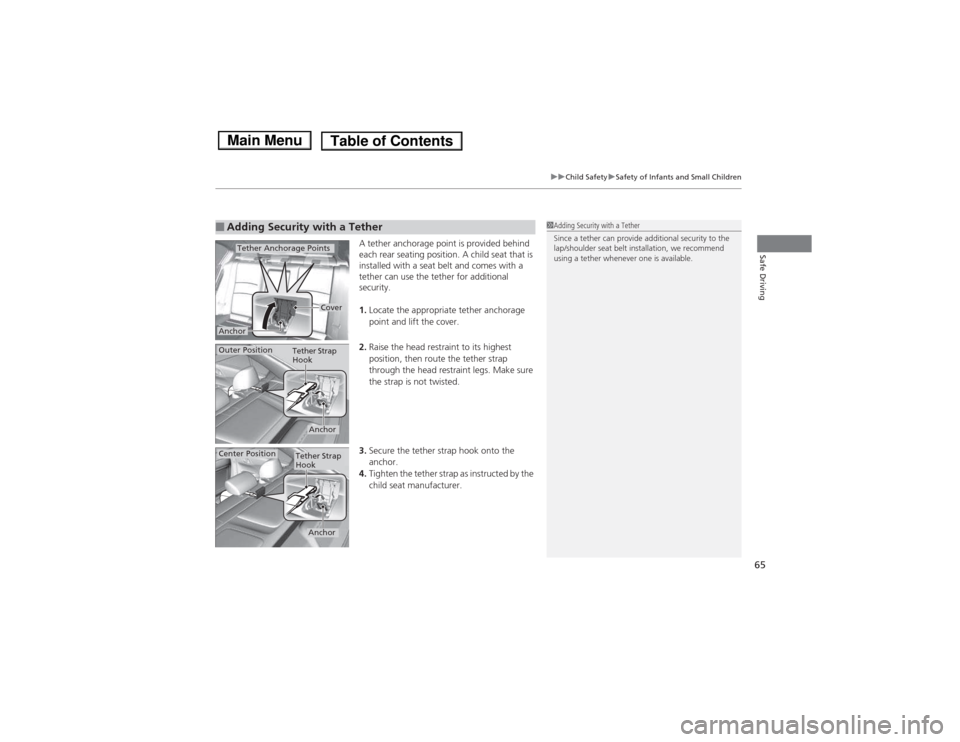
Safe DrivingA tether anchorage point is provided behind
each rear seating position. A child seat that is
installed with a seat belt and comes with a
tether can use the tether for additional
security. 1.Locate the appropriate tether anchorage
point and lift the cover.
2. Raise the head restraint to its highest
position, then route the tether strap
through the head restraint legs. Make sure the strap is not twisted.
3. Secure the tether strap hook onto the anchor.
4. Tighten the tether strap as instructed by the
child seat manufacturer.
■Adding Security with a Tether1Adding Security with a Tether
Since a tether can provide additional security to the
lap/shoulder seat belt installation, we recommend
using a tether whenever one is available.
Tether Anchorage Points
Cover
Anchor
Outer Position
Tether Strap
Hook
Anchor
Center PositionTether Strap
Hook
Anchor
Table of ContentsMain Menu
Page 100 of 561

Continued99
uuGauges and Multi-Information DisplayuMulti-Information Display
Instrument Panel
The vehicle icon on the display moves forward or backward while driving.
The more aggressive the acceleration is, the further the icon moves forward.
The more aggressive the deceleration is, the further the icon moves backward.
Keep the icon near the center of the circle for better fuel economy while driving.
The fuel economy display color changes while driving. The area around the vehicle
icon becomes blue with aggressive acceleration and deceleration, and blue green as
fuel economy gets better, then green when driving in the most fuel efficient style.
Keep the color green as long as possible.
■Eco Drive Display1Eco Drive Display
The ambient meter color changes corresponding to
the eco drive display.
Aggressive
Deceleration
Vehicle Icon Aggressive
Acceleration
Blue Green Blue Moderate
Deceleration
Slow
Acceleration/
Deceleration Moderate
Acceleration
Blue green Blue green
Main MenuTable of Contents