Page 2 of 561
Contents
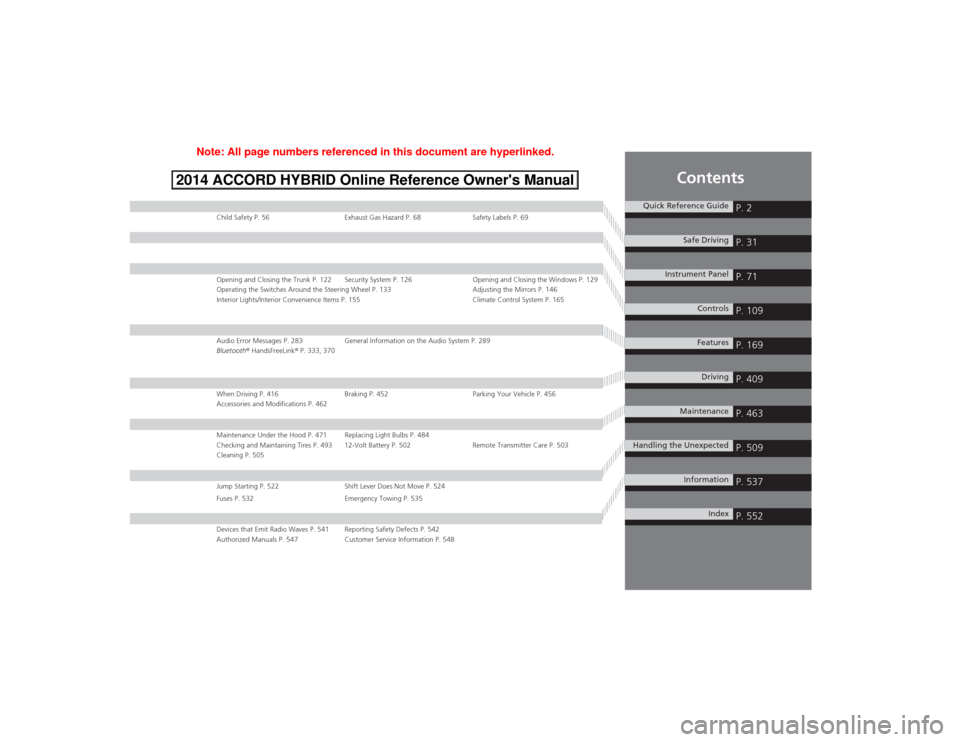
Child Safety P. 56 Exhaust Gas Hazard P. 68 Safety Labels P. 69
Opening and Closing the Trunk P. 122 Security System P. 126 Opening and Closing the Windows P. 129
Operating the Switches Around the Steering Wheel P. 133 Adjusting the Mirrors P. 146
Interior Lights/Interior Convenience Items P. 155 Climate Control System P. 165
Audio Error Messages P. 283 General Information on the Audio System P. 289
Bluetooth® HandsFreeLink ® P. 333, 370
When Driving P. 416 Braking P. 452 Parking Your Vehicle P. 456
Accessories and Modifications P. 462
Maintenance Under the Hood P. 471 Replacing Light Bulbs P. 484
Checking and Maintaining Tires P. 493 12-Volt Battery P. 502 Remote Transmitter Care P. 503
Cleaning P. 505
Jump Starting P. 522 Shift Lever Does Not Move P. 524
Fuses P. 532 Emergency Towing P. 535
Devices that Emit Radio Waves P. 541 Reporting Safety Defects P. 542
Authorized Manuals P. 547 Customer Service Information P. 548
Quick Reference GuideP. 2
Safe DrivingP. 31
Instrument PanelP. 71
ControlsP. 109
FeaturesP. 169
DrivingP. 409
MaintenanceP. 463
Handling the UnexpectedP. 509
InformationP. 537
IndexP. 552
Note: All page numbers referenced in this document are hyperlinked.
2014 ACCORD HYBRID Online Reference Owner's Manual
Page 3 of 561
2
Quick Reference Guide
Quick Reference Guide
Visual Index
❙System Indicators (P 72)
❙Gauges (P 92)
❙Navigation System *
() See Navigation System Manual
❙Audio System (P 175, 197, 230)
❙POWER Button (P 133)
❙Rear Window Defogger (P 142)
❙Front Seat Heater Switches *
(P 163)
❙ECON Button (P 422)
❙Multi-Information Display (P 94)
❙Heated Mirror Button (P 142)
❙Climate Control System (P 165)
❙Lane Departure Warning (LDW) Button *
(P 441)
❙Hazard Warning Button
❙Audio with Touch Screen *
(P 198, 231)
❙Audio/Information Screen
(P 176, 201, 233)
❙Acoustic Vehicle Alerting System Button *
(P 423)
❙ (Vehicle Stability Assist (VSA ®) System OFF) Button (P 444)
Main Menu
Page 5 of 561
Visual Index
4
Quick Reference Guide
❙Door Mirror Controls (P 147)
❙Passenger's Front Airbag
(P 46)
❙Parking Brake (P 452)
❙Glove Box (P 157)
❙Rearview Mirror (P 146)
❙Hood Release Handle (P 472)
❙Power Door Lock Master Switch (P 120)
❙Power Window Switches (P 129)
❙Interior Fuse Box (P 533)
❙Driver's Front Airbag (P 46)
❙Trunk Main Switch (P 124)
❙Fuel Fill Door Release Handle (P 460)
❙Trunk Release (P 122)
❙Shift Lever Transmission (P 420)
❙USB Port
(P 171)
❙Auxiliary Input Jack (P 172)
❙Accessory Power Socket
(P 160)
❙EV Button (P 10)
Main Menu
Page 19 of 561
18
Quick Reference Guide
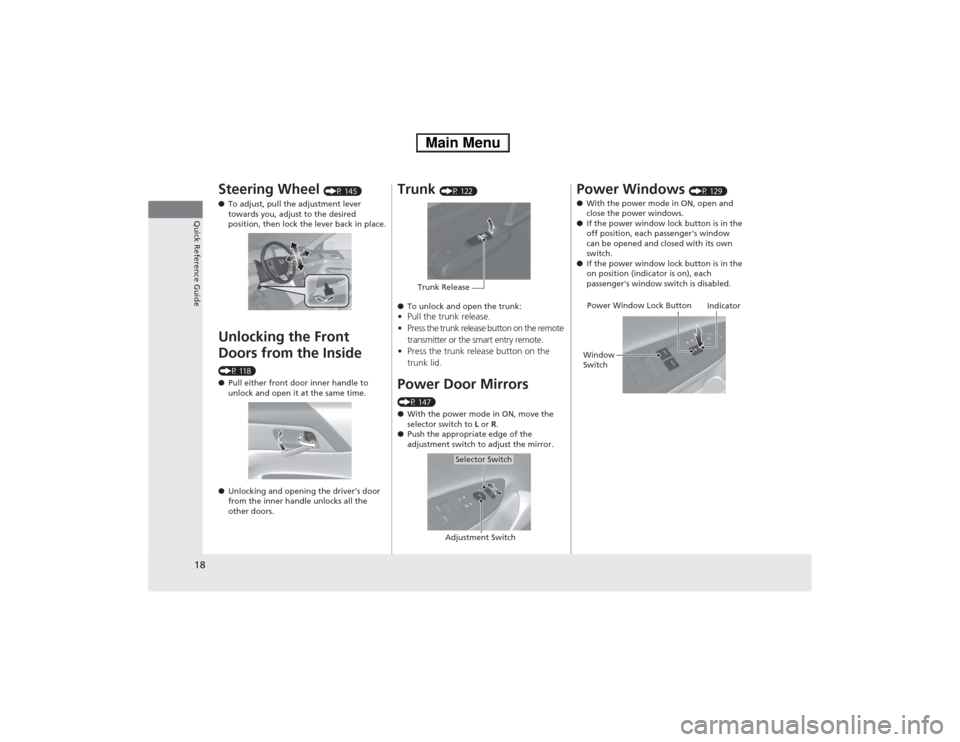
Steering Wheel (P 145)
● To adjust, pull the adjustment lever
towards you, adjust to the desired
position, then lock the lever back in place.
Unlocking the Front Doors from the Inside
(P 118) ● Pull either front door inner handle to
unlock and open it at the same time.
● Unlocking and opening the driver’s door
from the inner handle unlocks all the
other doors.Trunk (P 122)
● To unlock and open the trunk:
• Pull the trunk release.
• Press the trunk release button on the remote
transmitter or the smart entry remote.
• Press the trunk release button on the trunk lid.
Power Door Mirrors
(P 147) ● With the power mode in ON, move the
selector switch to L or R.
● Push the appropriate edge of the
adjustment switch to adjust the mirror.
Trunk Release
Selector Switch
Adjustment Switch
Power Windows (P 129)
● With the power mode in ON, open and
close the power windows.
● If the power window lock button is in the
off position, each passenger's window
can be opened and closed with its own
switch.
● If the power window lock button is in the
on position (indicator is on), each
passenger's window switch is disabled.
Power Window Lock Button
Window
Switch Indicator
Main Menu
Page 20 of 561
19
Quick Reference Guide
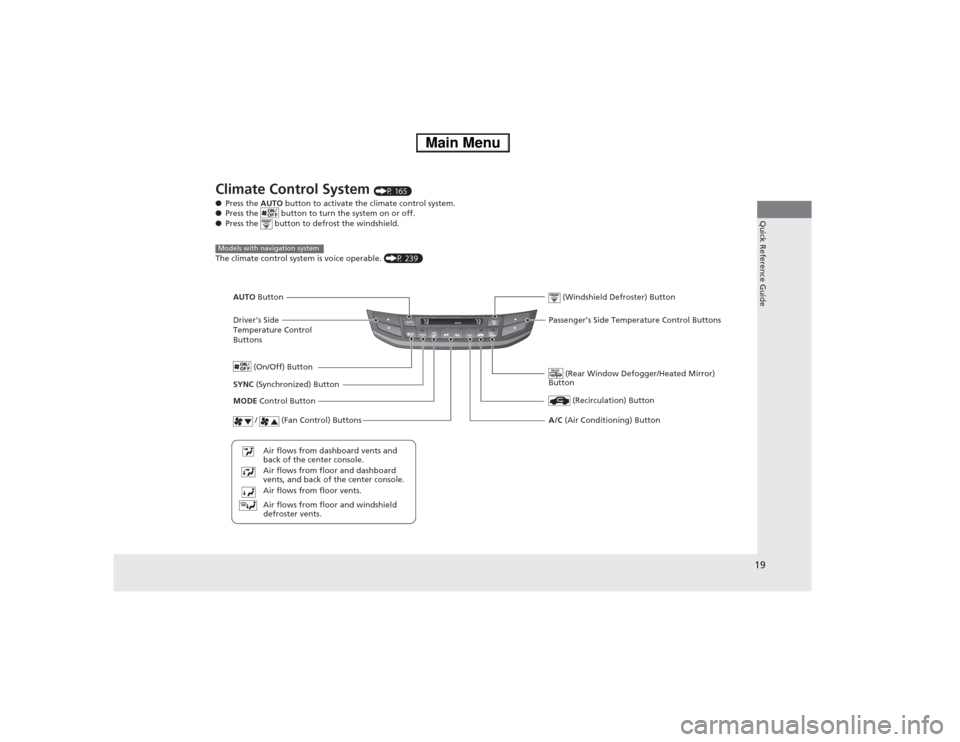
Climate Control System (P 165)
● Press the AUTO button to activate the climate control system.
● Press the button to turn the system on or off.
● Press the button to defrost the windshield.
The climate control system is voice operable. (P 239)
Models with navigation system
Driver’s Side
Temperature Control
Buttons
(Rear Window Defogger/Heated Mirror)
Button
(Windshield Defroster) Button
SYNC (Synchronized) Button
Air flows from floor and windshield
defroster vents.
Air flows from floor vents.
Air flows from floor and dashboard
vents, and back of the center console.
Air flows from dashboard vents and
back of the center console.
AUTO
Button
(On/Off) Button
(Recirculation) ButtonMODE Control Button
/ (Fan Control) Buttons
A/C (Air Conditioning) Button
Passenger’s Side Temperature Control Buttons
Main Menu
Page 45 of 561

44
uuAirbagsuAirbag System Components
Safe Driving
The front, front side, and side curtain
airbags are deployed according to the
direction and severity of impact. Both side
curtain airbags are deployed in a rollover.
The airbag system includes:
aTwo SRS (Supplemental Restraint System)
front airbags. The driver's airbag is stored
in the center of the steering wheel; the
front passenger's airbag is stored in the
dashboard. Both are marked SRS
AIRBAG .
bTwo side airbags, one for the driver and
one for a front passenger. The airbags are
stored in the outer edges of the seat-
backs. Both are marked SIDE AIRBAG.
cTwo side curtain airbags, one for each
side of the vehicle. The airbags are stored
in the ceiling, above the side windows.
The front and rear pillars are marked
SIDE CURTAIN AIRBAG .
dAn electronic control unit that continually
monitors and records information about
the sensors, the airbag activators, the
seat belt tensioners, and driver and front
passenger seat belt use when the power
mode is in ON.
eAutomatic front seat belt tensioners. The
driver's and front passenger's seat belts
incorporate sensors that detect whether
or not they are fastened.
fA driver's seat position sensor. If the seat
is too far forward, the airbag will inflate
with less force.
gWeight sensors in the front passenger's
seat. The front passenger's airbag will be
turned off if the weight on the seat is 65
lbs (29 kg) or less (the weight of an infant
or small child).
hImpact sensors that can detect a
moderate-to-severe front or side impact.
iAn indicator on the dashboard that alerts
you that the front passenger's front
airbag has been turned off.
jAn indicator on the instrument panel that
alerts you to a possible problem with your
airbag system or seat belt tensioners.
kSafing Sensor
lA rollover sensor that detects whether
the vehicle is about to roll over.
Table of ContentsMain Menu
Page 47 of 561
46
uuAirbagsuTypes of Airbags
Safe Driving
Types of Airbags
Your vehicle is equipped with three types of airbags: •Front airbags: Airbags in front of the driver's and front passenger's seats.
• Side airbags: Airbags in the driver's and front passenger's seat-backs.
• Side curtain airbags: Airbags above the side windows.
Each is discussed in the following pages.
Front Airbags (SRS)
The front SRS airbags inflate in a moderate-to-severe frontal collision to help protect
the head and chest of the driver and/or front passenger.
SRS (Supplemental Restraint System) indicates that the airbags are designed to
supplement seat belts, not replace them. Seat belts are the occupant's primary restraint system.
The front airbags are housed in the center of the steering wheel for the driver, and
in the dashboard for the front passenger. Both airbags are marked SRS AIRBAG.
■Housing Locations
1Types of Airbags
The airbags can inflate whenever the power mode is in ON.
After an airbag inflates in a crash, you may see a
small amount of smoke. This is from the combustion
process of the inflator material and is not hamful.
People with respiratory problems may experience
some temporary discomfort. If this occurs, get out of
the vehicle as soon as it is safe to do so.
1Front Airbags (SRS)
Dual-Stage, Multiple-Threshold Front Airbags (SRS)
Your vehicle is equipped with dual-stage, multiple-
threshold front airbags (SRS).
During a frontal crash severe enough to cause one or
both front airbags to deploy, the airbags can inflate
at different rates, depending on the severity of the
crash, whether or not the seat belts are latched, and/
or other factors. Frontal airbags are designed to
supplement the seat belts to help reduce the
likelihood of head and chest injuries in frontal crashes.
Table of ContentsMain Menu
Page 53 of 561
52
uuAirbagsuSide Curtain Airbags
Safe Driving
Side Curtain Airbags
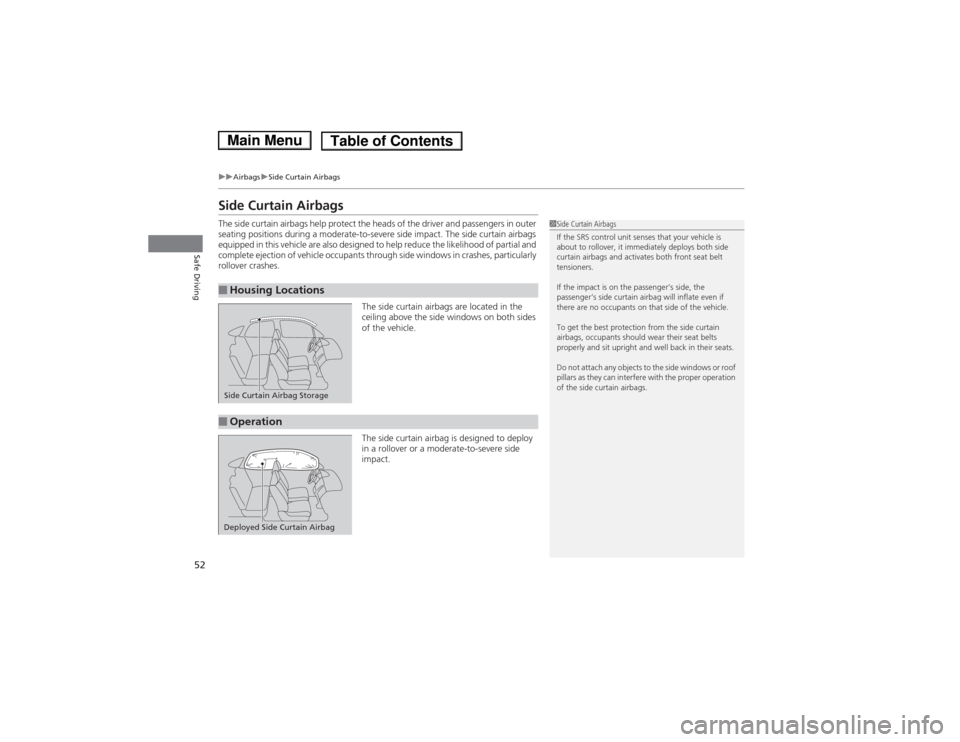
The side curtain airbags help protect the heads of the driver and passengers in outer
seating positions during a moderate-to-severe side impact. The side curtain airbags
equipped in this vehicle are also designed to help reduce the likelihood of partial and
complete ejection of vehicle occupants through side windows in crashes, particularly
rollover crashes.The side curtain airbags are located in the
ceiling above the side windows on both sides
of the vehicle.
The side curtain airbag is designed to deploy
in a rollover or a moderate-to-severe side impact.
■Housing Locations
1Side Curtain Airbags
If the SRS control unit senses that your vehicle is
about to rollover, it immediately deploys both side
curtain airbags and activates both front seat belt
tensioners.
If the impact is on the passenger’s side, the
passenger’s side curtain airbag will inflate even if
there are no occupants on that side of the vehicle.
To get the best protection from the side curtain
airbags, occupants should wear their seat belts
properly and sit upright and well back in their seats.
Do not attach any objects to the side windows or roof
pillars as they can interfere with the proper operation
of the side curtain airbags.
Side Curtain Airbag Storage
■Operation
Deployed Side Curtain Airbag
Table of ContentsMain Menu