Page 150 of 460

WARNINGS
When doing this procedure, you willbe taking the vehicle out of parkwhich means the vehicle can rollfreely. To avoid unwanted vehiclemovement, always fully set the parkingbrake prior to doing this procedure. Usewheel chocks if appropriate.
If the parking brake is fully released,but the brake warning lamp remainsilluminated, the brakes may not beworking properly. See your authorizeddealer.
Your vehicle is equipped with a brake-shiftinterlock feature that prevents thegearshift lever from being moved from P(Park) when the ignition is in the 3 (on)position and the brake pedal is not pressed.
If you cannot move the gearshift lever outof P (Park) position with the ignition in the4 (on) position and the brake pedalpressed, a malfunction may have occurred.It is possible that a fuse has blown or thevehicle’s brake lamps are not operatingproperly. See Fuse Specification Chart(page 215).
If the fuse is not blown and the brakelamps are working properly, the followingprocedure will allow you to move thegearshift lever from P (Park):
1. Apply the parking brake. Turn theignition key to 1 (off), then remove thekey.
2. Move the steering column to the fulldown and full rearward position(toward the driver’s seat).
3. Remove the gearshift lever boot.
4. Place fingers into hole where thegearshift lever boot was removed fromand pull top half of shroud up andforward to separate it from the lowerhalf of the shroud. There is a hinge atthe forward edge of the top shroud.Roll the top half of the shroud upwardon the hinge point to clear the hazardflasher button, then pull straightrearward toward the driver’s seat toremove.
5. Remove the top half of the shroud.
6. Remove the three fasteners under thecolumn that secure the lower shroudhalf to the column.
7.Pull the lock lever into the full unlockedposition and remove the lower shroudcover by pulling the lever handlethrough the slot in the cover.
8.Apply the brake and move the gearshiftlever into N (Neutral).
147
Super Duty (TFA)
TransmissionE163185 E163186
Page 190 of 460

TOWING A TRAILER
WARNINGS
Do not exceed the GVWR orthe GAWR specified on thecertification label.
Towing trailers beyond themaximum recommendedgross trailer weight exceeds thelimit of the vehicle and couldresult in engine damage,transmission damage, structuraldamage, loss of vehicle control,vehicle rollover and personalinjury.
Your vehicle may have electricalitems, such as fuses or relays,related to towing. See the Fuseschapter.
Your vehicle's load capacitydesignation is by weight, not byvolume, so you cannot necessarilyuse all available space whenloading a vehicle.
Towing a trailer places an extraload on your vehicle's engine,transmission, axle, brakes, tiresand suspension. Inspect thesecomponents periodically during,and after, any towing operation.
Load Placement
To help minimize how trailermovement affects your vehiclewhen driving:
•Load the heaviest items closestto the trailer floor.
•Load the heaviest itemscentered between the left andright side trailer tires.
•Load the heaviest items abovethe trailer axles or just slightlyforward toward the trailertongue. Do not allow the finaltrailer tongue weight to goabove or below 10-15% of theloaded trailer weight.
•Select a tow bar with thecorrect rise or drop. When boththe loaded vehicle and trailerare connected, the trailer frameshould be level, or slightlyangled down toward yourvehicle, when viewed from theside.
When driving with a trailer orpayload, a slight takeoff vibrationor shudder may be present due tothe increased payload weight.Additional information regardingproper trailer loading and settingyour vehicle up for towing islocated in another chapter of thismanual. See Load Limit (page176). You can also find theinformation in the RV & TrailerTowing Guide, available at anauthorized dealer.
187
Super Duty (TFA)
Towing
Page 206 of 460

Follow the severe duty schedule in yourScheduled Maintenance information forengine oil and transmission fluid changeintervals.
Snowplowing with your AirbagEquipped Vehicle
WARNINGS
Do not attempt to service, repair, ormodify the airbag supplementalrestraint system (SRS) or its fuses.See your Ford or Lincoln Mercury dealer.
Additional equipment such assnowplow equipment may affect theperformance of the airbag sensorsincreasing the risk of injury. Please refer tothe Body Builders Layout Book forinstructions about the appropriateinstallation of additional equipment.
All occupants of the vehicle,including the driver, should alwaysproperly wear their safety belts, evenwhen provided with an airbagsupplemental restraint system (SRS).
Your vehicle is equipped with a driver andpassenger airbag supplemental restraintsystem. The supplemental restraint systemwill activate in certain frontal and offsetfrontal collisions when the vehicle sustainssufficient frontal deceleration.
Careless or high speed driving whileplowing snow that results in sufficientvehicle decelerations can deploy theairbag. Such driving also increases the riskof accidents
Never remove or defeat the trippingmechanisms designed into the snowremoval equipment by its manufacturer.Doing so may cause damage to the vehicleand the snow removal equipment as wellas possible airbag deployment.
Engine temperature while plowing
When driving with a plow, your engine mayrun at a higher temperature than normalbecause the attached snowplow blade willrestrict airflow to the radiator.
•If you are driving more than 14.91 mi(24 km) at temperatures abovefreezing, angle the plow blade eitherfull left or full right to providemaximum airflow to the radiator.
•If you are driving less than 14.91 mi(24 km) at speeds up to 44.7 mph(72 km/h) in cold weather, you will notneed to worry about blade position toprovide maximum airflow.
Transmission operation whileplowing
WARNING
Do not spin the wheels at over34.2 mph (55 km/h). The tires mayfail and injure a passenger orbystander.
•Shift transfer case to 4L (4WD Low)when plowing in small areas at speedsbelow 5 mph (8 km/h).
•Shift transfer case to 4H (4WD High)when plowing larger areas or light snowat higher speeds. Do not exceed 15 mph(24 km/h).
•Do not shift the transmission from aforward gear to R (Reverse) until theengine is at idle and the wheels havestopped.
203
Super Duty (TFA)
Driving Hints
Page 217 of 460
CHANGING A FUSE
Fuses
WARNING
Always replace a fuse with one thathas the specified amperage rating.Using a fuse with a higher amperagerating can cause severe wire damage andcould start a fire.
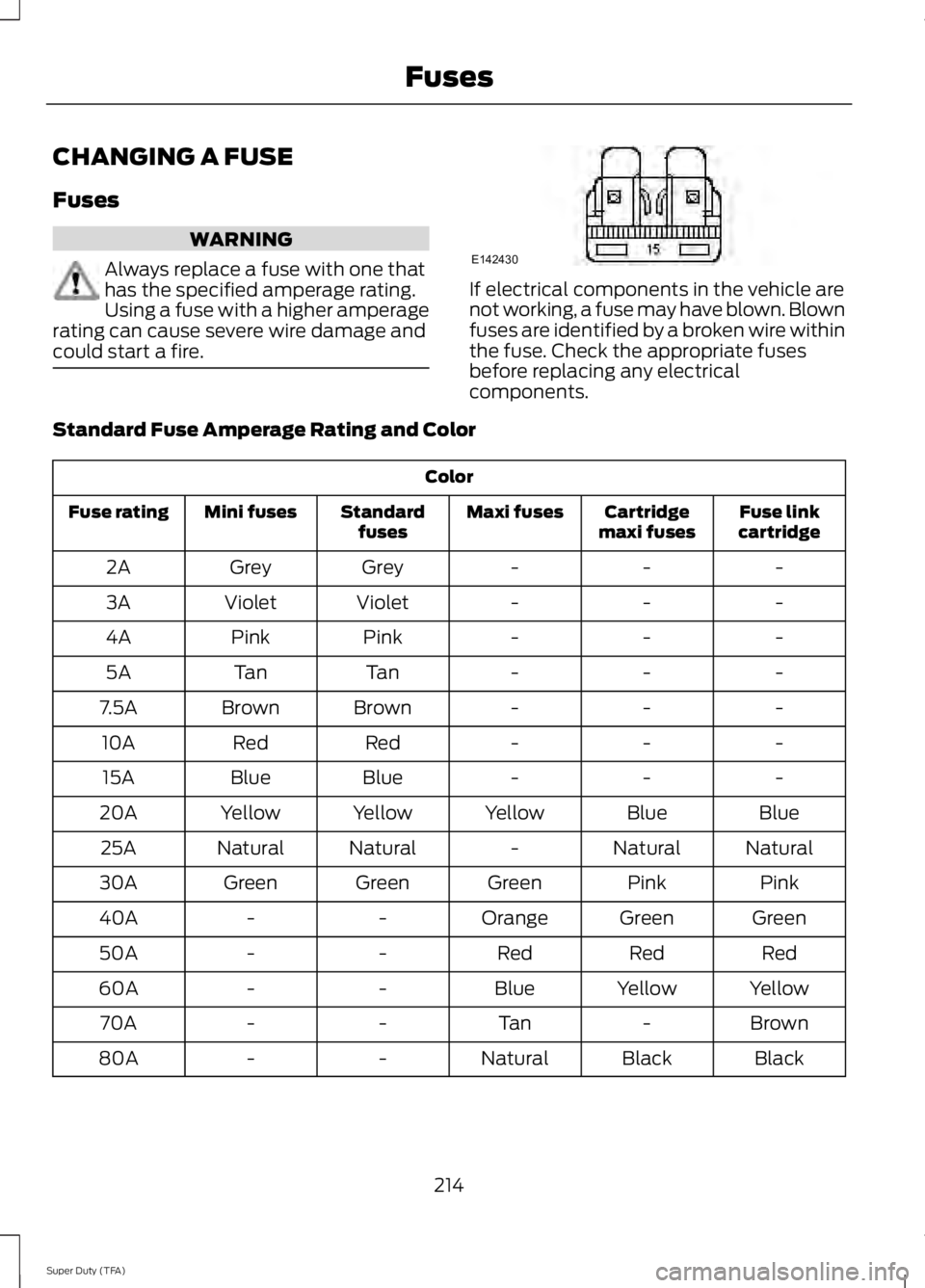
If electrical components in the vehicle arenot working, a fuse may have blown. Blownfuses are identified by a broken wire withinthe fuse. Check the appropriate fusesbefore replacing any electricalcomponents.
Standard Fuse Amperage Rating and Color
Color
Fuse linkcartridgeCartridgemaxi fusesMaxi fusesStandardfusesMini fusesFuse rating
---GreyGrey2A
---VioletViolet3A
---PinkPink4A
---TanTan5A
---BrownBrown7.5A
---RedRed10A
---BlueBlue15A
BlueBlueYellowYellowYellow20A
NaturalNatural-NaturalNatural25A
PinkPinkGreenGreenGreen30A
GreenGreenOrange--40A
RedRedRed--50A
YellowYellowBlue--60A
Brown-Tan--70A
BlackBlackNatural--80A
214
Super Duty (TFA)
FusesE142430
Page 218 of 460
FUSE SPECIFICATION CHART
Power Distribution Box
WARNINGS
Always disconnect the battery beforeservicing high current fuses.
To reduce risk of electrical shock,always replace the cover to thepower distribution box beforereconnecting the battery or refilling fluidreservoirs.
The power distribution box is located inthe engine compartment. It hashigh-current fuses that protect yourvehicle's main electrical systems fromoverloads.
If you disconnect and reconnect thebattery, you will need to reset somefeatures. See Changing the 12V Battery(page 235).
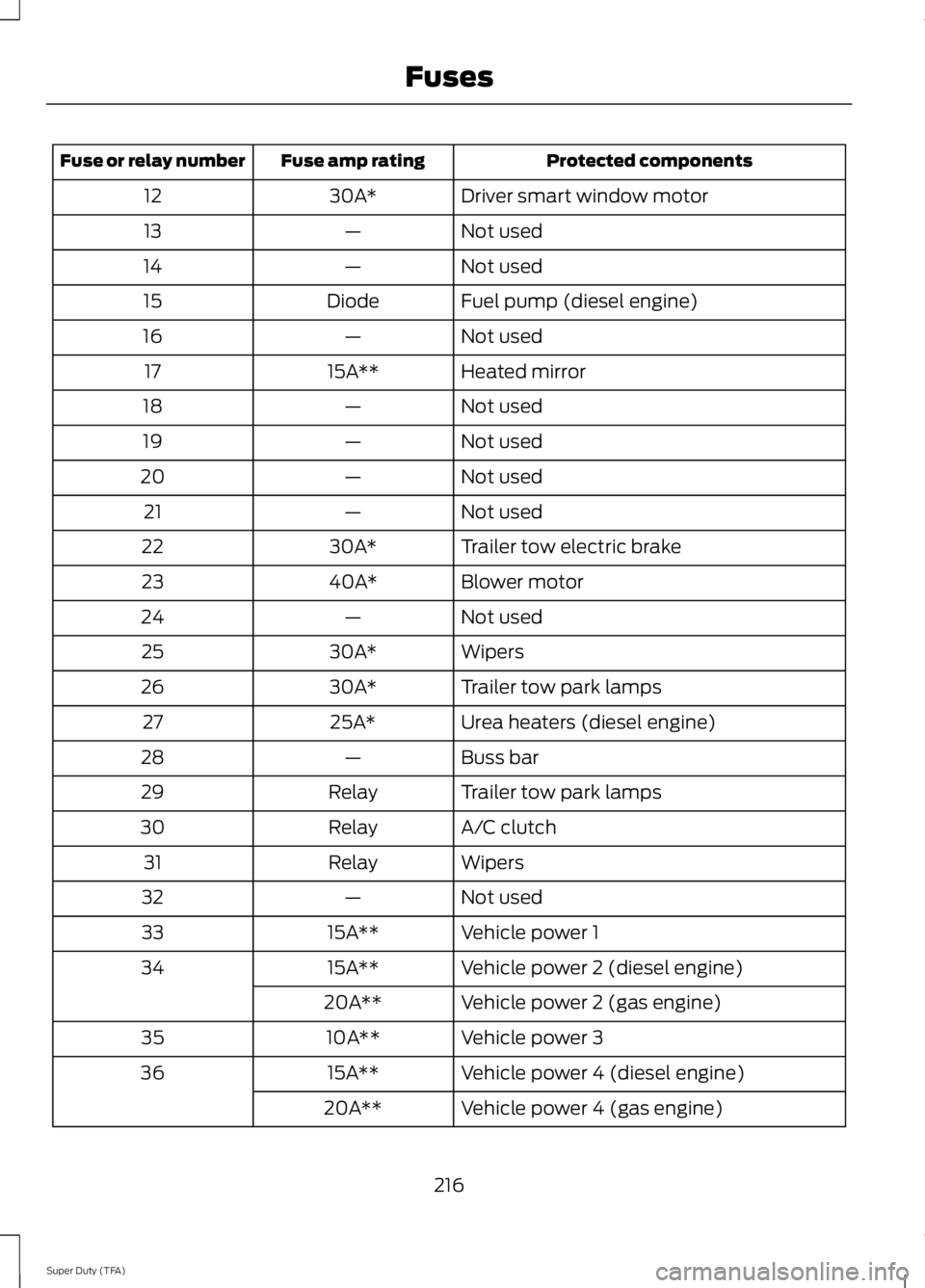
Protected componentsFuse amp ratingFuse or relay number
Blower motorRelay1
Not used—2
Urea heaters (diesel engine)Relay3
Not used—4
Rear window defroster, Heated mirrorsRelay5
Not used—6
Rear window defroster, Heated mirrors50A*7
Passenger seat30A*8
Driver seat30A*9
Not used—10
Not used—11
215
Super Duty (TFA)
FusesE163101
Page 219 of 460
Protected componentsFuse amp ratingFuse or relay number
Driver smart window motor30A*12
Not used—13
Not used—14
Fuel pump (diesel engine)Diode15
Not used—16
Heated mirror15A**17
Not used—18
Not used—19
Not used—20
Not used—21
Trailer tow electric brake30A*22
Blower motor40A*23
Not used—24
Wipers30A*25
Trailer tow park lamps30A*26
Urea heaters (diesel engine)25A*27
Buss bar—28
Trailer tow park lampsRelay29
A/C clutchRelay30
WipersRelay31
Not used—32
Vehicle power 115A**33
Vehicle power 2 (diesel engine)15A**34
Vehicle power 2 (gas engine)20A**
Vehicle power 310A**35
Vehicle power 4 (diesel engine)15A**36
Vehicle power 4 (gas engine)20A**
216
Super Duty (TFA)
Fuses
Page 220 of 460
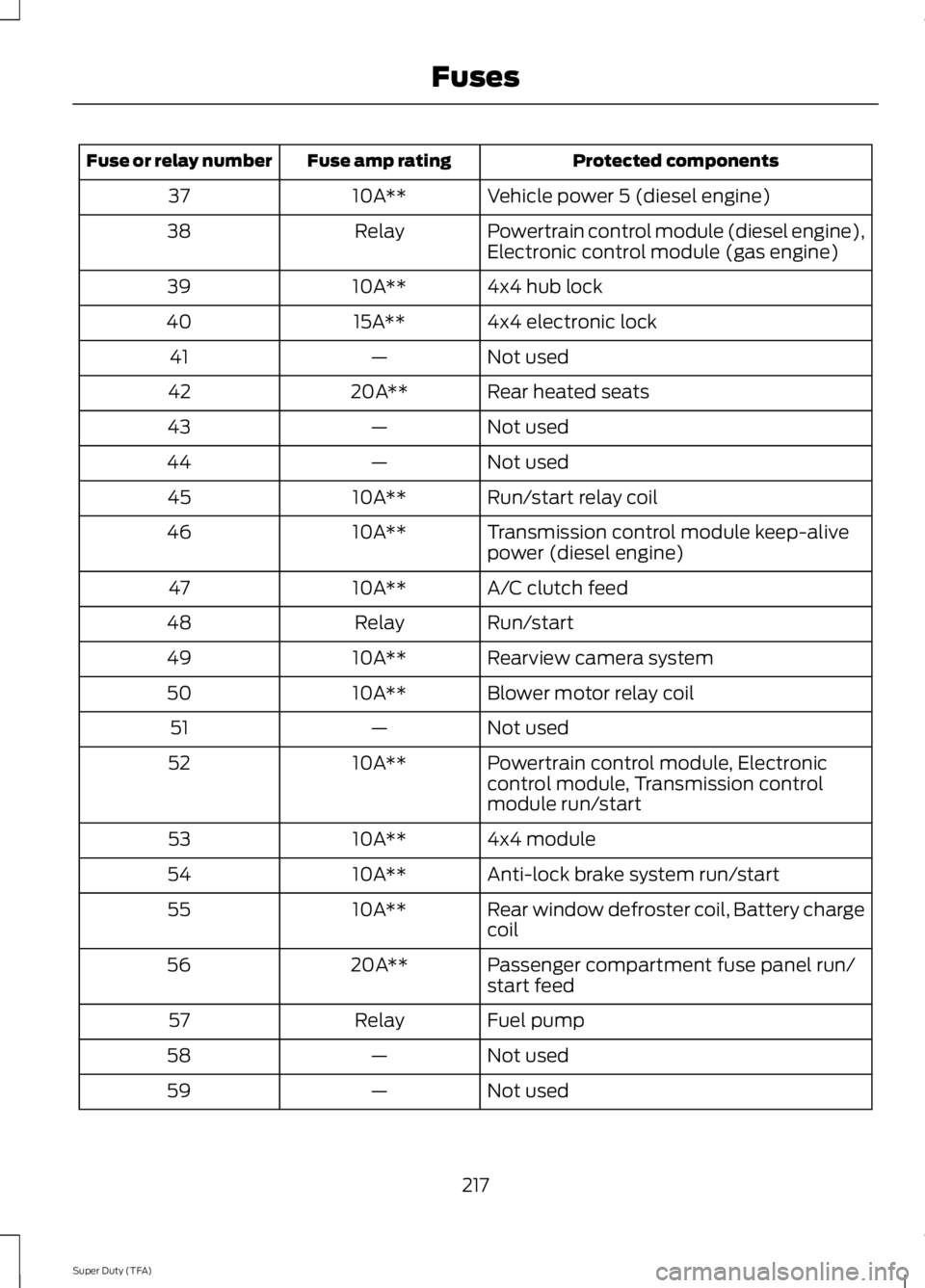
Protected componentsFuse amp ratingFuse or relay number
Vehicle power 5 (diesel engine)10A**37
Powertrain control module (diesel engine),Electronic control module (gas engine)Relay38
4x4 hub lock10A**39
4x4 electronic lock15A**40
Not used—41
Rear heated seats20A**42
Not used—43
Not used—44
Run/start relay coil10A**45
Transmission control module keep-alivepower (diesel engine)10A**46
A/C clutch feed10A**47
Run/startRelay48
Rearview camera system10A**49
Blower motor relay coil10A**50
Not used—51
Powertrain control module, Electroniccontrol module, Transmission controlmodule run/start
10A**52
4x4 module10A**53
Anti-lock brake system run/start10A**54
Rear window defroster coil, Battery chargecoil10A**55
Passenger compartment fuse panel run/start feed20A**56
Fuel pumpRelay57
Not used—58
Not used—59
217
Super Duty (TFA)
Fuses
Page 221 of 460
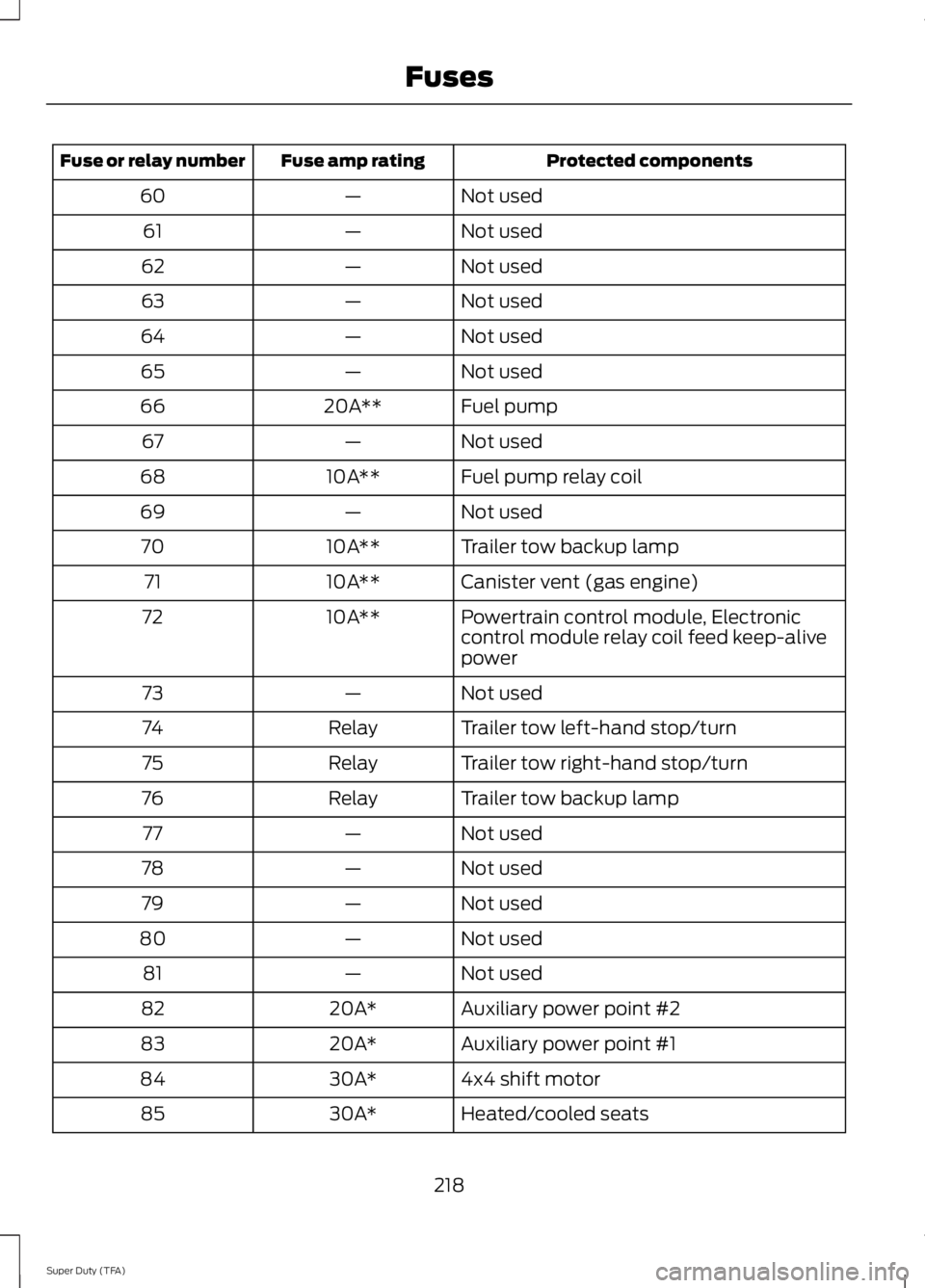
Protected componentsFuse amp ratingFuse or relay number
Not used—60
Not used—61
Not used—62
Not used—63
Not used—64
Not used—65
Fuel pump20A**66
Not used—67
Fuel pump relay coil10A**68
Not used—69
Trailer tow backup lamp10A**70
Canister vent (gas engine)10A**71
Powertrain control module, Electroniccontrol module relay coil feed keep-alivepower
10A**72
Not used—73
Trailer tow left-hand stop/turnRelay74
Trailer tow right-hand stop/turnRelay75
Trailer tow backup lampRelay76
Not used—77
Not used—78
Not used—79
Not used—80
Not used—81
Auxiliary power point #220A*82
Auxiliary power point #120A*83
4x4 shift motor30A*84
Heated/cooled seats30A*85
218
Super Duty (TFA)
Fuses