Page 10 of 41
PRINCIPLE OF OPERATION
WARNINGS
Hill descent control cannot controldescent in all surface conditions andcircumstances, such as ice orextremely steep grades. Hill descentcontrol is a driver assist system and cannotsubstitute for good judgment by the driver.Failure to do so may result in loss of vehiclecontrol, crash or serious injury.
Hill descent control does not providehill hold at zero miles per hour (0kilometers per hour). When stopped,the parking brake must be applied or thevehicle must be placed in P (Park) or itmay roll away.
Hill descent control allows the driver to setand maintain vehicle speed whiledescending steep grades in various surfaceconditions.
Hill descent control can maintain vehiclespeeds on downhill grades between 2 mph(3 km/h) and 12 mph (20 km/h). Above 20mph (32 km/h), the system remainsarmed, but descent speed cannot be setor maintained.
Hill descent control requires a coolingdown interval after a period of sustaineduse. The amount of time that the featurecan remain active before cooling varieswith conditions. The system will provide awarning in the message center and a chimewill sound when the system is about todisengage for cooling. At this time,manually apply the brakes as needed tomaintain descent speed.
USING HILL DESCENT
CONTROL
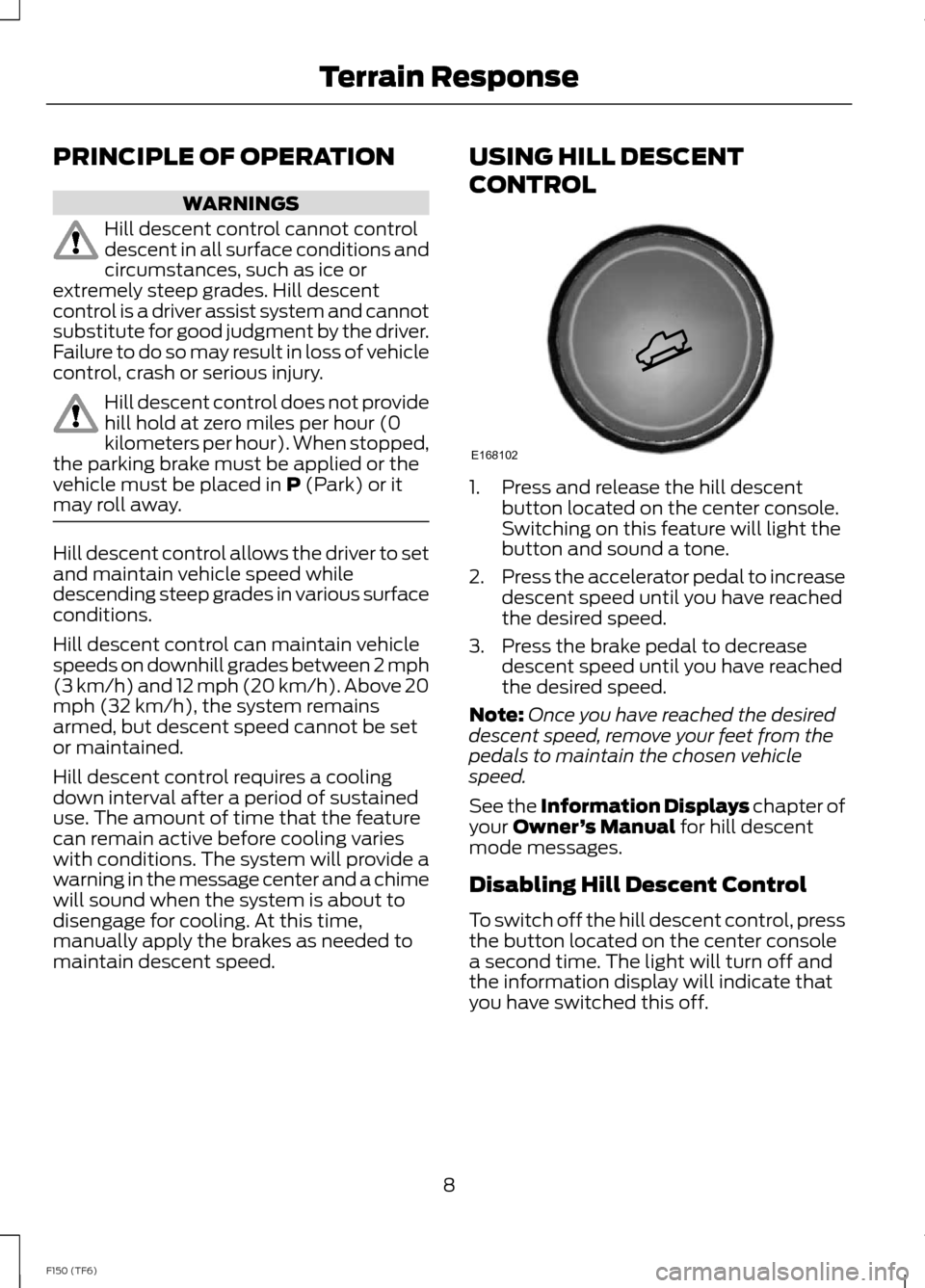
1.Press and release the hill descentbutton located on the center console.Switching on this feature will light thebutton and sound a tone.
2.Press the accelerator pedal to increasedescent speed until you have reachedthe desired speed.
3.Press the brake pedal to decreasedescent speed until you have reachedthe desired speed.
Note:Once you have reached the desireddescent speed, remove your feet from thepedals to maintain the chosen vehiclespeed.
See the Information Displays chapter ofyour Owner’s Manual for hill descentmode messages.
Disabling Hill Descent Control
To switch off the hill descent control, pressthe button located on the center consolea second time. The light will turn off andthe information display will indicate thatyou have switched this off.
8F150 (TF6)Terrain ResponseE168102
Page 18 of 41
Enabling off-road mode
WARNING
Off-road mode is specificallycalibrated for off-road drivingconditions and should never be usedon pavement.
To enter off-road mode the followingconditions must be met:
•The vehicle must be traveling less than5 mph (8 km/h).
•Your foot must be off of theaccelerator pedal.
Note:If any of the conditions are not met,the information display screen will displaythe appropriate messages to guide the driverthrough the proper operating procedures.
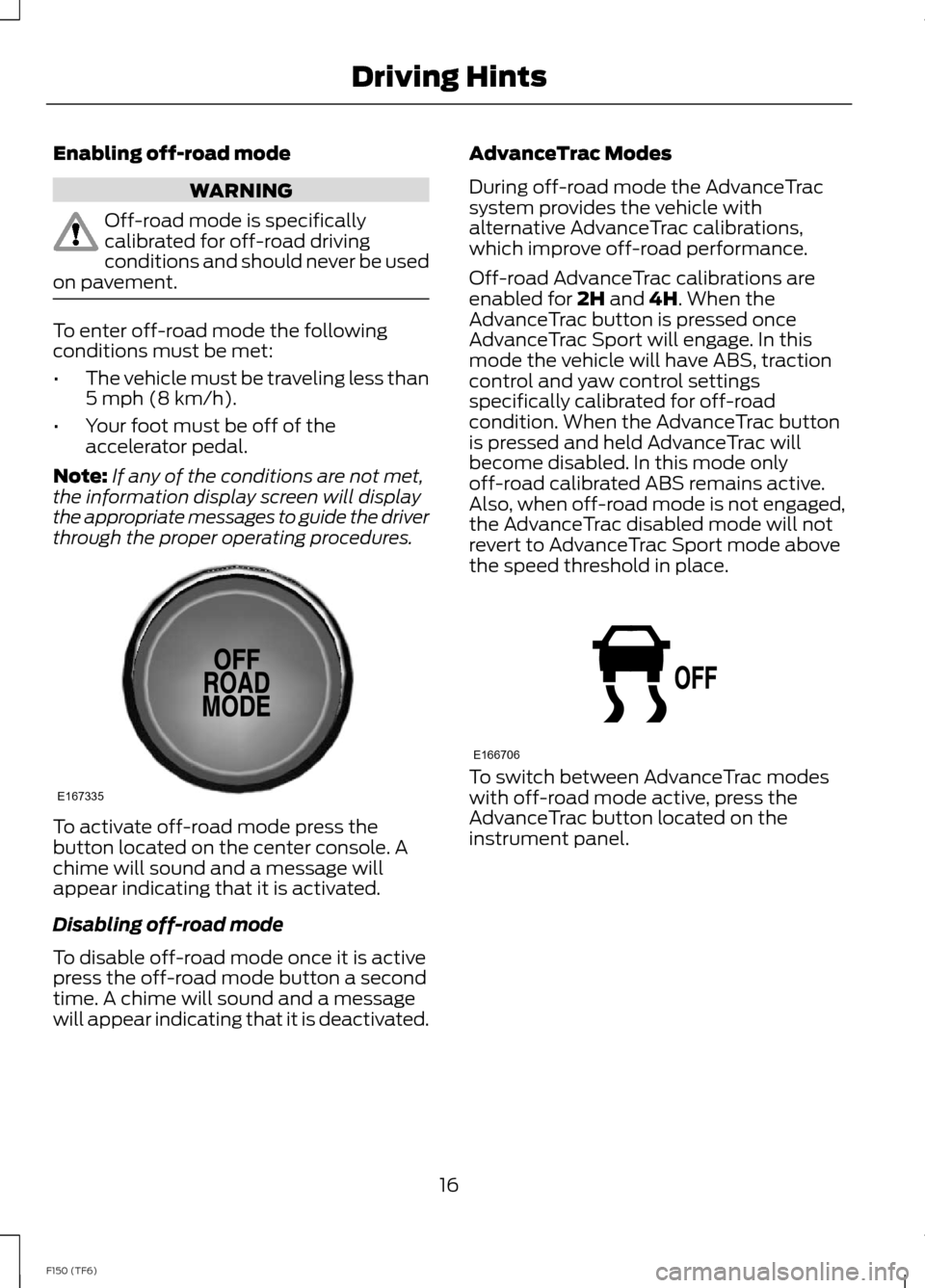
To activate off-road mode press thebutton located on the center console. Achime will sound and a message willappear indicating that it is activated.
Disabling off-road mode
To disable off-road mode once it is activepress the off-road mode button a secondtime. A chime will sound and a messagewill appear indicating that it is deactivated.
AdvanceTrac Modes
During off-road mode the AdvanceTracsystem provides the vehicle withalternative AdvanceTrac calibrations,which improve off-road performance.
Off-road AdvanceTrac calibrations areenabled for 2H and 4H. When theAdvanceTrac button is pressed onceAdvanceTrac Sport will engage. In thismode the vehicle will have ABS, tractioncontrol and yaw control settingsspecifically calibrated for off-roadcondition. When the AdvanceTrac buttonis pressed and held AdvanceTrac willbecome disabled. In this mode onlyoff-road calibrated ABS remains active.Also, when off-road mode is not engaged,the AdvanceTrac disabled mode will notrevert to AdvanceTrac Sport mode abovethe speed threshold in place.
To switch between AdvanceTrac modeswith off-road mode active, press theAdvanceTrac button located on theinstrument panel.
16F150 (TF6)Driving HintsE167335 E166706
Page 35 of 41
AUXILIARY SWITCHES
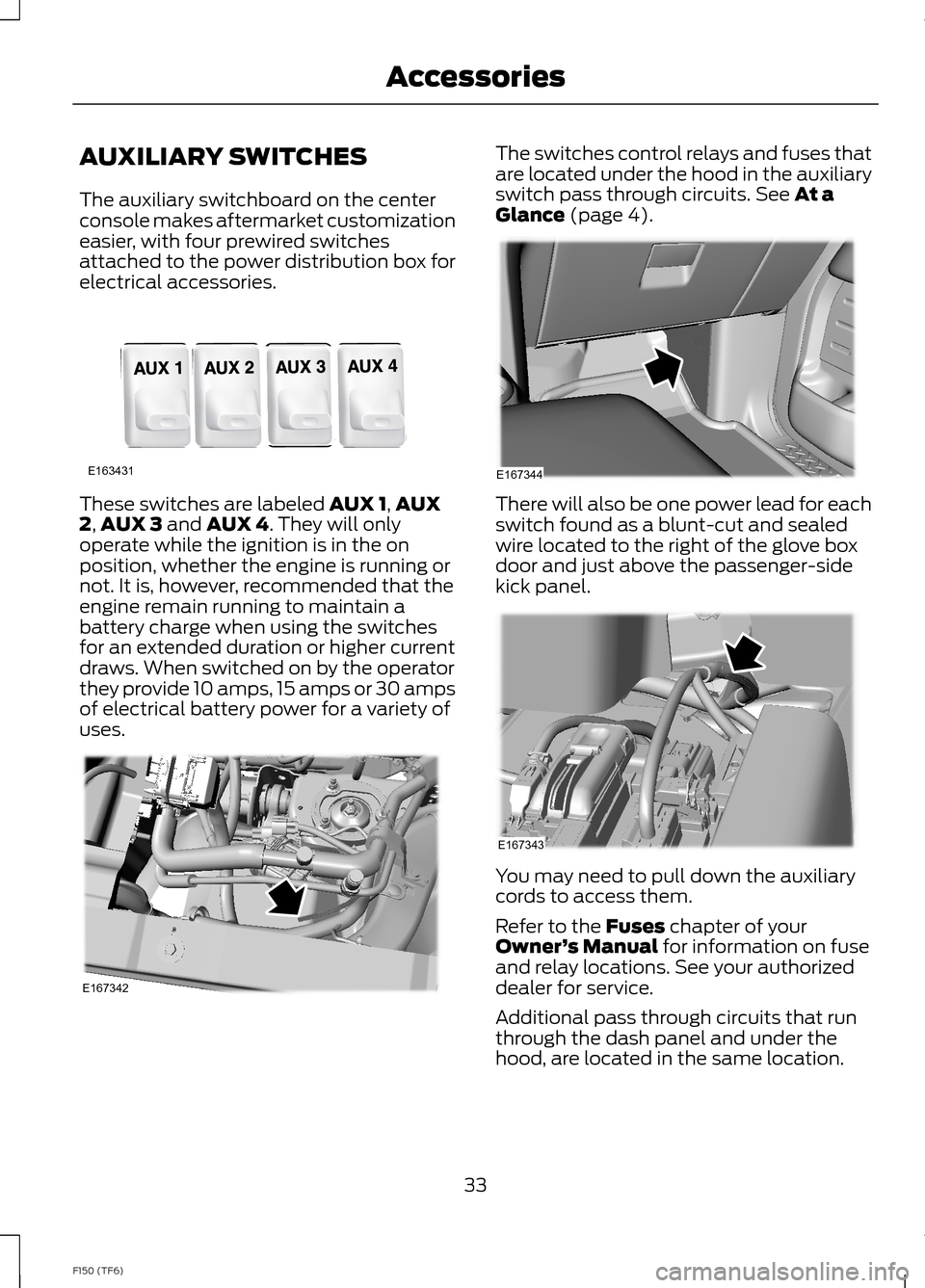
The auxiliary switchboard on the centerconsole makes aftermarket customizationeasier, with four prewired switchesattached to the power distribution box forelectrical accessories.
These switches are labeled AUX 1,AUX2,AUX 3 and AUX 4. They will onlyoperate while the ignition is in the onposition, whether the engine is running ornot. It is, however, recommended that theengine remain running to maintain abattery charge when using the switchesfor an extended duration or higher currentdraws. When switched on by the operatorthey provide 10 amps, 15 amps or 30 ampsof electrical battery power for a variety ofuses.
The switches control relays and fuses thatare located under the hood in the auxiliaryswitch pass through circuits. See At aGlance (page 4).
There will also be one power lead for eachswitch found as a blunt-cut and sealedwire located to the right of the glove boxdoor and just above the passenger-sidekick panel.
You may need to pull down the auxiliarycords to access them.
Refer to the Fuses chapter of yourOwner’s Manual for information on fuseand relay locations. See your authorizeddealer for service.
Additional pass through circuits that runthrough the dash panel and under thehood, are located in the same location.
33F150 (TF6)AccessoriesE163431 E167342 E167344 E167343