2014 FORD F SERIES MOTORHOME AND COMMERCIAL CHASSIS fuel filter
[x] Cancel search: fuel filterPage 5 of 143
Hazard Warning Flashers.............................51
Jump Starting the Vehicle............................51
Customer Assistance
Getting the Services You Need.................54
In California (U.S. Only)...............................55
The Better Business Bureau (BBB) AutoLine Program (U.S. Only)........................56
Utilizing the Mediation/ArbitrationProgram (Canada Only).........................56
Getting Assistance Outside the U.S. andCanada...........................................................57
Ordering Additional Owner'sLiterature.......................................................58
Reporting Safety Defects (U.S.Only)...............................................................58
Reporting Safety Defects (CanadaOnly)...............................................................59
Fuses
Fuse Specification Chart............................60
Changing a Fuse...............................................71
Maintenance
General Information......................................72
Under Hood Overview..................................73
Engine Oil Dipstick.........................................75
Engine Oil Check.............................................75
Engine Coolant Check..................................76
Automatic Transmission FluidCheck..............................................................79
Brake Fluid Check..........................................80
Power Steering Fluid Check.......................82
Fuel Filter...........................................................83
Changing the 12V Battery...........................83
Changing the Engine Air Filter...................85
Vehicle Care
General Information......................................87
Cleaning the Exterior.....................................87
Cleaning the Engine......................................87
Cleaning the Alloy Wheels.........................88
Vehicle Storage..............................................88
Wheels and Tires
Tire Care.............................................................91
Using Snow Chains.....................................106
Changing a Road Wheel............................107
Technical Specifications.............................110
Capacities and Specific-ations
Engine Specifications....................................111
Motorcraft Parts.............................................112
Vehicle Identification Number..................113
Vehicle Certification Label.........................113
Transmission Code Designation..............114
Technical Specifications.............................115
Extended Service Plan(ESP)
Extended Service Plan (ESP)...................119
Scheduled Maintenance
General Maintenance Information..........121
Normal Scheduled Maintenance...........124
Special Operating Conditions ScheduledMaintenance..............................................126
Scheduled Maintenance Record............128
2Motorhome (TY3) , enUSATable of Contents
Page 7 of 143
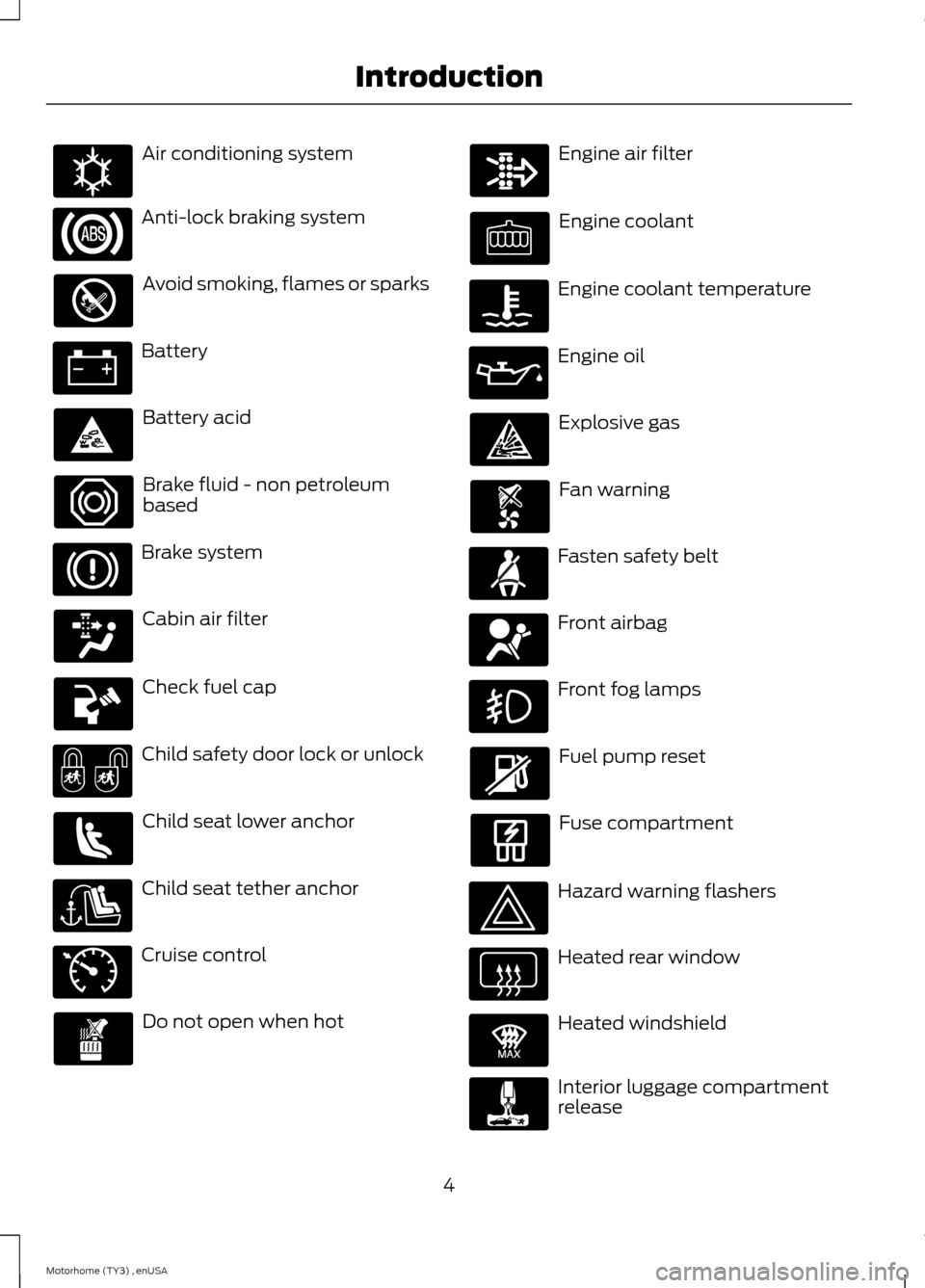
Air conditioning system
Anti-lock braking system
Avoid smoking, flames or sparks
Battery
Battery acid
Brake fluid - non petroleumbased
Brake system
Cabin air filter
Check fuel cap
Child safety door lock or unlock
Child seat lower anchor
Child seat tether anchor
Cruise control
Do not open when hot
Engine air filter
Engine coolant
Engine coolant temperature
Engine oil
Explosive gas
Fan warning
Fasten safety belt
Front airbag
Front fog lamps
Fuel pump reset
Fuse compartment
Hazard warning flashers
Heated rear window
Heated windshield
Interior luggage compartmentrelease
4Motorhome (TY3) , enUSAIntroductionE162384 E71340 E91392
Page 86 of 143
4.Check the fluid level on the dipstick. Itshould be between the arrows in theFULL range on the side of the dipstickwith the words MAX. HOT at the top.Do not add fluid if the level is withinthis range.
5.If the fluid is low, add fluid in smallamounts, continuously checking thelevel until it reaches the FULL range.Be sure to put the dipstick back in thereservoir.
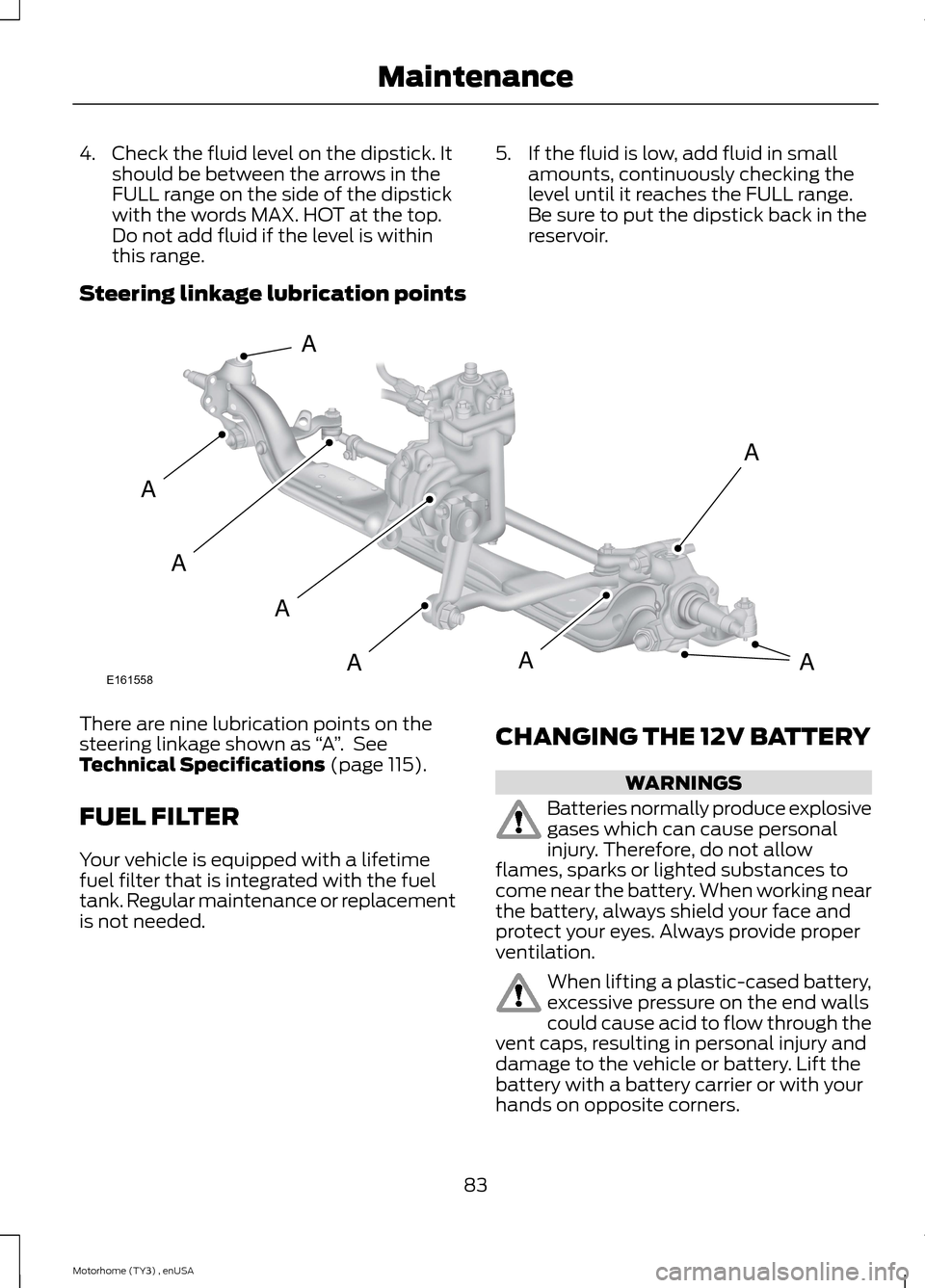
Steering linkage lubrication points
There are nine lubrication points on thesteering linkage shown as “A”. SeeTechnical Specifications (page 115).
FUEL FILTER
Your vehicle is equipped with a lifetimefuel filter that is integrated with the fueltank. Regular maintenance or replacementis not needed.
CHANGING THE 12V BATTERY
WARNINGS
Batteries normally produce explosivegases which can cause personalinjury. Therefore, do not allowflames, sparks or lighted substances tocome near the battery. When working nearthe battery, always shield your face andprotect your eyes. Always provide properventilation.
When lifting a plastic-cased battery,excessive pressure on the end wallscould cause acid to flow through thevent caps, resulting in personal injury anddamage to the vehicle or battery. Lift thebattery with a battery carrier or with yourhands on opposite corners.
83Motorhome (TY3) , enUSAMaintenanceE161558AAAAAAAA
Page 88 of 143
•The transmission must relearn itsadaptive strategy. As a result of this,the transmission may shift firmly. Thisoperation is considered normal and willnot affect function or durability of thetransmission. Over time the adaptivelearning process will fully updatetransmission operation to its optimumshift feel.
•The clock and the preset radio stationsmust be reset once the battery isreconnected.
•Your vehicle’s engine is electronicallycontrolled by a computer, some controlconditions are maintained by powerfrom the battery, the engine mustrelearn its idle and fuel trim strategy.
When the battery is disconnected or a newbattery is installed, begin the batteryrelearn process:
1.With the vehicle at a complete stop,set the parking brake.
2.Put the gearshift lever in P (Park), turnoff all accessories and start the engine.
3.Run the engine until it reaches normaloperating temperature.
4.Allow the engine to idle for at least oneminute.
5.Turn the A/C on and allow the engineto idle for at least one minute.
6.Drive the vehicle to complete therelearning process.
•The vehicle may need to be drivento relearn the idle and fuel trimstrategy.
CHANGING THE ENGINE AIR
FILTER
WARNING
To reduce the risk of vehicle damageand personal burn injuries, do notstart your engine with the air cleanerremoved and do not remove it while theengine is running.
Change the air filter element at the properinterval. See Scheduled Maintenance(page 121).
When changing the air filter element, useonly the air filter element listed. SeeCapacities and Specifications (page111).
Note:Failure to use the correct air filterelement may result in severe enginedamage. The customer warranty may bevoid for any damage to the engine if thecorrect air filter element is not used.
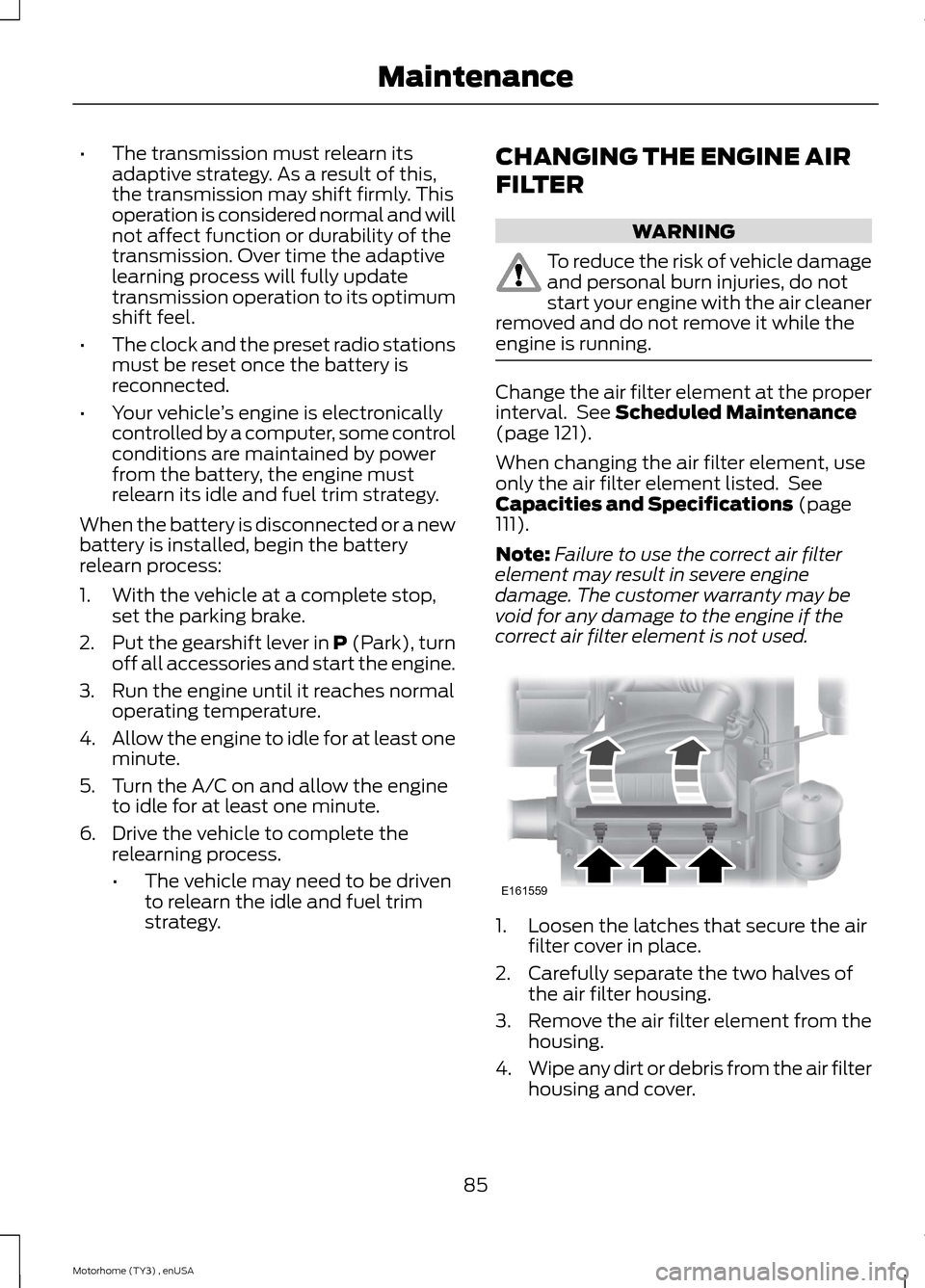
1.Loosen the latches that secure the airfilter cover in place.
2.Carefully separate the two halves ofthe air filter housing.
3.Remove the air filter element from thehousing.
4.Wipe any dirt or debris from the air filterhousing and cover.
85Motorhome (TY3) , enUSAMaintenanceE161559
Page 91 of 143
When washing:
•Take care when using a power washerto clean the engine. The high-pressurefluid could penetrate the sealed partsand cause damage.
•Do not spray a hot engine with coldwater to avoid cracking the engineblock or other engine components.
•Spray Motorcraft Engine Shampoo andDegreaser on all parts that requirecleaning and pressure rinse clean. InCanada, use Motorcraft EngineShampoo.
•Never wash or rinse the engine while itis hot or running; water in the runningengine may cause internal damage.
•Never wash or rinse any ignition coil,spark plug wire or spark plug well, orthe area in and around these locations.
•Cover the battery, power distributionbox, and air filter assembly to preventwater damage when cleaning theengine.
CLEANING THE ALLOY
WHEELS (If Equipped)
Note:Do not apply a cleaning chemical towarm or hot wheel rims and covers.
Note:Some automatic car washes maycause damage to the finish on your wheelrims and covers.
Note:Industrial-strength or heavy-dutycleaners in combination with brush agitationto remove brake dust and dirt, could wearaway the clear coat finish over a period time.
Note:Do not use hydrofluoric acid-basedor high caustic-based wheel cleaners, steelwool, fuels or strong household detergents.
Note:If you intend parking your vehicle foran extended period after cleaning thewheels with a wheel cleaner, drive yourvehicle for a few minutes before doing so.This will reduce the risk of increasedcorrosion of the brake discs.
Alloy wheels and wheel covers are coatedwith a clear coat paint finish. To maintaintheir condition we recommend that you:
•Clean the wheels weekly usingMotorcraft Wheel and Tire Cleaner.Apply using manufacturer'sinstructions.
•Use a sponge to remove heavydeposits of dirt and brake dustaccumulation.
•Rinse thoroughly with a strong streamof water when you have completed thecleaning process.
•To remove tar and grease, useMotorcraft Bug and Tar Remover.
VEHICLE STORAGE
If you plan on storing your vehicle for 30days or more, read the followingmaintenance recommendations to makesure your vehicle stays in good operatingcondition.
We engineer and test all motor vehiclesand their components for reliable, regulardriving. Under various conditions,long-term storage may lead to degradedengine performance or failure unless youuse specific precautions to preserve enginecomponents.
General
•Store all vehicles in a dry, ventilatedplace.
•Protect from sunlight, if possible.
•If vehicles are stored outside, theyrequire regular maintenance to protectagainst rust and damage.
88Motorhome (TY3) , enUSAVehicle Care
Page 92 of 143
Body
•Wash your vehicle thoroughly toremove dirt, grease, oil, tar or mud fromexterior surfaces, rear-wheel housingand the underside of front fenders.
•Periodically wash your vehicle if it isstored in exposed locations.
•Touch-up exposed or primed metal toprevent rust.
•Cover chrome and stainless steel partswith a thick coat of auto wax to preventdiscoloration. Re-wax as necessarywhen you wash your vehicle.
•Lubricate all hood, door and trunk lidhinges, and latches with a light gradeoil.
•Cover interior trim to prevent fading.
•Keep all rubber parts free from oil andsolvents.
Engine
•The engine oil and filter should bechanged prior to storage because usedengine oil contains contaminates thatmay cause engine damage.
•Start the engine every 15 days for aminimum of 15 minutes. Run at fast idlewith the climate controls set to defrostuntil the engine reaches normaloperating temperature.
•With your foot on the brake, shiftthrough all the gears while the engineis running.
•We recommend that you change theengine oil before you use your vehicleagain.
Fuel system
•Fill the fuel tank with high-quality fueluntil the first automatic shutoff of thefuel pump nozzle.
Cooling system
•Protect against freezing temperatures.
•When removing your vehicle fromstorage, check coolant fluid level.Confirm that there are no coolingsystem leaks and that fluid is at therecommended level.
Battery
•Check and recharge as necessary. Keepconnections clean.
•If storing your vehicle for more than 30days without recharging the battery,we recommend that you disconnectthe battery cables to maintain batterycharge for quick starting.
Note:It is necessary to reset memoryfeatures if battery cables are disconnected.
Brakes
•Make sure the brakes and parking brakerelease fully.
Tires
•Maintain recommended air pressure.
Miscellaneous
•Make sure all linkages, cables, leversand pins under your vehicle are coveredwith grease to prevent rust.
•Move vehicles at least 25 ft (7.5 m)every 15 days to lubricate working partsand prevent corrosion.
Removing Vehicle From Storage
When your vehicle is ready to come out ofstorage, do the following:
•Wash your vehicle to remove any dirtor grease film build-up on windowsurfaces.
•Check windshield wipers for anydeterioration.
89Motorhome (TY3) , enUSAVehicle Care
Page 131 of 143
Ford specification WSL-M2C192-A, partnumber F1TZ-19580-B, or equivalent. Addfriction modifier XL-3 (EST-M2C118-A) orequivalent for complete refill ofTraction-Lok rear axles. See Capacitiesand Specifications (page 111).
California fuel filter replacement: If youregister your vehicle in California, theCalifornia Air Resources Board hasdetermined that the failure to perform thismaintenance item does not nullify theemission warranty or limit recall liabilitybefore the completion of your vehicle'suseful life. Ford Motor Company, however,urges you to have all recommendedmaintenance services performed at thespecified intervals and to record all vehicleservice.
Hot climate oil change intervals:Vehicles operating in the Middle East,North Africa, Sub-Saharan Africa orlocations with similar climates using anAmerican Petroleum Institute (API)Certified for Gasoline Engines (Certificationmark) oil of SM or SN quality, the normaloil change interval is 5000 miles (8000kilometers).
If the available API SM or SN oils are notavailable, then the oil change interval is3000 miles (4800 kilometers).
Engine air filter replacement: The life ofthe engine air filter is dependent onexposure to dusty and dirty conditions.Vehicles operated in these conditionsrequire frequent inspection andreplacement of the engine air filter.
SCHEDULED MAINTENANCE RECORD
128Motorhome (TY3) , enUSAScheduled MaintenanceE146852RepairOrder#:Distance:Enginehours(optional):Multi-pointinspection(recommended):Signature:Dealerstamp
Page 141 of 143
Engine Oil Check.............................................75Adding Engine Oil.................................................75Resetting the Oil Life MonitoringSystem.................................................................75Engine Oil Dipstick.........................................75Engine Specifications....................................111Drivebelt Routing..................................................111Essential Towing Checks............................44Before Towing a Trailer......................................45Hitches.....................................................................44Launching or Retrieving a Boat or PersonalWatercraft (PWC)..........................................46Safety Chains........................................................44Trailer Brakes.........................................................45Trailer Lamps.........................................................45When Towing a Trailer........................................45Export Unique Options...................................7Extended Service Plan (ESP)...................119SERVICE PLANS (CANADA ONLY).............120SERVICE PLANS (U.S. Only)...........................119
F
Ford Credit...........................................................5(U.S. Only).................................................................5Fuel and Refueling.........................................22Fuel Consumption.........................................25Calculating Fuel Economy................................25Filling the Tank......................................................25Fuel Filter...........................................................83Fuel Quality......................................................23Choosing the Right Fuel.....................................23Octane Recommendations..............................23Fuses..................................................................60Fuse Specification Chart............................60Diode and Relay Module...................................66Passenger Compartment Fuse Panel..........67Power Distribution Box......................................60
G
Gauges.................................................................12Engine Coolant Temperature Gauge.............13Engine Oil Pressure Gauge.................................12Fuel Gauge...............................................................13Speedometer..........................................................12Transmission Fluid TemperatureGauge....................................................................12
General Maintenance Information..........121Multi-point Inspection.......................................123Owner Checks and Services...........................122Protecting Your Investment.............................121Why Maintain Your Vehicle?............................121Why Maintain Your Vehicle at YourDealership?.......................................................121Getting Assistance Outside the U.S. andCanada............................................................57Getting the Services You Need.................54Away From Home................................................54
H
HandbrakeSee: Parking Brake...............................................34Hazard Warning Flashers.............................51Hints on Driving With Anti-LockBrakes..............................................................33
I
Ignition Switch................................................20In California (U.S. Only)...............................55Information Displays......................................16General Information.............................................16Information Messages...................................17Engine........................................................................18Maintenance...........................................................18Transmission...........................................................19Instrument Cluster..........................................12Instrument Lighting Dimmer......................10Introduction........................................................3
J
Jump Starting the Vehicle............................51Connecting the Jumper Cables.......................52Jump Starting........................................................53Preparing Your Vehicle.......................................52Removing the Jumper Cables..........................53
L
Lighting Control...............................................10Headlamp Flasher................................................10High Beams.............................................................10Lighting...............................................................10
138Motorhome (TY3) , enUSAIndex