Page 317 of 476
JACKING AND TIRE CHANGING
WARNING!
•Do not attempt to change a tire on the side of the
vehicle close to moving traffic. Pull far enough off
the road to avoid the danger of being hit when
operating the jack or changing the wheel.
• Being under a jacked-up vehicle is dangerous.
The vehicle could slip off the jack and fall on you.
You could be crushed. Never put any part of your
body under a vehicle that is on a jack. If you need
to get under a raised vehicle, take it to a service
center where it can be raised on a lift.
• Never start or run the engine while the vehicle is
on a jack.
• The jack is designed to be used as a tool for
changing tires only. The jack should not be used
to lift the vehicle for service purposes. The ve-
hicle should be jacked on a firm level surface
only. Avoid ice or slippery areas.
Jack Location/Spare Tire Stowage — If
Equipped
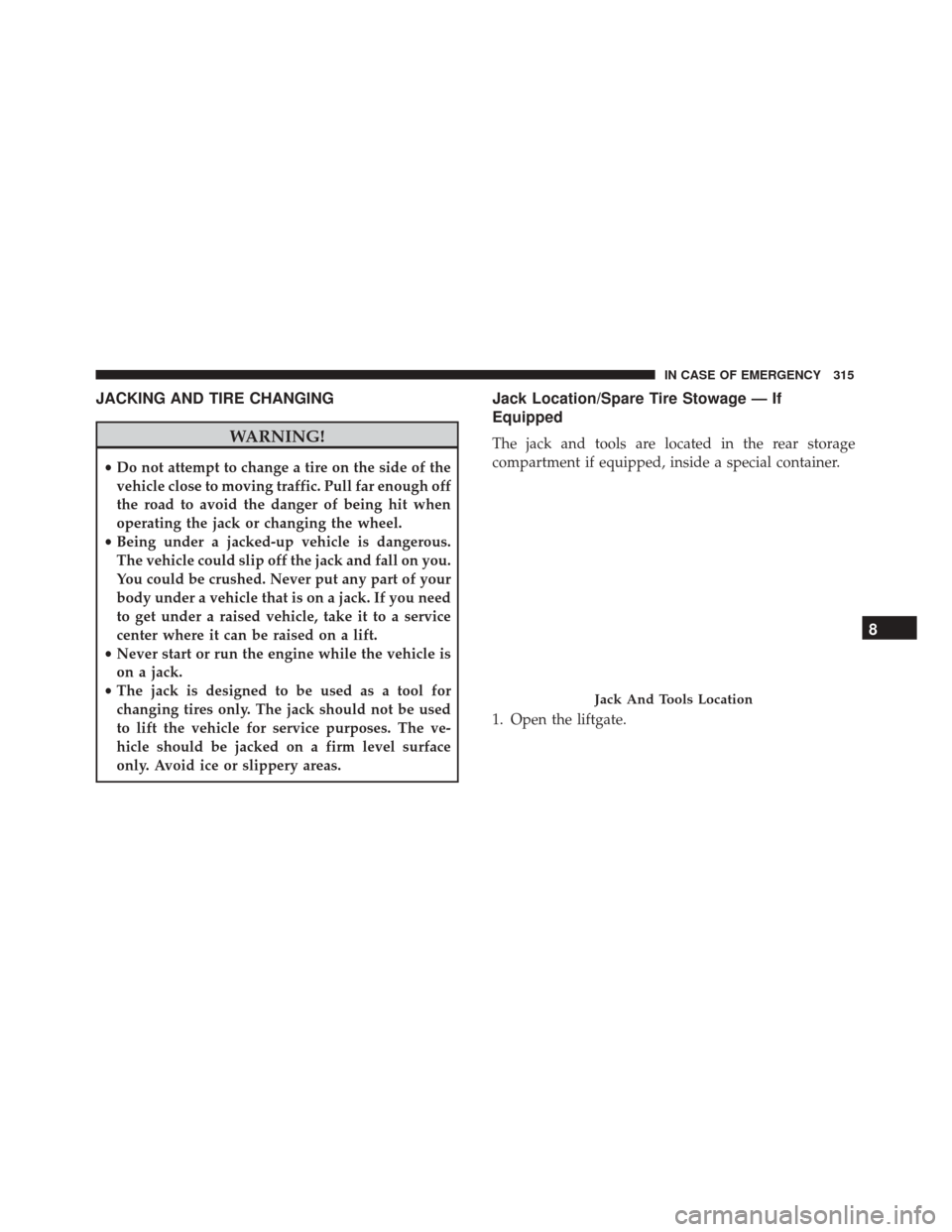
The jack and tools are located in the rear storage
compartment if equipped, inside a special container.
1. Open the liftgate.
Jack And Tools Location
8
IN CASE OF EMERGENCY 315
Page 320 of 476
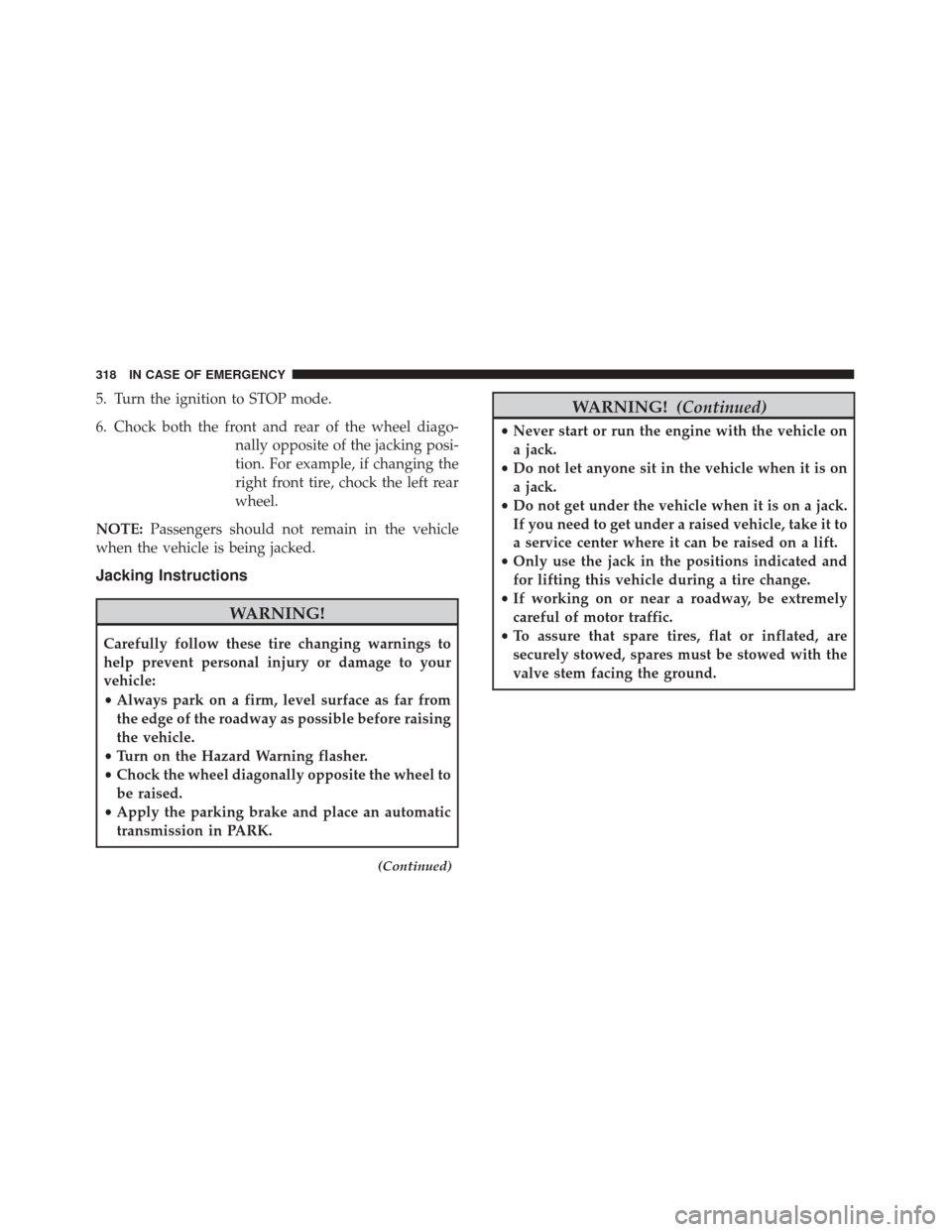
5. Turn the ignition to STOP mode.
6. Chock both the front and rear of the wheel diago-nally opposite of the jacking posi-
tion. For example, if changing the
right front tire, chock the left rear
wheel.
NOTE: Passengers should not remain in the vehicle
when the vehicle is being jacked.
Jacking Instructions
WARNING!
Carefully follow these tire changing warnings to
help prevent personal injury or damage to your
vehicle:
• Always park on a firm, level surface as far from
the edge of the roadway as possible before raising
the vehicle.
• Turn on the Hazard Warning flasher.
• Chock the wheel diagonally opposite the wheel to
be raised.
• Apply the parking brake and place an automatic
transmission in PARK.
(Continued)
WARNING! (Continued)
•Never start or run the engine with the vehicle on
a jack.
• Do not let anyone sit in the vehicle when it is on
a jack.
• Do not get under the vehicle when it is on a jack.
If you need to get under a raised vehicle, take it to
a service center where it can be raised on a lift.
• Only use the jack in the positions indicated and
for lifting this vehicle during a tire change.
• If working on or near a roadway, be extremely
careful of motor traffic.
• To assure that spare tires, flat or inflated, are
securely stowed, spares must be stowed with the
valve stem facing the ground.
318 IN CASE OF EMERGENCY
Page 324 of 476

NOTE:•Your vehicle may be equipped with a compact
spare tire or a limited — use spare tire. For further
information refer to “Tires — General Information”
in “Maintaining Your Vehicle”.
• For vehicles so equipped, do not attempt to install
a center cap or wheel cover on the compact spare.
8. Install the wheel bolts with the threaded end of the wheel bolt toward the wheel. Lightly tighten the
wheel bolts.
WARNING!
To avoid the risk of forcing the vehicle off the jack,
do not fully tighten the wheel bolts until the
vehicle has been lowered. Failure to follow this
warning may result in serious injury.
9. Lower the vehicle to the ground by turning the wheel bolt wrench counterclockwise.
10. Finish tightening the wheel bolts. Push down on the wrench while at the end of the handle for increased
leverage. Tighten the wheel bolts in a star pattern
until each wheel bolt has been tightened twice. Refer to “Torque Specifications” in “Technical Data”
for the proper lug bolt torque. If in doubt about the
correct tightness, have them checked with a torque
wrench by your authorized dealer or at a service
station.
11. Securely stow the jack, tools, chocks and flat tire.
WARNING!
A loose tire or jack thrown forward in a collision or
hard stop could endanger the occupants of the
vehicle. Always stow the jack parts and the spare
tire in the places provided. Have the deflated (flat)
tire repaired or replaced immediately.
Road Tire Installation
1. Mount the road tire on the axle.
2. Install the remaining wheel bolts with the threaded end of the wheel bolt toward the wheel. Lightly
tighten the wheel bolts.
322 IN CASE OF EMERGENCY
Page 335 of 476
NOTE:Push the �ESC Off� switch (if necessary), to
place the Electronic Stability Control (ESC) system in
�Partial Off� mode, before rocking the vehicle. Refer to
“Electronic Brake Control” in “Safety” for further infor-
mation. Once the vehicle has been freed, push the �ESC
Off� switch again to restore �ESC On�mode.
WARNING!
Fast spinning tires can be dangerous. Forces gener-
ated by excessive wheel speeds may cause damage,
or even failure, of the axle and tires. A tire could
explode and injure someone. Do not spin your
vehicle’s wheels faster than 30 mph (48 km/h) or for
longer than 30 seconds continuously without stop-
ping when you are stuck and do not let anyone near
a spinning wheel, no matter what the speed.
CAUTION!
•Racing the engine or spinning the wheels may
lead to transmission overheating and failure. Al-
low the engine to idle with the transmission in
NEUTRAL for at least one minute after every five
rocking-motion cycles. This will minimize over-
heating and reduce the risk of clutch or transmis-
sion failure during prolonged efforts to free a
stuck vehicle.
• When “rocking” a stuck vehicle by shifting be-
tween DRIVE/ SECOND gear and REVERSE, do
not spin the wheels faster than 15 mph (24 km/h),
or drivetrain damage may result.
• Revving the engine or spinning the wheels too
fast may lead to transmission overheating and
failure. It can also damage the tires. Do not spin
the wheels above 30 mph (48 km/h) while in gear
(no transmission shifting occurring).
8
IN CASE OF EMERGENCY 333
Page 344 of 476

▫Tire Terminology And Definitions .........384
▫ Tire Loading And Tire Pressure ..........384
� TIRES — GENERAL INFORMATION .......389
▫ Tire Pressure ...................... .389
▫ Tire Inflation Pressures ................390
▫ Tire Pressures For High Speed Operation . . .391
▫ Radial Ply Tires .....................391
▫ Tire Types ......................... .392
▫ Run Flat Tires — If Equipped ............393
▫ Spare Tires — If Equipped ..............393
▫ Tire Spinning ...................... .394
▫ Tread Wear Indicators .................394 ▫
Life Of Tire ....................... .395
▫ Replacement Tires ....................395
� TIRE CHAINS (TRACTION DEVICES) ......397
� DEPARTMENT OF TRANSPORTATION
UNIFORM TIRE QUALITY GRADES .......398
▫ Treadwear ......................... .398
▫ Traction Grades ..................... .398
▫ Temperature Grades ...................398
� TIRE ROTATION RECOMMENDATIONS . . . .399
� STORING THE VEHICLE ................400
342 MAINTAINING AND CARING FOR YOUR VEHICLE
Page 382 of 476
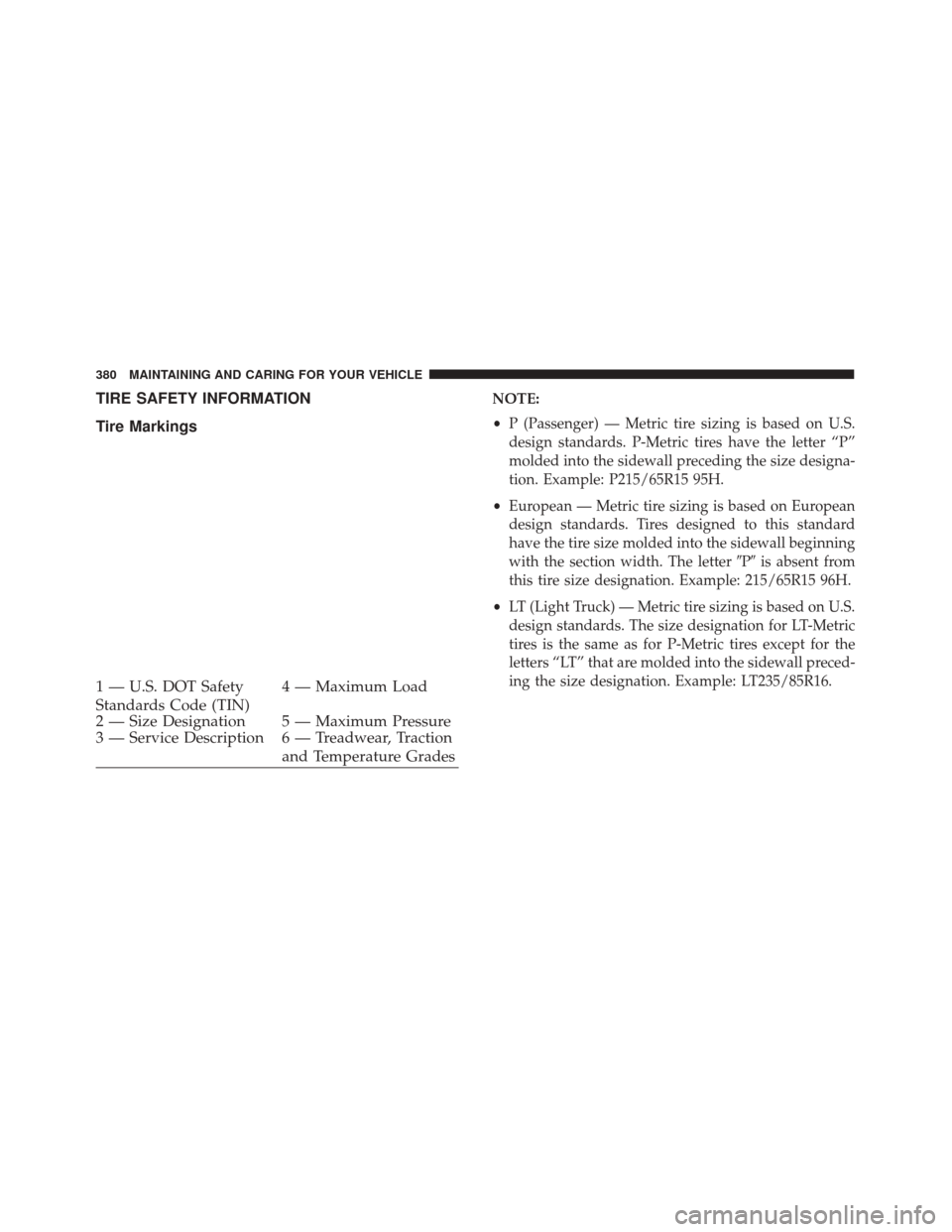
TIRE SAFETY INFORMATION
Tire MarkingsNOTE:
•P (Passenger) — Metric tire sizing is based on U.S.
design standards. P-Metric tires have the letter “P”
molded into the sidewall preceding the size designa-
tion. Example: P215/65R15 95H.
• European — Metric tire sizing is based on European
design standards. Tires designed to this standard
have the tire size molded into the sidewall beginning
with the section width. The letter �P�is absent from
this tire size designation. Example: 215/65R15 96H.
• LT (Light Truck) — Metric tire sizing is based on U.S.
design standards. The size designation for LT-Metric
tires is the same as for P-Metric tires except for the
letters “LT” that are molded into the sidewall preced-
ing the size designation. Example: LT235/85R16.
1 — U.S. DOT Safety
Standards Code (TIN) 4 — Maximum Load
2 — Size Designation 5 — Maximum Pressure
3 — Service Description 6 — Treadwear, Traction and Temperature Grades
380 MAINTAINING AND CARING FOR YOUR VEHICLE
Page 383 of 476
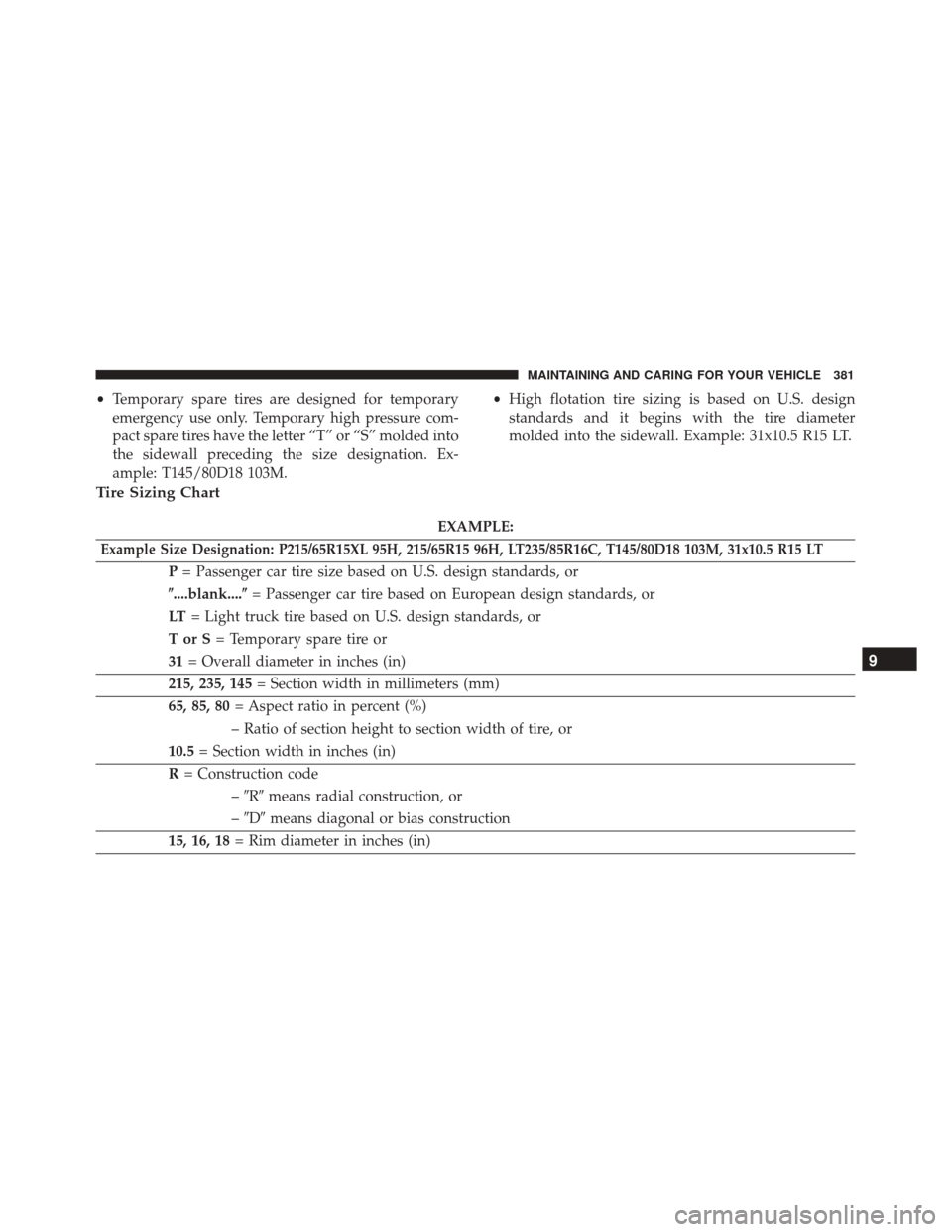
•Temporary spare tires are designed for temporary
emergency use only. Temporary high pressure com-
pact spare tires have the letter “T” or “S” molded into
the sidewall preceding the size designation. Ex-
ample: T145/80D18 103M. •
High flotation tire sizing is based on U.S. design
standards and it begins with the tire diameter
molded into the sidewall. Example: 31x10.5 R15 LT.
Tire Sizing Chart
EXAMPLE:
Example Size Designation: P215/65R15XL 95H, 215/65R15 96H, LT235/85R16C, T145/80D18 103M, 31x10.5 R15 LT
P = Passenger car tire size based on U.S. design standards, or
�....blank....� = Passenger car tire based on European design standards, or
LT = Light truck tire based on U.S. design standards, or
TorS= Temporary spare tire or
31 = Overall diameter in inches (in)
215, 235, 145 = Section width in millimeters (mm)
65, 85, 80 = Aspect ratio in percent (%)
– Ratio of section height to section width of tire, or
10.5 = Section width in inches (in)
R = Construction code
–�R� means radial construction, or
– �D� means diagonal or bias construction
15, 16, 18 = Rim diameter in inches (in)
9
MAINTAINING AND CARING FOR YOUR VEHICLE 381
Page 385 of 476
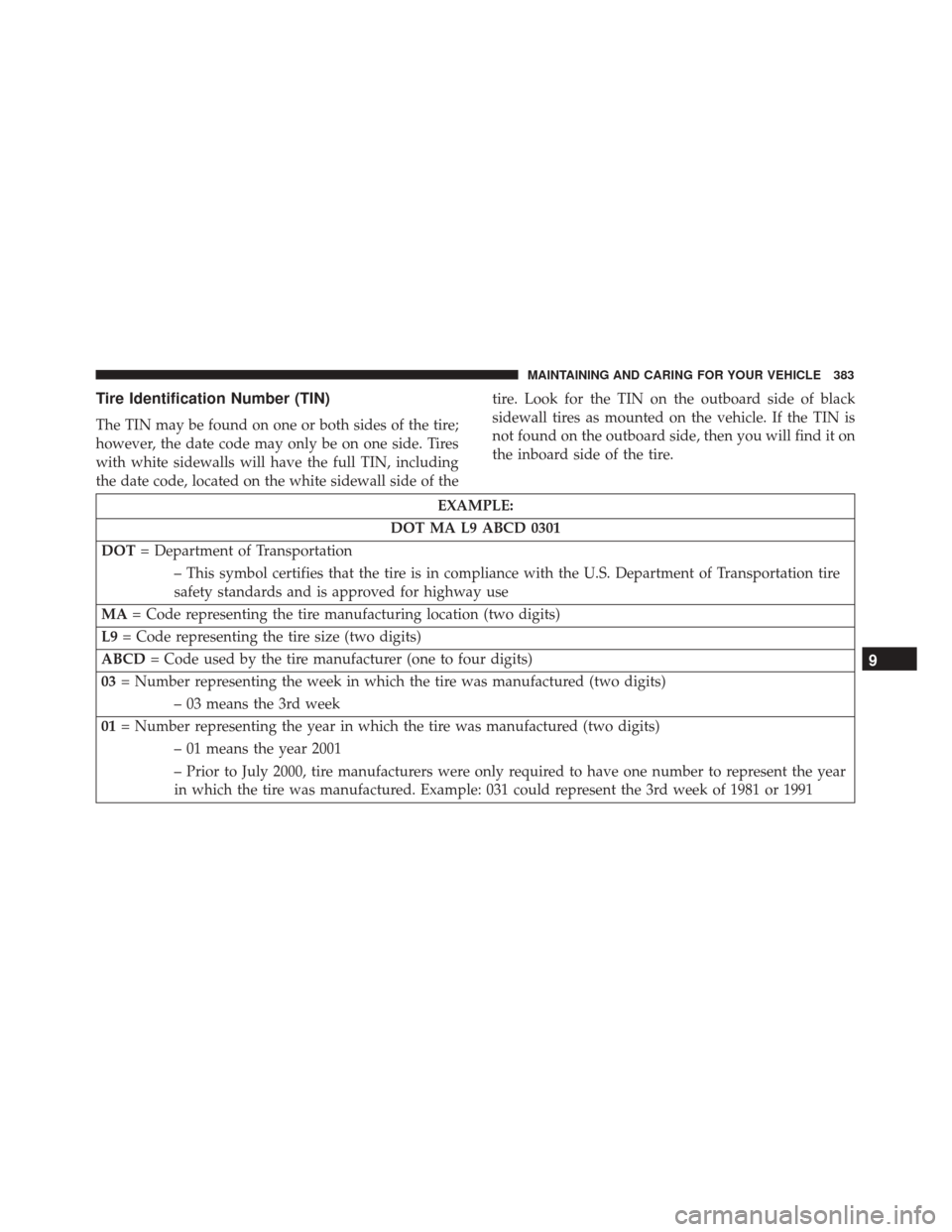
Tire Identification Number (TIN)
The TIN may be found on one or both sides of the tire;
however, the date code may only be on one side. Tires
with white sidewalls will have the full TIN, including
the date code, located on the white sidewall side of thetire. Look for the TIN on the outboard side of black
sidewall tires as mounted on the vehicle. If the TIN is
not found on the outboard side, then you will find it on
the inboard side of the tire.
EXAMPLE:
DOT MA L9 ABCD 0301
DOT = Department of Transportation
– This symbol certifies that the tire is in compliance with the U.S. Department of Transportation tire
safety standards and is approved for highway use
MA = Code representing the tire manufacturing location (two digits)
L9 = Code representing the tire size (two digits)
ABCD = Code used by the tire manufacturer (one to four digits)
03 = Number representing the week in which the tire was manufactured (two digits)
– 03 means the 3rd week
01 = Number representing the year in which the tire was manufactured (two digits)
– 01 means the year 2001
– Prior to July 2000, tire manufacturers were only required to have one number to represent the year
in which the tire was manufactured. Example: 031 could represent the 3rd week of 1981 or 1991
9
MAINTAINING AND CARING FOR YOUR VEHICLE 383