2014 FIAT 500X ABS
[x] Cancel search: ABSPage 159 of 476
Warning Light” does not come on when the ignition
switch is turned to the ON position, have the light
repaired as soon as possible.
Brake Assist System (BAS)
The BAS is designed to optimize the vehicle’s braking
capability during emergency braking maneuvers. The
system detects an emergency braking situation by sens-
ing the rate and amount of brake application and then
applies optimum pressure to the brakes. This can help
reduce braking distances. The BAS complements the
anti-lock brake system (ABS). Applying the brakes very
quickly results in the best BAS assistance. To receive the
benefit of the system, you must apply continuous
braking pressure during the stopping sequence, (do not
“pump” the brakes). Do not reduce brake pedal pres-
sure unless braking is no longer desired. Once the brake
pedal is released, the BAS is deactivated.
WARNING!
The Brake Assist System (BAS) cannot prevent the
natural laws of physics from acting on the vehicle,
(Continued)
WARNING!(Continued)
nor can it increase the traction afforded by prevail-
ing road conditions. BAS cannot prevent collisions,
including those resulting from excessive speed in
turns, driving on very slippery surfaces, or hydro-
planing. The capabilities of a BAS-equipped ve-
hicle must never be exploited in a reckless or
dangerous manner, which could jeopardize the us-
er’s safety or the safety of others.
Hill Start Assist (HSA)
The HSA system is designed to mitigate roll back from
a complete stop while on an incline. If the driver
releases the brake while stopped on an incline, HSA will
continue to hold the brake pressure for a short period. If
the driver does not apply the throttle before this time
expires, the system will release brake pressure and the
vehicle will roll down the hill as normal.
The following conditions must be met in order for HSA
to activate:
•The feature must be enabled.
• The vehicle must be stopped.
• Park brake must be off.
6
SAFETY 157
Page 181 of 476
Knee Impact Bolsters
The Knee Impact Bolsters help protect the knees of the
driver and front passenger, and position the front
occupants for improved interaction with the front air
bags.
WARNING!
•Do not drill, cut, or tamper with the knee impact
bolsters in any way.
• Do not mount any accessories to the knee impact
bolsters such as alarm lights, stereos, citizen band
radios, etc.
Supplemental Driver Knee Air Bag
This vehicle is equipped with a Supplemental Driver
Knee Air Bag mounted in the instrument panel below
the steering column. The Supplemental Driver Knee Air
Bag provides enhanced protection during a frontal
impact by working together with the seat belts, preten-
sioners, and front air bags.
Supplemental Side Air Bags
Your vehicle is equipped with two types of side air
bags:
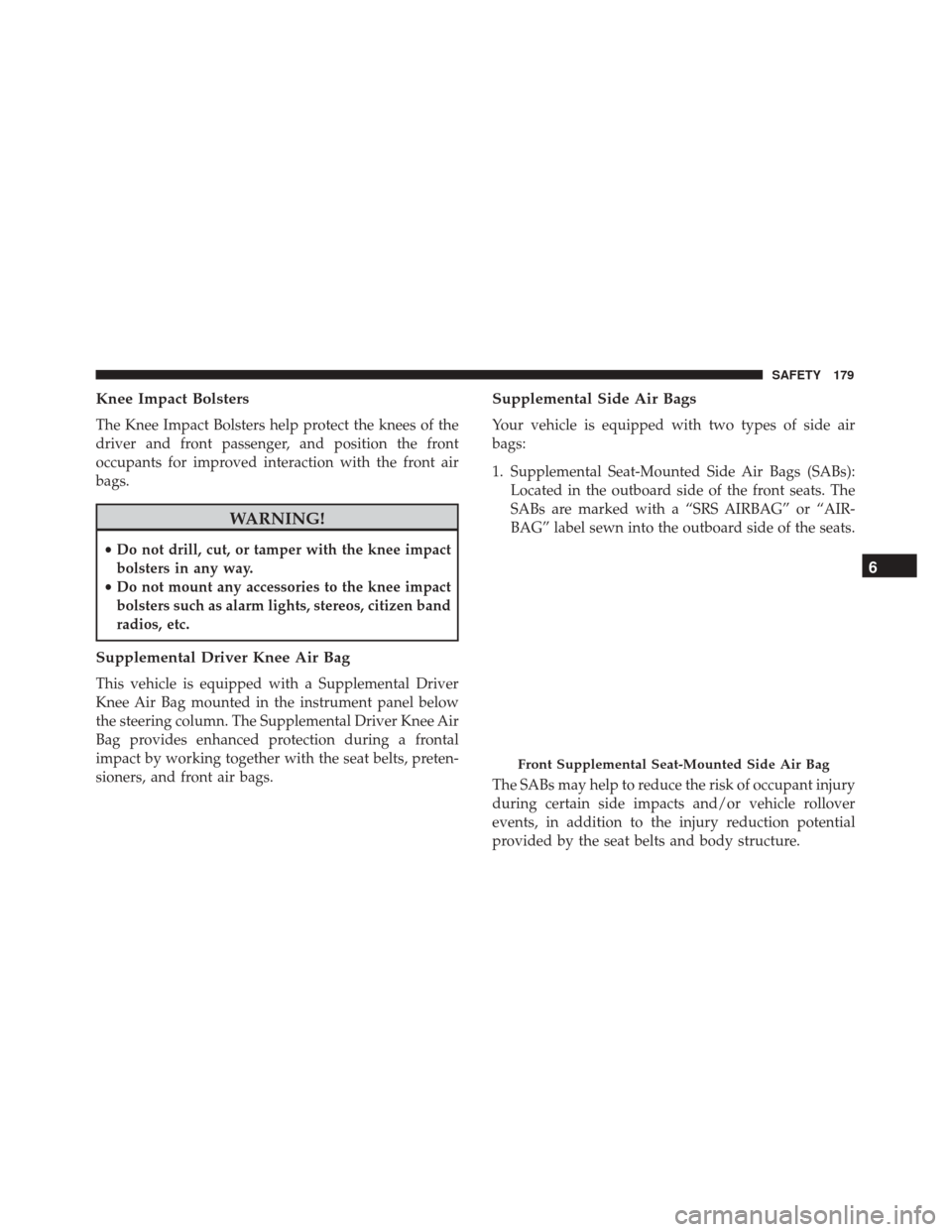
1. Supplemental Seat-Mounted Side Air Bags (SABs): Located in the outboard side of the front seats. The
SABs are marked with a “SRS AIRBAG” or “AIR-
BAG” label sewn into the outboard side of the seats.
The SABs may help to reduce the risk of occupant injury
during certain side impacts and/or vehicle rollover
events, in addition to the injury reduction potential
provided by the seat belts and body structure.
Front Supplemental Seat-Mounted Side Air Bag
6
SAFETY 179
Page 183 of 476
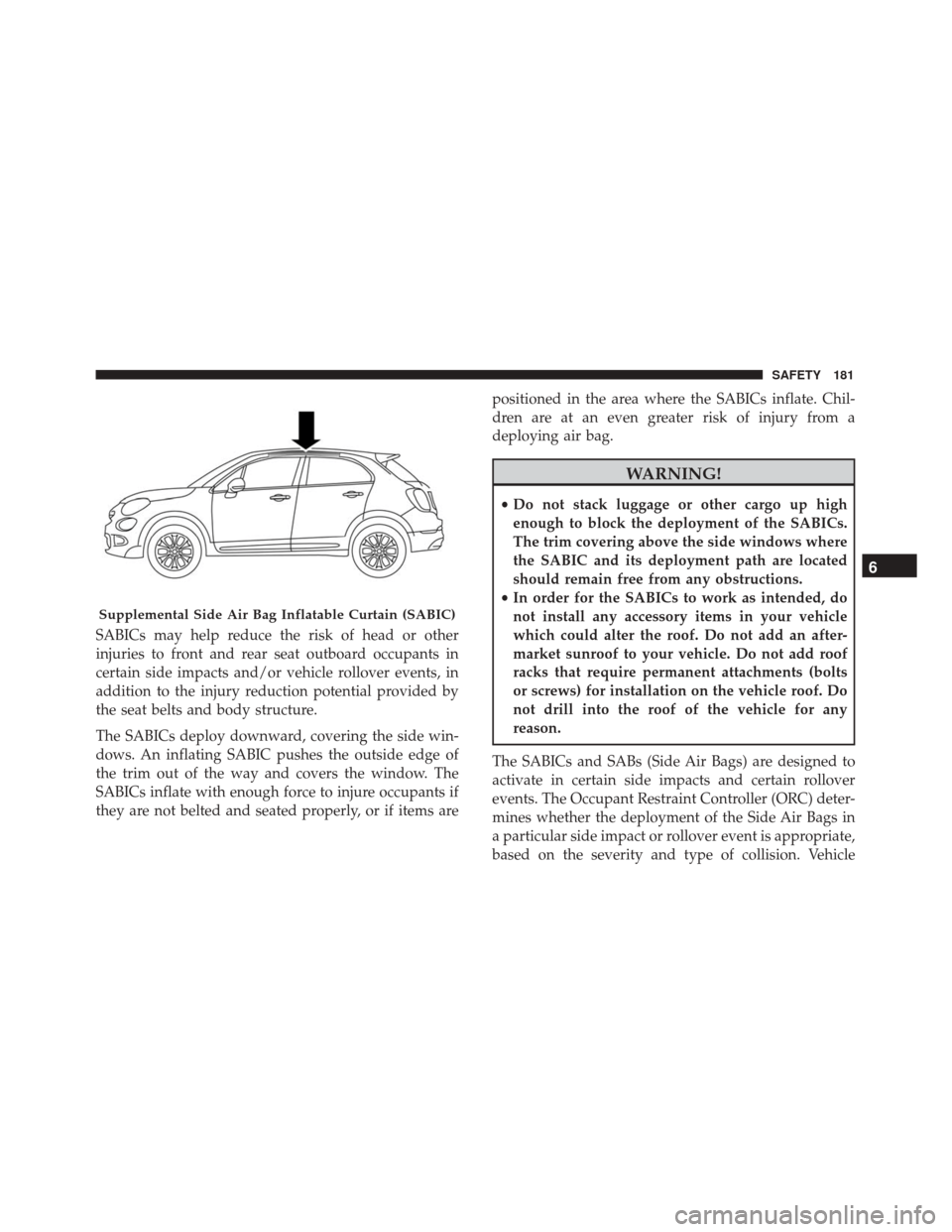
SABICs may help reduce the risk of head or other
injuries to front and rear seat outboard occupants in
certain side impacts and/or vehicle rollover events, in
addition to the injury reduction potential provided by
the seat belts and body structure.
The SABICs deploy downward, covering the side win-
dows. An inflating SABIC pushes the outside edge of
the trim out of the way and covers the window. The
SABICs inflate with enough force to injure occupants if
they are not belted and seated properly, or if items arepositioned in the area where the SABICs inflate. Chil-
dren are at an even greater risk of injury from a
deploying air bag.
WARNING!
•
Do not stack luggage or other cargo up high
enough to block the deployment of the SABICs.
The trim covering above the side windows where
the SABIC and its deployment path are located
should remain free from any obstructions.
• In order for the SABICs to work as intended, do
not install any accessory items in your vehicle
which could alter the roof. Do not add an after-
market sunroof to your vehicle. Do not add roof
racks that require permanent attachments (bolts
or screws) for installation on the vehicle roof. Do
not drill into the roof of the vehicle for any
reason.
The SABICs and SABs (Side Air Bags) are designed to
activate in certain side impacts and certain rollover
events. The Occupant Restraint Controller (ORC) deter-
mines whether the deployment of the Side Air Bags in
a particular side impact or rollover event is appropriate,
based on the severity and type of collision. Vehicle
Supplemental Side Air Bag Inflatable Curtain (SABIC)
6
SAFETY 181
Page 245 of 476
recover after the vehicle has left these areas. Under rare
conditions, when the radar is not tracking any vehicles
or objects in its path this warning may temporarily
occur.
If weather conditions are not a factor, the driver should
examine the sensor. It may require cleaning or removal
of an obstruction. The sensor is located behind the
lower grille. In absence of visible obstructions on the
bumper, it could be necessary to wipe off the radar
directly on the surface, after having the radar cover
removed. It’s recommended that your authorized
dealer perform’s this operation.
NOTE:
•If the “Brake Control Front Radar Sensor Temporar-
ily Blocked” message occurs frequently (e.g. more
than once on every trip) without any snow, rain,
mud, or other obstruction, have the radar sensor
realigned at your authorized dealer.
• Installing a snow plow, front-end protector, an after-
market grille or modifying the grille is not recom-
mended. Doing so may block the sensor and inhibit
Brake Control operation.Precautions While Driving With Brake Control
In certain driving conditions, such as:
• Driving in the vicinity of a curve
• Small vehicles and/or not aligned to the lane
• Lane changing of other vehicles
• Passing of vehicles in an oncoming intersection
The intervention of the system could be unexpected or
delayed. The driver must therefore always pay particu-
lar attention, while maintaining control of the car to
drive in complete safety.
7
STARTING AND OPERATING 243
Page 295 of 476
5. Install the headlamp bulb and socket; align the tabsand turn it clockwise making sure it is properly
locked.
WARNING!
Carry out the operation of replacing lamps only
with the engine off. Also make sure that the engine
is cold, to avoid the danger of burns. Position Lights/Daytime Running Lights/Fog Lights
To replace the bulbs proceed as follows:
1. Turn the front wheels completely.
2. Use a suitable tool to remove the access door.
3. Remove the electrical connectors.
Headlamp Bulb Connector
Position Light/Daytime Running Light/Fog light Access
1 — Screws
2 — Access Door
8
IN CASE OF EMERGENCY 293
Page 310 of 476

Mounting Fuse Cover and Locking Screw
Proceed as follows:
1. Properly secure the fuse cover to the box, slidecompletely from top to bottom.
2. Fully depress the screw, using the special screw- driver supplied.
3. Slowly turn the screw clockwise.
4. Release the screw.
Cavity Maxi Fuse Cartage Fuse Mini Fuse Description
F01 70 Amp Tan ––Module Body Com-
puter
F02 60 Amp Blue ––Module Body Com-
puter, Rear Distribu- tion Units
Battery Fuse Cover Location
1 — Fuse Cover Tabs
2 — Fuse Cover
308 IN CASE OF EMERGENCY
Page 327 of 476
WARNING!(Continued)
•A loose Tire Service Kit thrown forward in a
collision or hard stop could endanger the occu-
pants of the vehicle. Always stow the Tire Service
Kit in the place provided. Failure to follow these
warnings can result in injuries that are serious or
fatal to you, your passengers, and others around
you.
• Take care not to allow the contents of Tire Service
Kit to come in contact with hair, eyes, or clothing.
Tire Service Kit sealant is harmful if inhaled,
swallowed, or absorbed through the skin. It
causes skin, eye, and respiratory irritation. Flush
immediately with plenty of water if there is any
contact with eyes or skin. Change clothing as soon
as possible, if there is any contact with clothing.
• Tire Service Kit Sealant solution contains latex. In
case of an allergic reaction or rash, consult a
physician immediately. Keep Tire Service Kit out
of reach of children. If swallowed, rinse mouth
immediately with plenty of water and drink
plenty of water. Do not induce vomiting! Consult
a physician immediately. Insert the power plug into the vehicle power outlet
socket. Start the vehicle engine.
Push the Tire Service Kit power button to the “I”
position. The electric compressor will be turned on,
sealant and air will inflate the tire.
Minimum 26 psi (1.8 bar) of pressure should be reached
within 20 minutes. If the pressure has not been reached
turn off and remove the Tire Service Kit, drive the
vehicle 30 feet (10 meters) back and forth, to better
distribute the sealant inside the tire.
Attach the clear flexible filling tube of the compressor
directly to the tire valve and repeat the inflation process.
When the correct pressure has been reached, start
driving the vehicle to uniformly distribute the sealant
inside the tire. After 10 minutes, stop and check the tire
pressure. If the pressure is below 19 psi (1.3 bar), do not
drive the vehicle, as the tire is too damaged, contact the
nearest authorized dealer.
8
IN CASE OF EMERGENCY 325
Page 372 of 476

WARNING!(Continued)
original factory installed hydraulic master cylin-
der reservoir.
• To avoid contamination from foreign matter or
moisture, use only new brake fluid or fluid that
has been in a tightly closed container. Keep the
master cylinder reservoir cap secured at all times.
Brake fluid in a open container absorbs moisture
from the air resulting in a lower boiling point.
This may cause it to boil unexpectedly during
hard or prolonged braking, resulting in sudden
brake failure. This could result in a collision.
• Overfilling the brake fluid reservoir can result in
spilling brake fluid on hot engine parts, causing
the brake fluid to catch fire. Brake fluid can also
damage painted and vinyl surfaces, care should
be taken to avoid its contact with these surfaces.
• Do not allow petroleum-based fluid to contami-
nate the brake fluid. Brake seal components could
be damaged, causing partial or complete brake
failure. This could result in a collision.
CAUTION!
Use of improper brake fluids will affect overall
clutch system performance. Improper brake fluids
may damage the clutch system resulting in loss of
clutch function and the ability to shift the transmis-
sion.
Manual Transmission — If Equipped
Lubricant Selection
Use only the manufacturers recommended transmis-
sion fluid. Refer to “Fluids, Lubricants, And Genuine
Parts” in “Technical Data” for further information.
Please see your authorized dealer for service.
Fluid Level Check
Check the fluid level by removing the fill plug. The
fluid level should be between the bottom of the fill hole
and a point not more than 3/16 inch (4.7 mm) below the
bottom of the hole.
Add fluid, if necessary, to maintain the proper level.
Please see your authorized dealer for service.
370 MAINTAINING AND CARING FOR YOUR VEHICLE