2014 FIAT 500L LIVING steering
[x] Cancel search: steeringPage 70 of 420
"Smart washing" function
Pull the lever towards the steering wheel (unstable
position) to activate the windscreen washer.
Keeping the stalk pulled for more than half a second,
with just one movement it is possible to operate
the washer jet and the wiper at the same time.
The wiper stops working three strokes after the
stalk is released.
A further stroke after approximately six seconds
completes the wiping cycle (for versions/markets,
where provided).
RAIN SENSOR
(for versions/markets, where provided)
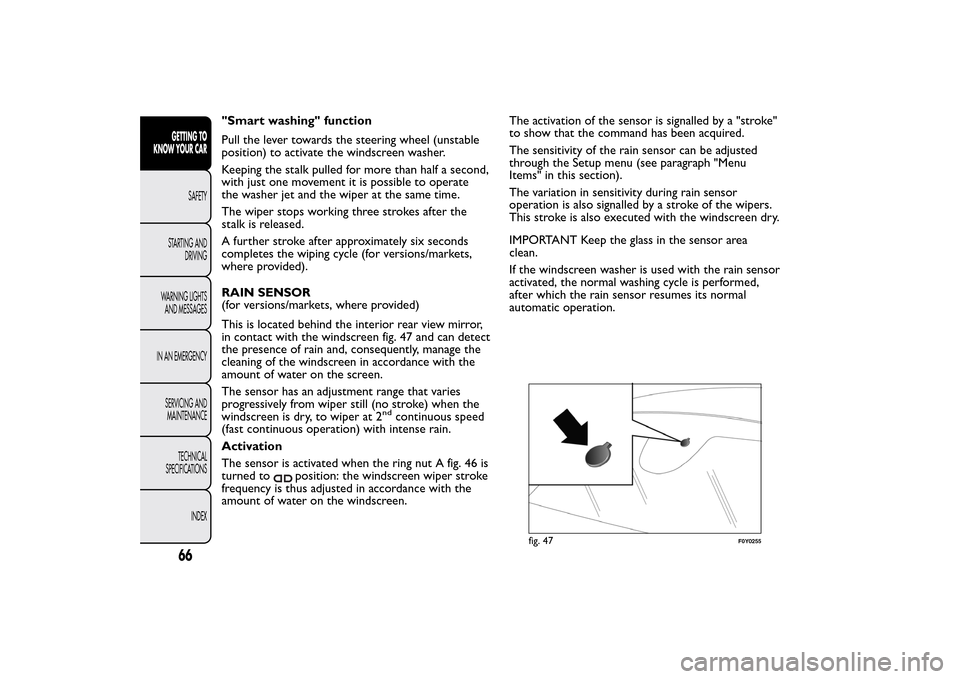
This is located behind the interior rear view mirror,
in contact with the windscreen fig. 47 and can detect
the presence of rain and, consequently, manage the
cleaning of the windscreen in accordance with the
amount of water on the screen.
The sensor has an adjustment range that varies
progressively from wiper still (no stroke) when the
windscreen is dry, to wiper at 2
nd
continuous speed
(fast continuous operation) with intense rain.
Activation
The sensor is activated when the ring nut A fig. 46 is
turned to
position: the windscreen wiper stroke
frequency is thus adjusted in accordance with the
amount of water on the windscreen.The activation of the sensor is signalled by a "stroke"
to show that the command has been acquired.
The sensitivity of the rain sensor can be adjusted
through the Setup menu (see paragraph "Menu
Items" in this section).
The variation in sensitivity during rain sensor
operation is also signalled by a stroke of the wipers.
This stroke is also executed with the windscreen dry.
IMPORTANT Keep the glass in the sensor area
clean.
If the windscreen washer is used with the rain sensor
activated, the normal washing cycle is performed,
after which the rain sensor resumes its normal
automatic operation.
fig. 47
F0Y0255
66GETTING TO
KNOW YOUR CAR
SAFETY
STARTING AND
DRIVING
WARNING LIGHTS
AND MESSAGES
IN AN EMERGENCY
SERVICING AND
MAINTENANCE
TECHNICAL
SPECIFICATIONS
INDEX
Page 82 of 420
DUALDRIVE ELECTRIC POWER STEERING
(for versions/markets, where provided)
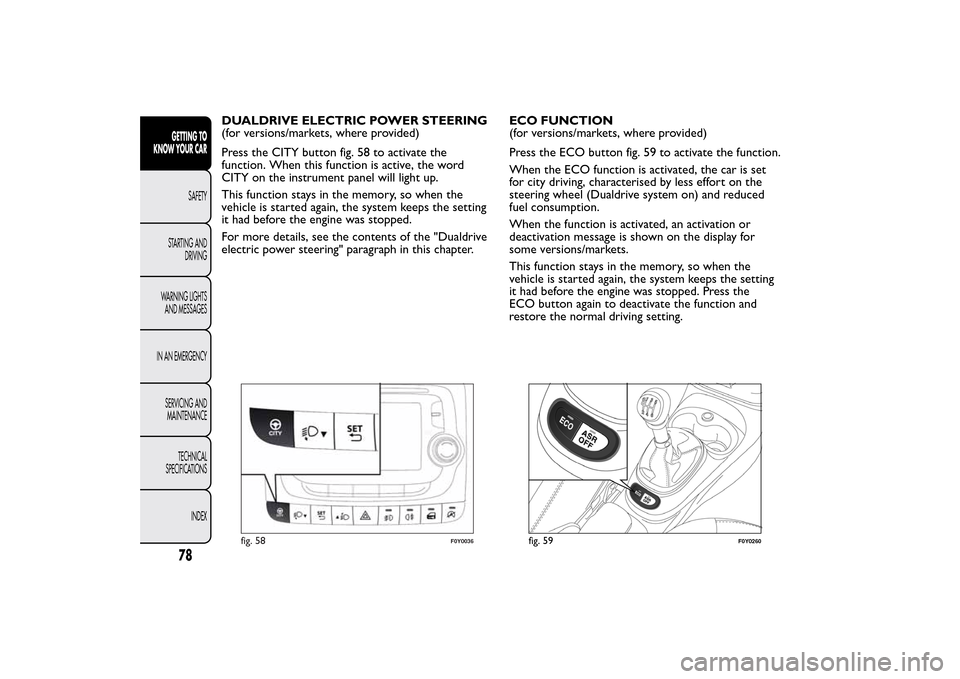
Press the CITY button fig. 58 to activate the
function. When this function is active, the word
CITY on the instrument panel will light up.
This function stays in the memory, so when the
vehicle is started again, the system keeps the setting
it had before the engine was stopped.
For more details, see the contents of the "Dualdrive
electric power steering" paragraph in this chapter.ECO FUNCTION
(for versions/markets, where provided)
Press the ECO button fig. 59 to activate the function.
When the ECO function is activated, the car is set
for city driving, characterised by less effort on the
steering wheel (Dualdrive system on) and reduced
fuel consumption.
When the function is activated, an activation or
deactivation message is shown on the display for
some versions/markets.
This function stays in the memory, so when the
vehicle is started again, the system keeps the setting
it had before the engine was stopped. Press the
ECO button again to deactivate the function and
restore the normal driving setting.
fig. 58
F0Y0036
fig. 59
F0Y0260
78GETTING TO
KNOW YOUR CAR
SAFETY
STARTING AND
DRIVING
WARNING LIGHTS
AND MESSAGES
IN AN EMERGENCY
SERVICING AND
MAINTENANCE
TECHNICAL
SPECIFICATIONS
INDEX
Page 119 of 420

DST SYSTEM
(Dynamic Steering Torque or steering
corrector)
The DST (steering corrector) function uses the
integration of the ESC system with the electric
power steering to increase the safety level of the
whole car.
In critical situations (understeering, oversteering,
braking with different grip conditions), through the
DST function the ESC system controls the steering
to implement an additional torque contribution
on the steering wheel, to suggest the most correct
manoeuvre to the driver.
The coordinated action of brakes and steering
increases the safety and car control feeling.
WARNING
The DST is a driving aid system and does
not replace the driver's actions while
driving the car.ERM ELECTRONIC ROLLOVER
MITIGATION SYSTEM
(Electronic Rollover Mitigation)
The system monitors the raising tendency of the
wheels from the ground if the driver performs
extreme manoeuvres like quick steering to avoid an
obstacle, especially in poor road conditions.
If such conditions occur the system intervenes on
brakes and engine power to reduce the possibility for
the wheels to be raised from the ground.
It is not possible to avoid tendency to roll over if the
phenomenon is due to reasons such as driving on
high side gradients, collision with objects or other
vehicles.
WARNING
The performance of a car with ERM
must never be tested in imprudent
or dangerous ways, with the possibility of
putting the safety of the driver or other people
at risk.
115GETTING TO
KNOW YOUR CARSAFETY
STARTING AND
DRIVING
WARNING LIGHTS
AND MESSAGES
IN AN EMERGENCY
SERVICING AND
MAINTENANCE
TECHNICAL
SPECIFICATIONS
INDEX
Page 127 of 420

Lane change by other vehicles
Vehicles suddenly changing lane, getting in the driving
lane of the car fig. 118 and inside the laser sensor
operating range, may cause system activation.IMPORTANT
WARNING
The system is an aid for the driver who
must never reduce attention while
driving.The responsibility always rests with the
driver, who must take into account the traffic
conditions for driving in complete safety.The
driver must always maintain a safe distance
from the vehicle in front .
WARNING
If the driver depresses the brake pedal
fully or carries out a fast steering during
system operation, the automatic braking
function may stop (e.g. to allow a possible
manoeuvre to avoid the obstacle).The laser sensor may have limited or
absent operation due to weather
conditions such as: heavy rain, hail, thick
fog, heavy snow, formation of ice layers on the
windscreen.
fig. 117
F0Y0321
fig. 118
F0Y0322
123GETTING TO
KNOW YOUR CARSAFETY
STARTING AND
DRIVING
WARNING LIGHTS
AND MESSAGES
IN AN EMERGENCY
SERVICING AND
MAINTENANCE
TECHNICAL
SPECIFICATIONS
INDEX
Page 132 of 420
EOBD SYSTEMThe EOBD system (European On Board Diagnosis)
carries out a continuous diagnosis of the
components of the car related to emissions. It also
alerts the driver, by turning on warning light
on
the instrument panel (together with a message
on the display on some versions), when these
components are no longer in peak condition (see
section “Warning lights and messages”).
The aim of the EOBD system (European On Board
Diagnosis) is to:
❒monitor the system efficiency;
❒indicate an increase in emissions;
❒indicate the need to replace damaged components.
The system also has a diagnosis connector that can
be interfaced to suitable instruments, to read the
error codes stored in the control unit together with
a series of specific parameters for engine operation
and diagnosis.
IMPORTANT After eliminating the failure, to check
the system completely, Fiat Dealerships run a bench
test and, if necessary, road tests which may also
call for a long journey.
DUALDRIVE ELECTRIC
POWER STEERINGThis only operates with the key turned to MAR and
the engine started. The steering allows the force
required at the steering wheel to be adjusted to suit
driving conditions.
IMPORTANT When turning the ignition key quickly,
full power steering functionality can be achieved after
a few seconds.
CITY FUNCTION ACTIVATION/
DEACTIVATION
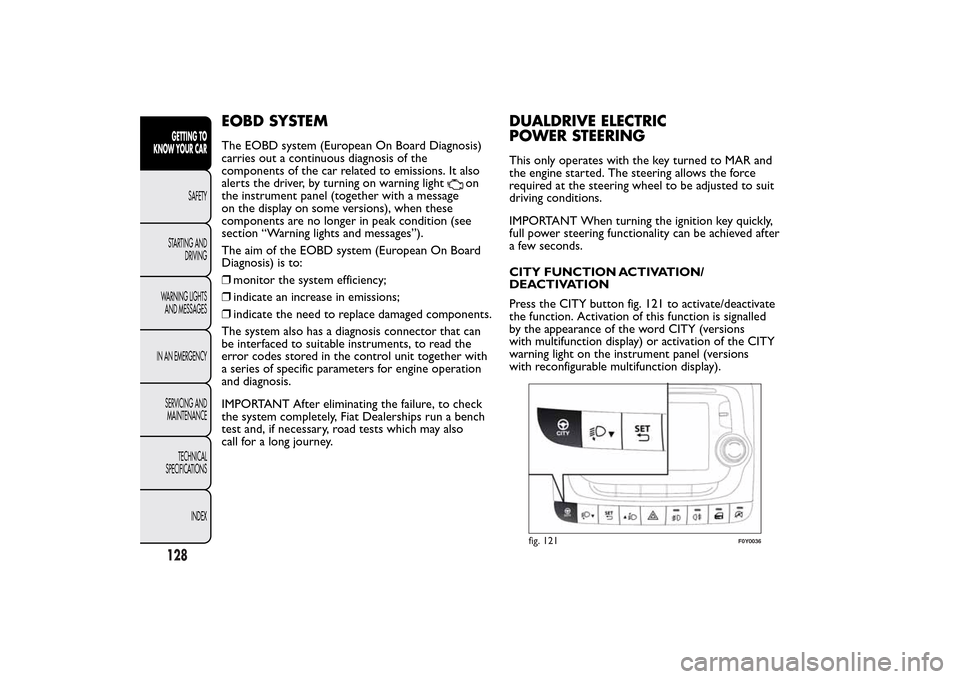
Press the CITY button fig. 121 to activate/deactivate
the function. Activation of this function is signalled
by the appearance of the word CITY (versions
with multifunction display) or activation of the CITY
warning light on the instrument panel (versions
with reconfigurable multifunction display).
fig. 121
F0Y0036
128GETTING TO
KNOW YOUR CAR
SAFETY
STARTING AND
DRIVING
WARNING LIGHTS
AND MESSAGES
IN AN EMERGENCY
SERVICING AND
MAINTENANCE
TECHNICAL
SPECIFICATIONS
INDEX
Page 133 of 420
When the CITY function is on, the steering wheel
effort is lighter, parking operations are easier:
therefore this function is particularly useful for
driving in city centres.
WARNING
It is absolutely forbidden to carr y out
any after-market operation involving
steering system or steering column
modifications (e.g.: installation of anti-theft
device) that could badly affect performance and
safety, invalidate warranty and also result in
non-compliance of the car with type approval
requirements.
IMPORTANT During parking manoeuvres requiring a
lot of steering, the steering may become harder;
this is normal and is due to the intervention of the
system to protect the electric steering motor from
overheating. No repair intervention is needed in this
case. When the car is used again, the power steering
will work normally again.
WARNING
Before performing any maintenance
operations, always turn off the engine
and remove the key from the ignition to lock
the steering column (especially when the car
wheels are not touching the ground). If this
is not possible (for example if the key needs to
be turned to MAR-ON or the engine must be
running), remove the main fuse that protects
the electric power steering.
129GETTING TO
KNOW YOUR CARSAFETY
STARTING AND
DRIVING
WARNING LIGHTS
AND MESSAGES
IN AN EMERGENCY
SERVICING AND
MAINTENANCE
TECHNICAL
SPECIFICATIONS
INDEX
Page 165 of 420

AIRBAGThe car is equipped with front airbags for driver and
passenger, driver's knee bag (for versions/markets,
where provided), seat-mounted side airbags for
driver's and passenger pelvis-chest-shoulder
protection (for versions/markets, where provided),
and window airbags for protecting the heads of front
and rear outer occupants.
The location of the airbags on the car is marked by
the writing "AIRBAG" in the middle of the steering
wheel, on the dashboard, on the side trim or on
a label placed next to the airbag deployment area.
FRONT AIRBAGS
The front driver/passenger airbags and the driver's
knee bag (for versions/markets, where provided)
protect the front seat occupants in the event of
frontal impacts of medium/high severity, by placing
the bag between the occupant and the steering
wheel or dashboard.
Therefore non-deployment in other types of impacts
(side impacts, rear shunts, roll-overs, etc.) does not
indicate a system malfunction.
Front (driver and passenger) airbags are not a
replacement for, but are complementary to, the seat
belts, which you are recommended to always wear,
as specified by law in Europe and most non-European
countries.
In the event of impact, those not wearing a seat belt
are projected forwards and may come into contactwith the bag which is still inflating. The protection
offered by the bag is compromised in these
circumstances.
Front airbags may not activate in the following
situations:
❒frontal impacts against highly deformable objects
not involving the front surface of the car (e.g.
wing collision against guard rail, etc.);
❒underride impacts with other vehicles or wedging
under protective barriers (e.g. trucks or guard
rails).
Failure to activate in the conditions described above
is due to the fact that they may not provide any
additional protection compared with seat belts, so
their activation would be inappropriate.
In these cases, non-deployment of the airbag does
not necessarily indicate a system malfunction.
WARNING
Do not apply stickers or other objects
on the steering wheel, on the dashboard
in the passenger airbag area, on roof side trims
or on the seats. Never put objects (e.g. mobile
phones) on the passenger side of the dashboard
since they could interfere with correct inflation
of the passenger airbag and also cause serious
injur y to the passengers.
161GETTING TO KNOW
YOUR CARSAFETYSTARTING AND
DRIVING
WARNING LIGHTS
AND MESSAGES
IN AN EMERGENCY
SERVICING AND
MAINTENANCE
TECHNICAL
SPECIFICATIONS
INDEX
Page 166 of 420

Front driver airbag
This consists of an instantly inflating bag contained in
a special compartment in the centre of the steering
wheel fig. 144.
WARNING
Always drive with your hands on the rim
of the steering wheel so that the airbag
can inflate freely if required. Do not drive with
your body bent forward. Keep your back
straight against the backrest .
Front passenger airbag
This consists of an instantly-inflating bag contained in
a special compartment in the dashboard fig. 145:
this bag has a larger volume than that on the driver's
side.
fig. 144
F0Y0112
fig. 145
F0Y0113
162GETTING TO KNOW
YOUR CAR
SAFETY
STARTING AND
DRIVING
WARNING LIGHTS
AND MESSAGES
IN AN EMERGENCY
SERVICING AND
MAINTENANCE
TECHNICAL
SPECIFICATIONS
INDEX
WARNING
SEVERE DANGER:When an active
passenger airbag is fitted, DO NOT
install rearward facing child restraints
on the front seat . Deployment of the
airbag in an accident could cause fatal injuries
to the baby regardless of the severity of the
collision.Therefore, always release the
passenger airbag when a rearward facing child
restraint is installed on the passenger front seat .
The front passenger seat must also be
positioned back as far as possible in order to
avoid the child restraint from coming into
contact with the dashboard. Immediately
reactivate the passenger airbag as soon as the
child restraint system has been removed.