2014 FIAT 500L LIVING dashboard warning lights
[x] Cancel search: dashboard warning lightsPage 96 of 420
PASSENGER SIDE FRONT DOOR AND
REAR DOOR EMERGENCY LOCKING
DEVICE
The passenger side front door and the rear doors
have a device to lock them when there is no
electrical power supply.
In this case proceed as follows:
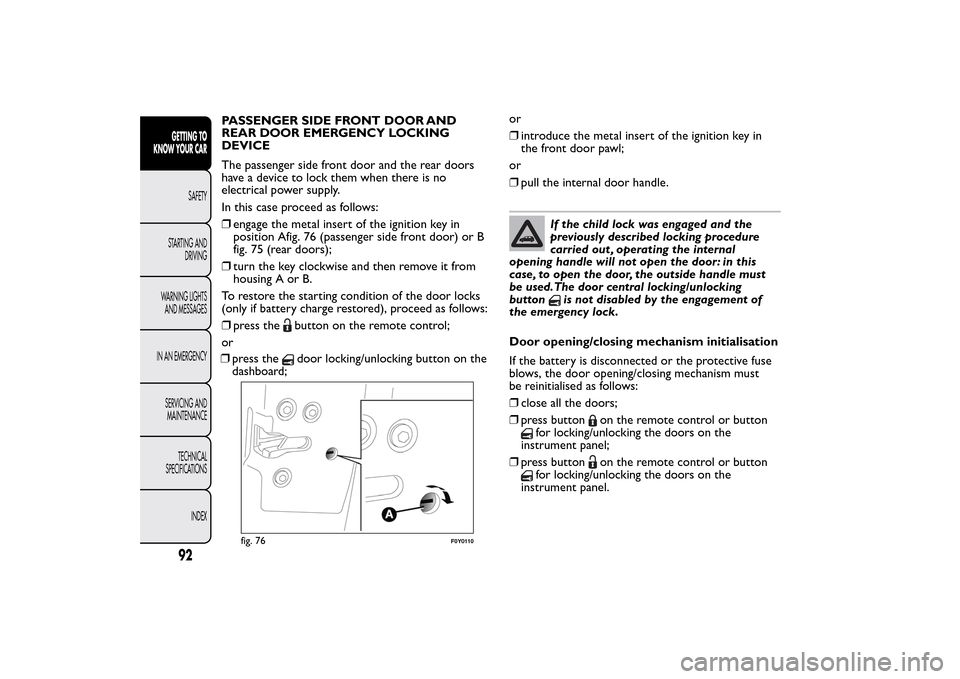
❒engage the metal insert of the ignition key in
position Afig. 76 (passenger side front door) or B
fig. 75 (rear doors);
❒turn the key clockwise and then remove it from
housing A or B.
To restore the starting condition of the door locks
(only if battery charge restored), proceed as follows:
❒press the
button on the remote control;
or
❒press thedoor locking/unlocking button on the
dashboard;or
❒introduce the metal insert of the ignition key in
the front door pawl;
or
❒pull the internal door handle.
If the child lock was engaged and the
previously described locking procedure
carried out , operating the internal
opening handle will not open the door: in this
case, to open the door, the outside handle must
be used.The door central locking/unlocking
button
is not disabled by the engagement of
the emergency lock.
Door opening/closing mechanism initialisation
If the battery is disconnected or the protective fuse
blows, the door opening/closing mechanism must
be reinitialised as follows:
❒close all the doors;
❒press button
on the remote control or button
for locking/unlocking the doors on the
instrument panel;
❒press button
on the remote control or button
for locking/unlocking the doors on the
instrument panel.
fig. 76
F0Y0110
92GETTING TO
KNOW YOUR CAR
SAFETY
STARTING AND
DRIVING
WARNING LIGHTS
AND MESSAGES
IN AN EMERGENCY
SERVICING AND
MAINTENANCE
TECHNICAL
SPECIFICATIONS
INDEX
Page 121 of 420
START&STOP SYSTEMINTRODUCTION
The Start&Stop system automatically stops the
engine each time the car is stationary and starts it
again when the driver wants to move off.
In this way, the efficiency of the car is increased, by
reducing consumption, emissions of harmful gases
and noise pollution.
OPERATING MODES
Engine stopping mode
With the car stopped, the engine stops with gearbox
in neutral and clutch pedal released.
NoteThe engine can only be stopped automatically
after exceeding a speed of about 10 km/h, to prevent
the engine from being repeatedly stopped when
driving at walking pace.
The
symbol appears on the display when the
engine stops.
Restarting the engine
Press the clutch pedal to restart the engine.MANUAL SYSTEM ACTIVATION/
DEACTIVATION
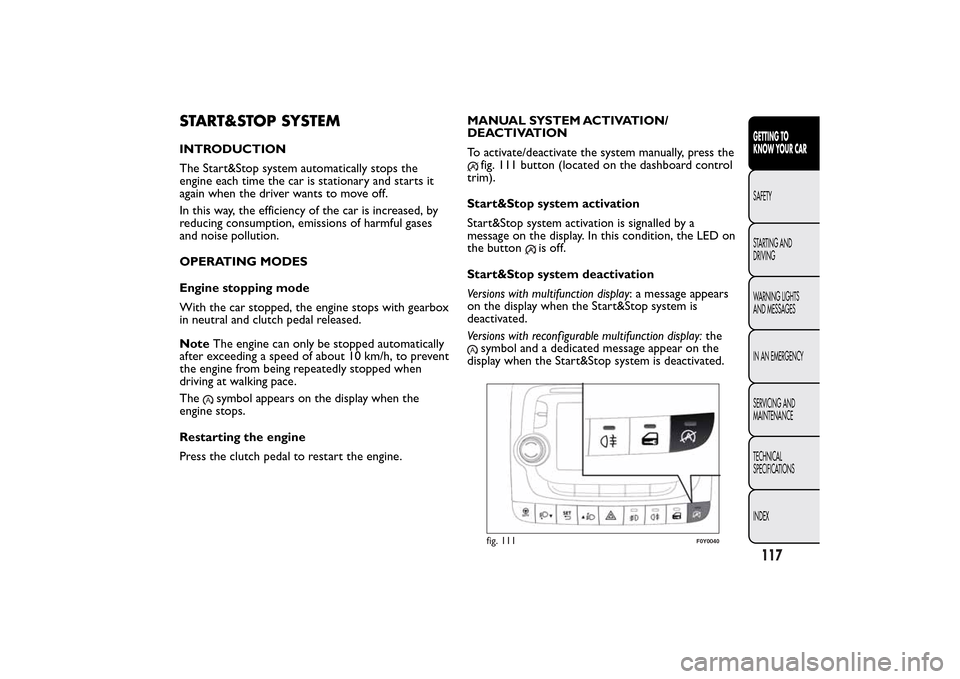
To activate/deactivate the system manually, press the
fig. 111 button (located on the dashboard control
trim).
Start&Stop system activation
Start&Stop system activation is signalled by a
message on the display. In this condition, the LED on
the button
is off.
Start&Stop system deactivation
Versions with multifunction display: a message appears
on the display when the Start&Stop system is
deactivated.
Versions with reconf igurable multifunction display:the
symbol and a dedicated message appear on the
display when the Start&Stop system is deactivated.fig. 111
F0Y0040
117GETTING TO
KNOW YOUR CARSAFETY
STARTING AND
DRIVING
WARNING LIGHTS
AND MESSAGES
IN AN EMERGENCY
SERVICING AND
MAINTENANCE
TECHNICAL
SPECIFICATIONS
INDEX
Page 134 of 420
RADIO SETUP SYSTEM(for versions/markets, where provided)
The car may be equipped with a dual storage
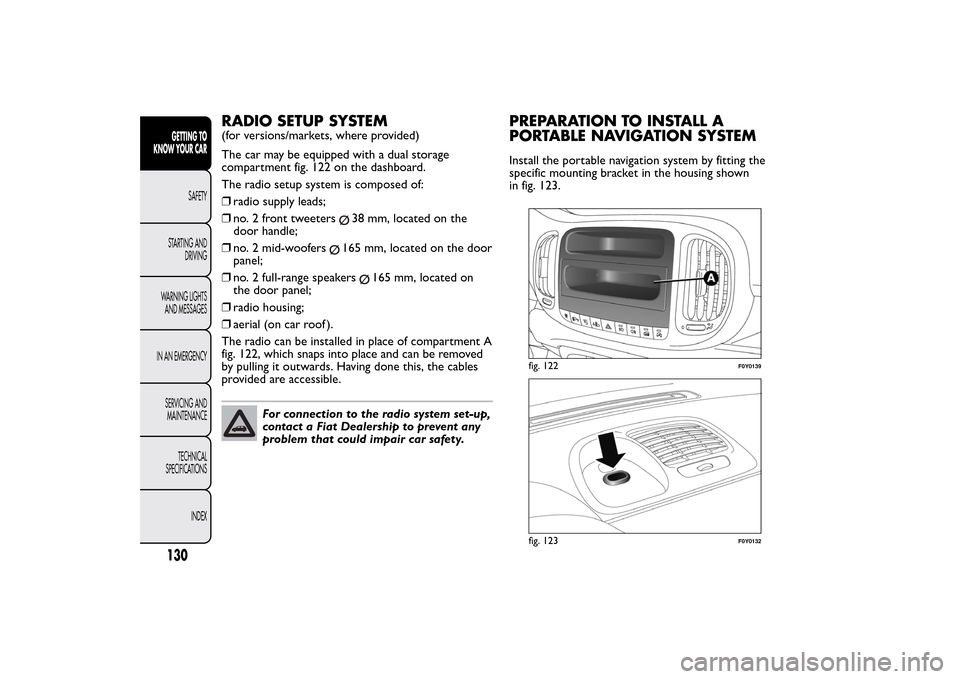
compartment fig. 122 on the dashboard.
The radio setup system is composed of:
❒radio supply leads;
❒no. 2 front tweeters
38 mm, located on the
door handle;
❒no. 2 mid-woofers165 mm, located on the door
panel;
❒no. 2 full-range speakers
165 mm, located on
the door panel;
❒radio housing;
❒aerial (on car roof ).
The radio can be installed in place of compartment A
fig. 122, which snaps into place and can be removed
by pulling it outwards. Having done this, the cables
provided are accessible.
For connection to the radio system set-up,
contact a Fiat Dealership to prevent any
problem that could impair car safety.
PREPARATION TO INSTALL A
PORTABLE NAVIGATION SYSTEMInstall the portable navigation system by fitting the
specific mounting bracket in the housing shown
in fig. 123.
fig. 122
F0Y0139
fig. 123
F0Y0132
130GETTING TO
KNOW YOUR CAR
SAFETY
STARTING AND
DRIVING
WARNING LIGHTS
AND MESSAGES
IN AN EMERGENCY
SERVICING AND
MAINTENANCE
TECHNICAL
SPECIFICATIONS
INDEX
Page 152 of 420
WARNING
Extreme Hazard! Do not place rearward
facing infant seat in front of an active
air bag. Deployment of the air bag in an
accident could cause fatal injuries to the baby
regardless of the severity of the collision. It
is advisable to always carr y children in a child
restraint system on the rear seat , which is
the most protected position in the event of a
collision.
WARNING
Should it be necessary to carry a child
on the passenger side front seat in a
rearward facing child restraint system, the
passenger side front airbag and side bag (for
versions/markets, where provided) must be
deactivated through the Setup menu.
Deactivation should be verified by checking
whether the
warning light is switched on in
the instrument panel.The passenger seat must
also be positioned back as far as possible in
order to avoid the child restraint system from
coming into contact with the dashboard.
WARNING
Do not adjust the front or rear seat if a
child is seated on it or on the dedicated
child restraint system.
148GETTING TO KNOW
YOUR CAR
SAFETY
STARTING AND
DRIVING
WARNING LIGHTS
AND MESSAGES
IN AN EMERGENCY
SERVICING AND
MAINTENANCE
TECHNICAL
SPECIFICATIONS
INDEX
Page 165 of 420

AIRBAGThe car is equipped with front airbags for driver and
passenger, driver's knee bag (for versions/markets,
where provided), seat-mounted side airbags for
driver's and passenger pelvis-chest-shoulder
protection (for versions/markets, where provided),
and window airbags for protecting the heads of front
and rear outer occupants.
The location of the airbags on the car is marked by
the writing "AIRBAG" in the middle of the steering
wheel, on the dashboard, on the side trim or on
a label placed next to the airbag deployment area.
FRONT AIRBAGS
The front driver/passenger airbags and the driver's
knee bag (for versions/markets, where provided)
protect the front seat occupants in the event of
frontal impacts of medium/high severity, by placing
the bag between the occupant and the steering
wheel or dashboard.
Therefore non-deployment in other types of impacts
(side impacts, rear shunts, roll-overs, etc.) does not
indicate a system malfunction.
Front (driver and passenger) airbags are not a
replacement for, but are complementary to, the seat
belts, which you are recommended to always wear,
as specified by law in Europe and most non-European
countries.
In the event of impact, those not wearing a seat belt
are projected forwards and may come into contactwith the bag which is still inflating. The protection
offered by the bag is compromised in these
circumstances.
Front airbags may not activate in the following
situations:
❒frontal impacts against highly deformable objects
not involving the front surface of the car (e.g.
wing collision against guard rail, etc.);
❒underride impacts with other vehicles or wedging
under protective barriers (e.g. trucks or guard
rails).
Failure to activate in the conditions described above
is due to the fact that they may not provide any
additional protection compared with seat belts, so
their activation would be inappropriate.
In these cases, non-deployment of the airbag does
not necessarily indicate a system malfunction.
WARNING
Do not apply stickers or other objects
on the steering wheel, on the dashboard
in the passenger airbag area, on roof side trims
or on the seats. Never put objects (e.g. mobile
phones) on the passenger side of the dashboard
since they could interfere with correct inflation
of the passenger airbag and also cause serious
injur y to the passengers.
161GETTING TO KNOW
YOUR CARSAFETYSTARTING AND
DRIVING
WARNING LIGHTS
AND MESSAGES
IN AN EMERGENCY
SERVICING AND
MAINTENANCE
TECHNICAL
SPECIFICATIONS
INDEX
Page 166 of 420

Front driver airbag
This consists of an instantly inflating bag contained in
a special compartment in the centre of the steering
wheel fig. 144.
WARNING
Always drive with your hands on the rim
of the steering wheel so that the airbag
can inflate freely if required. Do not drive with
your body bent forward. Keep your back
straight against the backrest .
Front passenger airbag
This consists of an instantly-inflating bag contained in
a special compartment in the dashboard fig. 145:
this bag has a larger volume than that on the driver's
side.
fig. 144
F0Y0112
fig. 145
F0Y0113
162GETTING TO KNOW
YOUR CAR
SAFETY
STARTING AND
DRIVING
WARNING LIGHTS
AND MESSAGES
IN AN EMERGENCY
SERVICING AND
MAINTENANCE
TECHNICAL
SPECIFICATIONS
INDEX
WARNING
SEVERE DANGER:When an active
passenger airbag is fitted, DO NOT
install rearward facing child restraints
on the front seat . Deployment of the
airbag in an accident could cause fatal injuries
to the baby regardless of the severity of the
collision.Therefore, always release the
passenger airbag when a rearward facing child
restraint is installed on the passenger front seat .
The front passenger seat must also be
positioned back as far as possible in order to
avoid the child restraint from coming into
contact with the dashboard. Immediately
reactivate the passenger airbag as soon as the
child restraint system has been removed.
Page 167 of 420

Driver knee airbag
(for versions/markets, where provided)
It is located in a special compartment under the
dashboard and has a dedicated cover fig. 146. It
provides additional protection in the event of
a frontal impact.Deactivation of passenger airbags: front airbag
and seat-mounted side airbag for pelvis-chest-
shoulder protection (for versions/markets,
where provided)
If a child must be carried on the front seat in
rearward facing child restrain system, deactivate the
passenger front airbag and the seat-mounted bag
for pelvis, chest and shoulder protection (for
versions/markets, where provided).
With the airbags deactivated, the
warning light
switches on in the instrument panel.
IMPORTANT To deactivate the airbags see the
description in the "Getting to know your car"
chapter, "Menu Options" paragraph.
fig. 146
F0Y0207
163GETTING TO KNOW
YOUR CARSAFETYSTARTING AND
DRIVING
WARNING LIGHTS
AND MESSAGES
IN AN EMERGENCY
SERVICING AND
MAINTENANCE
TECHNICAL
SPECIFICATIONS
INDEX
Page 170 of 420
WARNING
On cars with seat-mounted side airbags,
do not cover the front seat backrests
with extra covers.
WARNING
Do not travel carrying objects in your
lap, in front of your chest or between
your lips (pipe, pencils, etc .).They could cause
severe injury if the airbag is deployed.
WARNING
If the car has been stolen or in the case
of attempt to steal it , if it has been
subjected to vandalism or floods, have the
airbag system checked by a Fiat Dealership.
166GETTING TO KNOW
YOUR CAR
SAFETY
STARTING AND
DRIVING
WARNING LIGHTS
AND MESSAGES
IN AN EMERGENCY
SERVICING AND
MAINTENANCE
TECHNICAL
SPECIFICATIONS
INDEX
WARNING
The airbags may also be deployed when
the car is not moving, if the key is in
the ignition and turned to MAR-ON or when
theengineisoff,ifthecarishitbyanother
moving vehicle.Therefore, even if the car is
stationary, when an active passenger airbag is
fitted, DO NOT install on the passenger seat
child restraint systems to be fitted rearward
facing on the front seat . Deployment of the
airbag following an impact could cause fatal
injuries to the child.Therefore, always release
the passenger airbag when a rearward facing
child restraint is installed on the passenger front
seat .The front passenger seat must also be
positioned back as far as possible in order to
avoid the child restraint from coming into
contact with the dashboard. Immediately
reactivate the passenger airbag as soon as the
child restraint system has been removed. Also
remember that , if the key is turned to STOP,
none of the safety devices (airbags or
pretensioners) will be deployed in the event of
collision. Non-deployment of these devices does
not indicate a system malfunction.