Page 388 of 590
NOTE:Even if the transmission can be reset, we recom-
mend that you visit your authorized dealer at your
earliest possible convenience. Your authorized dealer has
diagnostic equipment to determine if the problem could
recur. If the transmission cannot be reset, authorized
dealer service is required.
Overdrive Operation
The automatic transmission includes an electronically
controlled Overdrive (fifth gear). The transmission will
automatically shift into Overdrive if the following con-
ditions are present:
• The shift lever is in the DRIVE position.
• Vehicle speed is sufficiently high.
• The driver is not heavily pressing the accelerator.AUTOSTICK®
Steering Wheel Mounted Paddle Shifters Or
Console Mounted Shifter
AutoStick® is a driver-interactive transmission feature
providing manual shift control, giving you more control
of the vehicle. AutoStick® allows you to maximize en-
gine braking, eliminate undesirable upshifts and down-
shifts, and improve overall vehicle performance.
This system can also provide you with more control
during passing, city driving, cold slippery conditions,
mountain driving, and many other situations.
386 STARTING AND OPERATING
Page 389 of 590
Operation
When the shift lever is in the DRIVE position, the
transmission will operate automatically, shifting between
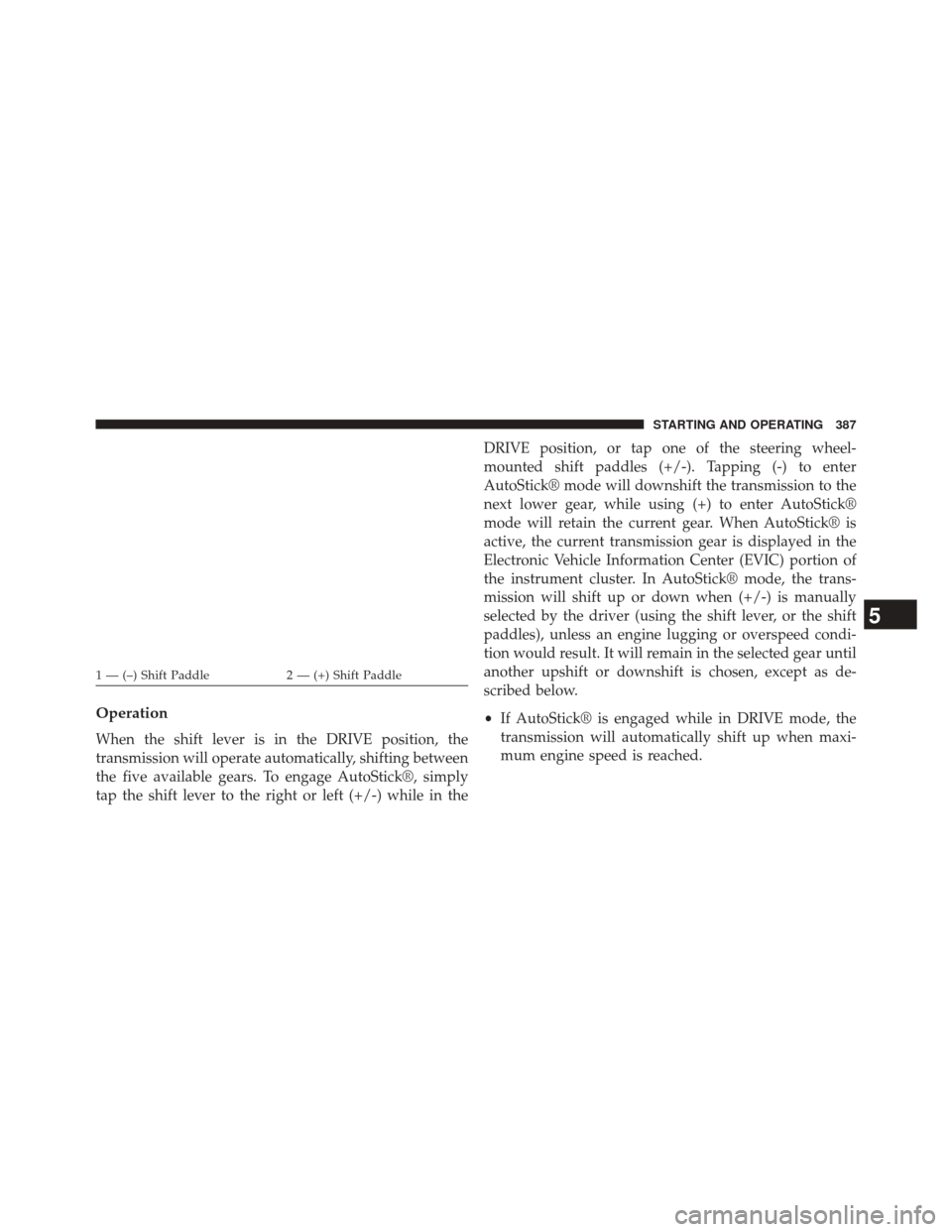
the five available gears. To engage AutoStick®, simply
tap the shift lever to the right or left (+/-) while in theDRIVE position, or tap one of the steering wheel-
mounted shift paddles (+/-). Tapping (-) to enter
AutoStick® mode will downshift the transmission to the
next lower gear, while using (+) to enter AutoStick®
mode will retain the current gear. When AutoStick® is
active, the current transmission gear is displayed in the
Electronic Vehicle Information Center (EVIC) portion of
the instrument cluster. In AutoStick® mode, the trans-
mission will shift up or down when (+/-) is manually
selected by the driver (using the shift lever, or the shift
paddles), unless an engine lugging or overspeed condi-
tion would result. It will remain in the selected gear until
another upshift or downshift is chosen, except as de-
scribed below.
•
If AutoStick® is engaged while in DRIVE mode, the
transmission will automatically shift up when maxi-
mum engine speed is reached.
1 — (–) Shift Paddle 2 — (+) Shift Paddle
5
STARTING AND OPERATING 387
Page 390 of 590
•If AutoStick® is engaged while in SPORT mode, the
transmission will remain in the selected gear even
when maximum engine speed is reached. The trans-
mission will upshift only when commanded by the
driver. Engine overspeed protection will be provided
by fuel cut off at or near redline.
• The transmission will automatically downshift as the
vehicle slows (to prevent engine lugging) and will
display the current gear.
• The transmission will automatically downshift to first
gear when coming to a stop. After a stop, the driver
should manually upshift (+) the transmission as the
vehicle is accelerated.
• You can start out, from a stop, in first or second gear.
Tapping (+), (at a stop) will allow starting in second
gear. Starting out in second gear is helpful in snowy or
icy conditions. •
The system will ignore attempts to upshift at too low
of a vehicle speed.
• Avoid using speed control when AutoStick® is en-
gaged.
• Transmission shifting will be more noticeable when
AutoStick® is engaged.
To disengage AutoStick® mode, hold the shift lever to the
right or press and hold the (+) shift paddle until “D” is
once again displayed in the instrument cluster. You can
shift in or out of the AutoStick® mode at any time
without taking your foot off the accelerator pedal.
WARNING!
Do not downshift for additional engine braking on a
slippery surface. The drive wheels could lose their
grip and the vehicle could skid, causing a collision or
personal injury.
388 STARTING AND OPERATING
Page 392 of 590
When SPORT mode is enabled, a shock symbol
will light up in the instrument cluster. Refer to
“Instrument Cluster Description” in “Under-
standing Your Instrument Panel” for further
information.
AUTO mode will provide a sporty comfortable ride,
where as SPORT or TRACK will be a firmer, sportier
suspension with better handling.
• Track Mode — This mode includes SPORT suspension
and affects transmission shifting in either “Auto” or
“Manual” mode. Refer to “AutoStick” in “Starting
And Operating” for further information. In TRACK
mode, the transmission has a sportier, more aggressive
shift pattern. In Manual mode, the transmission will
hold gear at redline during manual shifting (console
shifter or paddle shifters). When TRACK mode is enabled, a flag symbol
will light up in the instrument cluster. Refer to
“Instrument Cluster Description” in “Under-
standing Your Instrument Panel” for further
information.
LAUNCH MODE — IF EQUIPPED
This vehicle is equipped with a Launch Control system
that is designed to allow the driver to achieve maximum
vehicle acceleration in a straight line. Launch Control is a
form of traction control that manages tire slip while
launching the vehicle. This feature is intended for use
during race events on a closed course where consistent
quarter mile and zero to sixty times are desired. The
system is not intended to compensate for lack of driver
experience or familiarity with the race track. Use of this
feature in low traction (cold, wet, gravel, etc) conditions
may results in excess wheel slip outside this systems
control resulting in an aborted launch.
390 STARTING AND OPERATING
Page 393 of 590
Preconditions:
•Launch control should not be used on public roads.
Always check track conditions and the surrounding
area.
• Launch Control is not available for the first 500 miles
of vehicle life.
• Launch Control should only be used when the engine
and transmission are at operating temperature.
• Launch Control is intended to be used on dry, paved
road surfaces only. Use on slippery or loose surfaces
may cause damage to vehicle components.
Launch Control is only available when the following
procedure is followed:
1. Press the “ESC OFF” button to put the vehicle into ESC Partial mode. The “ESC OFF” lamp will illumi-
nate in the cluster. 2. Press the “ESC OFF” button a second time to put the
vehicle into Launch Control. The “ESC OFF” lamp will
remain lit, and the cluster display will read “Launch
Control Enabled”.
3. Make sure the vehicle is not moving.
4. Make sure the steering wheel is pointing straight.
5. Hold the brake and make sure the vehicle is in “Drive”.
6. While holding the brake, rapidly apply the accelerator pedal to wide open throttle. The engine speed will
hold at approximately 1825 RPM for the quickest
launch.
• Messages will appear in the cluster EVIC display to
inform the driver if one or more of the above
conditions (3 through 6) have not been met.
5
STARTING AND OPERATING 391
Page 394 of 590
7. When conditions 3 through 6 have been met, thecluster EVIC display will read “Launch Ready Release
Brake”.
Release the brake and continue to hold wide open
throttle to launch.
8. Keep the vehicle pointed straight.
Launch control will be active until the vehicle reaches
62 mph (100 kph), at which point the ESC system
continues in ESC full ON mode. Activating Launch
Control again from this state will require pressing the
“ESC OFF” button twice. Repeat steps 3 through 8.
Launch control will abort before launch completion and
display “Launch Aborted” in the cluster under any the
following conditions:
• The accelerator pedal is released during launch. ESC
system continues in ESC full ON. •
The ESC system detects that the vehicle is no longer
moving in a straight line. ESC system continues in ESC
full ON.
• The “ESC OFF” button is pressed to change the system
to another mode. One press puts the ESC system into
ESC Full-On.
NOTE:
• After launch control has been aborted, the vehicle will
resort back to ESC Full ON.
• Launch mode is not available within the first 500 miles
of engine break-in.
DRIVING ON SLIPPERY SURFACES
Acceleration
Rapid acceleration on snow covered, wet, or other slip-
pery surfaces may cause the driving wheels to pull
erratically to the right or left. This phenomenon occurs
392 STARTING AND OPERATING
Page 395 of 590
when there is a difference in the surface traction under
the rear (driving) wheels.
WARNING!
Rapid acceleration on slippery surfaces is dangerous.
Unequal traction can cause sudden pulling of the rear
wheels. You could lose control of the vehicle and
possibly have a collision. Accelerate slowly and
carefully whenever there is likely to be poor traction
(ice, snow, wet mud, loose sand, etc.).
Traction
When driving on wet or slushy roads, it is possible for a
wedge of water to build up between the tire and road
surface. This is known as hydroplaning and may causepartial or complete loss of vehicle control and stopping
ability. To reduce this possibility, the following precau-
tions should be observed:
1. Slow down during rainstorms or when the roads are
slushy.
2. Slow down if the road has standing water or puddles.
3. Replace tires when tread wear indicators first become visible.
4. Keep tires properly inflated.
5. Maintain sufficient distance between your vehicle and the vehicle in front of you to avoid a collision in a
sudden stop.
Your vehicle may be equipped with a Limited Slip
Differential (LSD) that reduces, but does not eliminate,
the amount of wheel slip across a given axle for im-
proved handling.
5
STARTING AND OPERATING 393
Page 398 of 590
POWER STEERING
The standard power steering system will give you good
vehicle response and increased ease of maneuverability
in tight spaces. The system will provide mechanical
steering capability if power assist is lost.
If for some reason the power assist is interrupted, it will
still be possible to steer your vehicle. Under these condi-
tions, you will observe a substantial increase in steering
effort, especially at very low vehicle speeds and during
parking maneuvers.
NOTE:
•Increased noise levels at the end of the steering wheel
travel are considered normal and do not indicate that
there is a problem with the power steering system.
• Upon initial start-up in cold weather, the power steer-
ing pump may make noise for a short amount of time.
This is due to the cold, thick fluid in the steering system. This noise should be considered normal, and it
does not in any way damage the steering system.
CAUTION!
Prolonged operation of the steering system at the end
of the steering wheel travel will increase the steering
fluid temperature and it should be avoided when
possible. Damage to the power steering pump may
occur.
Power Steering Fluid Check
Checking the power steering fluid level at a defined
service interval is not required. The fluid should only be
checked if a leak is suspected, abnormal noises are
apparent, and/or the system is not functioning as antici-
pated. Coordinate inspection efforts through an autho-
rized dealer.
396 STARTING AND OPERATING