2014 AUDI TT ROADSTER warning light
[x] Cancel search: warning lightPage 91 of 244

Homelink
Universal remote
control
General information
The HomeLink universal remote control can
be programmed with hand-held transmitters
from existing equipment.
You must first program the Homelink trans
mitter before you can use the system
~ page 89, Programming the HomeLink
transmitter.
In order to program the Homelink transmit
ter for devices utilizing rolling code, a second
person on a ladder who can safely reach the
garage door opener motor is recommended.
It is also necessary to locate the "learn" but
ton on your garage door opener motor . Refer
to the operating instructions for the opener, as the location and color of this button may
vary by manufacturer .
You can still use the origina l remote control
for the device at any time.
A WARNING
-
- Never use the Homelink transmitter
with any garage door opener that does
have not the safety stop and reverse fea
ture as requ ired by federal safety stand
ards. This includes any garage door open
er model manufactured before April 1,
1982.
- A garage door opener which cannot de
tect an object, signaling the door to stop
and reverse does not meet current feder
al safety standards. Using a garage door
opener without these features increases
risk of serious injury or death.
- For safety reasons never release the
parking brake or start the engine while
anyone is standing in front of the vehicle.
- A garage door or an estate gate may
sometimes be set in motion when the Homelink remote control is being pro
grammed. If the device is repeatedly ac-
Homelink 89
tivated, this can overstrain motor and
damage its electrical components -an
overheated motor is a fire hazard!
- To avoid possible injuries or property
damage, please always make absolutely
certain that no persons or objects are lo
cated in the range of motion of any
equipment being operated.
(!) Tips
- If you would like more information on
Homelink, where to purchase the Home
Link compat ible products, or would like
to purchase the Homelink Home Light
ing Package, please call toll-free:
1-800-355-3515.
- For Declaration of Compliance to United
States FCC and Industry Canada regu la
tions
~page 229.
Programming the Homelink transmitter
The transmitter is programmed in two phas
es. For rolling code transmitters, a third
phase is also necessary.
Fig. 98 Overhead co nsole: Homelink keypad
Fig. 99 Fro nt bumper, d river side: locatio n of tra nsm it-
ter unit
IJ-
Page 94 of 244

92 Driving Safel y
Driving Safely
General notes
Safe driving habits
Please remember -safety first!
This chapter contains important information,
tips, instructions and warnings that you need
to read and observe for your own safety, the
safety of your passengers and others . We have
summarized here what you need to know
about safety belts, a irbags, ch ild restra ints as
well as child safety. Your safety is for us
priori
ty number 1.
Always observe the info rmat ion
and warn ings in th is sect ion -fo r yo ur own
safety as well as for that of your passengers.
The information in this se ction app lies to all
model ve rsions of your veh icle . Some of the
feat ures desc ribed in this sec tions may be
standard equipment on some models, or may
be optional equipment on others . If you are
not sure, ask your authorized Aud i dealer.
A WARNING
- Make certain that you follow the instruc
t ions and heed the WARNINGS in this
Manual. It is in your interest and in the
interest of your passengers .
- Always keep the complete Owner's Liter
ature in your Audi when you lend or sell
yo ur vehicle so that this important info r
mation will a lways be ava ilable to the
dr iver and passenge rs.
- Always keep the Owner's literature handy
so that you can find i t eas ily if you have
ques tions.
Safety equipment
The safety features are part of the occupant
restraint system and work together to help
redu ce the risk of injury in a wide variety of
accident situations.
Your safety and the safety of your passenge rs
should not be left to chance. Advances in
technology have made a varie ty o f fea tures
avai la bl e to he lp re duce the risk of injury in an accident
. The following is a lis ting o f just a
few of the safety features in your Audi:
- sophis tic ated s afety be lts fo r drive r and a ll
passenger sea ting pos it ions,
- safety belt pre-tensione rs,
- fro nt airbags,
- knee airbags for the front seats,
- side airbags in the front seats,
- LATCH anchorages for child restraints,
- ad justab le steering column .
T hese ind iv idual safety features can wor k to
ge ther as a sys tem to he lp p rotec t you and
you r passengers in a wide range of accidents.
These features cannot wo rk as a system if
they are not always p roper ly adjusted and
properly used!
Safet y is everyb ody's re spon sibilit y!
Important things to do before driving
Safety is everybody's job! Vehicle and occu
pant safety always depends on the informed and careful driver.
For yo ur safety and the safety of you r passen
gers,
befor e driving alwa ys:
"' Make s ure that all lights and signa ls are op
erati ng correctly .
"' Ma ke su re t hat the t ire p ressu re is co rrec t.
"' Mak e su re that all windows are clean and a f
ford good vis ibility to the outs ide.
"' Sec ure all luggage and other items caref ully
I:!) page 66.
"'Make sure that nothing can interfere with
the pedals.
"' Adjust front seat, head res traint and mirrors
correctly for your height .
"' Inst ruct passe ngers to adjust the head re
st raints accord ing to the ir height .
"' Ma ke sur e to use the r igh t chi ld restraint
correc tly to protect c hild ren
¢ page 130,
Child Safety .
"'Sit properly in your seat and make sure that
your passengers do the same
I:!) page 60,
General recommendations. .,_
Page 95 of 244
.. Fasten your safety belt and wear it properly.
Also instruct your passengers to fasten their
safety belts properly ¢
page 101.
What impairs driving safety?
Safe driving is directly related to the condi
tion of the vehicle, the driver as well as the
driver's ability to concentrate on the road
without being distracted.
The driver is responsible for the safety of the
veh icle and a ll of its occupants . If your ability
to drive is impaired, safety risks for everybody
in the vehicle increase and you also become a
hazard to everyone else on the road ¢
,&..
Therefore:
.,. Do not let yourself be distracted by passen
gers or by us ing a cellular telephone.
.. NEVER drive when your driv ing ability is im
paired (by medicat ions, alcohol, drugs, etc.) .
.. Observe all traffic laws, ru les of the road
and speed limits and plain common sense.
.. ALWAYS adjust your speed to road, traffic
and weather conditions.
.. Take frequent breaks on long trips. Do not
drive for more than two hours at a stretch .
.. Do NOT drive when you are tired, under
pressure or when you are stressed.
A WARNING
Impaired driving safety increases the risk
of serious personal injury and death when
ever a vehicle is being used.
Drivin g Sa fely 93
Proper occupant
seating positions
Proper seating position for the driver
The proper driver seating position is impor
tant for safe, relaxed driving.
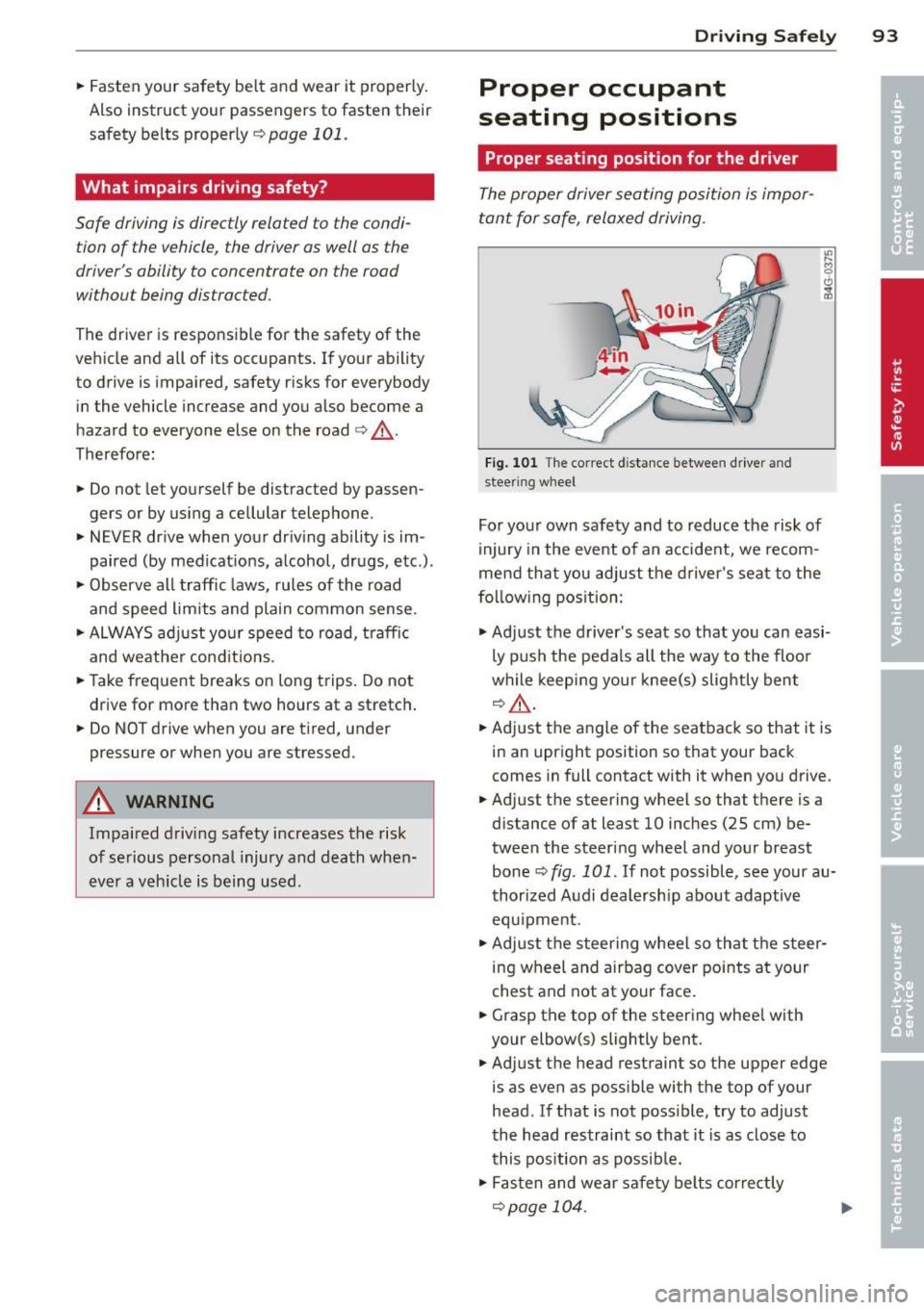
Fig. 101 The correct d istance between driver an d
steer ing wheel
For your own safety and to reduce the risk of
injury in the event of an accident, we recom
mend that you adjust the driver's seat to the
f o ll ow ing pos ition:
.,. Adjust the driver's seat so that you can easi
ly push the pedals all the way to the floo r
while keeping your knee(s) slightly bent
q&_ ,
.. Adjust the angle of the seatback so that it is
in an upright position so that your back
comes in full contact with it when you drive.
.. Adjust the steering wheel so that there is a
distance of at least 10 inches (25 cm) be
tween the steering wheel and your breast
bone¢
fig. 101. If not possible, see your au
thorized Audi dealership about adaptive
equ ipment .
.. Adjust the steering wheel so that the steer
ing wheel and airbag cover points at your
chest and not at your face .
.. Grasp the top of the steering whee l with
your elbow(s) slightly bent .
.. Adjust the head restraint so the upper edge
is as even as possible with the top of your
head . If that is not poss ible, try to adjust
the head restraint so that it is as close to
this pos ition as possib le .
.. Fasten and wear safety belts correctly
qpage 104.
Page 103 of 244
Safety belts
General notes
Always wear safety belts!
Wearing safety belts correctly saves lives!
This chapte r exp lains why safety be lts a re nec
essary, how they work and how to adjust and
wear them correctly.
~ Read a ll the informat ion that fo llows and
heed all of the inst ruct ions and WARNINGS.
A WARNING
Not wearing safety belts or wearing them
improperly increases the risk of ser ious
personal in jury and death .
- Safety belts are the sing le most effective
means availab le to red uce the r isk of se
rious injury and death in a utomob ile acci
de nts . For your prot ecti on and that of
yo ur passenge rs, always co rrec tly wear
sa fe ty bel ts when the ve hicle is mov ing.
- P re g nant women, injured, or physically
imp aired perso ns must also use safe ty
belts. L ike a ll vehicle occup ants, they are
more like ly to be ser ious ly injure d if they
do not wea r safety be lts . The best way to
protect a fet us is to protect the mother -
thro ughout the entire pregnancy.
Number of seats
Your Audi TT Roadster has two seating posi
tions. Each seat ing pos ition has a safety be lt.
A WARNING
Not wearing safety belts or wearing them
im proper ly increases the risk of ser ious
personal in jury and death.
- Never st rap more than one person, in
clu ding small ch ild ren, into any belt. It is
especially dangerous to place a safety
belt over a child s itting on yo ur lap.
- Never let mo re people ride in the ve hicle
t h an t he re a re safety be lts ava ilable.
Sa fety belts 1 O 1
- Be s ure everyone riding in the vehicle is
properly restrained w ith a separate sa fe
ty belt or child restra int.
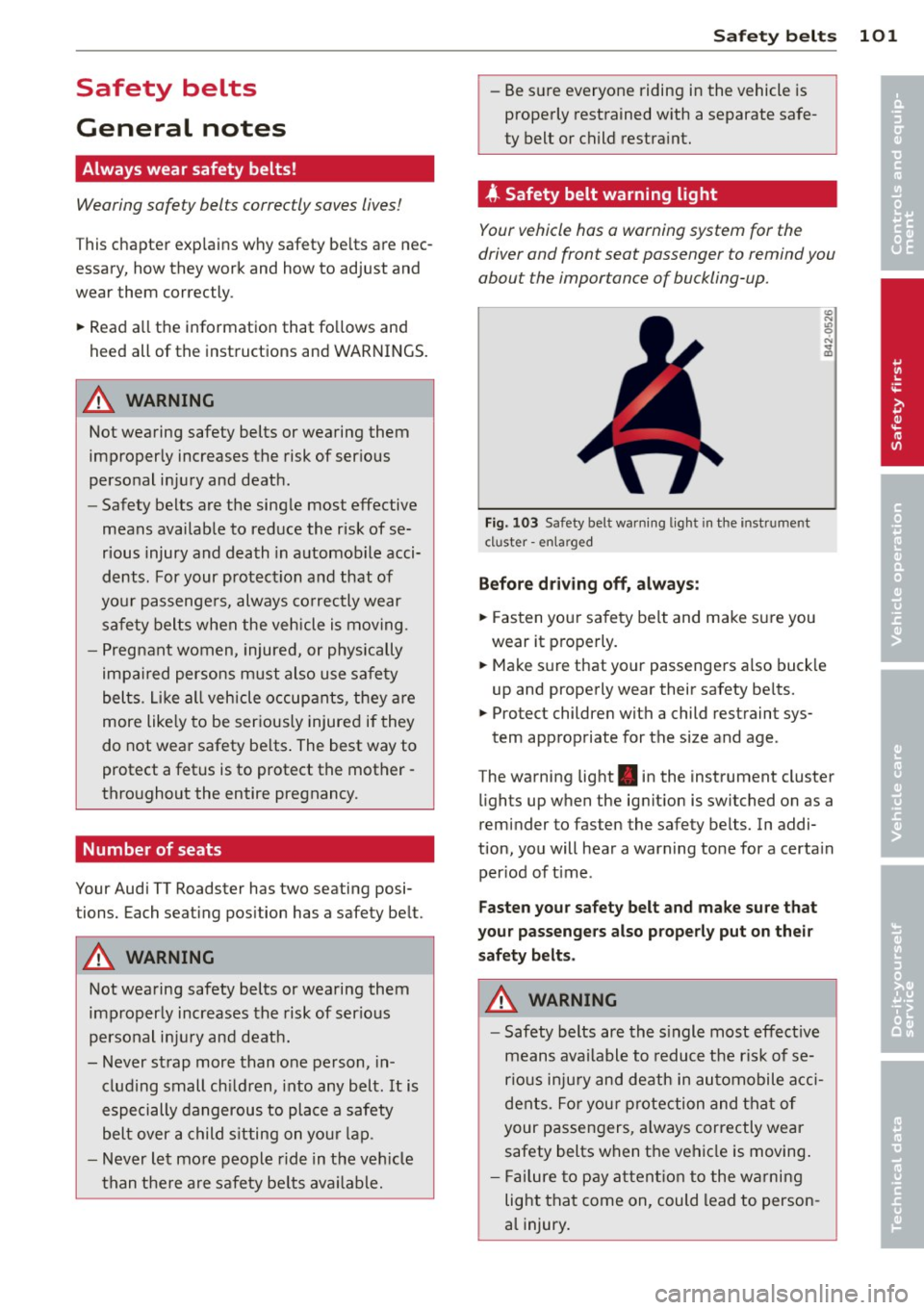
4 Safety belt warning light
Your vehicle has a warning system for the
driver and front seat passenger to remind you
about the importance of buckling-up.
Fi g. 1 03 Safety be lt warn ing lig ht in the instr ume nt
cl uster -enla rged
Befor e driv ing off, always :
~ Fasten your sa fe ty belt and make su re you
wear it p roperly.
~ Make s ure that yo ur passenge rs a lso buck le
up and properly wear their safety be lts.
~ Protect childre n with a child rest raint sys-
tem appropriate for the s ize and age .
The wa rning light . in the instrument cluster
li ghts up w hen the ig nit ion is switched on as a
reminder to fasten the safety belts. In addi
tion , you will hear a warning tone for a certa in
per iod of t ime .
Fasten your safety belt and make sure that
your passengers also properly put on their saf ety belts .
A WARNING
-Safety belts are the s ingle most effect ive
means ava ilable to reduce t he risk of se
rio us inju ry and death in au tomobile a cci
de nts. Fo r yo ur pro tection and tha t of
your passen gers, a lways correctly wear
safety belts when t he ve hicl e is moving .
- Fail ure to p ay att ention t o the wa rni ng
light that come on, could lead to person
a l injury . •
•
Page 107 of 244
During normal driving the belt lets you move
freely.
Safety belt pretensioners
The safety belts are equipped with a belt p re
tensione r that helps to t igh ten the safety belt
and remove s lack when the pretensione r is ac
tivated. The function of the pretensioner is monitored by a warning light
q page 15.
Switchable lo cking feature
Every safe ty belt excep t the one on the driver
seat is eq uipped w ith a switchab le locking fea
ture that
mu st be used when the safety belt is
used to attach a child seat . Be s ure to read the
important informat ion about th is feature
q page 138.
A WARNING
Improperly positioned safety belts can
cause serious injury in an accident
¢ page 105, Safety belt position .
-Safety belts offer optimum protection
only when the seatback is upright and
belts are properly positioned on the
body .
-
- Never attach the safety belt to the buck
le for another seat . Attach ing the belt to
the wrong buckle will reduce safety belt
effect iveness and ca n cause serious per
sonal in jury.
- A passenger who is no t properly rest rain
ed can be serio usly inju red by the safety
belt itself when it moves from the stron-
ger parts of the body into critical areas
like the abdomen .
- Always lock the convert ible locking re
tractor when yo u are secur ing a chi ld
seat in the vehicle
¢ page 140.
Safety belts 105
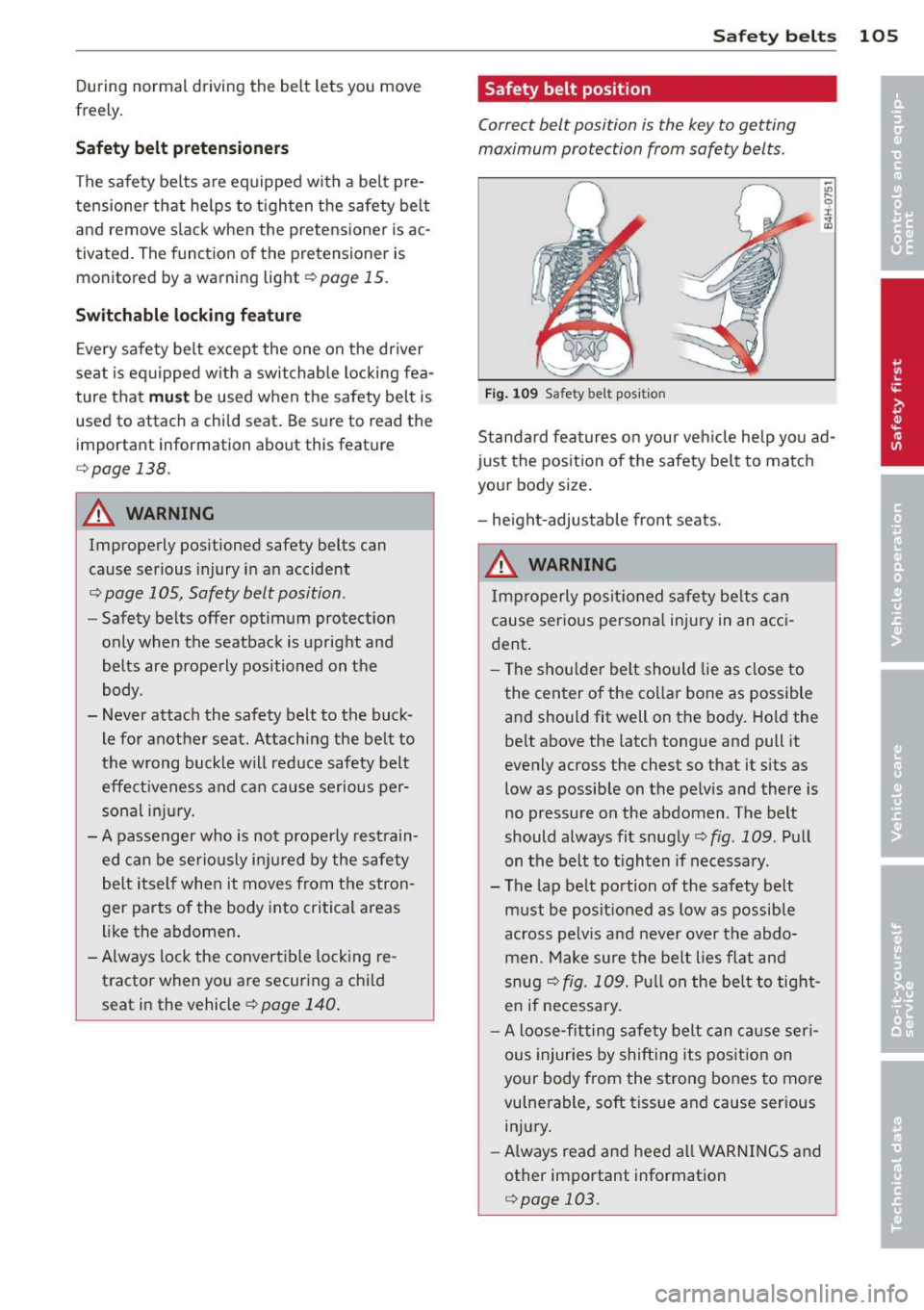
Safety belt position
Correct belt position is the key to getting
maximum protection from safety belts .
Fig . 1 09 Safety belt po sit ion
;;;
9 r ., a,
Standard fea tures on your veh icle he lp you ad
just the position o f the safety bel t to matc h
your body size .
- he ight-adjustable fron t seats.
A WARNING
Improperly posit ioned s afety be lts c an
cause serious persona l injury in an acci
dent .
-
-The s hou lder belt should lie as close to
the center o f the collar bone as possible
a nd should fit well on the body. Hold the
be lt above the latch tongue and pull it
evenly across the chest so that it sits as
low as possib le on the pelv is and there is
no pressure on the abdomen . The belt
should always fit snugly¢
fig. 109 . Pull
on the belt to t ighten if necessary.
- The lap belt portion of the safety belt
must be posit ioned as low as possible
across pelvis and never over the abdo
men . Make sure the belt lies flat and
snug
q fig. 109. Pu ll on the be lt to tight
e n if necessary.
- A loose-fitting safety belt can cause seri
ous injuries by shifting its pos it ion on
your body from the strong bones to more
vulnerable, soft tissue and cause ser ious
injury.
- Always read and heed all WARNINGS and
other important information
¢ page 103.
Page 113 of 244
Safety Standard 208 as applicable at the time
your vehicle was manufactured.
The Standard requires the front a irbag on the
passenger side to be t urned off ("sup
pressed") if a child up to about one year of
age restrained in one of the rear -facing or for
ward -facing infant restra ints listed in Federal
Motor Vehicle Safety Standard 208 with wh ich
the Advanced Airbag System in your vehicle
was certified has been installed on the front passenger seat. Fo r a listing of the child re
straints that were used to certify compliance
with the US Safety Standard
¢ page 132.
The PAS SENG ER AIR BAG OFF light in the in
strument panel tells you when the front Ad
vanced A irbag on the passenger side has been
turned off by the e lectronic control u nit.
Each t ime you turn on the ignition, the
PAS
SENGER AIR BAG OFF
l ight w ill come on for a
few seconds and:
- will stay on if the front passenger seat is not
occupied,
- will stay on if there is a small child or child
restraint on the front passenger seat,
- wi ll go off if the front passenger seat is oc
cupied by an adult as registered by the
weight-sensing mat
¢ page 119, Monitor
ing the Advanced Airbag System.
The PASSENGER AIR BAG OFF light comes on
when the control un it detects a total weight
on the front passenger seat that requires the
front airbag to be turned off .
If the total weight on the front passenger
seat is more than that of a typical 1 year-old
chi ld but less than the weight of a small
ad ult, the front airbag on the passenge r side
can dep loy (the
PASSENGER AIR BAG OFF
light does not come o n). If the PASSENGER
AIR BAG OFF
l ight does not come on, the
front airbag on the passenger side has not
been turned off by the electronic control unit
and can dep loy if the control unit senses an
impact that meets the conditions stored in its
memory.
For e xample , the airbag may deploy if :
Airbag system 11 1
- a small child that is heav ie r th an a typical 1
year -old chi ld is o n the front passenger seat
(regard less o f whether the child is in one o f
the child safety seats listed ¢
page 132), or
- a child who has outgrown child restraints is
on the front passenger seat.
If the front passenger airbag is turned off, the
PASSENGER AIR BAG OFF light comes on in
the instr ument pane l and stays on.
T he front airbag on the passenge r side may
not deploy (t he PASSENGER AIR BAG OFF
light does not illuminate a nd stay lit) even if a
small ad ult or teenager, or a passenger who is
not sitting upright with their back against a
non-recl ined backrest w ith their feet on the
vehicle floor in front of the seat is on the front
passenger seat ¢
page 93, Proper seating po
sition for the driver.
If the front passenger airbag dep loys, the
Federa l Standard requ ires the airbag to meet
the "low risk" dep loyment criteria to reduce
the risk of injury th rough interact ion w ith the
airbag. "Low risk" deployment occurs in those
crashes that ta ke place at lower dece le rat io ns
as de fined in the e lectronic co ntrol unit
¢ page 1 20, PASSENG ER AIR BAG O FF light.
Always remember, a c hild safety seat or infant
ca rr ier installed on the front seat may be
stru ck and kno cked out of po sit io n by the rap
idly in flat ing passenger 's airbag in a fronta l
collision. The ai rbag co uld great ly red uce the
effectiveness of the chi ld restraint and even
seriously in jure the child during inflation.
A WARNING
A child in a rearward-fac ing ch ild safety
seat installed on the front passenger seat
will be ser ious ly injured and can be killed if
the front airbag inflates - even with an Ad
van ced A irbag System.
- The inflating airbag will h it the ch ild
safety seat or infant carrie r with great
for ce and will smas h the child safety seat
a nd child ag ain st the ba ckrest, door o r
roof.
•
•
Page 114 of 244
112 Airbag sys te m
- Never install a rearward facing child
safety seat on the front passenger seat
unless the
PA SS EN GER AIR B AG OFF
light comes on and stays on . If the P A S
SE NGER AI R BA G OFF
light does not
come on and stay on the inflating airbag
wi ll hit the child safety seat or infant car
rier with great force and will smash the
child safety seat and child agains t the
backrest, door or roo f. Have the airbag
system inspected immediately by your
authorized Audi dealer .
- Forward-facing chi ld safety seats instal
led on the front passenger's seat may in
terfere with the deployment of the air bag and cause serious personal injury to
the ch ild.
A WARNING
If, in exceptional c ircumstances, you must
install a forward -facing child restra int on
the front passenger's seat:
- Always make sure the forward -fac ing
seat has been des igned and certified by
its manufacturer for use on a front seat
with a passenger front and side airbag.
- Never put the forward-facing child re
straint up aga inst or very near the inst ru
ment pane l.
- Always move the passenger seat into its
rearmost position in the seat's fore and
aft adjustment range , as far away from
the a irbag as poss ible before installing
the fo rward-facing child restraint. The
backrest must be adjusted to an upright
position.
- Make sure that the
PASSENGER AIR BAG
OFF
light comes on and stays on all the
t ime whenever the ignition is switched
on.
A WARNING
To reduce the risk of serious injury, make sure that the
PASSENGER AI R BAG OFF
light will be d isplayed whenever a ch ild re
straint is installed on the front passenger
seat and the ignit ion is switched on. -
If the
PASSENGER AIR BAG OFF light
does not stay on, perform the checks de
scribed
<=> page 119, Monitoring the Ad
vanced Airbag System .
-Have the airbag system inspected by
your Aud i dea ler immediately.
- Always carefully follow instructions from
child restraint manufacturers when in
stall ing ch ild restra ints .
A WARNING
=
If, in except iona l circumstances, you must
i nstall a forward or rearwa rd-facing child
restra int on the front passenger's seat :
- Improper installation of ch ild restra ints
can reduce their effectiveness o r even
p revent them from providing any protec
tion .
- An improp erly installed ch ild restra int
can interfere with the airbag as it de
p loys and seriously inj ure o r even k ill the
child -even with an Advance d Airbag
System.
- Always carefu lly follow the m anu fact ur
er 's ins truc tions p rov ided with the chi ld
safety seat or carrier .
- Never p lace add itiona l it ems on the seat
that can increase the total weight regis
tered by the weight-sensing mat and can
cause injury in a crash.
Page 117 of 244

-a small adu lt or teenager is on the front pas
senger seat
- a passenger who is not sitting upright w ith
their back against a non-reclined backrest
with their feet on the vehicle floor in front
of the seat is on the front passenger seat.
I f the front passenger airbag deploys, the
Federal Standard requires the airbag to meet
the " low risk" deployment criteria to help re
duce the risk of injury through interaction
with the airbag . "Low risk" deployment occurs
in those crashes that take place at lower de
celerations as defined in the electron ic control
un it
¢ page 119 .
Alw ays rem emb er: Please be sure to read the
important information in the sections that
follow and be sure to heed all of the WARN
INGS.
A WARNING
To reduce the risk of injury when an airbag inflates, a lways wear safety belts prope rly.
- If you are unrestrained, lean ing forward,
sitting sideways or out of position in any
way, your risk of inj ury is much higher.
- You w ill also receive serious inju ries and
cou ld even be killed if you are up against
the a irb ag or too close to it when it in
flates - even with an Advanced Airbag
¢page 109 .
.&_ WARNING
-
A child in a rearward-facing child safety
seat installed on the front passenger seat
w ill be seriously injured and can be k illed if
the front a irbag inflates - even with an Ad
vanced Airbag System.
- Although the Advanced Airbag System in
your vehicle is designed to turn off the
front a irbag when a rearward-fac ing
child restraint has been installed on the
front passenger seat, nobody can abso l u te ly guarantee that deployment is im
poss ible in a ll conceivable situations that
may happen d uring the useful life of your
vehicle.
A irbag system 11 5
-The inflating airbag will hit the child
safety seat or infant carrier with great
force and will smash the child safety seat and child against the backrest, doo r, or
roof.
- If you must install a rearward fac ing
child safety seat on the front passenger
seat because of exceptional c ircumstan
ces and the
PASSENGER AIR BAG OFF
light does not come on and stay on have
the airbag sys tem inspected by your Audi
dea ler.
.&_ WARNING
I f, in except iona l circumstances, you must
install a forward-facing child restraint on
the front passenger's seat:
- Always make sure the forward -facing
seat has been designed and certified by its manufacturer for use on a front seat
with a passenger front and s ide a irbag.
- Never put the forward-facing child re
straint up against or very near the instru
ment panel.
- Always move the passenger seat into its
rearmost pos ition in the seat's fore and
aft adjustment range, as far away from
the airbag as possible, before installing
the forward-fac ing ch ild restra int. The
backrest must be ad justed to an upright
position.
- Make sure that the
PASSENGER AIR BAG
OFF
li ght comes on and stays o n all the
time wheneve r the ig nit ion is swit ched
on.
Advanced Airbag System components
T he front passenge r seat in yo ur vehicle has a
lot of very important parts of the Advanced
Airbag System in it . These parts include the
weight-sensing mat, sensors, wiring, brack ets, and more. The funct ion of the system in
the front passenger seat is checked by the
electronic control unit when the ignition is on .
The cont rol unit monitors the Advanced A ir
bag System and turns the airbag indicator
l igh t on when a malfunct ion in the system
•
•