2014 AUDI TT ROADSTER engine
[x] Cancel search: enginePage 89 of 244

_& WARNING
-Always adapt your driving to the traffic
flow.
- Only use Launch Control when road and
traffic conditions allow it and other driv
ers will not be endangered or annoyed by
your driving and the acceleration of the
vehicle .
- Make sure that ESC remains enabled .
With the ESC disabled, the veh icle could
brake away, particularly on a slick and
slippery road -risk of skidding!
- Once acce lerat ion is finished, switch ASR
on again by briefly pushing the ESC but
ton.
@ Tips
- The transm ission temperature may in
crease significantly after using the
Launch Control Program. If that hap
pens, the program may not be available
for a few minutes. I t will be availab le
again after a coo l-down period.
- When accelerating using the Launch
Control program, all vehicle parts are
subject to heavy loads . This can result in
increased wear.
Back-up program
Applies to vehicles: with S tronic
In the event of a system malfunction, there is
a back-up program.
I n the event of system mal func tion, the auto
matic transmission switches to the fail-safe
mode. A ll of the selector lever position dis
plays for the automatic transmission are high
lighted with a light background in the instru
ment cluster display . In some cases you can
not use reverse gear any more .
If the transmission switches to fail-safe mode, you should take the vehicle to an au
thorized Audi dealership as soon as possible
to have the condition corrected.
Transmission 87
Clutch is overheating
Applies to vehicles: with S tronic
• Clutch is overheating! Please stop vehi
cle!
If the symbols are illuminated, the clutch is
overheating and could be damaged if you con
tinue to drive. Stop the vehicle and a llow the
transmission to cool with the se lector lever in
the P posit ion while the engine runs at idle.
If
the warning does not turn off, do not continue
driving. See your authorized A udi dealer or
qualified repair facility for assistance. Other
wise serious transmission damage could re
sult. Once the indicator light has turned off,
drive to your authorized Audi dealer or quali
fied repa ir facility immed iately to have the
malfunction corrected.
Selector lever emergency release
Applies to vehicles: wi th S tronic
If the vehicle's power supply fails, the selec
tor lever can be released in an emergency.
--
-
-
-
-
---Fig. 96 Se lector lever : Removing the selector lever
boot
.. ~
- ,
Fig. 97 Selector lever : Using the em erge ncy release to
move out of the Park pos it ion
T he emergency release mechanism is located
in the right front area under the selector lever ..,.
Page 91 of 244

Homelink
Universal remote
control
General information
The HomeLink universal remote control can
be programmed with hand-held transmitters
from existing equipment.
You must first program the Homelink trans
mitter before you can use the system
~ page 89, Programming the HomeLink
transmitter.
In order to program the Homelink transmit
ter for devices utilizing rolling code, a second
person on a ladder who can safely reach the
garage door opener motor is recommended.
It is also necessary to locate the "learn" but
ton on your garage door opener motor . Refer
to the operating instructions for the opener, as the location and color of this button may
vary by manufacturer .
You can still use the origina l remote control
for the device at any time.
A WARNING
-
- Never use the Homelink transmitter
with any garage door opener that does
have not the safety stop and reverse fea
ture as requ ired by federal safety stand
ards. This includes any garage door open
er model manufactured before April 1,
1982.
- A garage door opener which cannot de
tect an object, signaling the door to stop
and reverse does not meet current feder
al safety standards. Using a garage door
opener without these features increases
risk of serious injury or death.
- For safety reasons never release the
parking brake or start the engine while
anyone is standing in front of the vehicle.
- A garage door or an estate gate may
sometimes be set in motion when the Homelink remote control is being pro
grammed. If the device is repeatedly ac-
Homelink 89
tivated, this can overstrain motor and
damage its electrical components -an
overheated motor is a fire hazard!
- To avoid possible injuries or property
damage, please always make absolutely
certain that no persons or objects are lo
cated in the range of motion of any
equipment being operated.
(!) Tips
- If you would like more information on
Homelink, where to purchase the Home
Link compat ible products, or would like
to purchase the Homelink Home Light
ing Package, please call toll-free:
1-800-355-3515.
- For Declaration of Compliance to United
States FCC and Industry Canada regu la
tions
~page 229.
Programming the Homelink transmitter
The transmitter is programmed in two phas
es. For rolling code transmitters, a third
phase is also necessary.
Fig. 98 Overhead co nsole: Homelink keypad
Fig. 99 Fro nt bumper, d river side: locatio n of tra nsm it-
ter unit
IJ-
Page 104 of 244

102 Safet y belt s
Why safety belts?
Frontal collisions and the law of physics
Frontal crashes create very strong forces for
people riding in vehicles .
Fig. 10 4 Unbe lted occupa nts in a vehicle heading for a
wall
Fig . 105 The ve hicle c ras hes into t he wa ll.
The physical principles are simp le. Both the
vehicle and the passengers possess energy
which varies w ith veh icle speed and body
weight . Engineers call th is energy ''kinetic en
ergy ."
The higher the speed of the vehicle and the
greater the vehicle's weight, the more energy
that has to be "absorbed" in the crash .
Vehicle speed is the most significant factor . If
the speed doub les from 15 to 30 mph (25 to
50 km/h) , the energy increases 4 t imes!
Because the occupants in this vehicle are not
using safety belts ¢
fig. 104, they will keep
mov ing at the same speed the vehicle was
mov ing just before the crash, unti l something
stops them -here, the wall
¢ fig . 105 .
The same pr inc iples apply to people sitting in
a vehicle that is involved in a frontal collision .
Even at city speeds of 20 to 30 mph (30 to 50
km/h), the forces act ing on the body can reach one ton (2,000 lbs, or 1,000 kg) or
more. At h
igher speeds, these forces are even
greater.
People who do not use safety belts are also
not attached to their vehicle. In a frontal colli
sion they wi ll also keep moving forward at t he
speed their vehicle was travell ing just before
the crash. Of course, the laws of physics don't
just app ly to frontal collisions, they determine
what happens in all kinds of acc idents and col
lis ions .
What happens to occupants not wearing
safety belts?
In crashes unbelted occupants cannot stop
themselves from flying forward and being in
jured or killed . Always wear your safe ty belts!
Fig . 106 A dr iver not wea ring a safety belt is vio le n tl y
t hrown forward
Unbelted occ upants a re not able to resist the
tremendous forces of impact by hold ing tight
or bracing themse lves. Without the benefit of
safety restra int systems, the unrestrained oc
cupant will slam violently into the steering
wheel, instr ument panel, w indshield, or what
ever else is i n the way ¢ fig. 106. This impact
with the veh icle inte rior has all the energy
they had j ust before the c rash.
Never rely on airbags alone for protection .
Even when they deploy, a irbags provide only
additional protection . Airbags a re not sup
posed to deploy in all k inds of accidents. A l
t h ough your Aud i is equipped wi th airbags, all
vehicle occupants, including the driver, must
wear safety be lts cor rectly in order to m ini
mize the risk of severe injury or death in a
crash .
Page 105 of 244
Remember too, that airbags will deploy only
once and that your safety belts are always
there to
offer protection in those accidents in
which airbags are not supposed to deploy or
when they have already deployed . Unbelted
occupants can also be thrown out of the vehi
cle where
even more severe or fatal injuries
can occur .
Safety belts protect
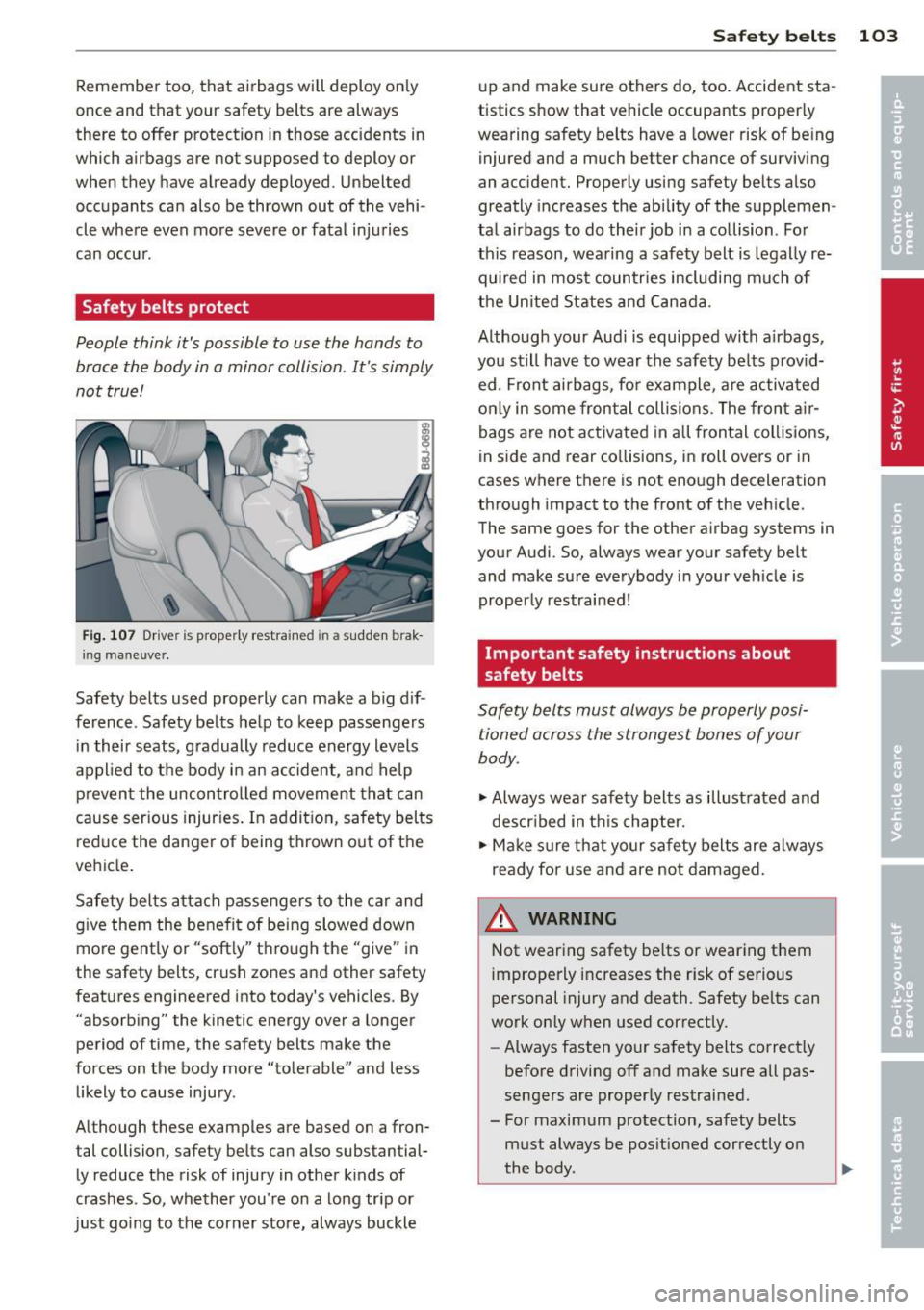
People think it's possible to use the hands to
brace the body in a minor collision . It's simply
not true!
Fig . 107 Driver is properly restrained in a sudden b rak
i ng maneuve r.
Safety belts used properly can make a big dif
ference . Safety belts help to keep passengers
in their seats, gradually reduce energy levels
applied to the body in an accident, and help
prevent the uncontrolled movement that can
cause serious injuries. In addition, safety belts
reduce the danger of being thrown out of the
vehicle.
Safety belts attach passengers to the car and
give them the benefit of being slowed down
more gently or "softly" through the "give" in
the safety belts, crush zones and other safety
features engineered into today's vehicles . By
"absorbing" the kinetic energy
over a longer
period of time, the safety belts make the
forces on the body more "tolerable " and less
likely to cause injury.
Although these examples are based on a fron tal collision, safety belts can also substantial
ly reduce the risk of injury in other kinds of
crashes. So, whether you're on a long tr ip or
just going to the corner store, always buckle
Safety belts 103
up and make sure others do, too. Accident sta
tistics show that vehicle occupants properly
wearing safety belts have a lower risk of be ing
injured and a much better chance of surviving
an accident. Properly using safety belts also
greatly increases the ability of the supplemen
tal airbags to do the ir job in a collision . For
th is reason, wearing a safety belt is legally re
quired in mos t countries including much of
the United States and Canada.
Although your Audi is equipped with a irbags,
you still have to wear the safety belts provid
ed . Front airbags, for example, are activated
only in some frontal collisions. The front air
bags are not activated in all frontal coll isions,
in side and rear collisions, in roll overs or in
cases where there is not enough deceleration
through impact to the front of the vehicle.
The same goes for the other airbag systems in
your Audi . So, always wear your safety belt
and make sure everybody in your vehicle is
properly restrained!
Important safety instructions about
safety belts
Safety belts must always be properly posi
tioned across the strongest bones of your
body .
"' Always wear safety belts as illustrated and
described in th is chapter.
"'Make sure that your safety belts are always
ready for use and are not damaged.
A WARNING ~
Not wearing safety belts or wearing them
improperly increases the risk of serious
personal injury and death. Safety belts can
work only when used correctly.
- Always fasten your safety belts correctly
before driving
off and make sure all pas
sengers are properly restrained.
- For maximum protection, safety belts must always be positioned correctly on
the body .
Page 144 of 244

142 Intelligent technology
Intelligent technology
Notice about data
recorded by vehicle
control modules
Your vehicle is not equipped with an Event Da
ta Recorder (EDR), installed by some manu
facturers fo r the express purpose of capturing
data for retrieval after an accident or crash
event . EDR's are sometimes ca lled "crash re
corders".
Some state laws restrict the retr ieval or down
loading of data stored by EDR's that were in
stalled in a vehicle for the express purpose of
retrieving data after an accident or crash
event without the owner's consent.
A lthough your vehicle is not equipped with an
EDR, it is equipped with a number of electron
ic control modules for various vehicle systems
such as, for examp le, eng ine function, em is
sion control, as well as for the airbags and
safety belts.
These electronic contro l modules also record
vehicle-re lated data during normal vehicle op
eration for diagnostic and repair purposes.
The recording capacity of the electronic con
trol modules is limited to data (no sound is re
corded) and only a small amount of data is ac
tually recorded over a very limited pe riod of
time and stored when a system fault or other
condition is sensed by a control unit. Some of
the data then stored may relate to vehicle
speed, direction, braking as we ll as restraint
system use and performance in the event of a
crash or other condition. Stored data can only
be read and downloaded with special equip
ment.
Electronic Stabilization
Control (ESC)
Description
ESC helps to improve road holding and vehicle
dynamics to help reduce the probability of
skidd ing and loss of vehicle control. It works
only when the engine is running. ESC detects certain difficult driving situat
ions, including
when the vehicle is beginning to spin (yaw)
out of control and helps you to get the veh icle
back under control by se lectively braking the
wheels, and/or reducing engine power and
providing steering assistance to help hold the
vehicle on the driver's intended course. The in
dicator light
G) in the instrument cluster
blinks when ESC is taking action to help you
control the vehicle.
ESC has limitations.
It is important to remem
ber that ESC cannot overcome the laws of
physics. It wi ll not always be able to help out
under all conditions you may come up against.
For example, ESC may not always be able to
help you master situations where there is a
sudden change in the coefficient of friction of
the road surface. When there is a section of
dry road that is suddenly covered with water,
slush or snow, ESC cannot perform the same
way it wou ld on the dry surface . If the vehicle
hydroplanes (rides on a cushion of water in
stead of the road surface), ESC will not be
able to help you steer the vehicle because con
tact with the pavement has been interrupted
and the vehicle cannot be braked or steered.
During fast cornering, particularly on winding
roads, ESC cannot always deal as effectively
with difficult driving situations as at lower
speeds.
Always adjust your speed and driving style to
road , traffic §&and weather conditions. ESC
cannot override the vehicle's physical limits,
increase the available traction, or keep a vehi
cle on the road if road departure is a result of
driver inattention . Instead, ESC improves the
poss ibility of keeping the vehicle under con
t rol and on the road dur ing extreme maneu
vers by using the driver's steering inputs to
help keep the vehicle go ing in the intended di
rection . If you are traveling at a speed that
causes you to run off the road before ESC can
provide any assistance, you may not experi
ence the benefits of ESC.
ESC includes and/or works togethe r with the
anti- lock brake system (ABS), brake assist sys-
tem and anti-slip regu lation (ASR). ESC is .,..
Page 145 of 244

switched on all the time. In certain situations
when you need less traction, you can switch
off ESC by pressing the button
lru. Be sure to
switch ESC on again when you no longer need
less traction.
Anti-lock braking system (ABS)
ABS prevents the wheels from locking up
when braking . The vehicle can still be steered
even during hard braking . Apply steady pres
sure to the brake pedal. Do not pump the ped
al. A pulsing in the brake pedal indicates that
the system is helping you to brake the vehicle.
Brake assist system
The brake assist system can decrease braking
d istance. It increases braking power when the
driver presses the brake pedal quickly in emer
gency si tuations. You must press and hold the
brake pedal until the situation is over .
Anti-slip regulation (ASR)
ASR reduces engine power when the drive
wheels begin to spin and adapts the force to
the road condit ions. This makes it easier to
start, accelerate and drive up hills.
Electronic differential lock (EDL)
The EDL brakes wheels that are spinning and
transfers the drive power to the other drive
wheel or whee ls if the vehicle is equipped with
all-wheel drive*. This function is available up
to about 60 mph (100 km/h) .
In extreme cases, EDL automat ica lly switches
off to help keep the brake on the braked wheel
from overheating. EDL w ill switch on again au
tomatically when conditions have returned to
normal.
..&, WARNING
- ESC, ABS, ASR and EDL cannot overcome
th e laws of physics. This is especially im
portant on slippery or wet roads.
If the
systems begin acting to stabilize your ve
hicle, you should immediately change
your speed to match the road and traffic
condit ions. Do not let the increased safe
ty provided by these systems tempt you
Intelligent technology 143
to take risks. Doing so will increase the
risk of a lo ss of vehicle control, co llision
and serious personal injuries.
- Always adapt your speed to road, traffic
and weather conditions. The risk of los
ing control of the vehicle increases when
driving too fast, especially through
curves and on slippery or wet roads, and
when driving too close to vehicles up
ahead. ESC, ABS, the brake assist sys
tem, EDL and ASR cannot prevent colli
sions.
- Always accelerate with special care on
even, smooth surfaces such as those that
are wet or covered with ice and snow.
The drive wheels can spin even with
these assistance systems that cannot al
ways he lp to reduce the risk of loss of ve
hicle control.
@ Tips
- ABS and ASR only work correct ly when
all four whee ls are equipped with identi
cal tires. D ifferent tire si zes can lead to a
reduction in engine power.
- You may hear noises when the systems
described are working.
- If the ind icator lightD] orE (USA
models)/ [iJ (Canada models) appears,
there may be a malfunction¢
page 18,
¢ page 18.
Switching on and off
ESC turns on au tomatically when you start
the engine.
Fig . 123 Ce nter conso le: ESC OFF butto n
Page 147 of 244

(D Note
Never push the vehicle or apply force to
the rear spoiler -it could be damaged.
@ Tips
Clean the spoiler compartment every 2 to
3 months . The spoiler compartment must
always be free of ice, snow, leaves or other
debris.
Braking
General information
What affects braking efficiency?
Oper ating condit ions and d riving hab it s
T he brakes on today's automobi les are st ill
s ubject to wear, depending largely on opera t
ing conditions and dr iv ing habi ts
c> & . On
vehicles that are e ither driven mostly in stop
and-go city traffic or are d riven hard , the
b rake pads should be checked by you r author
i zed Audi dealer more often than specified i n
the
Warr ant y & Maint enan ce booklet . Failure
to have your brake pads inspected can res ult
in red uced brake performance.
On steep slopes, you shou ld use the brak ing
effect of the eng ine. This way, you p revent un
necessa ry wear on the brake system . If you
must use yo ur brakes, do not hold the brakes
down continuously. Pump th e brakes at inter
vals.
Noises may occur when braking d epending on
the speed, braki ng force and outside condi
tions such as temperature and humidity.
Moistu re or road salt
Unde r certain conditions, for example, w hen
driving through water or ve ry heavy rain, or
even after washing your vehicle, the braking
effect can be reduced d ue to moisture (or in
fre ezing conditions ice) on the brake pads . A
few ca utious brake applicat ions should dry off
the b rake pads or remove any ice coatings.
The effectiveness of the brakes can be reduced
when th e vehicle is driven on a salt-covered
Int ellig ent technolog y 145
road and the b rakes are no t used. Likewise ,
you clean off accumulated salt coating from brake d iscs and pads with a few cautious ap
plications of the brake
c> & .
Cor ro sion
T here may be a tendency for dir t to build up
on the brake pads and corrosion to form on
the discs if the car is not driven regu larly or
on ly fo r short trips with litt le use of the
brakes.
If the brakes are not used frequently, or if cor
rosion has formed on the discs, it is advisable
to clean off the pads and discs by braking
firmly a few times from a moderately high
speed
c> & .
Faults in the brak e syst em
If you shou ld notice a sudden increase in
brake pedal trave l, then one of the two brake
c ircuits may have fai led
c> & .
Low brake fluid lev el
Malfunctions can occur in the brake system if
the b rake fluid level is too low. The brake fluid
level is monitored electronica lly.
Brake booster
T he brake booster inc reases the pressure that
you generate with the brake peda l. It works
o nl y when the engine is running
.c> &
Brake lining wear status
Brake lining wear may be checked by visual in
spection of the condition of the brake pads
through the open ings in the wheel. If neces
sary, the wheel may be removed for t his in
spection
c> page 209, What should I be
aware of when changing a tire? .
A WARNING
--=
-You should perform braking maneuvers
for the purpose of cleaning the brake
system only if road conditions permit.
Other road users must not be put at risk -
you may cause an accident!
- Before descend ing a steep grade, reduce
speed and sh ift transmission into a lower
~
•
•
Page 148 of 244

146 Intellig ent technolog y
gear or lower driving range. Do no t ride
t h e brakes or hold the pedal down too
long or too often. This cou ld cause the
bra kes to get hot and dimin ish braking
efficiency .
- Do no t "ride the brakes" by resting your
foot on the pedal when you do not intend
to brake . Th is may cause the brakes to
overheat, prematu re wear and inc reased
stopp ing distan ce.
- Under certain climat ic and operating
c ondit ions such as passing through wa
ter, driving i n heavy ra in or after wash ing
the vehicle, the effect iveness of the
brakes can be red uced . In winter, ice can
accumulate on the brake pads, linings,
discs and d rums . Carefully apply brakes
for a test . Brakes will dry and ice coat
ings will be cleaned off after a few care
ful brake applications.
- Driving for an extended period of time on
salt-covered roads w ithout us ing your
brakes can also affect braking efficiency .
Clean off accumulated salt coating from
brake d iscs and pads w it h a few cautious
brake appli cat ions.
- If you damage the fro nt spo iler, or if you
ins tall a different spoiler, be su re the air
flow to the fron t bra kes is not o bstr uct
ed. O therwise the brake system co uld
overheat reducing the effectiveness of
the entire brake system.
- F ailure o f one bra ke c ircuit will impair
the b raking capability resulting in an in
creased stopp ing distance . Avoid driv ing
the vehicle and have it towed to the near
est Aud i dea le r o r qualified workshop.
- Never let the vehicle ro ll to a stop w ith
the engine shut off.
- If the brake booster is not working, t he
brake pedal must be pressed considera
bly harder to make up for the lack of
booster assistance . Electro-mechanical
power assist
The electro-mechanical power assist helps
the driver when steering .
The degree of power assi st is electronically
matched to vehicle speed .
T he power steering system assists the driver
so that he can steer the vehicle with reduced
physical effor t.
Power steering will not work if t he engine is
off . As a result, the steering wheel will be hard
to turn.
A WARNING
If the system develops a problem , you
must seek qualified profess iona l assis
tance .
(D Note
-
If there is an e lectronic malfunction, ser
votronic
will still function like a conven
tiona l power steering system, providing a
constant steering support force that is no
l onge r proportionate to the vehicle speed .
This is most not icea ble whe n tu rni ng the
s tee ring w heel a t low speeds (fo r example
when pa rking), -more effort w ill be re
q uired than us ua l.
- Be aware o f the diffe rent than usual
steering response and adjust your steer
ing force acco rdingly.
- Have the problem checked and set right
by an autho rize d Aud i dealer as soon as
possible.
- If a s teer ing mal func tion occurs, this is
signa led wit h the
,'Zr~ or .• indicato r
lights and a warning tone, see.
(D Tips
- If the powe r stee ring system sho uld fai l,
or if the engine is not ru nning (fo r exam
ple, whi le being towed), you will still be
able to steer the vehicle. However, more
effort will be required to do so.
11-