2014 AUDI TT ROADSTER engine
[x] Cancel search: enginePage 181 of 244

Charging of battery
Starting the engine requires a well charged battery.
11-Al way s read and heed all WARNING S be
low¢
A and ¢ A in Working on the bat
tery on page 177.
11-Switch off the ignit ion and all electrical con
sumers.
11-Make sure the area is well vent ilated when
you charge the bat tery.
11-Connect charger cables. ALWAY S co nnect
charge r cables POSITI VE
G) to POSITIVE
G) ; NEGATIVE Qto NEGA TIV E Q .
11-Switch on the charger.
11-Turn off the charger¢ &_.
11-Disconnect the charger cables.
11-Connect both battery cables to the battery if
necessary -
first plus, then m inus.
When charging at
low voltages (e.g. with a
trickle charg er), the battery cables do not
h ave to be d isconnected first. Before charging
at
high voltages, i.e. " fas t charging ", you
must disconnect both cables. In e ithe r case,
follow the instru ctions from the man ufactu rer
of the charger .
Fastcharging a battery is
dan gerou s¢ & in
Working on the battery on page 177.
It r e
q ui res specia l charg ing equipment and the
know ledge to go with it. We recommend hav
ing your battery fast charged on ly by a quali
f ied workshop .
A discharged battery can
freeze at tempera
tures of on ly 32 °F (0 °C). A llow a frozen bat
tery to thaw completely befo re attempting to
charge it¢ & . However, we recommend not
using a thawed battery again because the bat
tery cas ing can be cracked due to ice forma
tion and can leak battery acid.
Do not open the battery caps when charging
the battery.
A WARNING
-
Charging a battery can be dangerous.
Checkin g and fillin g 179
-Never charge a frozen battery. It may ex
plode because of gas trapped in the ice.
Allow a frozen battery to thaw out first.
- Do not reuse batteries wh ich were fro
zen. The battery housing may have
cracked and weakened when the battery
froze.
- Charge the battery in a well ventilated
area. Keep away from open flame or elec
trical spark. Do not smoke. Hydrogen gas
generated by the battery is explos ive.
- To reduce the danger of explosion, never
connect or d isconnect c harger cab les
while the charger is ope rat ing.
- Fast cha rging a batte ry is dangerous and
should only be attempted by a compe
tent techn ic ian with the prope r equip
men t.
- Battery acid that may spi ll dur ing cha rg
i n g should be washed off wi th a solu tion
of wa rm w ater and baking soda to neu
trali ze the ac id.
(D Note
Neve r use a fast cha rg er as a boost er to
star t the engi ne. This w ill ser iously dam
age sens it ive e lectronic componen ts, su ch
as cont ro l units, re lays, radio, etc., as well
as the batte ry charger.
(D Tips
T he vehicle ba tte ry mu st not be charged
wi th a standa rd small charger that plugs
into t he cigarette lighter or outlet . •
•
Page 182 of 244

180 Checking and filling
Windshield/headlight
washer container
M N
Fi g. 137 Fender , left : cover on t he w inds hield a nd
headl ig ht* was her fl uid reservoir
The washer flu id container is marked wi th the
symbol
Q on its cap <=>page 16 7, fig . 130 .
.. Before you check anyth ing in the engine
compartment,
alw ays re ad an d heed all
W ARNING S r=> A in Working in the engine
compartment on page 165 .
.,. Lift the filler cap tongue to add washer flu
id . You can fill the container to the top .
.,. Press the cap back onto the fi ller neck after
filling the containe r.
You can find the reservoir
ca pacity in the table
i n
r=> page 224 .
Clean water should be used when filling up . If
possible, use soft water to prevent scal ing on
the washer jets . Always add a glass cleaner
solutio n (with frost p rotection in the winter) .
(D Note
-Do not mix engine coolant antifreeze or
any other addi tives to fill up the wind
shield washer rese rvoi r.
- Do not use glass cleaners contain ing
paint solvent; you r isk damaging the
paint.
Page 188 of 244

186 Tire s and wheel s
you have stored . The system does not
recognize the load condition of your vehicle.
The effectiveness of the tire pressu re monito r
ing system w ill be impaired if yo u store nor
mal load pressures but then operate the vehi
cle at its maximum load¢.&..
See the il lustration¢
fig. 138 for the location
of the label on dr iver's side 8-pillar (color of
the actua l labe l and exact location on the ve
hicle wi ll vary slightly).
Note that the followi ng tab le is accurate a t
the time o f go ing to press and is subject to change. In the
event of discrepancies, the t ire
pressure label (on driver's side 8-pi llar) a lways
takes precedence .
T he table below lists the recommended cold
ti re inflation pressu res for the Audi mode l
covered by your Owner's Literature at the vehi
cle's capacity weight and the t ire sizes instal
l ed on the respective models as original
equipment, or as a factory option.
Model/ Tire designation
Tire pressure front Tire pressure rear
Engine full load full load
no rmal load
condition normal load
condition
condition (2 occupants condition
(2 occu-
( up to 2 oc-
plus lug- (up to 2 oc-
pants plus
cupants)
gage) cupants)
luggage)
PSI kPA PSI kPA PSI kPA PSI kPA
TT /TTS : 22 5/50 Rl 7 94H All Sea -
32 220 32 220 29 200 29 200 2.0 liter son
4-c ylin-225 /50 Rl 7 94W XL High
d er
Perf orm ance
32 220 32 220 29 200 29 200
2
45 /4 5 Rl 7 95 H All Sea-
32 220 32 220 29 200 29 200 son
245 /45 Rl7 95YX L High
32 220 32 220 29 200 29 200 Perf ormance
245 /40 R1 8 93H All S ea-
32 220 32 220 29 200 29 200 son
2 45 /40 Rl8 9 3Y XL High
32 220 33 230 29 200 30 210 Perform ance
25 5/35 Rl 9 96Y XL Hi gh
32 220 32 220 29 200 29 200 Perf or mance
X L= r ein for ce d or e xtra lo ad tire . It m ay also a ppear as xl, EX TRA LO AD, or RF on th e tire side-
w all.
The correct tire pressure for the spare wheel is
l ocated on a label on the driver's side 8-pillar.
Because technical changes may be made to
vehicle equ ipment dur ing the model year, al
ways compare the tire size designation on the
tire pressure labe l on your vehicle w ith the
tires on your vehicle. Ma ke sure that the tire
size information on the vehicle label is the same
as the size of the tires on the veh icle.
T his is espec ially important if the veh icle be
longs to someone e lse or you boug ht the vehi
cle w ith different rims/tires or you bought the
vehicle as a previously owned veh icle.
Remember, your safety and that of your pas-
sengers also depends on making sure that
II>-
Page 207 of 244
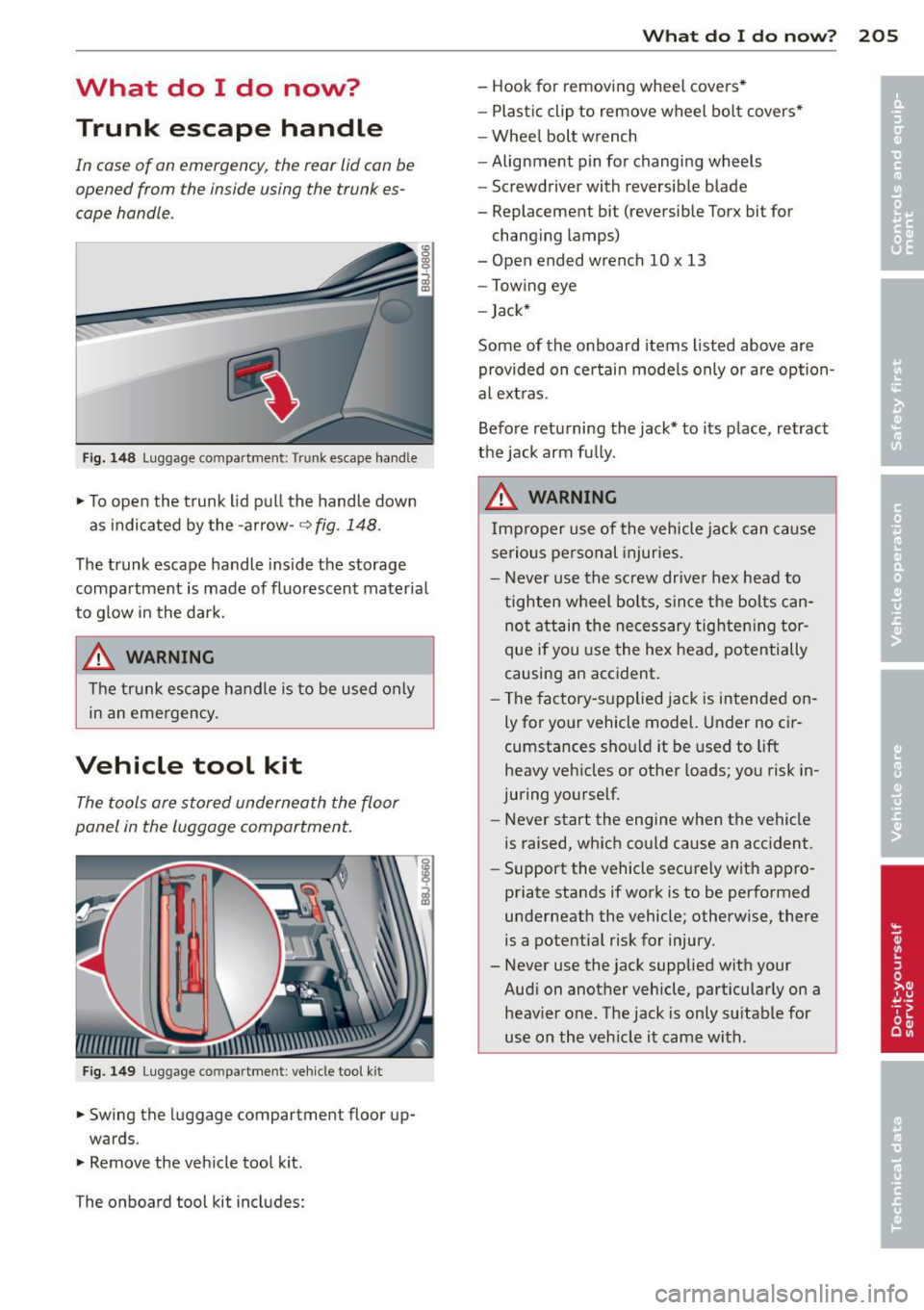
What do I do now? Trunk escape handle
In case of an emergency, the rear lid can be
opened from the inside using the trunk es
cape handle .
Fig. 148 Luggage compa rtment: Tr unk escape handle
"' To open the trunk lid pu ll the handle down
as indicated by the -arrow-~
fig. 148.
The trunk escape handle inside the storage
compartment is made of fluorescent materia l
to g low in the dark.
& WARNING
The trunk escape handle is to be used only
in an emergency .
Vehicle tool kit
The tools ore stored underneath the floor
panel in the luggage compartment.
F ig. 1 49 Luggage co mpa rt ment : veh icle tool ki t
"'Swing the luggage compartment floor up
wards.
"' Remove the vehicle tool k it.
The onboard tool kit includes:
What do I d o now ? 205
- Hook for removing wheel covers*
- Plastic clip to remove wheel bo lt covers*
- Wheel bolt w rench
- Alignment pin for changing wheels
- Screwdriver with reversible blade
- Replacement bit (reversible Torx bit for changing lamps)
- Open ended wrench 10 x 13
- Towing eye
- Jack*
Some of the on board items listed above are
provided on ce rtain mode ls only or are option
al ext ras.
Before returning the jack* to its place, retract
the jack arm fu lly.
& WARNING
Improper use of the vehicle jack can cause
serious pe rsonal injuries .
- Never use the screw drive r hex head to
tighten wheel bo lts, since the bolts can
not attain the necessary tighte ning tor
que if you use the hex head, potentially
causing an accident.
- The factory-supplied jack is intended on
ly for yo ur vehicle model. Under no ci r
cumstances should it be used to lift
heavy veh icles or other loads; you risk in
juring yourself .
- Never start the engine when the vehicle
is raised, wh ich could cause an accident.
- Support the vehicle securely with appro
priate stands if work is to be performed
underneath the vehicle; otherwise, there
is a potential risk for injury.
- Never use the jack supplied with your Audi on another vehicle, particularly on a heav ier one . The jack is only suitable for
use on the veh icle it came with .
Page 215 of 244

Fuses and bulbs
Electrical fuses
Replacing fuses
Fuses that have blown will have metal strips
that have burned through.
Fig. 161 End face of instrument panel: removing cover
p la te to access fuses
Fig . 162 Left side of eng ine compart ment: fuse cove r
Fuse cover on the left end face of the
instrument panel
.. Switch off the ignition and the electrical
component affected.
.. Carefully pry the fuse cover off the instru
ment panel using the ignition key or a
screwdriver
~ fig. 161 .
.. Check the fuse list ing on the next pages to
find out which f use belongs to the compo
nent which has failed
¢ page 214, Fuse Lo
cation, Instrument Panel left .
.. Remove the blown fuse with the plastic clip
provided. The clip is located on the holder in
t he fuse box .
.. Replace a blown fuse (recognizable by the
melted metal str ip inside) with a fuse of the
same amperage .
.. Firmly snap the cover back onto the instru
ment pane l face .
Fuses and bulbs 213
Fuse cover in engine compartment
.. Switch the ignit ion and the affected con
sumer off .
.. Unlatch the fuse cover, p ush the two slides
forward
~ fig. 162.
.. Fi nd out which fuse belongs to the equip
ment which stopped working
~page 215,
Fuse location, le~ side of engine compart
ment.
.. Remove the plastic from its retainer in the
fuse box cove r (left face end of the instru
ment panel), place it on the f use in question
and pull it out .
.. If the fuse is burned out (recogni zable by
melted strips of metal), replace it with a
new fuse
of the same rating .
.. Replace the fuse cover .
.. Push the two slides to the rear
¢ fig. 162.
Insta ll the fuse cover carefully to prevent
water from enter ing .
The various electrical circuits are protected by
fuses. The fuses are clustered in a centralized
unit. The unit is located behind the face panel
at the end of the instrument panel.
You are well advised to keep a supply of spare
fuses in your vehicle. Fuses with the proper
ampere ratings are available at your author
ized Audi dealer.
A WARNING
-
Do not repair fuses and never replace a
b lown fuse with one that has a higher amp
rating. This can cause damage to the elec
trica l system and a fire.
(D Note
If a new fuse burns out again after short ly
have you have installed it, have the electri
ca l system checked by your authorized
Audi dealer.
Page 216 of 244

214 Fuses and bulbs
Fuse Location, Instrument Panel left
0
Fi g. 163 Fuse carrier behind the instrument panel end
face, cove r removed
Some of the equipment items listed are op
tional or only available on certain model con
figurations .
Note that the following table is accurate at
the time of going to press and is subject to
change. In the event of discrepancies, the la
bel on the inside of the cover always takes
preceden ce .
The power seats are protected by circuit
breaker s,
which automatically reset after a
few seconds after the overload has been rem
ed ied.
No . Equipment Amps
Engine relay, fuel tank control
1
unit, A irbag Off light, light
10 switch (sw itch illumination), d i-
agnos tic connector
2
ABS, ASR, ESC, brake light
5 switch
3 AFS headlight (left) s
No.
4
5
6
7
8
9
10
11
12
13
14
15
16
17
18
19
20
21
22
23
Equipment Amps
Oil level sensor (extended main-
tena nce interval) (WIV), tire
pressure monitoring system,
switch for Electronic Stabiliza-
s tion Control (ESC), AFS head-
lights (control unit), A/C system
(pressure sensor), backup light
sw itch
Automatic headlight range con-
trol, AFS headlight (right) /
5/10
manual headlight range con-
trol, halogen headlights
Control unit for CAN data trans-
fer (gateway), electromechani-
s cal steering, automatic trans-
mission shift gate
Acoustic Park Assist, automatic
dipping interior rear view mir- ror, garage door opener, heata-
s ble windshield washer nozzles,
washer pump, wind deflector
relay (Roadster)
H aldex clutch/Ha ldex clutch
5/10 (T TS)
Control un it Audi magnetic ride
s
Airbag contro l unit s
Mass airflow sensor, crankcase 5/10
heating
Door control unit (central lock-
10 ing driver/passenger)
Diagnostic connector
10
Rain sensor, automatic trans-
s miss ion shift gate
Roof light (interior lighting)
5
A/C system (control unit) 10
Tire pressure monitoring sys-
5 tern (control un it)
Not used
Not used
Not used
Fuel injectors (gasoline engine)
10
Wind deflector (Roadster) 30
Horn 20
Page 217 of 244

No. Equipment 24 Transmission (control unit)
25 Heater rear window Coupe/
heated rear window Roadster
26 Driver's side power window
27 Passenger's s ide power window
28 Not used
29 Washer pump
30 Cigarette lighter
31 Starter
32 Steering column module
33 Instrument cluster
34 Radio navigation system, radio
35 Audio amplifier
36 Engine (control un it)
37 CAN (Gateway)
38 Cigarette lighter
39 Not used
40 Not used
41 Not used
42 Not used
43 Not used
44 Not used
45 Not used
46 Not used
47 SOARS
tuner, cell phone pack-
age, TV tuner
48 VOA inte rface
49 Not used
Fuse location, left side of engine
compartment Amps
15
30/20
30
30
15
20
40
5
5
20/15
30 10
5
20
5
5
Fig. 164 Illustrat ion of fuse ho lder on left side of en
gine compart ment: fuses (without fuse cover)
Fuse s and bulb s 215
Some of the equipment items listed are op
tiona l or only avai lab le on certain model con
figurations.
Note th at the foll owing t abl e is ac cur ate at
the time of going t o pre ss and i s subject to
ch ang e.
Fus e holder (bla ck )
No. Equipment Amps
1 Not used
2 Not used
3 Not used
4 Not used
Anti-theft warning system (sen-
5 sor), anti-theft warning system
5
(horn)
6 H
eadlamp washer system
30
Electric f uel pumps (supp ly),
7 volume contro l valve/Interrelais 15/10
(5-cy l.)
8 W indshield w ipers 30
9 Heated
seats (driver and pas-
25
senger)
10 L
umbar support (driver and
10
passenger)
11 Not used
12 Vent
ilation blower
40
Fu se holder (brown )
No. Equipment Amps
1 Not used
2 Electric
fuel pump (5-cyl.)
30
3 Not used
4 Not used
Relay coil relay volume cont ro l
5 va
lve (4-cy l.)/02 sensors (5 -
5/10
cyl.)
6 02 sensors 10
7 Positioning valves pre-wired en-
10
g ine harness
8 Ignition coi ls 20
9 Eng
ine (control unit)
25
10 Water pump de layed-off 10
Page 218 of 244

216 Fuse s a nd bul bs
No. Equipment Amps
11 Feed (brake pedal) 5
12
Activated charcoal fi lter/charge
10 pressure contro l valve
Bulbs
Replacing light bulbs
For your safety, we recommend that you have
your authorized Audi dealer replace burned
out bulbs for you .
It is becoming increasingly more and more
difficult to replace vehicle light bulbs since in
many cases, other parts of the car must first
be removed before you are able to get to the
bulb . Th is appl ies especially to the l ight bulbs
in the front of your car which you can only
reach through the engine compartment.
Sheet metal and bulb holders can have sharp
edges that can cause ser ious cuts, and parts
must be co rrectly taken apart and then prop
e rly put back together to help prevent break
age of parts and long term damage from wa
ter that can enter housings that have not been properly resealed.
For your safety, we recommend that you have
your author ized Audi dealer replace any bulbs
for you, since your dealer has the proper tools,
the correct bu lbs and the expertise.
Gas disc harg e la mps (X enon l ig ht s}*:
Due to the high electrical voltage, have the
bulbs replaced by a qualified technician.
Headlights with Xenon light can be identified
by the high voltage sticker.
A WARNING
Contact with high-voltage components of
the electrical system and improper re
placement of gas discharge (Xenon) head
light bulbs can cause serious personal in
jury and death.
- Xenon bulbs are pressurized and can ex
plode when being changed. -
Changing Xenon lamps requires the spe
cial tra ining, instructions and equip
ment.
- Only an authorized Audi dealer or other
qualified workshop should change the
bulbs in gas discharge lamps.
A WARNING
=
There are parts with sharp edges on the
openings and on the bulb holders that can
cause ser ious cuts.
- If you are uncertain about what to do,
have the work performed by an author
ized Audi dealer or other qualified work
shop. Serious personal injury may result
from improperly performed work.
@ Tips
- If you must replace the light bulbs your
self, a lways remember that the eng ine
compartment of any vehicle is a hazard
ous area to work in. A lways read and
heed all WARNINGS
¢page 165, Work
ing in the engine compartment¢.&..
-It is best to ask your authorized Audi
dealer whenever yo u need to change a
bulb .
-