2014 AUDI TT ROADSTER engine
[x] Cancel search: enginePage 219 of 244

Emergency situations
General
This chapter is intended for trained emer
gency crews and working personnel who
have the necessary tools and equipment to
perform these operations.
Starting by pushing or
towing
(D Note
Vehicles with an automatic transmission
cannot be started by pushing or towing .
Starting with jumper
cables
If necessary, the engine can be started by
connecting it to the battery of another vehi
cle.
If the engine should fail to start because of a
discharged or weak battery, the battery can be
connected to the battery of
another vehicle,
using a
pair of jumper cables to start the en
g ine.
Jumper cables
Use only jumper cables of sufficiently
largecross section to safely carry the starter
current. Refer to the manufacturer's specifica
tions.
Use only jumper cables which have
insulated
termina l clamps and are properly marked for
distinction :
plus(+) cable in most cases colored red
minus(-) cable
in most cases colored black.
_& WARNING
Batteries contain electricity, acid, and gas.
Any of these can cause very serious or fatal
injury. Follow the instructions below for
safe handling of your vehicle's battery.
- Always shield you r eyes and avoid lean
ing over the battery whenever possible.
Emergency situations 21 7
-A discharged battery can already freeze
at temperatures just below 32 °F (0 °C).
Before connect ing a jumper cable, the
frozen battery must be thawed com
pletely, otherwise it could explode .
- Do not allow battery acid to contact eyes
or skin . Flush any contacted area with
water immediately .
- Improper use of a booster battery to
start a vehicle may cause an explosion.
- Vehicle batter ies generate explosive gas
es. Keep sparks, flame and lighted c iga
rettes away from batteries.
- Do not try to jump start any veh icle w ith
a low ac id level in the battery.
- The voltage of the booster battery must
also have a 12-Volt rating. The capacity
(Ah) of the booster battery should not be
lower than that of the discharged bat
tery. Use of batteries of diff erent voltage
or substantially different "Ah" rat ing
may cause an exp losion and personal in
jury.
- Never charge a frozen battery. Gas trap
ped in the ice may cause an explosion.
- Never charge or use a battery that has
been frozen . The battery case may have
be weakened.
- Use of batter ies of different voltage or
substantially different capacity (Ah) rat
ing may cause an exp losion and injury .
The ca pa city (Ah) of the booster battery
should not be lower than that of the dis
charged battery.
- Before you check anything in the engine
compartment, always read and heed all
WARNINGS
c::;,page 165, Working in the
engine compartment.
(D Note
- App lying a higher voltage booster bat
tery will cause expensive damage to sen
sit ive electronic components, such as
control units, relays, rad io, etc .
- There must be no electrical contact be
tween the vehicles as otherwise current
could already start to flow as soon as the
posit ive(+) terminals are connected. ..,. •
•
Page 220 of 244

218 Emergency situations
@ Tips
The discharged battery must be properly
connected to the vehicle's electrical sys
tem.
Use of jumper cables
Make sure to connect the jumper coble
clomps in exactly the order described below!
Fig. 165 Engine compart ment: Co nnectors for jumper
cables and charger
Fig. 166 Jump starting with the battery of another ve
hicle: @discharged veh icle batte ry,® booste r battery
The procedure described below for connecting
jumper cables is intended to provide a jump
start for your veh icle.
Preparatory measures
1. Do not jump start a frozen battery! Re
place such a battery!
2 . Otherwise apply the hand brake and put
the selector lever into P position.
3. For both vehicles switch off all consumers
and the ign ition.
Connecting/disconnecting the jumper
cable .
4. Connect one end of the red jumper cable
on the
jump start bolt@q fig. 166
(Bolts under red cover = "positive") of the
vehicle to be started @.
5. Connect the other end of the red jumper
cable to the positive terminal @of the
booster battery @.
6. Connect one end of the black jumper ca
ble to the negat ive terminal @of the
booster battery @.
7. Connect the other end of the black jumper
cable to the negative terminal (bolt head)
@ in the external start ing point @ of
your vehicle.
8. Route the jumper cables so that they can
not catch in any rotating parts in the en
gine compartment.
Starting the engine
9. Start the engine of the vehicle providing
assistance and allow it to run at id le .
10. Now start the engine of the vehicle with
the discharged battery, wait for two to
three minutes until the engine "runs"
smoothly.
11. If the eng ine does not start: Stop try ing
after 10 seconds and then try again after
about 30 seconds.
12. In the vehicle that has received start as
sistance, turn on the heater blower and
the rear window heating to elim inate any
vo ltage peaks when disconnecting . Driv
ing lights must be switched off!
13 . Disconnect the cable while the engine is
running exactly in
reverse order to that
described in¢
page 218, Connecting/dis
connecting the jumper coble ..
When do
ing so, make sure that the cable cannot
contact rotating eng ine parts.
14. Close the cover on the positive terminal.
The battery is vented to the outside to prevent
gases from entering the vehicle inter ior. Make
sure that the jumper clamps are well connect
ed with their
metal parts in full contact with
the battery terminals.
A WARNING ~
To avoid serious personal injury and dam-
age to the vehicle, heed all warnings and
Page 221 of 244

instructions of the jumper cable
manufacturer. If in doubt, call for road
service.
- Jumper cables must be long enough so
that the vehicles do not touch.
- When connecting jumper cables, make
sure that they cannot get ca ught in any
moving parts in the eng ine compart
ment.
- Before you check anything in the engine
compartment, always read and heed all
WARNINGS
Q page 165, Working in the
engine compartment.
(D Note
Improper hook-up of jumper cables can ru
in the generator.
-Always connect POSITIVE(+) to POSI TIVE(+), and NEGATIVE( -) to NEGATIVE
( - ) ground post of the battery manager
control unit.
- Check that all screw plugs on the battery
cells are screwed in firmly . If not, tighten
plugs prior to connecting clamp on nega
tive battery terminal.
- Please note t hat the procedure for con
nect ing a jumper cable as described
above applies spec ifically to the case of
your vehicle be ing j ump started. When
you are giv ing a jump start to anothe r ve
hi cle, do
not connect the negat ive (-) ca
ble to the negative(- ) terminal on the
discharged battery ©- Instead, securely
connect the negative (-) cable to either a
solid metal component that is firmly bo lted to the engine block or to the en
gine block itself. If the battery that is be
i ng charged does not vent to the outside,
es caping ba tte ry gas cou ld ig nite and ex
plo de!
Em erg en cy si tuation s 219
Emergency towing
with commercial tow
truck
General hints
Your Audi requires special handling for tow
ing.
T he following information is to be used by
commercial tow truck operators who know
how to operate their equipment safely.
- Never tow your Audi , towing will cause
damage t o the engine a nd transmi ssion.
- Never wrap th e safet y chain s or winch ca
ble s ar ound the brak e lin es.
- To preven t unne cess ary dam age, your Aud i
mu st be transported with a car carrier
(flatbed truck ).
- To load th e vehi cle on to the fl at bed , use
the towing lo op found in the vehicle to o ls
and attach to the front o r rear anchorage
Q poge 220 and Qpoge 221.
A WARNING
A veh icle being towed is not safe for pas
sengers. Never allow anyone to ride in a
vehicle be ing towed, for any reason.
-
•
•
Page 224 of 244

222 Emergency situations
Lifting vehicle
Lifting with workshop hoist and with
floor jack
The vehicle may only be lif ted at the lifting
points illustra ted.
F ig. 174 Rear lift in g poin t (ri gh t side)
Fi g. 1 75 Fro nt lift in g po int (r ig ht s ide)
• Read and heed WARNI NG ¢,& .
• Locate lifting points
r=> fig . 174 r=> fig . 1 75 .
• Adjust lift ing arms of wor ks h op hoist or
floor jack to match vehicle lifting points.
• In se rt a rubber pad between the floor jack/
workshop hoist and the lifti ng po ints.
If you must lift your vehicle with a floor jack
to work underneath, be sure the vehicle is safely supported on stands intended for this
purpose.
Front lifting point
The lifting point is locate d on t he floor pan re
info rcement about at the same level as the
jac k mounting point
r=> fig. 175. Do not lift
the vehicle at the vertical sill reinforcement.
Rear lifting point
The lifting point is locate d on t he vertical rein
forceme nt of the lower s ill for t he on boa rd
j ac k
t:!>fig . 174.
Lifting with vehicle jack
Refer to r=>page 210.
/n.. WARNING
-To re duce the risk of ser ious injury and
ve hicl e damage .
- Always lift th e ve hicle o nly at t he spe
c ia l works hop hoist and floor jac k lift
p o ints illust rated
t:!> fig . 17 4 and
r=> fig. 175.
- Fa il u re to lift th e veh icle at th ese
p oi nts co ul d cau se the vehicle to tilt or
f a ll from a li ft if th ere is a ch an ge in ve
h icl e weig ht distr ib utio n an d ba lan ce.
T his mi ght happ en, for ex ample, when
h eavy com ponent s such as the engine
b lock o r tra nsmissi on are remove d.
- Wh en removin g heavy c ompone nts like
these , anch or vehicle to hoist or ad d co r
respon ding we ights to maintain t he cen
ter of gravity. Ot herwise , th e ve hicle
might tilt or slip off the ho ist, causing
serio us pe rsonal injury.
(D Note
-Be aware o f the followin g points bef ore
liftin g the vehicle:
- The vehicle should never be lifted or
jacked up from underneath the engine
oil pan, the transmission housing, the
front or rear axle or the body side members. This could lead to seriou s
damage.
- To avoid damage to the underbody or
chassis frame, a rubber pad must be inserted between the floor jack and
the lift points.
- Before driving over a workshop hoist,
check that the vehicle weight does not
exceed the permissible lifting capacity
of the hoist .
- Before driving over a workshop hoist,
ensure that there is sufficient clear
ance between the hoist and low parts
of the vehicle.
-
Page 225 of 244

Technical Data
Vehicle identification
F ig. 176 Veh ide Identificat ion Numbe r (VlN) plate: lo ·
c ation on d river 's s ide das h pane l
XXXXX XX · X -XXXX XXX
~ fAllftlli. -llllll · NR. ~ W!ru -llllll -NO.
xx
XXXX XXXX XX X XXXXXXXX
XXX XXX
IYP /TYPE
XX XXXXXXX XX X X XX
XXX KW XXX
®i ~W.::·f :l~~ XXXX XXX XXX
©+ ::rw= xxxx I xxxx XXX I xx
M. · AUSSt I IJ'IIDIIS
~--
EOA 7D 5 4UB 6XM SSG SRW
2E H JOZ 1LB lA S 1BA
3FC SMU 7X l
FD A 9G3 OG7 OYH OJF
TL6 3 KA 8EH UlA X98 027
lXW 803 908 824 D2D
7T6 CV7 7KO 4X3 2K2
3L4 4KC 3YO 413 502
1S A 7GB 01A 4GO
XX. X XX X XX X XXXX
Fig.
177 T he vehicle identification label - inside the
luggage co mpartment
Veh icle Id entifica tion Numb er (VlN )
The Veh icle Iden tifica tion Number is located
in different p laces :
- under the w indshield on the driver 's side
~fig. 176.
- i n the Driver Informat ion d isp lay i=;, page 24 .
- on the vehicle identification label.
Vehicle identific ation lab el
The Vehicle identification label is located in
the luggage compartment in the spare whee l
well.
Te chni cal Data 22 3
The label ~ fig. 177 shows the fo llowing vehi
cle data :
(D Vehicle Ident ifi cat ion Number (V IN)
@ Vehicle type , engine output, transmission
@ Engine and transm ission code
@ Pa int number and interior
® Optional equipment numbers
The information of the vehicle identification label can also be found in your Warranty
&
Maintenance booklet.
Saf ety complian ce sticker
The Sa fety compliance sticker is your assur
ance that your new vehicle complies with all
applicable Federa l Motor Vehicle Safety
Standards which were in effect at the time the
vehicle was manufactured. You can find this
sticker on the left door jamb .
It shows the
month and year of product ion and the vehicle
identification number of your vehicle (perfora
t ion) as well as the Gross Veh icle Weight Rat·
ing (GVWR) and the Gross Ax le Weight Rating
(GAWR).
H igh volt age warning label
The high voltage warning label is located in
the engine compartment next to the engine
hood re lease. The spar k ign ition system com
plies wi th the Canadian standard IC ES-002.
Weights
Gross Vehicle Weight Rating
The Gross Vehicle Weight Rat ing (GVWR), and
the Gross Axle Weight Rating (GAWR) for
front and rear are listed on a sticker on the
left door j amb.
The Gross Vehicle Weight Rat ing includes the
weight of the bas ic vehicle plus fu ll fuel tank,
o il and coo lant, plus maximum load , which in
cludes passe nger we igh t (1 50 lbs/68 kg pe r
designated sea ting position) and luggage
weight.
II>
Page 227 of 244
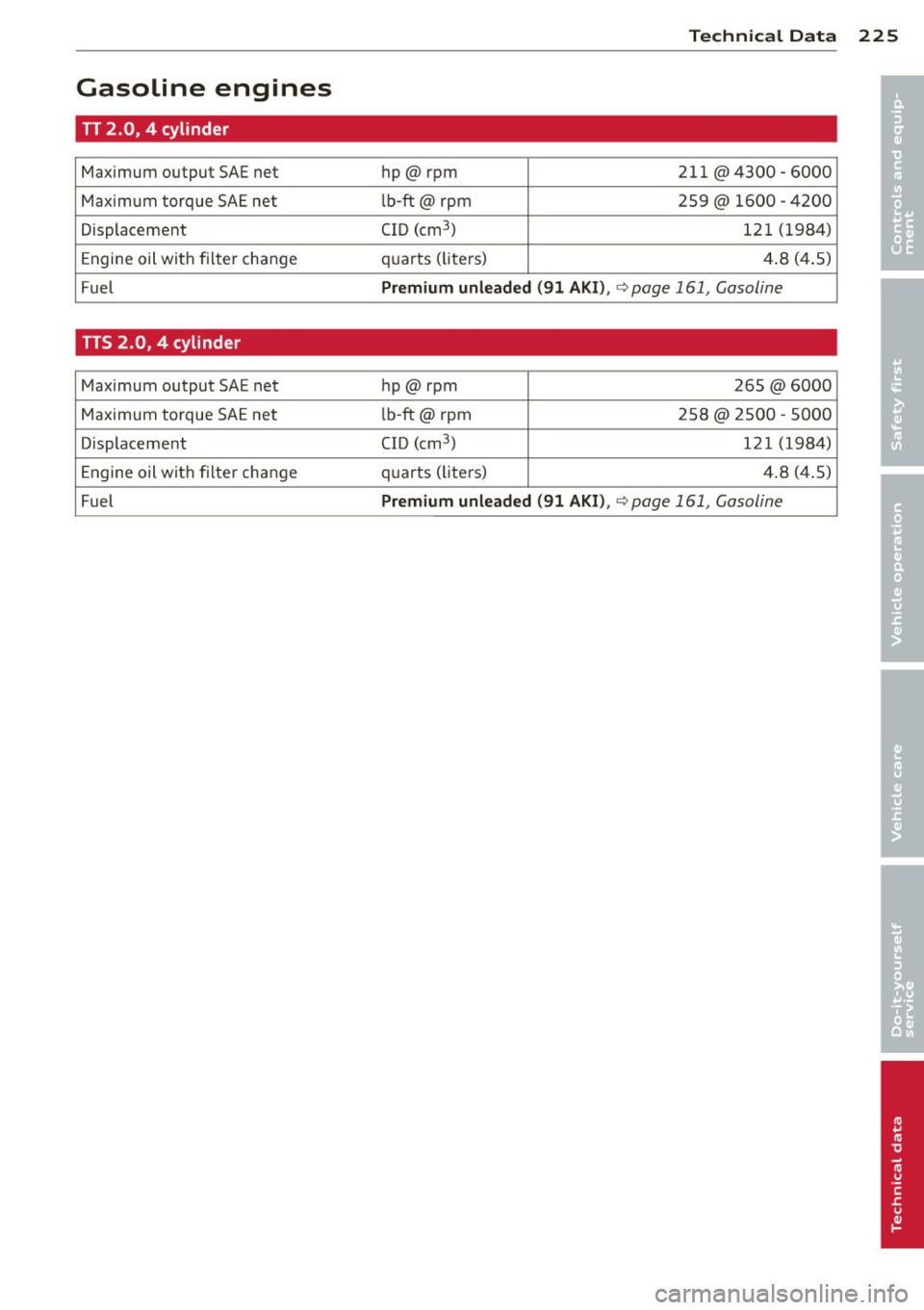
Technical Dat a 225
Gasoline engines
•
TT 2.0, 4 cylinder •
Maximum output SAE net hp@rpm 211 @4300 - 6000
Maximum torque SAE net lb-ft@ rpm 259@ 1600 - 4200
Displacement CID (cm
3
) 121 (1984)
Engine oil with f ilter change q
uarts (liters) 4.8 (4 .5)
Fuel
Prem ium unleaded (91 AKI) , ¢page 161, Gasoline
TTS 2.0, 4 cylinder
Maximum output SAE net hp@rpm 265 @6000
Maximum torque SAE net l
b -ft@ rpm 258@ 2500 -5000
Displacement CID (cm
3
) 121 (1984)
Engine oil with filter change q
uarts (li ters) 4.8 (4 .5)
Fuel
Premium unleaded (91 AKI) , ¢page 161, Gasoline
Page 228 of 244

226 Consumer Information
Consumer Information
Warranty coverages
You r Audi is covered by the following war
ranties:
- New Vehicle Limited Warranty
- Limited Warranty Against Corrosion Perfo-
ration
- Emissions Control System Warranty
- Emissions Performance Warranty
- California Emissions Control Warranty (USA
vehicles only)
- California Emissions Performance Warranty
(USA vehicles only)
Detailed information regarding your warran
ties can be found in your
Warranty & Mainte
nance booklet .
Operating your vehicle
outside the U.S.A. or
Canada
Government regu lations in the United States
and Canada require that automobiles meet
specific emission regulations and safety
standards. Therefore, veh icles built for the
U.S.A . and Canada differ from vehicles sold in
other countries .
If you p lan to take your vehicle outside the
continental limits of the United States or Can
ada, there is the possibility that:
- unleaded fuels for vehicles with cata lytic
converter may not be available;
- fuel may have a considerably lowe r octane
rating. Improper fuel may cause engine
damage ;
- service may be inadequate due to lack of
proper service facilities, tools or testing
equipment ;
- replacement pa rts may not be readily availa
ble.
- Navigation systems for vehicles built for the
U.S.A. and Canada will not necessar ily work
in Europe, and may not work in other coun
tries outside of North America.
(D Note
Audi cannot be responsible for mechanical
damage that could result from inadequate
fuel, service or parts availability.
Audi Service Repair Manuals and Literature
Audi Official Factory Service Manuals and Lit
erature are published as soon as possible after
model introduction. Service Manuals and liter
ature are available to order from the Audi
T echnical Literature Ordering Center at:
www.audi.techliterature.com
Maintenance
General
Your vehicle has been designed to help keep
maintenance requirements to a minimum.
However, a certain amount of regular mainte
nance is still necessary to assure your vehicle's
s afety, economy and rel iability. For detailed
vehicle maintenance consult your Warranty &
Maintenance booklet.
Under difficult operating conditions, for ex
ample at extremely low outside temperatures,
i n very dusty regions , etc., some service work
should be performed between the intervals
specified. This applies particularly to:
- oil changes, and
- cleaning or replacing the air filter.
@ For the sake of the environment
By regu larly maintaining your vehicle, you
help make sure that emission standards
are maintained, thus minimizing adverse
effects on the environment .
' Important considerations for you and
your vehicle
T he increasing use of electron ics , soph isticat
ed fuel injection and emission control sys
tems, and the generally increasing technica l
complexity of today's automobiles, have
liJJ,
Page 229 of 244

steadily reduced the scope of maintenance
and repairs which can be carried o ut by vehicle
owners.
Also, safe ty and en vironment al con
cerns p lace very strict limits on the nature of
repairs and adjustments to engine and trans
miss io n parts which an owner can perform .
Maintenance, adjustments and repa irs usua lly
require special tools, testing dev ices and oth
er equipment availab le to specially trained
workshop personne l in order to assure proper
pe rformance, reliab ility and safety of the vehi
cle and its many systems .
Improper ma intenance, adjustments and re
pa irs can impair the operation and reliability
of your vehicle and even void your vehicle war
ranty. Therefore, p roof of servic ing in accord
ance w ith the maintenance schedule may be a
condition for upholding a poss ible war ran ty
claim made within the warranty period .
Above all, operational safety can be adversely
affected, creating unnecessary risks for you
and your passengers .
If in doubt about any serv icing, have it done
by your authorized Audi dealer or any othe r
p roperly equipped and q ualified works hop .
We strong ly urge you to give yo ur auth o rized
Aud i dea ler the opportuni ty to perform all
schedu led maintenance and necessary repairs .
Your dea ler has the facilities, original parts
and tra ined spec ialists to keep your vehicle
running properly.
Performing limit ed ma inten anc e yourself
The fo llow ing pages describe a limited num
ber of proced ures which can be pe rformed on
your vehicle with ordina ry too ls, should the
need arise and trained personnel be unavaila
ble. Before performing any of these proce
dures, always t horoughly read a ll of the app li
cable text and carefully follow the instruc
tions given . Always rigorously obse rve the
WARNINGS provided.
Befo re you check anything in the engine
c ompartm ent, a lway s re ad and heed all
WARN INGS ~
A and ~ A in Working in the
engine compartment on page 165.
Con sumer In formation 22 7
_& WARNING
- Ser ious personal injury may occur as a re
sult of improperly performed mainte
nance, ad justments or repa irs .
- Always be extremely careful when work
ing on the vehicle . Always follow com
monly accep ted safety pract ices and gen
era l common sense. Never r is k personal
inju ry.
- Do not attempt any of the maintenance,
checks or repairs descr ibed o n the fol
lowing pages if you are not fully fam ilia r
with these or othe r procedures with re
spect to the vehi cle, or are uncertain how
to p roceed .
- Do not do any work without the proper
too ls and equipment. Have the necessa ry
wo rk done by your authorized A udi deal
er or another proper ly equipped and
qualified wor kshop.
- The engine compartment of any motor
veh icle is a potentially hazardous area.
Never reach into t he area around or
touch the rad iator fan. It is temperature
contro lled and can switch on suddenly -
even when the engine is off and the igni
tion key has been removed. The rad iator
f a n switches on a utomat ica lly when the
coo lant reaches a certain tempera ture
an d will continue to run until the coo lant
tem perature drops .
- Always remove the ign ition key before
anyone gets under the vehicle.
- Always support your veh icle with safety
stands i f it is necessary to work under
neath the vehicle. The jack s upplied with
the vehicle is not adequate for this pur
pose and cou ld collapse causing serio us
personal injury.
- I f you must work underneath the vehicle
with the wheels on t he ground, a lways
make sure the vehicle is on leve l ground,
that the wheels a re a lways securely
blocked a nd that the engine cannot be
started. •
•