2014 AUDI RS7 SPORTBACK check engine
[x] Cancel search: check enginePage 222 of 292
220 Check ing and filling
Engine cooling system
Coolant
The engine coolant performs two functions: it
keeps the engine from overheating and it pro
tects the engine from freezing in the winter .
The cooling system is sealed and generally re
quires little attention.
The cooling system has been filled at the fac
tory with a permanent coolant which does not need to be changed. The coolant consists of a
mixture of specially conditioned water and the
manufacturer's glycol-based coolant addi-
tive G13 antifreeze with ant icorros ion addi
tives (50% for USA models; 60% for Canadian models) . This mixture both assures the neces
sary frost protection and protects metal com
ponents in the engine's cooling system from
corrosion and scaling.
It a lso raises the boil
ing point of the coo lant.
D o not reduce the concentration o f the coo l
ant in the summer by adding plain water .
The
proportion of coolant add it iv e mu st be at
lea st 50 % but not mo re than 60 %
to main
tain antifree ze protection and cooling efficien
cy. If the coolant frost protect ion is too low,
the coolant could freeze and damage the veh i
cle heating and eng ine cooling system .
For year-round driving, antifree ze is added at
the factory for temperatures down to:
- -31° F(-35°C)USA
- - 40 ° F ( -40 °C) Canada.
I f you must add coo lant, use a m ixture of wa
ter and coolant addit ive. Mixing the coolant
addit ive wi th dist illed wate r is recommended.
_& WARNING
Before yo u check any thing in the engine
compartment, always read and heed all
WARNINGS
¢ &. in Working in the engine
compartment on page 213.
(D Note
- Before winter se ts in, have the coolant
checked to see if the coolant additive in
-
your vehicle is sufficient to meet the cli mate conditions . This is especia lly impor
tant if you live in a reg ion where the win
ter is extreme ly cold. If necessary, in
crease the proportion of coolant add itive
to 60% .
- When adding coolant additive to your
cooling system , remember :
- We recommend us ing on ly coolant ad
d it ive G12 ++ or G1 3 (check the labe l)
for your vehicle . This coolant additive is
avai lable at autho rized Audi dea lers .
Other types of antifreeze can signifi
cantly reduce corrosion protection. The
resu lting corrosion can cause a loss of
coolant and serious engine damage .
- Do not add any type of rad iator leak seal
ant to your vehicle's engine coolant.
Add ing radiator repa ir flu id may adverse
ly affect the function and performance of
your cooling system and could resu lt in
damage not covered by you r New Ve hicle
Limited War ran ty.
Checking the engine coolant level
The engine coolant level can be checked with
a quick glance.
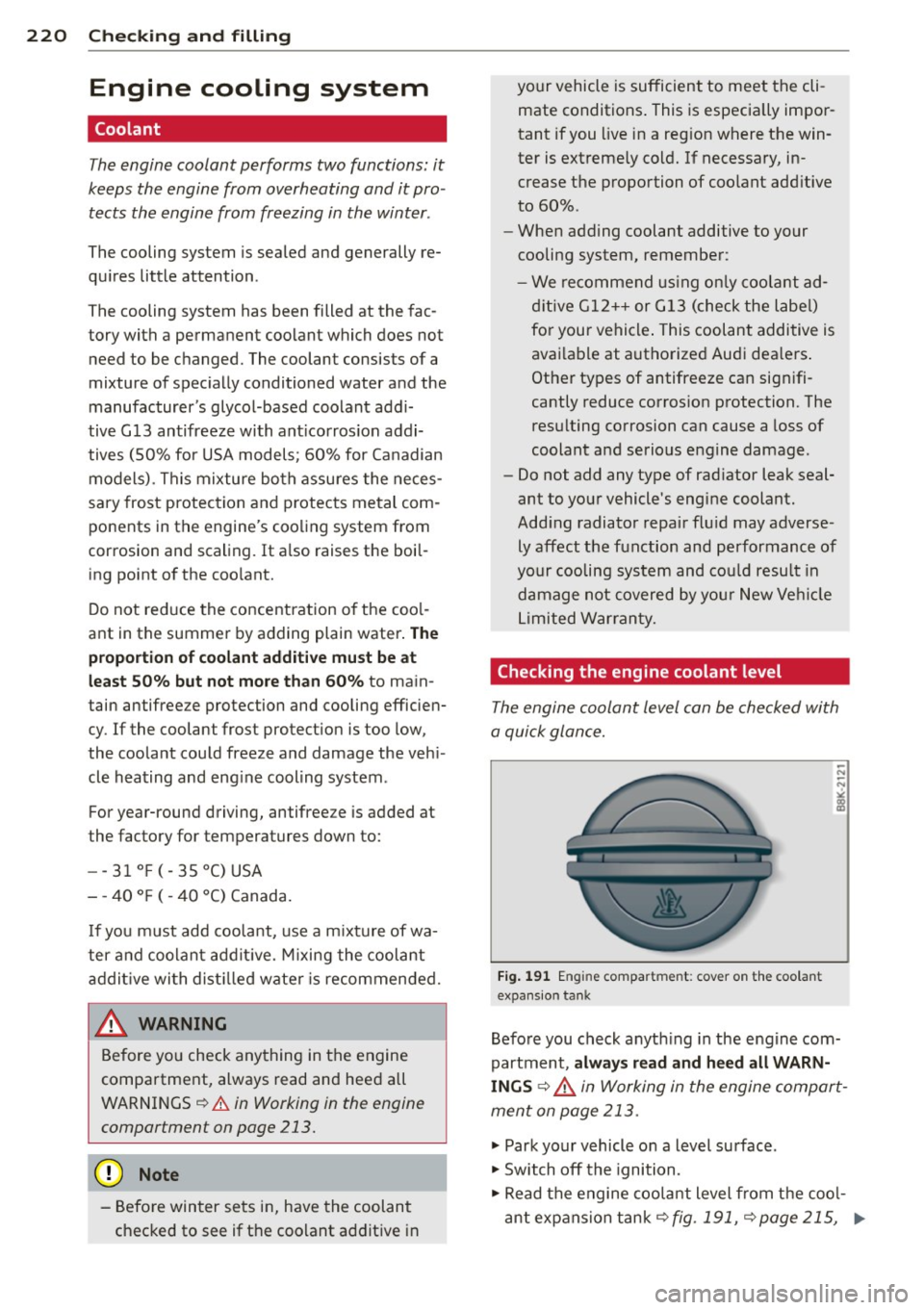
F ig . 1 91 Engin e compar tmen t: cover o n th e coolant
expans io n tank
Befo re you check anyth ing in the engine com
partment,
always r ead and he ed all WARN
INGS
¢ &_ in Working in the engine compart
ment on page 213.
.,. Park your vehicle on a level surface .
.,. Switch off the ignition .
.,. Read the engine coo lant level from the coo l
a nt expansion tank¢
fig . 191, ¢ page 215, ..,.
Page 223 of 292
fig. 188. With a cold engine, the coolant
lev el should be between the "min" and
"max" markings. When the engine is warm,
the level may be slightly above the "max"
marking .
The location of the coolant expansion tank
can be seen in the engine compartment illus
t ration
<=> page 215.
To obtain an accurate reading , the engine
must be switched
off.
The expansion tank in your vehicle is equipped
with an electric coolant level sensor.
When the coolant level is too low, the warning
light in the Auto-Check System<=>
page 15 will
illuminate until you add coolant and the level
has been restored to normal. Even though
there is an electric coolant level sensor, we
still recommend you check the coolant level
from time to time .
Coolant loss
Coolant loss may indicate a leak in the cooling
system. In the event of coolant loss, the cool
ing system should be inspected immediately
by your authorized Audi dealer. It is not
enough merely to add coolant .
In a
sealed system, losses can occur only if
the boiling point of the coolant is exceeded as
a result of overheating.
&_ WARNING
-
The cooling system is under pressure and
can get very hot. Reduce the risk of scald
ing from hot coolant by following these
steps.
- Turn
off the engine and allow it to cool
down.
- Protect your face, hands and arms from
escaping fluid and steam by covering the
cap with a large, thick rag.
- Turn the cap slowly and very carefully in
a counter-clockwise direction while ap
plying light, downward pressure on the
top of the cap.
Checking and filling 221
-To avoid being burned, do not spill anti
freeze or coolant on the exhaust system
or hot engine parts. Under certain condi
tions, the ethylene glycol in engine cool
ant can catch fire .
(D Note
Do not add any type of radiator leak seal
ant to your vehicle 's engine coolant. Add-
ing radiator repair fluid may adversely af
fect the function and performance of your
cooling system and could result in damage
not covered by your New Vehicle Limited
Warranty.
Adding coolant
Be very careful when adding engine coolant.
Before you check anything in the engine com
partment,
always read and heed all WARN
INGS <=>.&. in Working in the engine compart
ment on page 213.
"'Turn off the engine.
"'Let the engine cool down .
"' Place a thick rag over the coolant expansion
tank
<=> page 220, fig. 191 and carefully
twist the cap counter-clockwise <=>_& .
"'Add coolant mixed in the correct ratio
<=> page 220, Coolant.
"'Twist the cap on again tightly.
Replacement engine coolant must conform to
exact specifications <=>
page 220, Coolant.
We recommend using only coolant addi-
tive G12++, G13 or in an emergency G12+. Do
not use a different additive. In an emergency
use plain water until you can get the correct
additive and can restore the correct ratio. This
should be done as soon as possible.
If you have lost a considerable amount of
coolant , then you should add cold antifreeze
and cold water only when the engine is cold.
Always use
new engine coolant when refilling.
Do not fill coolant above the "MAX" mark. Ex -
cess coolant will be forced out through the ..,.
•
•
Page 224 of 292
222 Checking and filling
pressure relief valve in the cap when the en
gine becomes hot.
.&_ WARNING
- The cooling system is under pressure and
can get
very hot. Reduce the risk of
sca lding from hot coolant by following
these steps .
- Turn off the eng ine and a llow it to cool
down.
- Protect your face, hands and arms from
escap ing flu id and steam by cover ing
the cap with a large , thick rag .
- Tu rn the cap slowly and
very carefully
in a counter -clockwise direction while
applying light, downward pressure on
the top of the cap .
- To avo id being burned, do not sp ill an
tifreeze or coolant on the exhaust sys
tem or hot engine parts. Under certain
conditions, the ethylene glycol in en
g ine coolant can catch fire.
- Antifreeze is poisonous. Always store an
t ifreeze in its original container and well
out of the reach of children.
- If you drain the coolant, it must be
caught and safely stored in a proper con
ta iner clearly marked "poison".
(D Note
- Coolant po llutes the environment and
could cause an engine fire. Excess coo l
ant will be forced out through the pres
sure relief valve i n the cap when the en
gine becomes hot .
- If, in an emergency, only water can be
added, the correct ratio between wate r
and antifreeze ~
page 220 must be re
stored as soon as possib le.
@) For the sake of the environment
Dra ined coolant should not be reused . Al
ways dispose of used coolant while
observ
ing all environmental regulations .
Radiator fan
The radiator fan switches on automatically by
itself .
An auxilia ry electric r adiator fan switches on
and off depending on coolan t tempera ture
and other vehicle operat ing condit ions .
After you switch the engine off, the aux iliary
fan can continue running for up to 10 minutes
- even w ith the ignition off . It can even swi tch
on aga in later by itself
c> .&. , if
- the temperature of the engine coo lant rises
due to the heat build-up from the engine in
the engine compartmen t, or
- the engine compartment heats up because
the vehicle is parked in intense sunlight.
.&_ WARNING ,_
- To reduce the risk of personal injury nev
er touch the radiator fan .
- The auxiliary electric fan is temperature
controlled and can sw itch on suddenly
even when the engine is not running .
- The auxiliary radiator fan sw itches on au
tomatically when the engine coo lant
reac hes a certain t emperature and wi ll
continue to run until the coolant temper
a ture drops.
Brake fluid
Checking brake fluid level
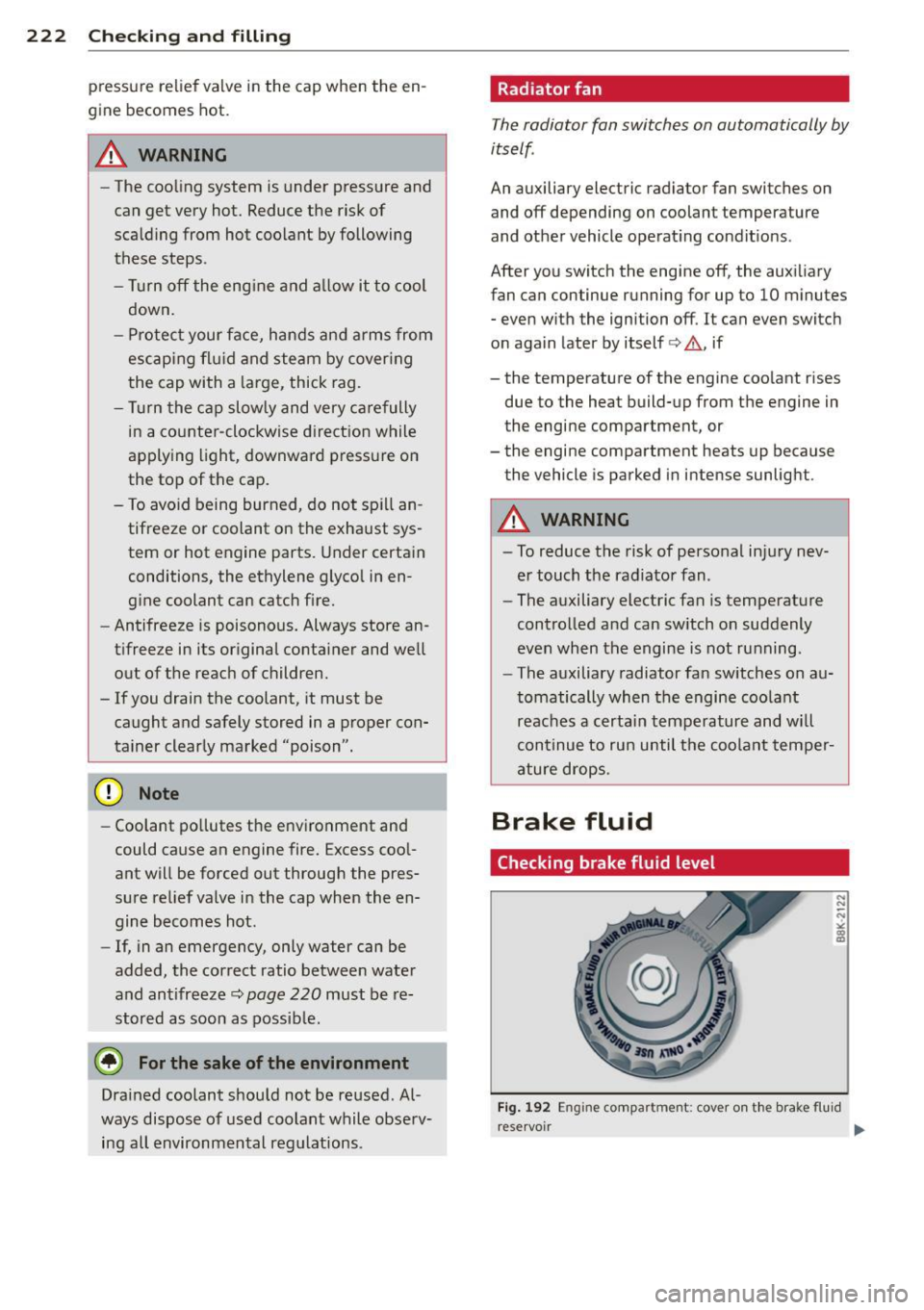
Fi g. 19 2 Engin e compart ment: cover on t he bra ke fluid
re servoir
Ill>
Page 225 of 292
Before you check anything in the engine com
partment,
always r ead and heed all W ARN
ING S ~ A in Working in the engine compart
ment on page 213.
.. Read the brake fluid level from the brake
fluid reservoir ¢
fig. 192, ~ page 215,
fig . 188.
The brake fluid level must be be
tween the "MIN" and "MAX" markings.
The location of the brake fl uid reservoir can be
seen in the engine compartment illustration
¢page 215.
The fluid level may drop slightly after some
time due to the automatic adjustment of the brake pads . This is not cause for alarm .
If the brake fluid level falls considerably be
l ow the "MIN" mark, the brake wa rning/indi
cator light
1111 (U .S . models)/ . (Canadian
models) will come on
~ page 14. Do not con
tinue to operate the vehicle. The comp lete
brake system shou ld be thoroughly checked
by an authorized Audi dealer or other quali
f ied fac ility and the cause corrected . If the
b rake fluid level is too low, the brake warn ing/
i ndicator light w ill illuminate . Contact an au
thor ized Audi dealer
imm ediately .
Changing brake fluid
Have the brake fluid changed by an experi
enced technician .
Brake fluid absorbs moisture from the a ir . If
the water content in the brake fluid is too
hi gh, cor rosion in the brake system may result
after a per iod of t ime . The bo iling po int of the
b rake fluid w ill also decrease considerab ly and
decrease braking performance.
Therefore, the brake flu id must be changed
ev ery two ye ars. A lways use new b rake fluid
which confo rms to Federal Motor Vehicle
Standard "FMVSS
116 DO T 4".
The brake flu id rese rvoi r ca n be difficult to
r each, therefo re , we recommend that yo u
h ave the brake fl uid changed by you r autho r
i zed
Audi de aler . Your dea le r has the correct
Checkin g and fillin g 223
tools, the right brake fl uid and the know -how
to do this for you .
A WARNING
-Brake flu id is poisonous. It must be stor
ed only in the closed or iginal container
out of the reach of children!
- Brake failure can resu lt from o ld or inap
propriate brake f lu id. Observe these pre
cautions:
- Use only b rake fluid tha t meets SA E
spe cificat ion
J 17 03 and conforms to
Federa l Moto r Ve hicl e Standard
116.
Always check with your authorized Audi
dealer to make sure yo u are using the
correct brake fluid. The correct type of
brake f luid is also ind icated on the
brake f luid reservoir .
- The brake fluid must be new. Heavy use
of the brakes ca n cause a vapor lock if
the brake fluid is left i n the system too
long. This can se riously affect the effi
c iency of the b rakes as well as your
safety , T his could result in an accident.
(!) Note
Brake fluid will damage the paint of your
vehicle.
@) For the sake of the environment
Because of the prob lem of proper disposal
of brake fluid as well as the spec ial too ls
r equired and the necessary expertise, we
r ecommend that you have th e brake flu id
changed by you r autho rized Aud i dea le r.
Battery
General information
Under normal operating cond itions, the bat
tery in your Audi does not need any ma inte
nance . With
high outside temperatu res or
lo ng da ily drives we recommend that you have
the e lectrolyte leve l che cked by a se rv ice fa
c il ity. The ele ctroly te leve l should also be
chec ked each t ime the battery is cha rged
~ page 226 . Iii>
•
•
Page 227 of 292
-Always wear eye protection. Do not let
battery acid or any lead particles get on
your skin or clothing. Shield your eyes .
Explosive gases can cause blindness or
other injury.
- Battery acid contains sulfuric acid . Sulfu
ric acid can cause blindness and severe
burns.
- Always wear gloves and eye protection.
Do not tilt the battery because acid
could leak out of the ventilation open
ings.
- If you get battery acid in your eyes or
on your skin, immediately rinse with
cold water for several minutes and get
medical attention .
- If you should ingest any battery acid,
seek medical attention immediately.
- Do not expose the battery to an open
flame, electric sparks or an open light.
- Do not smoke.
- Do not interchange the positive and neg -
ative cables .
= When working on the battery, be sure
not to short-circuit the terminals with
tools or other metal objects. This would cause the battery to heat up very quickly,
which could lead to damage or explosion and personal injury.
- When a battery is charged, it produces
hydrogen gas which is explosive and
could cause personal injury .
- Always keep the battery well out of the
reach of children.
- Before work is done on the electrical sys
tem, disconnect the negative ground ca ble .
- Before performing any work on the elec
trical system, switch off the engine and
ignition as well as any electrical equip
ment. The negative cable on the battery
must be disconnected . If you are just go
ing to replace a light bulb, then it is
enough to switch off the lights.
- Before disconnecting the battery, switch
off the anti-theft alarm system! Other
wise you will set off the alarm.
Checking and filling 225
-When disconnecting the battery, first
disconnect the negative cable and then
the positive cable.
- Before reconnecting the battery, make
sure all electrical consumers are switch
ed off. Reconnect the positive cable first
and then the negative cable . Never inter
change the cables -this could start a fire!
- Never charge a frozen or a thawed-out
battery . It could explode! If a battery has
frozen , then it must be replaced . A dis
charged battery can freeze over at 32 °F
(0 °C) .
-Make sure the vent hose is always attach
ed to the opening on the side of the bat
tery .
- Never use batteries which are damaged.
There is the danger of an explosion! Al
ways replace a damaged battery.
&_ WARNING
California Proposition 65 Warning:
- Battery posts, terminals and related ac
cessories contain lead and lead com
pounds, chemicals known to the State of
California to cause cancer and reproduc
tive problems. Wash hands after han dling.
(D Note
- Do not disconnect the vehicle battery
when the ignition is on or when the en gine is running, otherwise, you will dam
age electronic components in the e lectri
cal system.
- If your vehicle is going to stand for a
long period of time without being driven,
protect the battery from "freezing", oth
erwise it will be damaged and will then
have to be replaced.
- When opening the doors, the windows
lower approximately 10 mm automati
cally . This function is not available when
the battery is disconnected, which
means there is a risk that the door sea l
or the window could be damaged.
•
•
Page 228 of 292
226 Checking and filling
Battery charging
Starting the engine requires a well charged
battery.
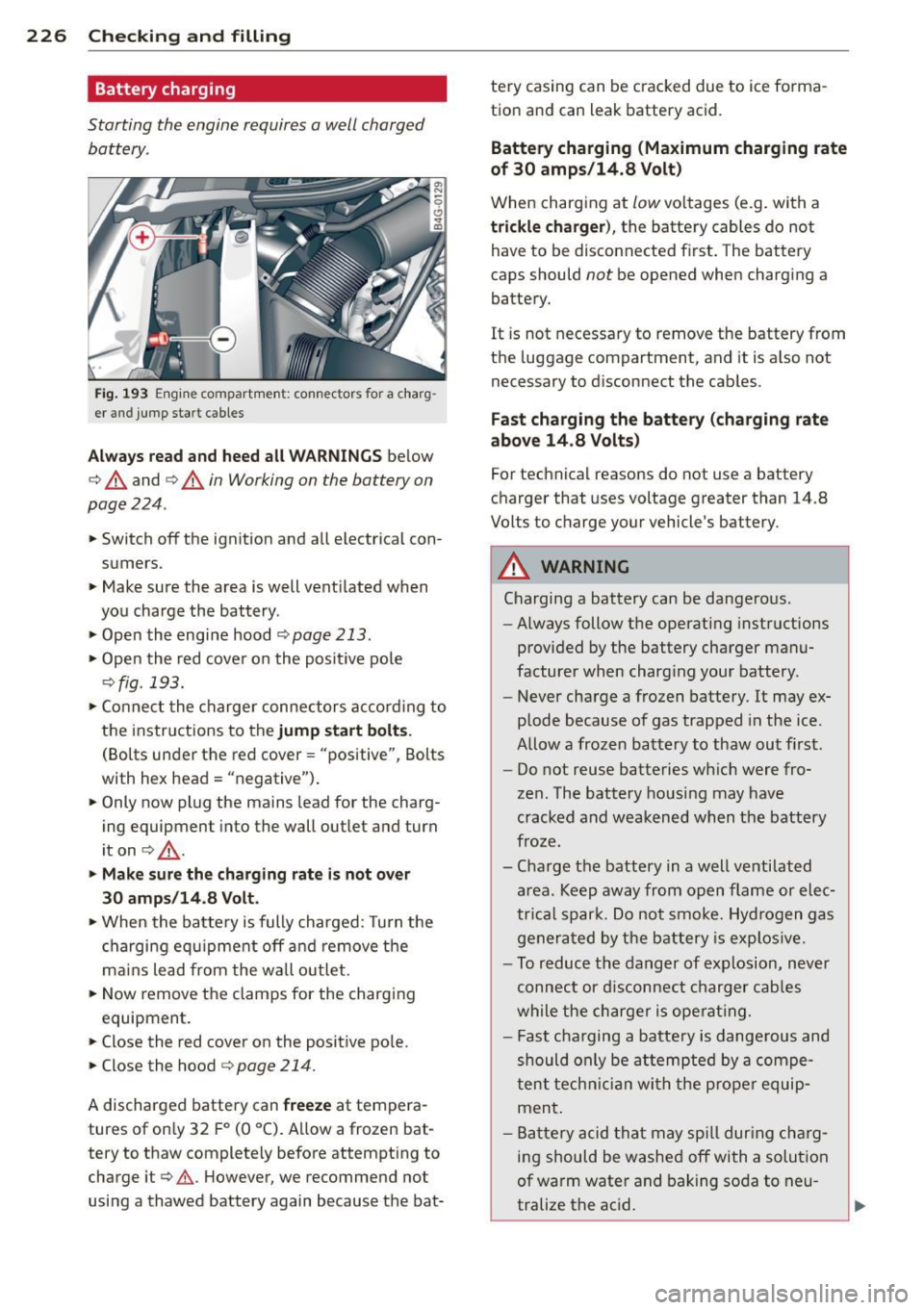
Fig . 193 Engine compartme nt: connecto rs for a charg
er and jump start cables
Always read and heed all WARNINGS below
c:> A and c:> A in Working on the battery on
page 224 .
.,. Switch off the ignition and all electrical con
sumers.
> Make sure the area is well vent ilated when
you charge the battery .
> Open the engine hood c:> page 213 .
> Open the red cover on the posit ive pole
c:>fig. 193.
> Connect the charger connectors according to
the instructions to the
jump start bolts.
(Bolts under the red cover = "positive", Bolts
with hex head= "negative") .
> Only now plug the mains lead for the charg
ing equipment into the wall outlet and turn
iton
c:> &_ .
.,. Make sure the charging rate is not over
30 amps/14.8 Volt.
> When the batte ry is fully charged: Turn the
charging equipment off and remove the
ma ins lead from the wall outlet.
> Now remove the clamps for the charging
equipment.
.. Close the red cover on the positive pole.
> Close the hood c:> page 214.
A discharged battery can freeze at tempera
tures of on ly 32 F
0 (0 °C). Allow a frozen bat
tery to thaw completely before attempting to charge it
c:> .&. However, we recommend not
using a thawed battery again because the bat- tery casing can
be cracked due to ice forma
tion and can leak battery acid.
Battery charging (Maximum charging rate
of 30 amps/14.8 Volt)
When charging at low voltages (e.g. with a
trickle charger), the battery cables do not
have to be disconnected f irst. The battery
caps should
not be opened when charging a
battery.
It i s not necessary to remove the battery from
the luggage compartment, and it is also not
necessary to disconnect the cables.
Fast charging the battery (charging rate
above 14 .8 Volts)
For technical reasons do not use a battery
charger that uses voltage greater than 14.8
Volts to charge your vehicle's battery .
A WARNING
Charging a battery can be dangerous.
- Always follow the operating instructions
provided by the battery charger manu
facturer when charg ing your battery.
- Never charge a frozen battery. It may ex
plode because of gas trapped in the ice .
Allow a frozen battery to thaw out first.
- Do not reuse batteries wh ich were fro
zen. The battery housing may have
cracked and weakened when the battery
froze.
- Charge the battery in a well ventilated area. Keep away from open flame or elec
tr ica l spar k. Do not smoke. Hydrogen gas
generated by the battery is explos ive.
- To reduce the danger of explosion, never
connect or disconnect charger cables
while the charger is operating .
- Fast charging a battery is dangerous and
should only be attempted by a compe
tent technician with the proper equip
ment .
- Battery acid that may spill dur ing charg
ing should be washed off with a solution
of warm water and baking soda to neu
tralize the acid.
Page 229 of 292
CD Note
Never use a fast charger as a booster to
start the engine. This will seriously dam
age sensitive electronic components, such
as control units, relays, radio, etc., as well
as the battery charger .
Battery replacement
The new battery must have the same specifi
cations and dimensions as the original equip
ment battery .
Intelligent energy management in your vehi
cle is respons ible for distributing the electri
cal energy throughout your vehicle
c::> page 195. The intelligent energy manage
ment system w ill keep the engine battery
charged bette r than vehicles w ithout t his sys
tem. To make sure the additional electr ica l en
ergy is available once again after you have
changed the battery, we recommend that you
install batteries of the same type and manu
facture only (the same as those installed at
the time your vehicle was delivered). Specifi
cations are listed on the battery hous ing. Your
author ized dealer must code the battery in
the energy management system to enable you
to use the energy management functions cor
rectly after replac ing the battery.
The new battery must have the same capacity,
voltage (12-volts), amperage, const ruct ion
and p lug sealing.
When installing the battery, make sure the ig
n ition and all electr ical consumers are sw itch
ed off .
CD Note
Make sure the ventilation hose on the s ide
of the battery is connected, otherwise
fumes or battery ac id can leak out.
@ For the sake of the environment
Because of the problem of proper d isposal
of a battery, we recommend your author
ized Aud i dealer change the battery for
you . Batteries contain su lfuric ac id and
Checkin g and fillin g 22 7
lead and must always be disposed o f prop
erly in compliance with a ll environmental
regulations. Disposing of vehicle batter ies
i mproperly is very dangerous to the envi
ronment .
Windshield/headlight*
washer container
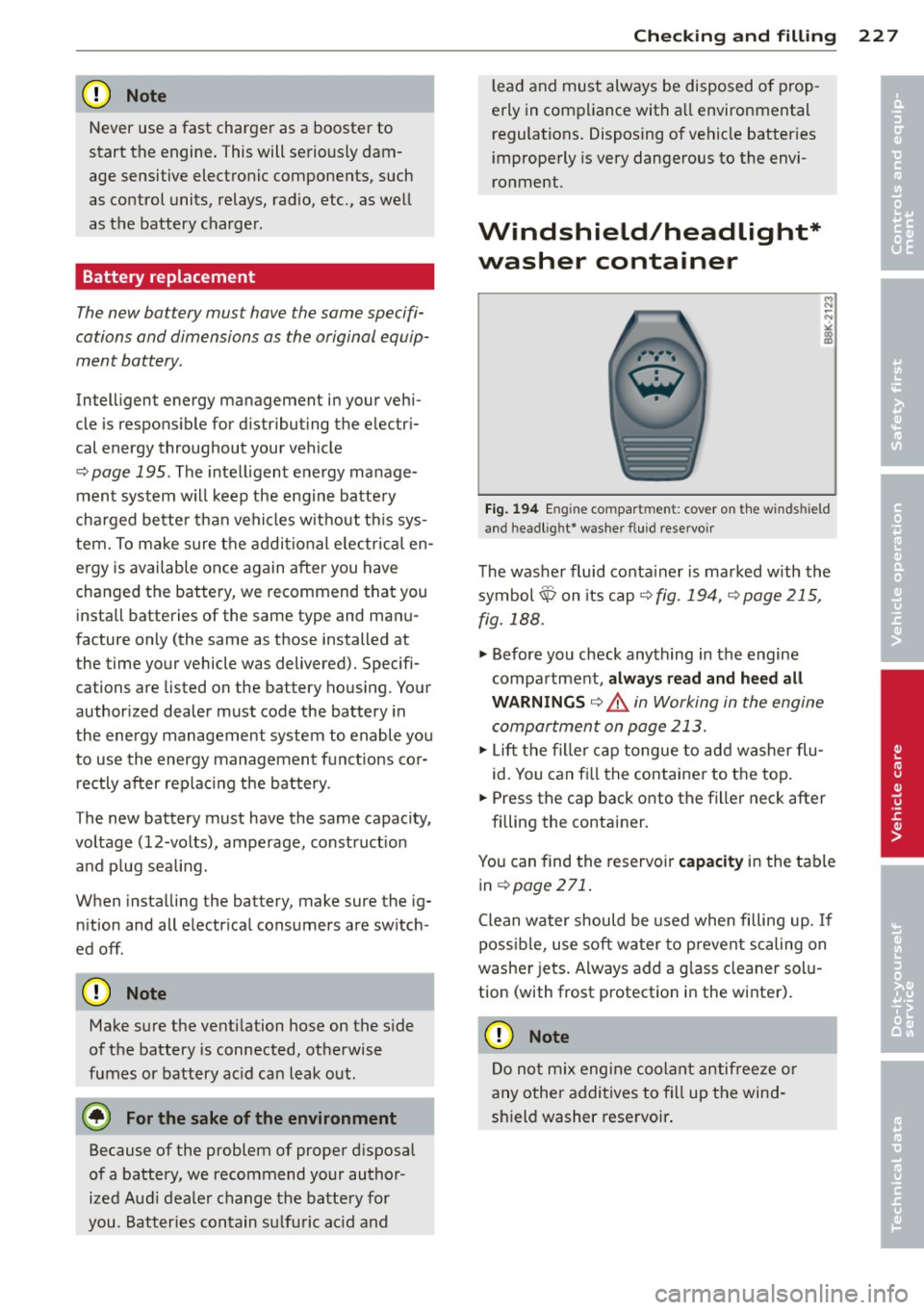
Fig. 194 Engine compart ment: cover on th e windshield
and headl ig ht* washer fluid reservo ir
The washer fluid conta iner is marked w ith the
symbol~ on its cap
c::> fig. 194, c::>page 215,
fig. 188.
.,. Before you check anything in the engine
compartment, always read and heed all
WARNINGS c::> &. in Working in the engine
compartment on page 213.
.. Lift the filler cap tongue to add washer flu
id. You can f ill the container to the top .
.. Press the cap back onto the fi ller neck after
filling the container.
You can find the reservoir
capacity in the table
in
c::> page 271.
Clean water should be used when filling up. If
possible, use soft water to prevent scaling on
washer jets. Always add a g lass cleaner solu
tion (with frost protection in the winter).
([) Note
Do not mix engine coolant antifreeze or
any other additives to fill up the wind
shield washer reservoir .
•
•
Page 262 of 292
260 Fuses and bulbs
Fuses and bulbs
Fuses
Replacing fuses
Fuses that have blown will have metal strips
that have burned through.
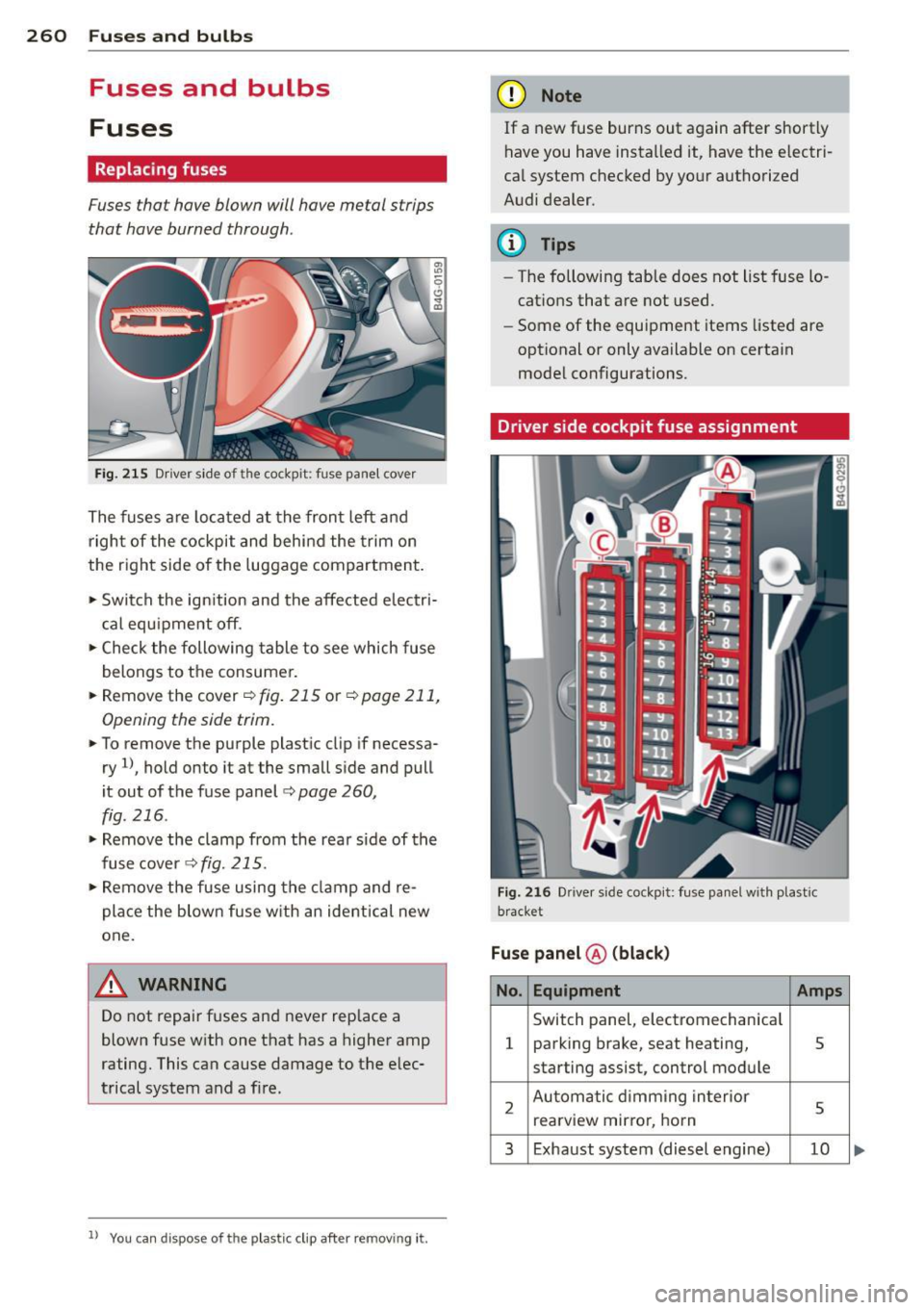
Fig. 215 Driver side of the cockpit: fuse panel cover
The fuses are located at the front left and
right of the cockpit and behind the trim on
the right side of the luggage compartment.
• Switch the ign ition and the affected electri
cal equ ipment off.
• Check the following table to see which fuse
belongs to the consumer.
• Remove the cover ¢
fig. 215 or¢ page 211,
Opening the side trim.
• To remove the purple plastic clip if necessa
ry
ll, hold onto it at the small side and pull
it out of the fuse panel
c:> page 260,
fig. 216 .
• Remove the clamp from the rear s ide of the
fusecover <>fig.
215.
• Remove the fuse using the clamp and re
pla ce the blown fuse w ith an ident ical new
one.
A WARNING
Do not repair fuses and never replace a
blown fuse with one that has a higher amp
rating. This can cause damage to the elec
trical system and a fire.
ll You can dis pose of the plastic clip after re moving it.
(D Note
If a new fuse burns out again after shortly
have you have installed it, have the electri
cal system checked by your authorized
Audi dealer.
(D Tips
-The following table does not list fuse lo
cations that are not used.
- Some of the equipment items listed are
optional or only available on certain
model configurations.
Driver side cockpit fuse assignment
Fig. 216 Dr ive r side cockpit: fuse panel with plastic
bracket
Fuse panel ® (black)
No. Equipment Amps
Switch panel, electromechanical
1 parking brake, seat heating, 5
starting assist, control module
2 Automatic dimming interior
5 rearview mirro r, horn
3 Exhaust system (diesel engine) 10