2014 AUDI Q5 lock
[x] Cancel search: lockPage 228 of 316

226 Fuel suppl y and filli ng your fu el t ank
enter the exhaust system and damage the
catalytic converter.
Refuelling
Fig. 190 Righ t rear ve hicle si de: Opening t he fuel filler
fl ap
Fig . 191 Fu el filler fla p w ith attached fuel cap
When activating the central locking, the fuel
filler flap is automatically unlocked or locked.
Refuel the vehicle with the ign ition turned
off .
Tak ing th e fu el cap off
• Press the Left side of the fue l filler flap to
open it ¢
fig. 190 -arrow-.
.. Unscrew fuel cap counter-clockwise and
hang it on the fuel filler flap ¢
fig. 191.
.. Check the Label on the inside of the fuel fill
er flap to determine if the vehicle must be
fueled with gasoline or diesel fuel.
Ref uelling pr ocedu re
.. Insert the fue l no zzle from the gasoline
pump into the fuel filler neck as far as it will
go .
.. Select a medium refuelling rate so that the
nozzle switches off automatically when the
tan k is full .
Putting the fu el cap b ack o n
• After f illing your tank, twist the fuel cap
clockwise as far as it will go .
.. Close the fue l filler flap.
T o avoid fuel spill ing o r evaporating from the
fuel tank always close fuel cap p roperly and
completely . An improperly closed fuel filler
cap may a lso ca use the
MIL Lamp ¢ page 26
to come on (on ly vehicles with gasoline en
gine).
A WARNING
-Improper refueling or handling of fuel can
cause fire, explosion and severe burns .
- Fuel is highly flammable and can cause
severe bu rns and other injur ies.
- Failure to shut the engine off while refu
eling and/or to insert the pump nozzle
fully into the fuel filler neck could cause
fuel to spray out of filler neck or to over
flow. Fue l spray and overflowing fuel can
cause a fire .
- Never use a cellular telephone while re
fue ling. The electromagnet ic rad iat ion
can cause spa rks that can ignite f uel va
pors and cause a fire .
- Never get back into your vehicle whi le re
fue ling.
If in exceptional circ umstances
you must get back in your vehicle while
refueling, make certain that you close
the door and touch metal to discharge
static e lectricity before touching the fill
er nozzle again . Static e lectr icity can
cause sparks that can ignite fuel vapors
released du ring refueling .
- Never smoke or have an open flame any
where in or near your vehicle when refu eling or filling a portable fuel conta iner.
- For your safety, we strongly recommend
that you do not travel with a portable
fuel conta iner in your vehicle . The con
tainer, fu ll o r empty may leak and could
cause a fire, especially i n a c rash.
- If , under exceptional c ircumstances, you
must transport a portab le fuel conta iner,
p lease observe the following: .,.
Page 229 of 316

-Never f ill a portable fuel container
while it is anywhere in or on the vehicle
(for example, in the luggage compart
ment, or on the trunk). Static electrici
ty can bu ild up while filling and can ig
nite fuel vapors causing a fire .
- Always place a portable fuel container on the ground before filling.
- Always keep the filler nozzle complete
ly inside the portable container before
and during filling.
- If fill ing a portable container made of
metal, the filler nozzle must always be
in contact with the container. This will
help prevent static electricity from dis
charging and cause a fire.
- Never spill fuel inside the vehicle or
luggage compartment. Fuel vapors are
h ig hly flammable.
- Always observe local and state/provin
cial laws regarding the use, storage
and transportation of fuel containers.
- Make certain the fuel container meets
industry standards (ANSI/ ASTM
F852-86).
(D Note
If any fuel has spilled onto the car, it
should be removed immediate ly to prevent
damage to the paint.
@ For the sake of the environment
As soon as the correctly operated nozzle
switches off automatically for the first
time, the tank is full. Do not try to add
more fue l because fuel may spill out. In
addition, the expansion space in the fuel
tank will be fi lled -causing the fue l to
overflow when it becomes warm and pol
lute the environment.
@ Tips
-Running your engine while refuelling
may cause vapors to escape or even
cause fuel to spill out of the tank. This
would then shut off the fuel nozzle be
fore the tank is full.
Fuel su ppl y and filling your fuel ta nk 22 7
-Do not refuel your vehicle with the igni
tion turned on . The fuel gauge may oth
erwise not indicate the correct fuel level
after refuelling.
- Diesel vehicles* are equipped with a die
sel misfueling protector. It allows the
vehicle to be fueled only with a diesel
fuel pump nozzle. A worn or damaged nozzle or a nozzle that is too small may
not be able to open the diesel misfueling
protector. If this is the case, try tu rning
the nozzle before insert ing it in the fuel
filler neck, use a different fuel pump or
see your authorized Audi dea ler
or au
thorized repair facility for assistance.
- The fuel filler flap of your vehicle is not
locked when you lock the vehicle from
the inside.
Unlocking the fuel filler flap by hand
You can open the fuel filler flap by hand if the
power locking system should fail.
Fig. 192 Luggage compartme nt: Eme rge ncy opening
of fuel filler f lap
The emergency opening mechanism is located
behind the right side trim panel in the lug
gage compartment.
.,. Open the r ight side trim panel.
• Loosen the st rap from its bracket and pull
on it¢
fig. 192. Now you can open the fuel
filler flap as usual.
Page 231 of 316

f-i Filling incorrectly
If the Ad Blue tank was filled with a diffe rent
f luid than Ad Blue and the system detects that
it is i ncorrect, a message wi ll appear.
Ad Blue -I' 600 mi (1000 km) Ad Blue :
Fault! No re start in 600 miles (1000 km)!
See owne r's manual
This message appea rs when it is only possib le
to drive the dist ance indicated in the dr iver in
form ation system. Drive to the neares t qua li
fied workshop to have the mal function re
pa ired. Otherwise the engine wi ll not start
again if you stop it once the distance indicated
has been driven.
AdBlue: Sy stem
fault. No restart ! See owner's manual
This message appea rs if the sys tem de te cts i t
was fil le d in cor re ctl y. Drive immed iate ly to
t he nearest qualified workshop to have t he
malfunct ion repaired . Otherwise you will not
be ab le to start the engine aga in once you
stop it.
Filling AdBlue
Ap plies to vehicles : wit h diesel e ngi ne
A special refill bottle must be used to fill the
AdBlue.
Fi g. 194 Right rea r ve hicle s ide: re m ov ing the Ad B lu e
cap
Fu el suppl y and filli ng your fuel t ank 229
Fig . 195 Ad B lue filler tube: inse rting th e refill bottle
The Ad Blue filler tube is located near the d ie
sel filler tube . Always add 1 ga llon (3.8 liters)
of Ad B lue (two bott les). This is the minim um
amount required to e nsur e the system de tects
t he re fill ing and to star t the engine . The A d Bl
u e tank capaci ty is approx imately 6 g allons
(23 lite rs) .
Opening the filler tube and adding
Ad Blue
Req uirement: The request to add Ad Bl ue must
appear in the instrument cluster display.
.,. Switch t he ignitio n off.
.,. Open the tank cove r
c::> page 226 .
.,. Tur n the cap co unterclockwise wi th t he lug
w rench from the vehicle too l kit to remove it
c::>fig . 194 .
... Remove the cap from the refill bottle.
... Posit ion the refill bottle o n the filler tube
and turn the bottle clockwise until it stops
turn ing
(D c::> fig. 195 .
.,. Press ligh tly aga ins t the bottom of the bot
t le @ to empty i t. Continue press ing the
bo ttom of the bottle unt il it i s empty or un
t il flui d stops flow ing in to the tank .
... Tu rn the bot tle to the left w ithout pressing
on the bottom.
Closing the filler tube
.,. Tur n the c ap clockwise on the fille r tub e
w it h t he l ug wrench un til you hear it ti gh ten
comp letely .
... Close the tank cover .
After filling
The vehicle must be d riven. The system may
ta ke u p to two m inu tes to detect t hat t he
Ad Bl ue has been f illed . .,..
Page 233 of 316

Checking and filling Engine hood
Releasing the engine hood
The engine hood is released from inside the
vehicle .
Fig. 196 Dr iver's side footwell: engin e hood release
lever
"' Open the driver's door .
"' Pull the release lever on the left under the
instrument panel
i=> fig. 196 in the d irection
of the arrow .
The hood pops up slightly under spring pres
sure.
Opening the engine hood
F ig . 197 Release lever under the engine hood
Before opening the engine hood, make sure
that the windshield wipers are flat against the
windshie ld. Otherwise, they could damage the
paint on the hood.
"' Pull up on the release under the hood
r::!> fig . 197 . This releases the catch.
"' Open the hood all the way
i=> .&,.
Checkin g and fillin g 231
A WARNING
Hot engine coolant can burn you.
- To reduce the risk of being burned, never
open the hood if you see or hear steam
or coolant escaping from the eng ine
compartment . Wait unt il no steam or
coolant can be seen or heard before care
fu lly opening the hood.
Closing the engine hood
"' Pull the hood down until the pressure from
the struts is reduced.
"' Let the hood
drop down and latch in p lace.
Do not try to push it shut; it may fail to en
gage
c;, .&, .
A WARNING
--
A hood that is not completely latched
could fly up and block your view while dr iv
ing.
- When you close the engine hood, check it
to make sure the safety catch has proper
ly engaged. The hood should be flush
with the surround ing vehicle body parts.
- If you notice while driv ing that the hood
is not secured properly, stop at once and
close it .
Working in the engine compartment
Be especially careful whenever you work in
the engine compartment.
Whenever yo u must pe rform any w ork in the
e n g ine com pa rt ment, for e xample ch ecki ng
and filling different fluids, th ere is a risk of
injury , burn s and accid ent s. T o pr eve nt per
so nal injury alwa ys obs erve the foll owing
WARNINGS . The en gine c ompa rtment of an y
vehicl e is a hazardou s are a
c;, Lh,.
A WARNING ~
To help avoid injury, be fo re you check any
thing under the hood:
- Turn off the engine.
- Remove the ignition key.
Page 241 of 316
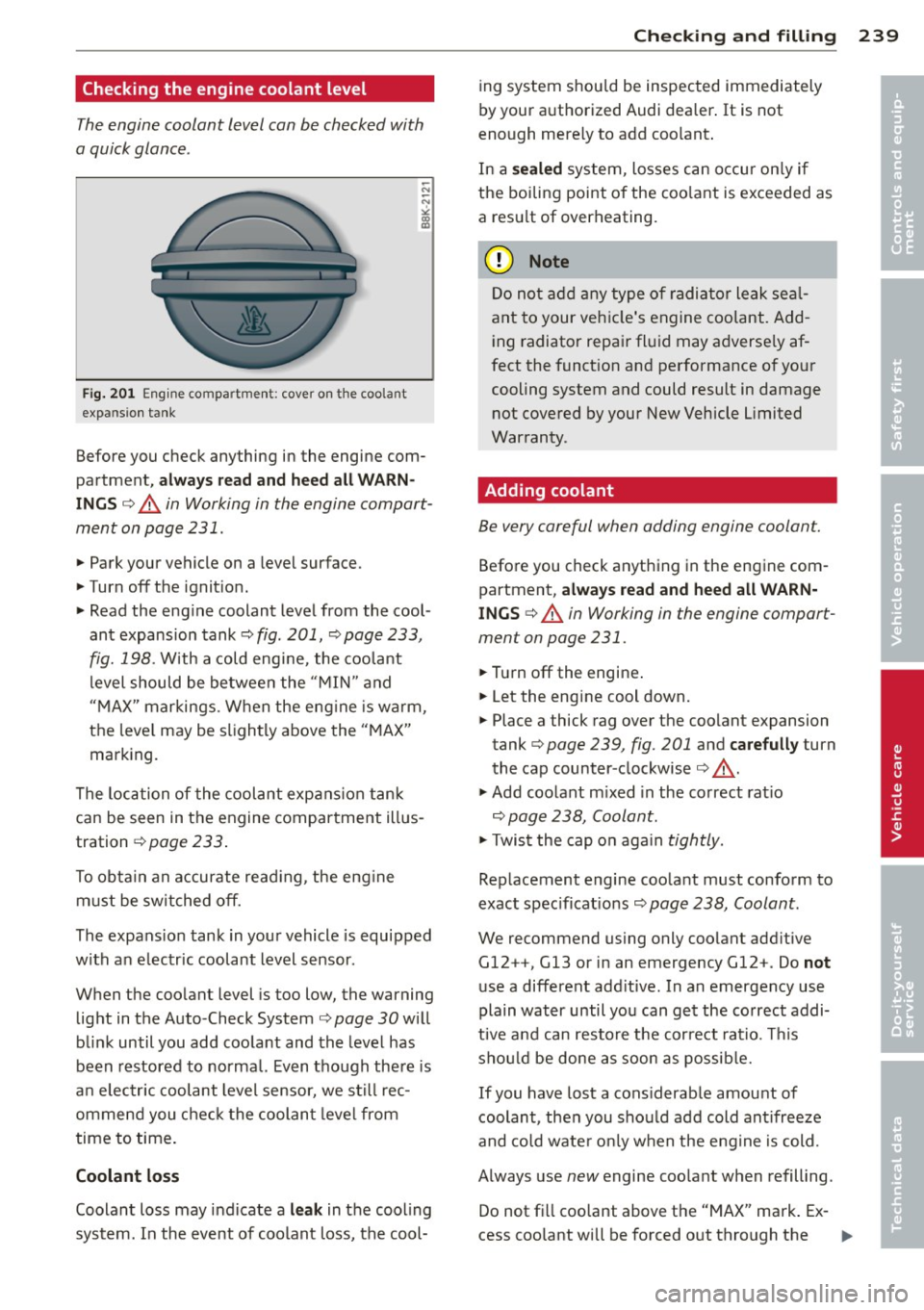
Checking the engine coolant level
The engine coolant level can be checked with
a quick glance .
Fig. 201 Eng ine co mpa rtme nt: cove r on the coola nt
exp ansion tank
Before you check anything in the engine com
partment,
a lway s re ad and he ed all WARN
INGS ¢ A in Working in the engine compart
ment on page 231 .
.,. Park your vehicle on a level surface.
.,. Turn off t he ignit ion.
.,. Read the eng ine coolant level from the cool
ant expansion tank¢ fig . 201, ¢ page 233,
fig. 198 . With a cold eng ine , the coola nt
level should be between the "M IN " and
"MAX" markings . W hen the eng ine is warm,
the leve l may be slightly above the "MAX"
marking.
The location of the coolant expans ion tank
can be seen in the engine compartment illus
tration ¢page 233.
To obtain an accurate read ing, the eng ine
must be switched off.
The expans ion tank in your vehicle is equipped
with an e lectr ic coolant level sensor .
When the coo lant level is too low, the warning
light in the Auto -Check System ¢ page 30 will
blink until you add coo lant and the level has
been restored to normal. Even though there is
a n elec tric coolant leve l sensor, we s till rec
ommend you chec k the coolant leve l from
time to time .
Coolant loss
Coolant loss may indicate a leak in the cool ing
system. In the event of coolant loss, the cool-
Checkin g and fillin g 239
ing system shou ld be inspected immediately
by your authorized Audi dealer . It is not
eno ugh merely to add coo lant .
In a
s ealed system, losses can occu r on ly if
the boiling point of the coo lant is exceeded as
a resu lt of overheating.
(D Note
Do not a dd any type o f radiator leak se al
ant to your veh icle's engine coo lant. Add
ing radiator repa ir flui d may adverse ly af
fect the funct ion and performance of yo ur
cooling system and could result in damage not covered by your New Vehicle Limited
Warranty.
Adding coolant
Be very careful when adding engine coolant.
Before you check anything in the engine com
partment,
always read and heed alt WARN
INGS ¢ A in Working in the engine compart
ment on page 231 .
.,. Turn off the engine .
.,. Let the engine cool down.
.,. Place a thick rag over the coo lant expansion
tank ¢ page 239, fig. 201 and
carefully turn
the cap counter -clockwise ¢
_& .
.,. Add coolant m ixed in the co rrect rat io
¢ page 238, Coolant.
.,. Twis t the cap o n aga in tightly.
Rep lacement engine coo lant must conform to
exact spec ificat ions ¢ page 238, Coolant.
We recommend using only coolant add itive
Gl2 ++, Gl3 or in an emergency Gl2 +. Do not
use a different add itive . In an emergency use
plain water until you can get the correct addi
tive and can restore t he cor rect ratio . Th is
sho uld be done as soon as possib le.
If you have lost a cons iderab le amount of
coolant, then you sho uld add cold ant ifreeze
and co ld wate r on ly w hen the eng ine is cold.
Always use new engine coo lant when refill ing .
Do not fi ll coo lant above the "MAX" mark. Ex
cess coolant will be forced o ut through the
•
•
Page 242 of 316

24 0 Ch eck ing and filling
pressure relief valve in the cap when the en
gine becomes hot.
A WARNING
- The coo ling system is under pressure and
can get very hot. Reduce the risk of
sca lding from hot coolant by following
these steps.
- Turn off the eng ine and a llow it to cool
down.
- Protect your face, hands and arms from escap ing fl uid and steam by cover ing
the cap with a large, thick rag.
- T urn the cap slowly and very carefully
in a counter-clockwise direction while
applying light, downward pressure on
the top of the cap.
- To avo id being burned, do not sp ill an
tifreeze or coolant on the exhaust sys
tem or hot engine parts. Under certain
conditions, the ethylene glyco l in en
g ine coolant can catch fire.
- Antifreeze is poisonous. Always store an
t ifreeze in its or iginal container and well
out of the reach of children.
- If you drain the coolant, it must be caught and safely stored in a proper con
tainer clear ly marked "poison".
- Coolant pollutes the environment and
could cause an engine fire. Excess coo l
ant will be forced out through the pres
sure re lief valve in the cap when the en
gine becomes hot.
- If, in an emergency, only water can be
added, the correct ratio between water
and antifreeze~
page 238 must be re
stored as soon as possib le.
@ For the sake of the environment
Dra ined coolant should not be reused. Al
ways dispose of used coolant while observ
ing all environmental regulations.
Radiator fan
The radiator fan switches on automatically by
itself.
The radiator fan is driven by the engine via the
V-belt. The viscous clutch regulates the speed
of the fan according to the temperature of the
coolant .
An auxiliary electric radiator fan* sw itches on
and off depending on coolant temperature
and other vehicle operat ing condit ions.
After you switch the engine off, the aux iliary
fan can continue running for up to 10 m inutes
- even w ith the ignition off. It can even switc h
on again later by itself
c> &. , if
- the temperature of the engine coo lant r ises
due to the heat build-up from the engine in
the engine compartment, or
- the engine compartment heats up because the vehicle is parked in intense sunlight.
A WARNING
- To reduce the risk of personal injury nev
er touch the radiator fan .
- The auxiliary electric fan is temperature
controlled and can sw itch on suddenly
even when the engine is not running.
- The auxiliary radiator fan sw itches on au
tomatically when the engine coo lant
reaches a certain temperature and w ill
con tinue to run until the coolant tempe r
a ture drops.
Page 243 of 316

Brake fluid
Checking brake fluid level
The brake fluid level can be checked with a
quick glance.
N
N
;:;;
" 03
"'
Fi g. 202 Eng ine compartment: cover on the brake flu id
reservoir
Before you check anything in the engine com
partment,
a lwa ys read and heed all WARN
ING S c:> .&.. in Working in the engine compart
ment on page 231 .
~ Read the brake fluid level from the brake
fluid reservoir
c:> fig. 202, <=> page 233,
fig . 198 .
The brake flu id level must be be
tween the "MIN" and "MAX" markings.
The brake fluid reservoir is located at the rear
partition of the engine compartment on the
left side
c::> page 2 33 .
The fluid level may drop slightly after some
time due to the automatic adjustment of the
brake pads . This is not cause for alarm .
If the brake fluid level falls
considerably be
low the "MIN" mark, the brake warning/indi
cator light (U.S. models:~, Canadian
models: .) will come on
c> page 18 and
c::> page 29 . Do not continue to operate the ve
h icle. The complete brake system should be
thoroughly checked by an authorized Aud i
dealer o r qualified workshop and the cause
corrected.
If the brake fluid level is too low,
the brake warning/indicator light will illum i
nate . Contact an authorized Audi dealer
im
m ediatel y.
Checkin g and fillin g 241
Changing brake fluid
Have the brake fluid changed by on experi
enced technician .
Brake fluid absorbs moisture from the air. If
the water content in the brake fluid is too
high, corrosion in the brake system may result
after a period of time . The boiling point of the
brake flu id will also dec rease considerably and
decrease braking pe rformance.
Therefore, the brake fluid must be changed
every two years. Always use new brake flu id
which conforms to Federal Motor Vehicle
Standard "F MVSS 116 DOT 4".
The brake fluid reservo ir can be d iff icult to
reach, the refore, we recommend that you
have the brake fluid changed by your author
i zed
Audi d ealer. Your dealer has t he correct
tools, the right brake fl uid and the know-how
to do this for you .
A WARNING -.
-Brake fluid is poisonous . It must be stor
ed only in the closed original container
out of the reach of children!
- Brake failure can resu lt from o ld or inap
propriate brake f luid. Observe these pre
cautions:
- Use only brake fluid that meets SAE
spe cificat ion
J 1 7 03 and conforms to
Federa l Moto r Ve hicl e Standard 116.
Always check with yo ur authorized Audi
dealer to make sure yo u are using the
correct bra ke fluid. The correct type of
brake f luid is also indicated on the
brake f luid reservoir.
- The brake fluid must be new. Heavy use
of the brakes can cause a vapor lock if
the brake fluid is left in the system too
l ong . This can seriously affect the effi
c iency of the brakes as well as your
safety. Th is cou ld resu lt in an accident.
(D Note
Brake fluid will damage the paint of your
vehicle .
Page 256 of 316

254 Tire s and wheel s
forget the spare tire. If the pressure in any tire
is too h igh when the tire is "cold," let air out
of the tire slowly with the edge of the tire
gauge and keep checking the pressure until
you reach the pressure that is correct for the
load (passengers and luggage) and kind of
driving you plan to do .
If the pressure in any tire is too low, note the
difference between the pressure in the cold
tire and the pressure you need and add the a ir
that you need to reach the correct pressure for
the vehicle load (passengers and luggage) for
the tires on your veh icle as listed on the on
your veh icle and in this manua l and the kind
of dr iving you p lan to do .
Never exceed th e ma ximum inflati on pres
s ur e list e d on th e tir e s idewall f or an y re a
so n.
Remembe r that the vehicle manufacturer, not
the tire manufactu rer , determ ines the correct
tire pressure for the t ires on your vehicle .
It is important to check the tire pressure when
the tires a re cold .
- Read the requ ired t ire pre ssure from the tire
pressure label. The tire pressure label is lo
cated on the driver's side 8 -p ill ar . The tire
pressure label lists the recommended cold
t ire inflat ion pressures for the vehicle at its
maximum capacity we ight a nd the tires that
were on your vehicle at the time it was man
u factured. For recommended tire press ures
for normal load conditions, please see chap
ter
¢ page 251 .
-Turn the valve stem cap counter-clockwise
to remove it from the tire valve.
- Place the air pressure gauge on the valve.
- The tire pressures should only be chec ked
and adjus ted when the tires are cold . The
s li ghtly raised pressures of warm tires must
not be reduced .
- Adjust the tire pressure to the load you are
carrying .
- Re insta ll the va lve stem cap o n the valve .
When should I check th e tir e pre ssure ?
The correct tire pressu re is especially impor
tant at high speeds. The pressu re should
therefore be checked at least once a month
and always before starting a jo urney . Do not
forget to check the tire pressure for the spare
wheel.
When should I adju st the ti re pre ssures?
Adjust the tire pressure to the load you are
carrying . After changing a whee l
or replacing
whee ls you have to adjust the tir e pressur es
on all wheels. In addition, you m ust then
store the new tire pressures in the tire pres
sure monitoring system*¢
page 267.
A WARNING
-Incorrect tire pressures and/or underinfla-
tion can lead sudden tire fa ilure, loss of
control, collision, se rious pe rsonal injury
or even death.
- When the warn ing symbol
[DJ appears in
the instrument cluster, stop and inspect
the t ires.
- Inco rrect tire pressure and/or underinfla
tion can cause increased tire wea r and
can affect the handling of the vehicle and
stopping ability.
- Incorrec t tire pressures and/or underin
flation can a lso lead to s udden t ire fail
ure, including a blowout and sudden de
flation, ca using loss of vehicle contro l.
- The driver is responsible for the correct
tire pressures for all tires on the vehicle .
The applicable pressure values are locat
ed on a sticker on the dr iver's s ide 8-pil
lar.
- On ly when all tires on the vehicle are fil
led to the correct pressure, the t ire pres
sure mon itor ing system* can work cor
rectly .
- The use of incorrect tire pressure values
can lead to acc idents or other damage .
Therefore it is essential that the drive r
observe the spec ified t ire pressure val ues
for the tires and the correct pressures for
II),