2014 AUDI A5 COUPE instrument cluster
[x] Cancel search: instrument clusterPage 88 of 286

86 Transmis sion
illuminates and a driver message ap
pears
¢ page 88 when the clutch is
overloaded.
- If the engine must remain running, never
have any driving position engaged when
checking under the hood. Make sure the
selector lever has securely engaged and
is locked in P with the parking brake set
¢ page 206. Otherwise, any increase in
engine speed may set the vehicle in mo
tion, even with the park ing brake ap
plied.
(D Note
- When stopping on an incline, do not try
to hold the vehicle in place by pressing
the accelerator pedal while a driving gear
is selected. This can cause the transmis
sion to overheat and can damage it. Acti
vate the parking brake or press the brake
pedal to prevent the vehicle from rolling.
- Allowing the vehicle to roll when the en
gine is stopped and the selector lever is
in N will damage the transmission be
cause it is not lubricated under those cir
cumstances.
@ Tips
For safety reasons, the park ing brake is re
leased automatically only when the driv
er's safety belt is engaged in the buckle.
Hill descent control
Applies to vehicles: with S tronic/tiptronic
The hill descent control system assists the
driver when driving down declines.
Hill descent control is activated when these
lector lever is in D/S and you press the brake
pedal. The transmi ssion automatically selects
a gear that is suitable for the incline. Hill de
scent control tries to maintain the speed ach ieved at the time of braking, within physical
and technical limitations. It may st ill be nec
essary to adjust the speed with the brakes. Hill descent contro
l switches off once the de
cline levels out or you press the accelerator
pedal.
On vehicles with the cruise control system*
¢ page 80, hill descent control is also activat
ed when the speed is set.
A WARNING
--
Hill descent control cannot overcome
physical limitations, so it may not be able
to maintain a constant speed under all
conditions. Always be ready to apply the brakes .
Manual shift program
Applies to vehicles: with S tronic/tiptron ic
Using the manual shift program you can
manually select gears.
Fig. 86 Center console: shift ing the gears manually
Fig. 87 Steering whee l: Shift butto ns~
Gear selection with selector lever
L'> N ... "!
"' m a,
N
--N ,;,
gi
The tiptronic mode can be selected either with
the vehicle stationary or on the move.
.,. Push the selector lever to the right from 0/
S. An M appears in the instrument cluster
display as soon as the transmission has
shifted .
Page 97 of 286
Audi adapt ive crui se c ontrol an d bra kin g guard 95
Setting the distance
Applies to vehicles: with Audi adaptive cruise control
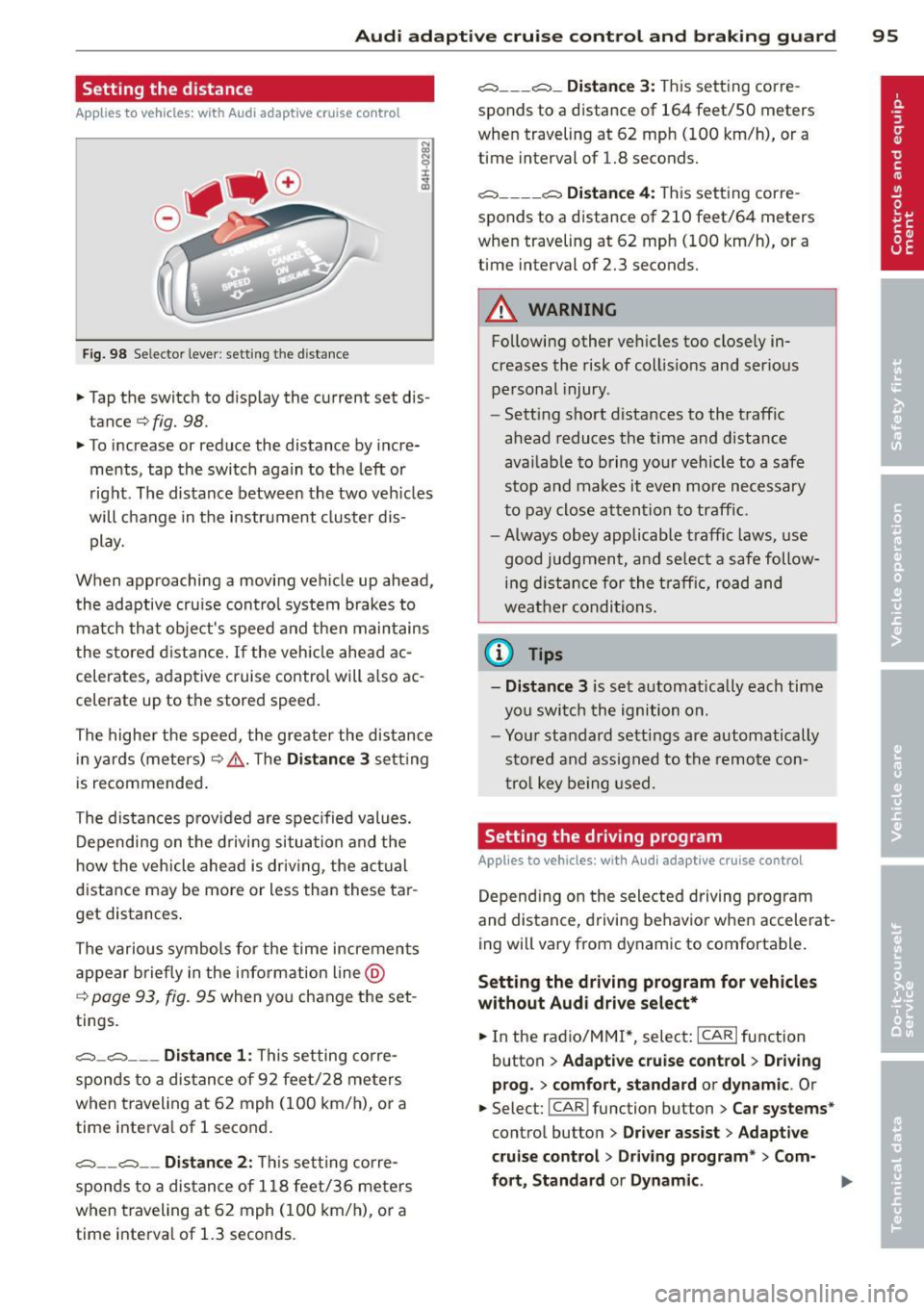
Fig. 98 Selector lever: setting the distance
• Tap the switch to display the current set dis
tance¢
fig. 98.
• To increase or reduce the distance by incre
ments, tap the switch again to the left or
right. The distance between the two veh icles
will change in the instrument cluster dis play.
When approaching a moving veh icle up ahead,
the adaptive cru ise contro l system brakes to
match that object's speed and then maintains
the stored d ist ance.
If the veh icle ahead ac
celerates, adaptive cruise control will a lso ac
celerate up to the stored speed.
The highe r the speed, the greate r the distance
in yards (meters)¢ .&,.. T he
Dis tanc e 3 setting
is recommended.
The distances prov ided are spec ified values.
Depending on the drivi ng situation and the
h ow the veh icle ahead is driv ing, the actual
distance may be more or less than these tar
get distances .
The various symbols for the time increments
appear briefly in the information line @
¢
page 93, fig. 95 when you change the set
tings.
c::::,_c::::, ___ Distance 1: This setting corre-
sponds to a distance of 92 feet/28 me ters
when traveling at 62 mph (100 km/h), or a
time interva l of 1 second.
c::::, __ c::::, __ Distan ce 2 : This setting corre
sponds to a distance of 118 feet/36 meters
when traveling at 62 mph (100 km/h), or a
time interva l of 1.3 seconds .
c::::, ___ c::::,_ Distanc e 3: This setting corre-
sponds to a distance of 164 feet/SO meters
when traveling at 62 mph (100 km/h), or a
time interval of 1.8 seconds.
c::::, ___ _ c::::, Di stanc e 4: This setting corre-
sponds to a distance of 210 feet/64 meters
when traveling at 62 mph (100 km/h), or a
time interval of 2.3 seconds.
A WARNING
Following other vehicles too closely in
creases the risk of coll is ions and ser ious
personal injury .
- Sett ing short distances to the traffic
ahead reduces the time and distance
available to bring your vehicle to a safe
stop and makes it even more necessary
to pay close atten tion to traffic.
- Always obey applicab le traffic laws, use
good judgment, and se lect a safe follow
ing d istance for the t raff ic, road and
weather conditions .
@ Tips
- Di stanc e 3
is set automatically each time
yo u swi tch the ignition on.
- You r standard settings are automatically
stored and assigned to the remote con
t ro l key be ing used.
Setting the driving program
Applies to vehicles: with Audi adaptive cruise control
Depend ing on the selected driving program
and distance, driving behavior when accelerat
ing will vary from dynamic to comfortable.
Setting the d riv ing program f or vehicles
without Aud i dri ve sel ec t*
• In the radio/MM!*, select: !CARI function
button
> Ad apt ive crui se control > Drivin g
p rog. > comfort, st a nd ard or dyna m ic.
Or
• Select: !CAR I function button > Car s yste m s*
control button > Dr iver a ssist > Adapti ve
crui se control> Driv ing program " > Com-
f o rt , St andard or Dynamic .
IJI-
Page 105 of 286

@ Tips
-Side assist is not active whi le you are
making the adjustment.
- Your settings are automatica lly stored
and assigned to the remote control key
being used.
Driver messages
Applies to vehicles: with Audi side assist
If s ide ass ist switches off by itself, the LED in
the button turns off and a message will ap
pear in the instrument cluster display:
Audi side assist unavailable: Sensors blocked
The radar sensors' vision is affected. Do not
cover the area in front of the sensors with bike
wheels, stickers, dirt or other objects. Clean
the area in front of the sensors, if necessary
c;.page 101, fig. 104.
Audi side assist: Currently unavailable
Side assist cannot be switched on temporarily
because there is a malfunc tion (for example,
the battery charge leve l may be too low) .
Audi side assist: System fault!
The system cannot guara ntee that it will de
tect veh icles correctly and it is switched off .
The sensors have been displaced or are faulty.
H ave the system checked by an authorized
Aud i dealer or authorized Aud i Service Facility
soon.
Audi side assist: Unavailable when towing
Side assist sw itches off automatically when a
factory- insta lled trailer h itch is connected to
the electrical connector on the trailer. There is
no guarantee the system will switch off when
usi ng a retrofitted trailer hitch. Do not use
side assist when towing a trailer .
Audi side assist 103
Page 107 of 286

-For vehicles with an automatic transmis
sion, selecting the
Dynamic mode re
su lts in sporty shifting characteristics .
The
5 gear posit ion engages automati
cally.
- In vehicles that have dynamic steering*,
operating noise is heard when starting or
stopping the eng ine. Th is does not ind i
cate a problem .
Selecting the driving mode
Applies to vehicles: with Audi drive select
You con choose between Comfort, Auto, Dy
namic and Individual* modes.
drive I I fi el•ct _ ~-=
Fig. 106 Center console ; Con trol for Aud i dr ive se lect
Fig. 107 MMI *: Aud i drive select
Adjusting the Individual mode
Applies to vehicles: with MMI and Aud i d rive select
Audi drive select 105
.. To set the mode, press the 1.:il'.'l button
r=> fig. 106 multiple times until the desired
mode is displayed in the instrument cluster .
Or
.. In the MMI*, select: ICARlfunction button>
Comfort, Auto , Dynamic or Individual* .
In vehicles without the MMI*, the ~:/~c1 button
is found underneath the shift/selector lever.
You can change the driving mode when the ve
hicle is stationary or whi le driving.
If traffic
permits, after changing modes, briefly take
your foot off the accelerator pedal so that the recently selected mode is also activated for
the engine and transmission.
Comfort -provides a comfort-oriented vehicle
setup and is suited for long drives on high
ways.
Auto -provides an overall comfortable yet dy
namic driving feel and is suited for every day
u se.
Dynamic -gives the driver a sporty driving
feel and is suited to a sporty driving style .
Individual* -~ page 105.
& WARNING ~
Pay attention to traffic when operating
drive select to prevent potential risk of an
accident .
You con personally specify the vehicle setup in the MMI* .
.. Select the ICARI function button > Set indi
vidual
control button. Once you select the
menu, you will automatically drive in the
in
dividual
mode.
Systems Comfort
Engine/Transmission
ba lanced
Steering comfortable The
equipment in your vehicle will determine
which settings you can adjust. The following
table prov ides an overview of the characteris
tics of eac h driving mode .
Auto Dynamic
balanced spo
rty
balanced sporty
Page 141 of 286

Even though your vehicle is equipped with an
Advanced Airbag System, make certain that
all ch ildren, especially those 12 years and
younger, a lways ride in the back seat properly
restrained for their age and size. The airbag
on the passenger side makes the front seat a
potentially dangerous place for a child to ride.
The front seat is not the safest place for a
child in a forward-facing child safety seat.
It
can be a very dangerous place for an infant or
a child in a rearward-facing seat.
The Advanced Airbag System in your veh icle
has been certified to comply w ith the Requ ire
ments of United States Federa l Motor Vehicle
Safety Standard 208 as applicable at the time
your vehicle was manufactured.
The Standard requires the front ai rbag on the
passenger side to be turned off ("sup
p ressed") if a ch ild up to about one year of
age restrained in one of the rear-facing or for
ward -facing infant restraints listed in Federal
Motor Vehicle Safety Standard 208 with wh ich
the Advanced Airbag System in your vehicle
was certified has been installed on the front passenger seat . For a listing of the child re
straints that were used to certify compliance
with the US Safety Standard
Q page 163.
The PASSENGER AIR BAG OFF light in the in
strument panel tells you when the front Ad
vanced A irbag on the passenger side has bee n
turned off by the electronic control unit.
Each t ime you turn on the ignition, the
PAS
SENGER AIR BAG OFF
light will come on for a
few seconds and :
- will stay on if the front passenger seat is not
occupied,
- will stay on if there is a small child or child restraint on the front passenger seat,
- will go off if the front passenger seat is oc
cupied by an adult as registered by the
weight-sensing mat
Q page 147, Monitor
ing the Advanced Airbag System .
The PASSENGER AIR BAG OFF light comes on
when the control un it detects a total weight
on the front passenger seat that requires the
front airbag to be turned off.
Airbag system 139
If the total weight on the front passenger
seat is more than that of a typical 1 year-o ld
c hild but less than the weight of a small
adult, the front airbag on the passenger side
can deploy (the
PASSENGER AIR BAG OFF
light does not come on). If the PASSENGER
AIR BAG OFF
light does not come on, the
front a irbag on the passenger side has not
been turned off by the electronic con trol unit
and can deploy if the contr ol unit senses an
impact that meets the cond itions stored in its
memory .
For example, the airbag may deploy if:
-a small ch ild that is heav ie r than a typical 1
year-old ch ild is o n the front passenger seat
(regard less of whether the child is in one of
the child safety seats listed
Q page 163), or
- a child who has outgrown child restraints is
on the front passenger seat.
If the front passenger airbag is turned off, the
PASSENGER AIR BAG OFF light comes on in
the instrument cluster and stays on.
The front airbag on the passenger side may
not deploy (the PASSENGER AIR BAG OFF
light does not illum inate and stay lit) even if a
small adult or teenager, or a passenger who is
not sitting uprig ht with their back against a
non-reclined backrest w ith their feet on the
vehicle floor in front of the seat is on the front
passenger seat
~ page 120, Proper seating
position for the driver.
If the front passenger airbag deploys, the
Federal Standard requires the airbag to meet
the "low risk" deployment criteria to reduce
the risk of injury thro ugh interaction with the
airbag . "Low risk" deployment occ urs in those
crashes that take place at lower dece lerat ions
as defined in the electronic control unit
Q page 148, PASSENGER AIR BAG OFF light .
Always remember, a child safety seat or infant
carr ier installed on the front seat may be
struck and knocked out of posit ion by the rap
idly inflating passenger's airbag in a frontal
collision . The airbag could greatly reduce the
effectiveness of the child restraint and even
seriously injure the child during inflation. •
•
Page 146 of 286
144 Airbag sys tem
-Always move the passenger seat into its
rearmost position in the seat's fore and
aft adjustment range, as far away from
the a irbag as poss ible, before insta lling
the forward-facing child restraint. The backrest must be adjusted to an upr ight
posit io n.
- Make sure that the
PASSENGER AIR BAG
OFF
light comes on and stays on all the
t ime w henever the ignition is switched
on.
Advanced Airbag System components
The fron t passenger sea t in your vehicle h as a
lot of very important par ts of the Advanced
Airbag System in it. These parts include t he
weight -sensing mat, sensors, wiring, brack
ets, and more. The function of the system in
the front passenger seat is checked by the
e lectronic control u nit when the ignit ion is on.
The control unit mo nitors the Advanced Air
bag System and turns the airbag indicator
l ight on when a ma lfunction in t he system
components is detected. The func tion of the
a ir bag ind icator light is described in greater
detai l be low . Because the front passenger
seat contains important parts of the Ad
vanced A irbag System, you m ust take care to
prevent it from be ing damaged. Damage to
the seat may prevent the Advanced Airbag for
the front passenger seat from doing its job in
a crash .
The front Advanced Airb ag Sy stem
consists of the following:
- Crash sensors in the front of the veh icle that
measure veh icle acceleration/deceleration
to provide information to the Advanced Air
bag System abou t the seve rity of the crash.
- An electron ic co ntrol unit, with integ rated
crash sensors for front and side impacts .
T he cont ro l unit "dec ides " w het her to fire
the front airbags based on the information
received from the crash senso rs . The contro l
unit a lso "decides" whethe r the safety be lt
pretensioners should be activated . -
An Advanced A irbag w ith gas generator and
cont ro l valve for the d river inside the steer
ing wheel h ub.
- An Advanced A irbag with gas ge nerator and
contro l valve inside the instrument pane l for
the front passenger.
- A weight-sensing mat under the up ho lstery
pad ding of the front passenger seat cushion
that measures the total weight on the seat.
The informat ion registered is sent continu
ously to the electronic contro l unit to regu
late deployment of the front Advanced Air bag on the passenger side .
- An airbag monitor ing system and i ndicator
light in the i nstr ument cluster ~
page 147 .
-A sensor in each front seat registers the dis
tance between the respective seat a nd the
steer ing whee l o r i ns trument panel. The i n
formation registered is sent cont inuo usly to
t he ele ctr onic cont ro l uni t to regula te de
p loyment o f the front Advance d Airbags .
- The
PASSENGER AIR BAG OFF ligh t comes
on and st ays on in the cen ter o f the instr u
ment panel~
page 148, fig . 135 and tells
you whe n the front Advanced Airbag on the
passenger side has been tu rned off .
- A sensor below the safety be lt latch for the
front seat passenger to measure the tension on the safety be lt . The tension on the safety
be lt and the weight registered by the
weight-sensing mat he lp the control unit
"decide" whether the front airbag for the
front passenger seat should be turned off or
not
~ pag e 138, Child restraints on the
front seat -some important things to
know.
- A senso r in the safety belt latch fo r th e d riv
er and fo r the front sea t passenger tha t
senses w het he r th at safety bel t is latched or
not and transmi ts this information to the
electronic control unit.
A WARNING
Damage to the front passenger seat can
p revent the front airbag from work ing
properly.
-
Page 151 of 286

make certain that the PASSENGER AIR BAG
OFF
light stays on continuous ly whenever the
i gnit ion is on. If the
PASSENGER AIR BAG
OF F
light does not appear and not stay on all
the t ime, stop as soon as it is safe to do so
and
- react ivate the system by turning the ignition
off and then turning it on again;
- remove and reinstall the child restraint .
Make sure that the child restraint is properly
installed and that the safety belt for the
front passenger seat has been correct ly
routed around the child restraint as descr i
bed in the child restraint manufacturer's in
structions;
- make sure that the convertible locking fea
ture on the safety be lt for the front passen
ger seat has been activated and that the
safety belt has been pulled tight. The belt
must not be loose o r have loops of slack so
that the sensor below the safety belt latch on the seat can do its job ¢
page 171.
-make sure that things that may increase the
weight of the chi ld and child safety seat are
not being transported on the front passen
ger seat;
- make sure that the safety belt tension sen
sor is not b locked. Shake the safety belt
latch on the front passenger seat back and
forth;
- If a strap or tether is being used to tie the child safety seat to the front passenger
seat, make sure that it is not so tight that it
causes the we ight-sensing mat to measure
more we ight than is actually on the seat.
If the PA SSEN GER A IR B AG OFF light st ill
do es not come o n
and does not stay on con
tinuously (when the ignition is switched on),
- take the chi ld restraint off the front passen-
ger seat and install it properly at one of the
rear seat pos itions . Have the a irbag system
inspected by your author ized Audi dealer
i mmediately .
- move the ch ild to a rear seat posit io n and
make sure that the child is properly restrain
ed in a child restraint that is appropriate for
its size and age.
A irbag system 149
The PAS SENGER AIR BAG OFF light should
NOT come on when the ignitio n is on and an
adult is s itting in a proper seating position on
the front passenger seat. If the
PAS SENGER
AIR B AG OFF
light comes on and stays on or
flashes for about 5 seconds wh ile driving, un
der these c ircumstances, make sure that:
- the adult on the front passenger seat is properly seated on the center of the seat
cushion with his or her back up aga inst the
backrest and the backrest is not recl ined
¢ page 120, Proper occupant seating posi
tions,
- the adult is not tak ing weight off the seat by
holding on to the passenger assist handle
above the front passenger door or support
ing their weight on the armrest,
- the safety belt is being properly wo rn and
tha t the re is not a lot of s lack in the safety
be lt webbing,
- accessory sea t covers or cushions o r other
things that may cause an incorrect reading
or impression on the weight-sensing mat
under the upho lstery of the seat have been
removed from the front passenger seat,
- a safety belt extender has not been left in the safety be lt latch for the front passenger
seat.
In add ition to the
PA SSENGER AIR BAG O FF
light in the center of the instrument panel,
the message
PASSENGER A IR BAG OFF or
PASSENGER AIR BAG ON will briefly appear
in the instrument cluster disp lay. This is to in
form the dr iver of the current front passenger
airbag status.
Important safety instructions on
monitoring the Advanced Airbag System
A WARNING
An airbag system that is not functioning
properly cannot provide supplemental pro
tection in a frontal crash.
- If the airbag ind icator light
¢ page 20
comes when the veh icle is being used,
have the system inspected immediately
by your authorized Audi dealer.
It i s
-
•
•
Page 157 of 286

Side airbags
Description of side airbags
The airbag system can provide supplemental
protection to properly restrained occupants.
Fi g. 1 38 S ide a irbag location i n the driver 's seat
The s ide a irbags are located in the sides of the
front sea t backrests ¢
fig . 138. They are iden
tified by the word "AIRBAG" .
The side airbag system ba sicall y consis ts of :
-the electronic control module and external
side impact senso rs
- the two side airbags located in the sides of
the front backrests
- the a irbag warning light in the instrument
cluster .
The airbag system is monitored electronica lly
to make certain that it is functioning properly at all times . Each time you turn on the igni
tion, the airbag system indicator light will
come on for a few seconds (self diagnostics) .
The s ide a irbag system supplements the safe
ty belts and can help to reduce the risk of in
jury to the dr iver's and front passenge r's up
pe r torso on the side of the veh icle that is
struck in a side co llision . The airbag deploys
on ly in side impacts and on ly when the vehicle
acceleration registered by the control u nit is
hi gh eno ugh . If this rate is below the refer
ence va lue programmed i nto the con trol un it,
the side airbags will not be triggered, even
though the car may be badly damaged as a re
sult of the collision. It is not possible to de
fine an airbag trigger ing range that will cover
eve ry possible angle of impact, since the ci r
cumstances wi ll vary conside rably between
A irba g sy stem 155
one collis ion and anothe r. Important factors
incl ude, for example, the nature (hard or soft)
of the impacting object, the ang le of impact,
vehicle speed, etc. ¢
page 156, Important
safety instructions on the side airbag system .
Aside from their normal safety function, safe
ty belts work to help keep the driver or front
passenger in position in the event of a side
collision so that the side airbags can provide protection .
The airbag system is
not a substitute for your
safety belt. Rather, it is part of the overall oc
cupant restra int system in your vehicle. Al
ways remember that the side airbag system can only help to protect you if you are wearing
you r safety be lt and wea ring it p roperly. This
is anothe r reason why you should a lways wear
yo ur safe ty be lts, no t ju st because the law re
quires you to do so¢
page 129, General
notes .
It is important to remembe r that wh ile the
s u pplementa l side airbag system is designed
to reduce the likelihood of ser ious inju ries,
other injur ies, for example, swelling, br uising,
and minor abrasions can also be associated
with deployed side airbags. Remember too,
s ide airbags will deploy only once and only in
certain kinds of accidents -your safety belts
are always the re to offer protection .
Vehicle damage, repair costs or
even the lack
of ve hicle damage are not necessarily a n indi
cation of over-sensitive or failed airbag activa
tion. In some coll is io ns, both front and side
airbags may inflate. Remember too, that air
bags will deploy only once and only in certain
k inds of co lli sions -you r safe ty be lts are al
w ays the re to offe r protection in those ac ci
dents in whi ch airbags are not s upposed to
deploy or when they have a lready deployed .
The side airbag system will not deploy:
-when t he ignit io n is tu rned off
- in side collisions whe n the acceleration
meas ured by the sensor is too low
- in front-e nd collisions
- in rear-end collis ions