2014 AUDI A5 COUPE brakes
[x] Cancel search: brakesPage 93 of 286

Audi adapt ive crui se c ontrol an d bra kin g guard 91
confirmed by the video camera, an acute
collision warning.
- For safety reasons, do not use adaptive
cruise control when driving on roads with
many curves, when the road surface is in
poor condition and/or in bad weather
(such as ice, fog, gravel, heavy rain and
hydroplan ing). Using the system under
these conditions cou ld result in a co lli
sion.
- Switch adaptive cruise control off tempo rar ily when driving in turning lanes, on
expressway exits or in cons truction
zones. This prevents the vehicle from ac celerating to the set speed when in these
situations.
- The adaptive cr uise control system wi ll
not brake by itse lf if you p ut your foot on
the accelerator pedal. Doing so can over
ride the speed and distance regulation .
- When approaching stationary objects
such as stopped traff ic, adaptive cruise
control will not respond and braking
guard w ill have limited function.
- The adaptive cruise control system and
braking guard do not react to people, an
ima ls, objects crossing the road or on
coming objects.
- The function of the radar sensor can be
affected by reflective objects such as
guard rails, the entrance to a tunnel,
heavy rain or ice.
- Never follow a ve hicle so closely that you
cannot stop your vehicle safely. The
adaptive cruise cont ro l cannot slow or
brake the veh icle safely when you follow
ano ther veh icle too closely. Alway s re
member that the automatic braking
function cannot bring the vehicle to a sudden or emergency stop under these
condit ions.
- To prevent unintended operation, always
switch ACC off when it is not being used.
(D Note
The sensor can be disp laced by impacts or
damage to the bumper, whee l housing and
underbody . That could affect the adaptive cruise control system and braking g
uard.
Have your authorized Audi dea ler o r au
thorized Audi Service Facility chec k their
funct ion.
In curves
App lies to vehicles: with A ud i ada ptive c ruise contro l
F ig . 91 Example: driving into a curve
When driving into a curve <=.> fig. 91 and ou t of
a curve, the adaptive cruise control may react
to a vehicle in the next lane and apply the
brakes. You can override or prevent the brak
ing by pressing the accelerator pedal briefly.
Stationary objects
App lies to vehicles: wit h Audi adapt ive cr uise contro l
F ig . 92 Example : objec t changing lanes an d stationary
object
The adaptive cru ise contro l system only reacts
to objects that are mov ing or that the system
has a lready detected as moving. For examp le,
if a ve hicle@ , which has already been detec t
ed by the adaptive cru ise con trol , turns or
changes lanes and another stationa ry vehicle
@ is located in front of that vehicle, the sys
tem will not react to the stationary vehicle.
Page 97 of 286
Audi adapt ive crui se c ontrol an d bra kin g guard 95
Setting the distance
Applies to vehicles: with Audi adaptive cruise control
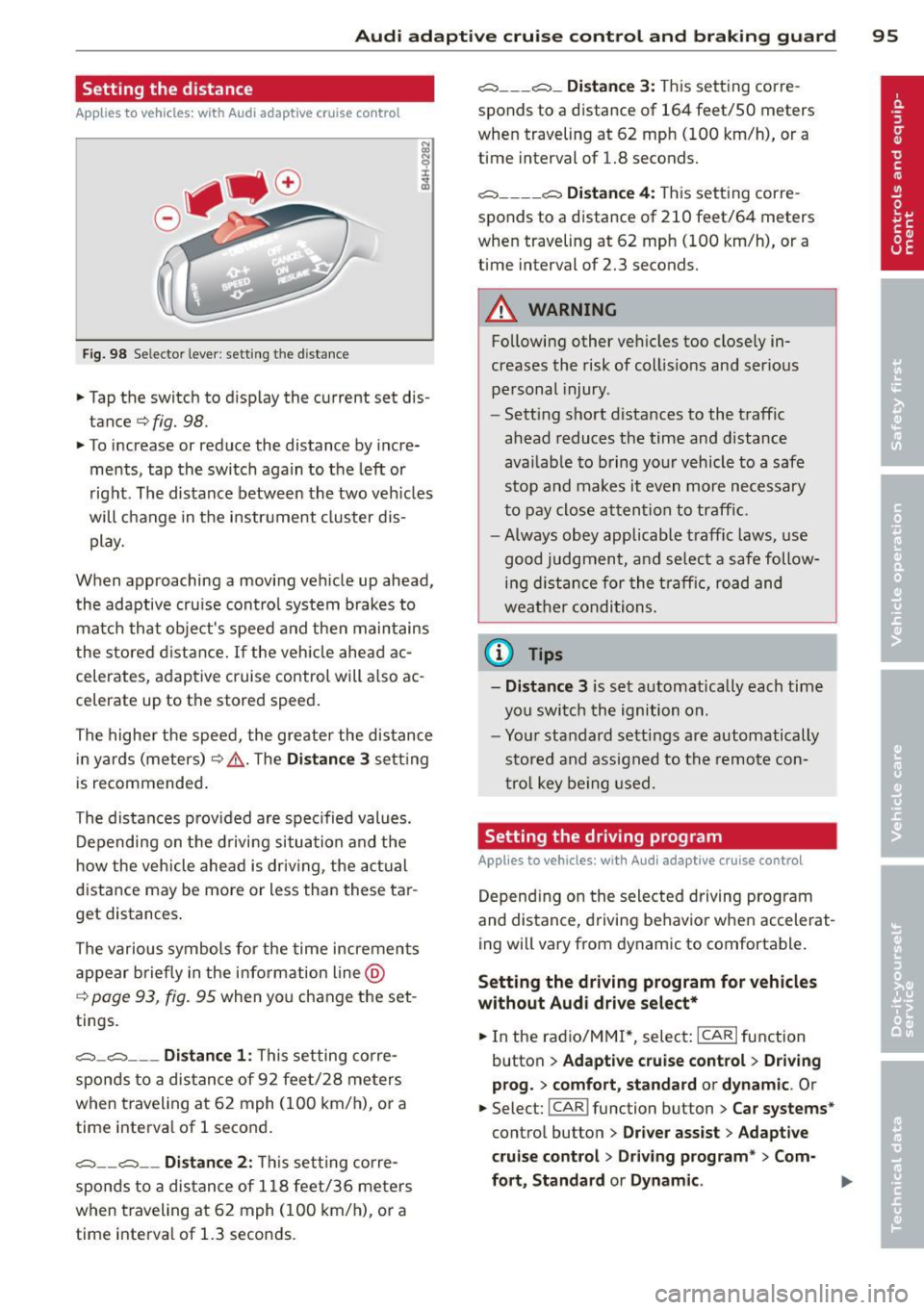
Fig. 98 Selector lever: setting the distance
• Tap the switch to display the current set dis
tance¢
fig. 98.
• To increase or reduce the distance by incre
ments, tap the switch again to the left or
right. The distance between the two veh icles
will change in the instrument cluster dis play.
When approaching a moving veh icle up ahead,
the adaptive cru ise contro l system brakes to
match that object's speed and then maintains
the stored d ist ance.
If the veh icle ahead ac
celerates, adaptive cruise control will a lso ac
celerate up to the stored speed.
The highe r the speed, the greate r the distance
in yards (meters)¢ .&,.. T he
Dis tanc e 3 setting
is recommended.
The distances prov ided are spec ified values.
Depending on the drivi ng situation and the
h ow the veh icle ahead is driv ing, the actual
distance may be more or less than these tar
get distances .
The various symbols for the time increments
appear briefly in the information line @
¢
page 93, fig. 95 when you change the set
tings.
c::::,_c::::, ___ Distance 1: This setting corre-
sponds to a distance of 92 feet/28 me ters
when traveling at 62 mph (100 km/h), or a
time interva l of 1 second.
c::::, __ c::::, __ Distan ce 2 : This setting corre
sponds to a distance of 118 feet/36 meters
when traveling at 62 mph (100 km/h), or a
time interva l of 1.3 seconds .
c::::, ___ c::::,_ Distanc e 3: This setting corre-
sponds to a distance of 164 feet/SO meters
when traveling at 62 mph (100 km/h), or a
time interval of 1.8 seconds.
c::::, ___ _ c::::, Di stanc e 4: This setting corre-
sponds to a distance of 210 feet/64 meters
when traveling at 62 mph (100 km/h), or a
time interval of 2.3 seconds.
A WARNING
Following other vehicles too closely in
creases the risk of coll is ions and ser ious
personal injury .
- Sett ing short distances to the traffic
ahead reduces the time and distance
available to bring your vehicle to a safe
stop and makes it even more necessary
to pay close atten tion to traffic.
- Always obey applicab le traffic laws, use
good judgment, and se lect a safe follow
ing d istance for the t raff ic, road and
weather conditions .
@ Tips
- Di stanc e 3
is set automatically each time
yo u swi tch the ignition on.
- You r standard settings are automatically
stored and assigned to the remote con
t ro l key be ing used.
Setting the driving program
Applies to vehicles: with Audi adaptive cruise control
Depend ing on the selected driving program
and distance, driving behavior when accelerat
ing will vary from dynamic to comfortable.
Setting the d riv ing program f or vehicles
without Aud i dri ve sel ec t*
• In the radio/MM!*, select: !CARI function
button
> Ad apt ive crui se control > Drivin g
p rog. > comfort, st a nd ard or dyna m ic.
Or
• Select: !CAR I function button > Car s yste m s*
control button > Dr iver a ssist > Adapti ve
crui se control> Driv ing program " > Com-
f o rt , St andard or Dynamic .
IJI-
Page 98 of 286

96 Audi adaptive cruise control and braking guard
Setting the driving mode for vehicles with
Audi drive select*
Refer to¢ page 105 .
@ Tips
Your settings are automatically stored and
assig ned to the remote contro l key being
used .
Request for driver intervention
Appl ies to vehicles : with Audi adaptive cruise co ntrol
F ig . 99 In st ru m ent cl uster: request for drive r in te rven
t io n
In ce rtain situ ations, t he system w il l prompt
you to take action . This cou ld happen, for ex
ample, if braking by the adaptive cr uise con
trol system is not enough to maintain enough
d ista nce to the vehicle ahead.
The inst rument cluste r will warn you about
the danger ¢
fig. 99:
- A red vehicle is pic tured in t he d is pla y.
- T he text
DISTANCE! appea rs in the st atus
b ar.
- T he red ind icator light . blinks.
- In add itio n, a warning tone sounds .
Audi braking guard
Description
Applies to vehicles: wi th Audi ada ptive cr uise contro l
Fig. 100 In str ume nt clus ter: approach wa rning
Braking guard uses a radar sensor. It a lso
funct ions wit hin the lim its of the system
when adapt ive cruise control is switched off.
What can Audi braking guard do?
When detected in time, the system can assess
s ituations when a vehicle ahea d brakes s ud
denly o r if your own vehicle is traveling at a
high speed and approach ing a vehicle up
ahead that is moving mo re slowly . Braking
guard does not react if it cannot detec t the
s ituation .
The system advises you of var ious situations:
- The
distance warning is given if yo u are too
close to the vehicle ahead for a long time. If
the vehicle ahead brakes sharp ly , yo u will
not be ab le to avoid a collision . The indicator
light . in the display comes on .
- The
approach warning is given when a de
tected vehicle up ahead in your lane is mov
ing m uch more slowly than yo u are or if it
brakes s harply . When t his war ning is given,
it may o nly be poss ibl e to avo id a co llision
by swe rv in g or b ra ki ng s harp ly. The indica tor
light . and indicator i n the di spl ay will
warn yo u about the danger ¢
fig. 100. You
w ill also hea r an acoustic signal.
If you do not rea ct fas t eno ugh o r do not r eact
at all t o the si tu at ion, B raki ng g uard will in
tervene by b raking and the message
braking
guard intervention
wi ll appea r.
Page 99 of 286

Audi adaptive cru ise control and brakin g guar d 97
-If a co llision is imminent, the system will
first provide an
acute wa rnin g by briefly and
sharp ly app lying the brakes .
- If you do not react to the ac ute warning,
braking guard can brake within the limits of
the system. This reduces the vehicle speed
in the event of a coll is ion.
- At speeds under 20 mph (30 km/h), the sys
tem can in it iate a complete decelerat ion
shortly before a collis ion
1>.
- If the braking guard senses that you are not
braking hard enough when a collision is im
minent, it can increase the braking force.
Which function s can be controll ed?
You can switch braking guard and the dis
tance/approach warning on or off in the radio
or MM I
¢ page 9 7, Settings in the radio/
MMI.
A WARNING
Lack of attention can cause col lis ions, oth
er accidents and serious persona l injuries.
The braking guard is an assist system and
cannot prevent a coll is ion by itself. The
driver must always intervene. The d river is
always responsib le for br aking at the cor
rect time .
- Always pay close attention to traffi c,
even when the bra king g uard is switched
on . Be ready to intervene and be ready to
take complete control whenever necessa ry. A lways keep the safe and lega l dis
tance between your vehicle and vehicles
up ahead.
- Braking guard works w ith in limits and
will not respond outs ide the system lim
its, for example when approaching a
stopped vehicle or stationary obstacle
(end of a traff ic jam or vehicle that has
broken down in traffic).
- Always remember that the radar sensor
for the braking guard wo rks only within
defined detection and ra nge limits that
1
> T hi s is not ava ilable in some countries .
may prevent the proper detection of oth
er vehicles .
- The radar sensor's function and range
can be reduced by rain, snow and heavy
spray. Moving ve hicles up ahead may not
be prompt ly detected or may not be de
tected at all.
- Reflective surfaces incl uding crash barri
ers or tunne l entrances may impair the
function of the radar senso r.
(D Tips
- Yo u can cancel the bra king that is in itiat
ed by the system by braking yourself, by
accelerating not iceably or by swerving.
- Braking guard error messages
¢page 98.
- Keep in mind that braking g uard can
brake unexpected ly. Always secure any
cargo or objects that you a re tra nsport
ing to reduce the risk of damage or in
jury .
Settings in the radio/MMI
Applies to veh icles: w it h Audi ada ptive cru ise co ntro l
.,. Sele ct: !CAR ! func tion button> Car sy ste m s*
con trol butto n > Driv er a ssist > Audi brak
ing guard .
Or
.,. Select: !CAR ! function button > Audi braking
gua rd.
Sy stem -
Switch A udi braking guard On an d
Off. When you switch the ignit ion on, the
message
Audi braking guard off appears if
the system is switched off.
Early warning -The distance and approach
warnings in the d isplay can be switched
On/
Off.
(D Tips
- Yo ur settings are au tom atically stored
and assigned to the remote cont ro l key
bein g used at the times the settings are
made.
Page 183 of 286

ESC includes and/or works together with the
anti-lock brake system (ABS), brake assist sys
tem, anti -slip regulation (ASR) , e lectronic dif
ferential lock (EDL), dynamic steering* and electronic i nteraxle differential lock* /selective
wheel torque control* . ESC is switched on all
the t ime. I n certain s ituations when you need
less traction, you can switch
off ASR by press
i ng the button~~
page 182, fig. 153 or
~ page 182, fig. 154. Be sure to sw itch ASR
on again when you no longer need less trac
tion.
Anti-lock b ra king s ystem (ABS)
ABS prevents the wheels from locking up
when braking. The vehicle can still be steered
even d uring hard brak ing . Apply ste ady p res
sure to the brake pedal. Do not pump the ped
a l. A pulsing in the brake peda l indicates t hat
the system is he lping you to brake the vehicle.
Brake assist system
The brake assist system can decrease bra king
d istance. It increases braking power when the
d river presses the brake pedal quick ly in emer
gency situations . You must press and hold the
brake peda l until the situation is over. In
veh icles w ith adaptive cru ise contro l*, the
brake assist system is more sensit ive if the
d istance detected to the veh icle ahead is too
small.
Anti- slip regulati on (ASR)
ASR reduces engine power when the drive
wheels begin to spin and adapts the force to
the road condit ions. This makes it eas ier to
start, accelerate and drive up hills.
Elect ronic diffe renti al lo ck (EDL )
The ED L brakes wheels that are spinning and
transfers the drive power to the other drive
wheel or wheels if the vehicle is equipped with
all-wheel drive*. This function is available up
to about 60 mph (100 km/h) .
In extreme cases, EDL automatica lly switches
off to help keep the brake on the braked whee l
from overheating. EDL w ill switch on again au-
Intellig ent technolog y 181
tomat ica lly when conditions have returned to
norma l.
Dynamic steering*
On vehicles with dynam ic steering*, ESC helps
stab il ize the s teer ing in crit ica l sit uat io ns.
Electronic interaxle differential lock* /
selective wheel torque control*
T he electronic i nteraxle differential lock (front
whee l dr ive) or the se lective whee l to rque
control (all-wheel dr ive) opera tes when dr iv
ing thro ugh curves. The front wheel on the in
side of the c urve or both whee ls on the inside
of the curve are braked selectively as needed .
This min imizes sliding in the front wheels and
allows for more precise driving through
cu rves . The applicable system may not acti
vate when dr iv ing in wet or snowy conditions.
A WARNING
- ESC, ABS , ASR, EDL dynam ic steering*
a nd the elect ronic interaxle differential
loc k* /se lective wheel torque control*
cannot overcome the laws of physics .
This is especially important on slippery
or wet roads. If the systems begin acting
to stabilize your veh icle, yo u should im
mediately change your speed to match
the road and traff ic conditions. Do not
let the increased safety provided by
these systems tempt you to take r isks.
Doing so will increase the risk of a loss of
veh icle contro l, col lision and ser ious per
sonal injuries.
- Always adapt your speed to road, traffi c
and wea ther conditions. The risk of los
ing contro l of the vehicle increases when
driving too fast, espec ially through
curves and on slippery or wet roads, and
when dr iv ing too close to vehicles up
ahead. ESC, ABS, the brake ass ist sys
tem, ASR, EDL dynam ic steering* and the
electronic interaxle differentia l lock*/se
lective whee l torque control* cannot p re-
vent co llisions . ..,.
•
•
Page 185 of 286

Intelligent technology 183
Sport mode on ESC/ASR off Sport mode off or
ESC /ASR on
Behavior
The ESC and ASR stabiliza- The stalbilization f unct ion T he fu ll stabilization f unc-
tion funct ions are lim ited is not available¢ .&,.. ESC tion of the ESC and ASR is
¢ .&,. .
and ASR are switched off . available agai n.
Operation Press the I~ OFF I button Press and ho ld the I~ OFFI Press t he I~ OF FI button
briefly. bu
tton lo nger than 3 sec-
again.
onds .
Indicator II turns on. II and 1/1 turn on. II tur ns off or fl and II
lights tur n off.
Driv er mes -Stab ilization control Stabilization control Stabilization control
sages (ESC ): Sport. Warning! (ESC ): off. Warning! Re- (ESC) : On
Restricted stability stricted stability
It is only possible to t urn off the ASR up to 30
mph (SO km/h) for vehicles with front whee l
d rive . At abou t
45 mph (70 km/h) it a utomat i
cally turns on aga in .
It is poss ible to turn off
the ASR a t any speed for veh icles with all
wheel drive.
_& WARNING
f--------- -
You should o nly sw itch sport mode on o r
switch ESC/ASR off if you r drivin g abili ties
and road conditions pe rm it .
- The s tabilization func tion is lim ited
w hen sport mode is sw itche d on. T he
dr iv ing whee ls co uld spin an d the vehicle
cou ld
swe rve, especially on slick or slip
pery road surfaces.
- The re is n o vehicle stabilization when
ESC/ASR a re switc hed off.
(D Tips
ES C/ASR cannot be sw itche d off or sport
mo de cannot be switc hed on when adap
t ive c ruise control * is switched on.
Braking
What affects braking efficiency?
New brake pads
During the firs t 250 miles (40 0 km), new
b ra ke pads do not possess their f ull braking
effect, they have to be "broke n in" first ¢.&,. .
You can compensate for th is slightly reduced
brak ing power by push ing harder on the brake pedal. Avoid heavy brak
ing loads dur ing the
break -in period .
Operating conditions and driving habits
The bra kes o n today's a utomo biles a re still
s u bject to wear, depend ing largely on operat
ing condit ions and driving habits ¢.&,. . On
vehicles that are either driven m ost ly in stop
and-g o city traff ic or are dr iven hard, the
brake pads should b e chec ked by your au tho r
iz ed Audi dea ler mo re often than specified in
the
Warranty & Maintenance booklet . Failure
to h ave yo ur bra ke pads insp ect ed ca n result
in reduced brake pe rfo rmance .
On steep slop es, you sho uld use the b raking
effe ct o f the e ngine. This way, you prevent un
ne ce ss ary wear on the br ake sys tem.
If you
mus t use your brakes, do not hold the b ra kes
down cont in uou sly. Pump the brakes at inter
vals.
Operating noise
N ois es m ay o ccur when br akin g depend ing on
th e speed, brak ing fo rce and o uts ide condi
ti ons such as tem pera ture and hum idity.
Effect of water and road salt
In certa in situa tions, for examp le afte r dr iv ing
t hr ough wa ter, in heavy rain, after overnight
c on den sat ion or after w ashin g your car , the
braking e ffec t ca n be reduce d by mois ture o r
ice on the b rake ro to rs and brake pads . The
brakes m ust be dr ied first with a few careful
brake ap plications .
•
•
Page 186 of 286

184 Intelligent technology
At higher speeds and with the windshield wip
ers turned on, the brake pads press against
the brake rotors for a short amount of time .
This occurs at regular intervals without the
driver noticing and provides for better brake
response time under wet condit ions .
The effectiveness of the brakes can be reduced
when the vehicle is dr iven on a salt-covered
road and the brakes are not used . Likew ise,
you clean
off accumulated sa lt coating from
brake discs and pads with a few caut ious ap
plications of the brake¢&. .
Cor ro sion
There may be a tendency for dirt to build up
on the brake pads and corrosion to form on
the discs if the car is not dr iven regularly or
only for short trips with l ittle use of the
brakes .
If the brakes are not used frequently , or if cor
rosion has formed on the discs, it is advisable
to clean
off the pads and discs by brak ing
firm ly a few times from a moderately high
speed ¢,& .
Fa ults in the brake system
If you should notice a sudden increase in
brake pedal travel, then one of the two brake
circu its may have failed¢&. .
Low brake fluid le vel
Malfunct ions can occur in the brake system if
the brake fluid level is too low. The brake fluid
leve l is monitored electronically .
Brake boost er
The brake booster increases the pressure that
you generate w ith the brake pedal. It works
only when the eng ine is running .¢ &.
Brake lining w ear status
Brake lining wea r may be checked by vis ual in
spection of the condition of the brake pads
through the openings in the whee l. If neces
sary, the whee l may be removed for this in
spection
¢ page 244, Changing a wheel.
_& WARNING
-New brake pads don't have the best stop
ping power and must be "broken -in" dur
ing the initial 100 to 150 miles (150 to
200 kilometers) of normal c ity driving .
You can compensate for this by pressing the brake pedal more firmly . T his also
applies later when new pads are instal led.
- You shou ld perform braking maneuvers
for the purpose of cleaning the brake system only if road conditions permit .
Othe r road users must not be put at risk -
you may ca use an accident!
- Before descend ing a steep grade, reduce
speed and sh ift transmission into a lower
gear or lower dr iving range. Do not ride
the brakes or hold the pedal down too
long o r too often . This could cause the
brakes to get hot and diminish braking
efficiency.
- Do not "ride the brakes" by rest ing you r
foot on the pedal when you do not intend
to b rake. This may cause the brakes to
overheat, p remature wear and increased
s topping distance.
- Unde r ce rtain cl imatic and ope rat ing
conditions such as passing thro ugh wa
ter, dr iving in heavy rain o r after washing
the vehicle, the effectiveness of the brakes can be reduced. In winter, ice can
accumu late on the brake pads, linings,
d iscs and drums. Carefully apply brakes
for a test. Brakes will dry and ice coat
ings will be cleaned
off after a few care
fu l brake applicat ions .
- Driving for an extended period of t ime on
salt-covered roads without using your brakes can a lso affect braking efficiency .
Clean
off accumulated salt coating from
b rake discs and pads wi th a few ca reful
b rake applications.
- I f you damage the front spoiler, or if you
install a different spoiler, be sure the a ir
flow to the front brakes is not obstruct-
ed . Otherwise the brake system could
~
Page 191 of 286

A WARNING 1= ~
After driving through water, mud, slush, etc., the brakes may be slow to take effect
because of wet brake rotors and pads. Dry
the brakes first by braking carefully to re
store the full brak ing effect.
([) Note
Vehicle components such as the engine,
transmiss ion, suspension or electrical sys
tem can be severely damaged by driving
through wate r.
@ Tips
- Check the depth of the water before dr iv
i ng through it.
- Do not stop the veh icle, dr ive in reverse
or switch the engine off when driving
th rough water.
- Keep in mind that oncoming vehicles
may create waves that raise the water
level and make it too deep for you r vehi
cle to drive th rough safely.
- Avoid dr iving through sa lt water because
i t can ca use corrosion.
Catalytic converter
It is very important that your emission con
trol system (catalytic converter) is function
ing properly to ensure that your vehicle is run
ning in an environmentally sound manner.
11-Always use lead -free gaso line¢ page 201,
Fuel supply .
"'"Never run the tank down all the way to emp
ty.
11-Never put too much motor oil in your engine
¢ page 211, ~ Adding engine oil .
11-Never try to push -or tow -start your veh icle .
The catalytic converter is an efficient "clean up" device built into the exhaust system of
the vehicle . The catalytic converter burns
many of the pollutants in the exhaust gas be
fore they are released into the atmosphere .
Drivin g and en vironm ent 18 9
The exclusive use of unleaded fuel is critically
important for the life of the catalytic convert
er and proper f unct ion ing of the engine.
A WARNING
- The temperature of the exhaust system
is high, both when driving and after stop
ping the eng ine.
- Never touch the exhaust tail pipes once
they have become hot. This could result in burns.
- Do not park or operate the vehicle in
areas where the hot exhaust system may
come in co ntact with dry grass, br ush,
fue l spill or other material wh ich can
cause a fire .
- Do not apply additional undercoating or
ru stp roof ing on or nea r the exhaust
manifold, exhaust pipes, cataly tic con
ve rter or heat shield s. Dur ing driving, the
substance used for undercoating could
overheat and cause a fire.
(D Note
- Be aware that just o ne tank filling with
leaded fuel w ill already ser iously de
grade the performance of the catalytic
converter .
- Do not exceed the cor rect engine oil level
¢ page 211.
-Do not drive until the f ue l t ank becomes
comple tely empty . The engine co uld m is
fire . Unburned fuel could also get into
the exhaust system and this co uld cause
the catalytic converter to overheat.
- Do not turn off the ignition while the ve
hicle is mov ing.
- Do not continue to operate your vehicle
under these conditions, as othe rwise fuel
can reach the catalyt ic converter. Th is
cou ld result in overheating of the con
verter, requir ing its replacement.
- To assure efficient operation of the Emis -
sion Control System: ..,. •
•