Page 375 of 422
10 Specifications
Dimensions and weights
10
373 Weights
Kerb weight includes the driver, the fuel tank
90% full and all fluids.
The weight of passengers and accessories,
and towball load (when a trailer is hitched, see
table page 374) influences the payload and is
not included in the kerb weight.
Permitted max. load = Gross vehicle weight -
Kerb weight.
NOTE
The documented kerb weight applies to
cars in the standard version - i.e. a car with-
out extra equipment or accessories. This
means that for every accessory added the
loading capacity of the car is reduced cor-
respondingly by the weight of the acces-
sory.
Examples of accessories that reduce load-
ing capacity are the Kinetic/Momentum/
Summum equipment levels, as well as other
accessories such as Towbar, Load carriers,
Space box, Audio system, Auxiliary lamps,
GPS, Fuel-driven heater, Safety grille, Car-
pets, Cargo cover, Power seats, etc.
Weighing the car is a certain way of ascer-
taining the kerb weight of your own partic-
ular car.
WARNING
The car's driving characteristics change
depending on how heavily it is loaded and
how the load is distributed.
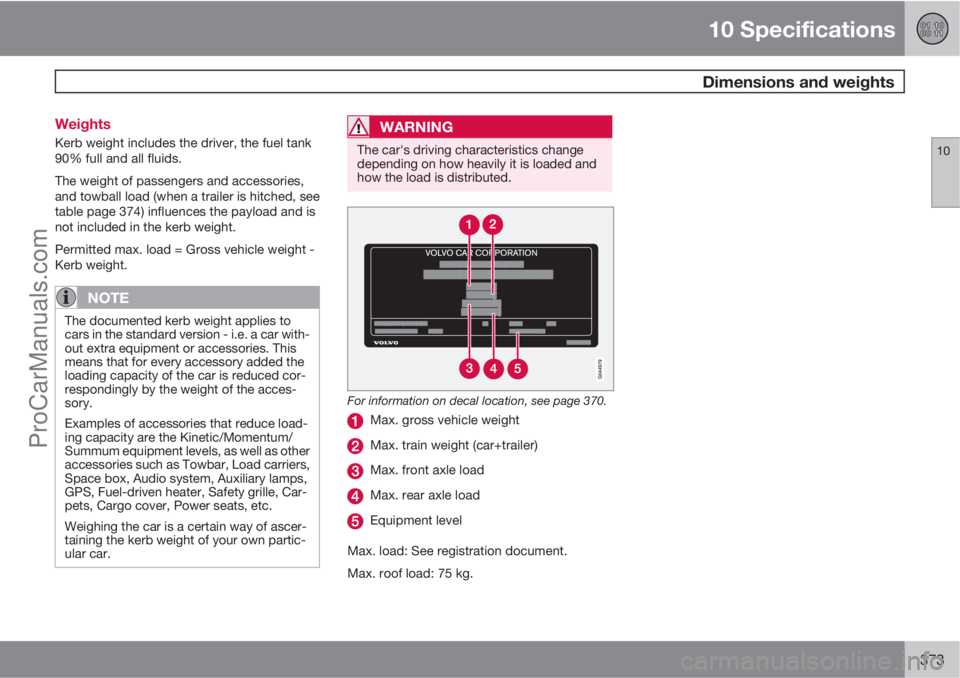
For information on decal location, see page 370.
Max. gross vehicle weight
Max. train weight (car+trailer)
Max. front axle load
Max. rear axle load
Equipment level
Max. load: See registration document.
Max. roof load: 75 kg.
ProCarManuals.com
Page 380 of 422

10 Specifications
Engine oil
10
378
Adverse driving conditions
Adverse driving conditions can lead to abnor-
mally high oil temperature or oil consumption.
Below are some examples of adverse driving
conditions.
Check the oil level more frequently for long
journeys:
•towing a caravan or trailer
•in mountainous regions
•at high speeds
•in temperatures colder than -30 °C or hot-
ter than +40 °C
The above also apply to shorter driving dis-
tances at low temperatures.Choose a fully synthetic engine oil for adverse
driving conditions. It provides extra protection
for the engine.
Volvo recommends Castrol oil products.
IMPORTANT
In order to fulfil the requirements for the
engine's service intervals all engines are
filled with a specially adapted synthetic
engine oil at the factory. The choice of oil
has been made very carefully with regard to
service life, starting characteristics, fuel
consumption and environmental impact.
An approved engine oil must be used in
order that the recommended service inter-
vals can be applied. Only use a prescribed
grade of oil for both filling and oil change,
otherwise you will risk affecting service life,
starting characteristics, fuel consumption
and environmental impact.
Volvo Car Corporation disclaims all war-
ranty liability if engine oil of the prescribed
grade and viscosity is not used.
Volvo recommends that oil changes are car-
ried out at an authorised Volvo workshop.
ProCarManuals.com
Page 384 of 422
10 Specifications
Fluids and lubricants
10
382
Other fluids and lubricants
Manual gearboxVolume (litres)Prescribed transmission fluid
MMT61.7BOT 350M3M661.9
Automatic gearboxVolume (litres)Prescribed transmission fluid
MPS67.3BOT 341
TF-80SC7.0AW1
TF-80SD7.0AW1
FluidSystemVolume (litres)Prescribed grade
Brake fluidBrake system0.6DOT 4+
Power steering fluidPower steering-WSS M2C204-A2 or equivalent product.
Washer fluidCars with headlamp washing5.4Washer fluid recommended by Volvo - with frost protection during
cold weather and below freezing point.
Cars without headlamp washing4.0
FuelPetrol engineapprox. 67Petrol: see page 288
Diesel engineapprox. 67Diesel: see page 289
ProCarManuals.com
Page 386 of 422
10 Specifications
Fuel
10
384
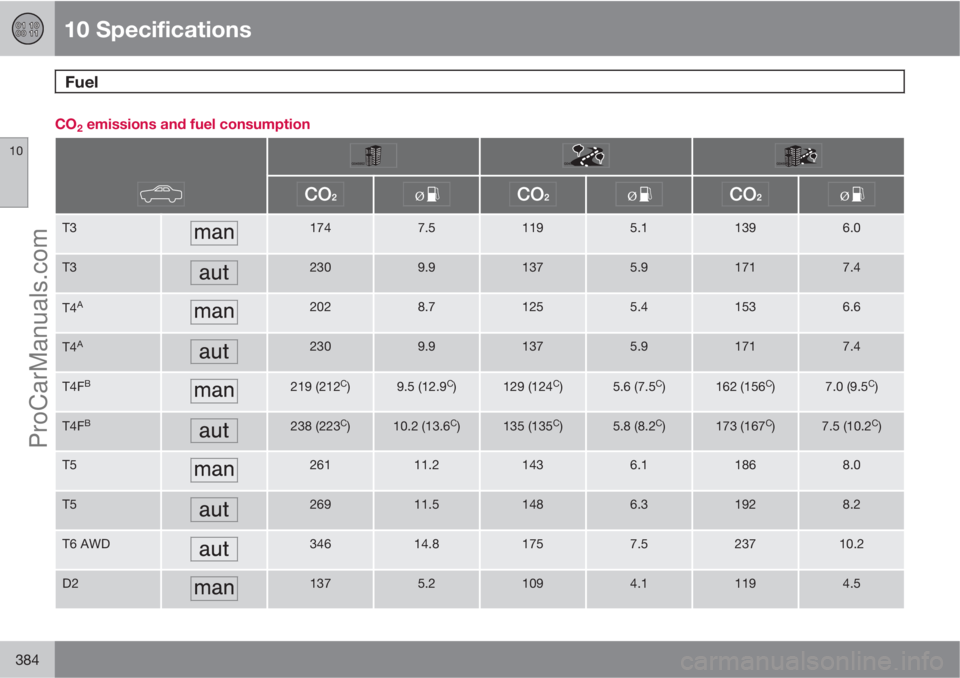
CO2 emissions and fuel consumption
T31747.51195.11396.0
T32309.91375.91717.4
T4A2028.71255.41536.6
T4A2309.91375.91717.4
T4FB219 (212C)9.5 (12.9C)129 (124C)5.6 (7.5C)162 (156C)7.0 (9.5C)
T4FB238 (223C)10.2 (13.6C)135 (135C)5.8 (8.2C)173 (167C)7.5 (10.2C)
T526111.21436.11868.0
T526911.51486.31928.2
T6 AWD34614.81757.523710.2
D21375.21094.11194.5
ProCarManuals.com
Page 387 of 422
10 Specifications
Fuel
10
��
385
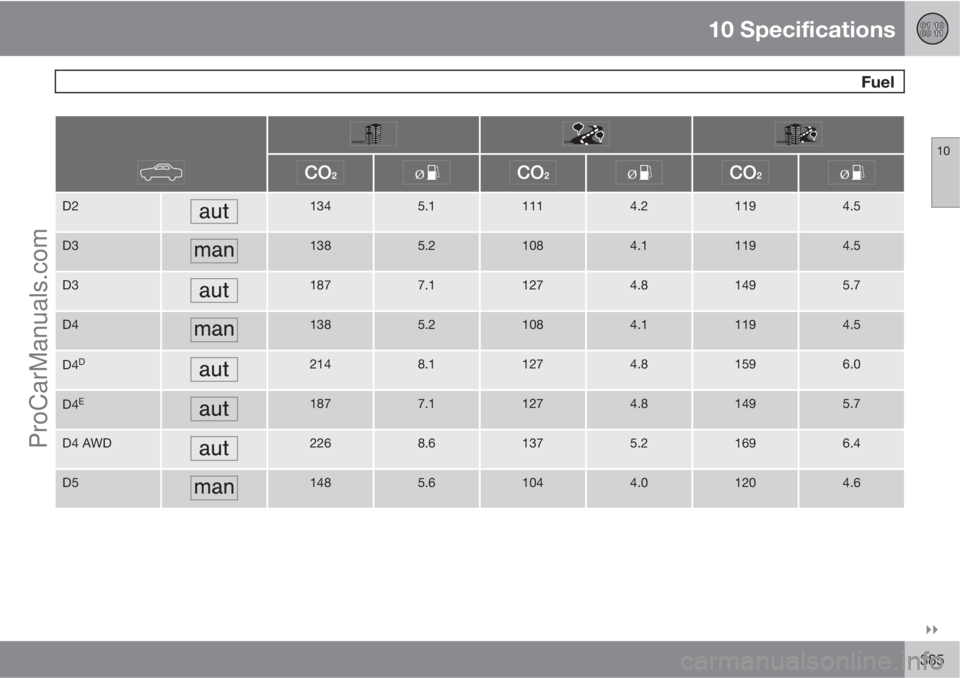
D21345.11114.21194.5
D31385.21084.11194.5
D31877.11274.81495.7
D41385.21084.11194.5
D4D2148.11274.81596.0
D4E1877.11274.81495.7
D4 AWD2268.61375.21696.4
D51485.61044.01204.6
ProCarManuals.com
Page 388 of 422
10 Specifications
Fuel
10
386
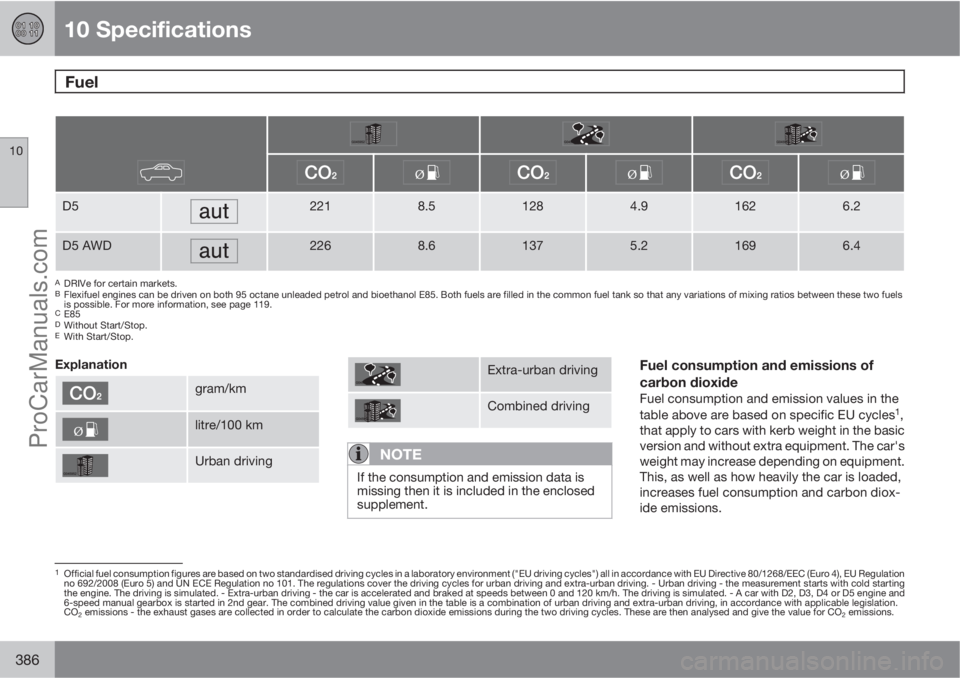
D52218.51284.91626.2
D5 AWD2268.61375.21696.4
ADRIVe for certain markets.BFlexifuel engines can be driven on both 95 octane unleaded petrol and bioethanol E85. Both fuels are filled in the common fuel tank so that any variations of mixing ratios between these two fuels
is possible. For more information, see page 119.
CE85DWithout Start/Stop.EWith Start/Stop.
Explanation
gram/km
litre/100 km
Urban driving
Extra-urban driving
Combined driving
NOTE
If the consumption and emission data is
missing then it is included in the enclosed
supplement.
Fuel consumption and emissions of
carbon dioxide
Fuel consumption and emission values in the
table above are based on specific EU cycles1,
that apply to cars with kerb weight in the basic
version and without extra equipment. The car's
weight may increase depending on equipment.
This, as well as how heavily the car is loaded,
increases fuel consumption and carbon diox-
ide emissions.
1Official fuel consumption figures are based on two standardised driving cycles in a laboratory environment ("EU driving cycles") all in accordance with EU Directive 80/1268/EEC (Euro 4), EU Regulation
no 692/2008 (Euro 5) and UN ECE Regulation no 101. The regulations cover the driving cycles for urban driving and extra-urban driving. - Urban driving - the measurement starts with cold starting
the engine. The driving is simulated. - Extra-urban driving - the car is accelerated and braked at speeds between 0 and 120 km/h. The driving is simulated. - A car with D2, D3, D4 or D5 engine and
6-speed manual gearbox is started in 2nd gear. The combined driving value given in the table is a combination of urban driving and extra-urban driving, in accordance with applicable legislation.
CO
2 emissions - the exhaust gases are collected in order to calculate the carbon dioxide emissions during the two driving cycles. These are then analysed and give the value for CO2 emissions.
ProCarManuals.com
Page 389 of 422
10 Specifications
Fuel
10
387
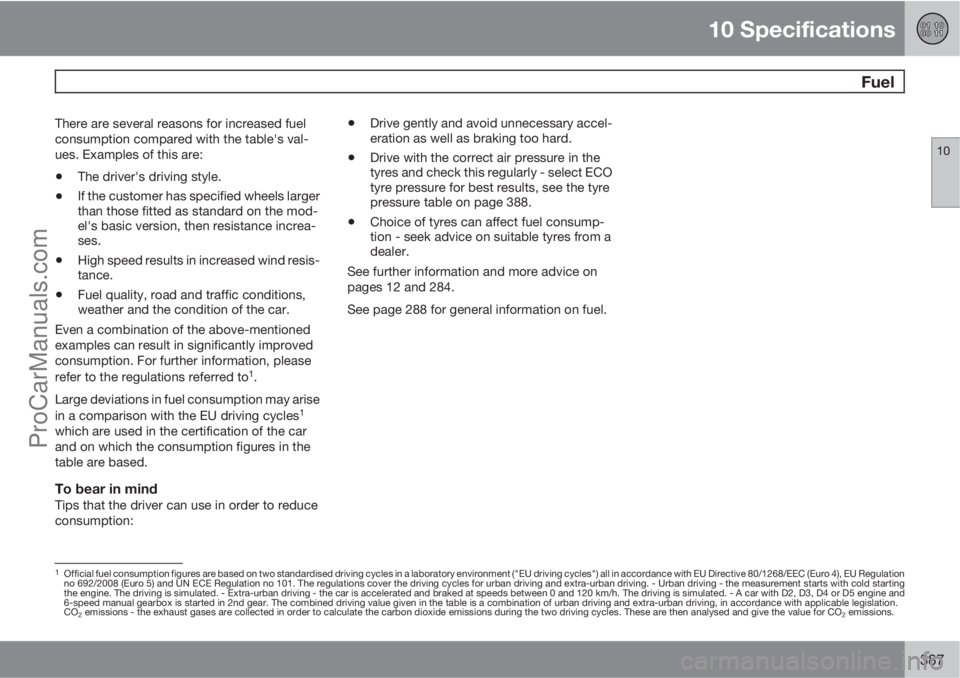
There are several reasons for increased fuel
consumption compared with the table's val-
ues. Examples of this are:
•The driver's driving style.
•If the customer has specified wheels larger
than those fitted as standard on the mod-
el's basic version, then resistance increa-
ses.
•High speed results in increased wind resis-
tance.
•Fuel quality, road and traffic conditions,
weather and the condition of the car.
Even a combination of the above-mentioned
examples can result in significantly improved
consumption. For further information, please
refer to the regulations referred to
1.
Large deviations in fuel consumption may arise
in a comparison with the EU driving cycles
1
which are used in the certification of the car
and on which the consumption figures in the
table are based.
To bear in mindTips that the driver can use in order to reduce
consumption:
•Drive gently and avoid unnecessary accel-
eration as well as braking too hard.
•Drive with the correct air pressure in the
tyres and check this regularly - select ECO
tyre pressure for best results, see the tyre
pressure table on page 388.
•Choice of tyres can affect fuel consump-
tion - seek advice on suitable tyres from a
dealer.
See further information and more advice on
pages 12 and 284.
See page 288 for general information on fuel.
1Official fuel consumption figures are based on two standardised driving cycles in a laboratory environment ("EU driving cycles") all in accordance with EU Directive 80/1268/EEC (Euro 4), EU Regulation
no 692/2008 (Euro 5) and UN ECE Regulation no 101. The regulations cover the driving cycles for urban driving and extra-urban driving. - Urban driving - the measurement starts with cold starting
the engine. The driving is simulated. - Extra-urban driving - the car is accelerated and braked at speeds between 0 and 120 km/h. The driving is simulated. - A car with D2, D3, D4 or D5 engine and
6-speed manual gearbox is started in 2nd gear. The combined driving value given in the table is a combination of urban driving and extra-urban driving, in accordance with applicable legislation.
CO
2 emissions - the exhaust gases are collected in order to calculate the carbon dioxide emissions during the two driving cycles. These are then analysed and give the value for CO2 emissions.
ProCarManuals.com
Page 406 of 422
10 Specifications
Symbols in the display
10
404* Option/accessory, for more information, see Introduction.
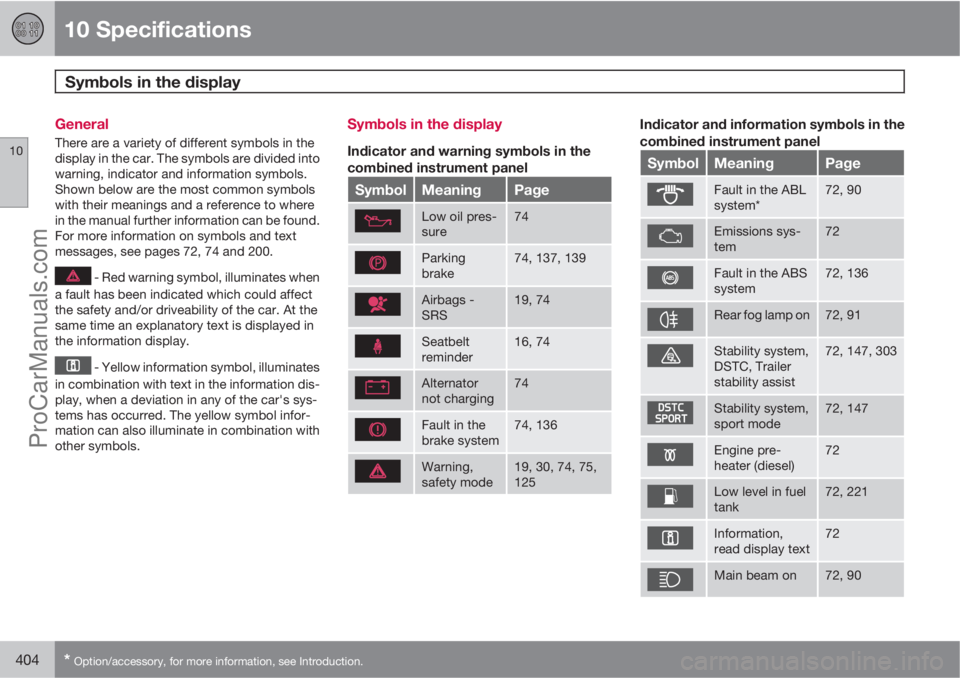
General
There are a variety of different symbols in the
display in the car. The symbols are divided into
warning, indicator and information symbols.
Shown below are the most common symbols
with their meanings and a reference to where
in the manual further information can be found.
For more information on symbols and text
messages, see pages 72, 74 and 200.
- Red warning symbol, illuminates when
a fault has been indicated which could affect
the safety and/or driveability of the car. At the
same time an explanatory text is displayed in
the information display.
- Yellow information symbol, illuminates
in combination with text in the information dis-
play, when a deviation in any of the car's sys-
tems has occurred. The yellow symbol infor-
mation can also illuminate in combination with
other symbols.
Symbols in the display
Indicator and warning symbols in the
combined instrument panel
SymbolMeaningPage
Low oil pres-
sure74
Parking
brake74, 137, 139
Airbags -
SRS19, 74
Seatbelt
reminder16, 74
Alternator
not charging74
Fault in the
brake system74, 136
Warning,
safety mode19, 30, 74, 75,
125
Indicator and information symbols in the
combined instrument panel
SymbolMeaningPage
Fault in the ABL
system*72, 90
Emissions sys-
tem72
Fault in the ABS
system72, 136
Rear fog lamp on72, 91
Stability system,
DSTC, Trailer
stability assist72, 147, 303
Stability system,
sport mode72, 147
Engine pre-
heater (diesel)72
Low level in fuel
tank72, 221
Information,
read display text72
Main beam on72, 90
ProCarManuals.com