2013 VOLVO V60 alarm
[x] Cancel search: alarmPage 67 of 422
02 Locks and alarm
02
65ProCarManuals.com
Page 77 of 422

03 Your driving environment
Instruments and controls
03
* Option/accessory, for more information, see Introduction.75
WARNING
If the brake and ABS symbols are illumi-
nated at the same time, there is a risk that
the rear end will skid during heavy braking.
WarningThe red warning symbol illuminates when a
fault has been indicated which could affect the
safety and/or driveability of the car. An explan-
atory text is shown on the information display
at the same time. The symbol remains visible
until the fault has been rectified but the text
message can be cleared with the OK button,
see page 200. The warning symbol can also
illuminate in conjunction with other symbols.
Action:
1. Stop in a safe place. Do not drive the car
further.
2. Read the information on the information
display. Implement the action in accord-
ance with the message in the display. Clear
the message using the OK button.
Reminder – doors not closed
If one of the doors, the bonnet2 or tailgate is not
closed properly then the information or warn-
ing symbol illuminates together with an explan-
atory text message in the combined instrumentpanel. Stop the car in a safe place as soon as
possible and close the door, bonnet or boot lid,
whichever is open.
If the car is driven at a speed lower than
approx. 7 km/h then the information
symbol illuminates.
If the car is driven at a speed higher
than approx. 7 km/h then the warning
symbol illuminates.
Trip meter
Trip meter and controls.
Display for trip meter
Controls for switching between trip metersT1 and T2, as well as resetting the trip
metersThe meters are used to measure short dis-
tances. The distance is shown in the display.
One short press on the control switches
between the two trip meters
T1 and T2. A long
press (more than 2 seconds) resets the cur-
rently displayed trip meter.
Clock
Clock and setting knob.
Display for showing the time
Controls for setting the clock
Turn the knob clockwise/anticlockwise to set
the clock. Turn first to the end position and then
turn past/over the end position a further
approx. 1 mm - a "click" sounds and is felt in
2Only cars with alarm*.
ProCarManuals.com
Page 79 of 422

03 Your driving environment
Volvo Sensus
03
* Option/accessory, for more information, see Introduction.77 General
Control panel in centre console
Navigation* - NAV, see separate owner's
manual (Road and Traffic Information Sys-
tem - RTI).
Infotainment (RADIO, MEDIA, TEL*), see
page 234.
Car settings - MY CAR, see page 202.
Park assist camera - CAM*, see
page 191.
Climate control, see page 210.
Volvo Sensus is the car's operating system, the
heart of your personal Volvo experience. Volvo
Sensus combines and presents many func-
tions in several of the car's systems on the
centre console TV screen. With Volvo Sensusthe car can be personalised by means of an
intuitive user interface. Settings can be made
in Car settings, Infotainment, Climate, etc.
With the centre console buttons and controls
or the steering wheel's right-hand keypad*
functions can be activated or deactivated and
many different settings can be made.
With a press on MY CAR all settings related to
the driving and control of the car are presented,
such as City Safety, Locks and alarm, setting
the clock, etc.
With a press on the respective function:
RADIO, MEDIA, TEL*, NAV* and CAM* other
sources, systems and functions can be acti-
vated, e.g. AM, FM1, CD, DVD*, TV*, Blue-
tooth*, navigation* and park assist camera*.
For more information on all functions/systems,
see the respective section in the owner's man-
ual.
ProCarManuals.com
Page 117 of 422

03 Your driving environment
Starting the engine
03
115
Operation
Remote control buttons for remote start.
Locking
Approach lighting
Information3
Remote starting the engineMaximum distance for enabling remote star-
ting of the engine is approx. 30 metres in unob-
structed space - in addition, the car must be
locked.
To remote start the engine:1. Briefly press on the remote control key's
lock button (1).
2. Follow this immediately afterwards with a
long press - at least 2 seconds - on
button (2).
If the conditions for ERS are fulfilled then the
following takes place:
1. All direction indicators flash quickly several
times.
2. The engine starts.
3. All direction indicators illuminate with a
constant glow for 3 seconds to verify that
the engine has started.
NOTE
After remote starting, the car continues to
be locked but with the alarm deactivated.
With PCC4 keyThe light indication for Approach
lighting5 flashes several times when
the button is pressed and then goes
to constant glow if all criteria for ERS
have been fulfilled. However, this does not
mean that ERS has started the engine.
To check whether ERS has started the engine,
the user can press the Information button (3) -
if the engine has started, there is a light indi-
cation on the button for Approach lighting (2).
Active functionsThe following functions are activated with a
remote started engine:
•Ventilation system
•Audio/video system.
Deactivated functionsThe following functions are deactivated with a
remote started engine:
•headlamps
•Position lamps
•Number plate lighting
•Windscreen wiper.
the engine is switched offThe following steps switch off an ERS-started
engine:
•The remote control key's lock button (1) is
depressed
•The car is unlocked
•A door is opened
3Only on PCC key, see page 47.4Read about the PCC key on page 47.5Read about Approach lighting on page 46 and 94.
ProCarManuals.com
Page 124 of 422
03 Your driving environment
Gearboxes
03
122* Option/accessory, for more information, see Introduction.
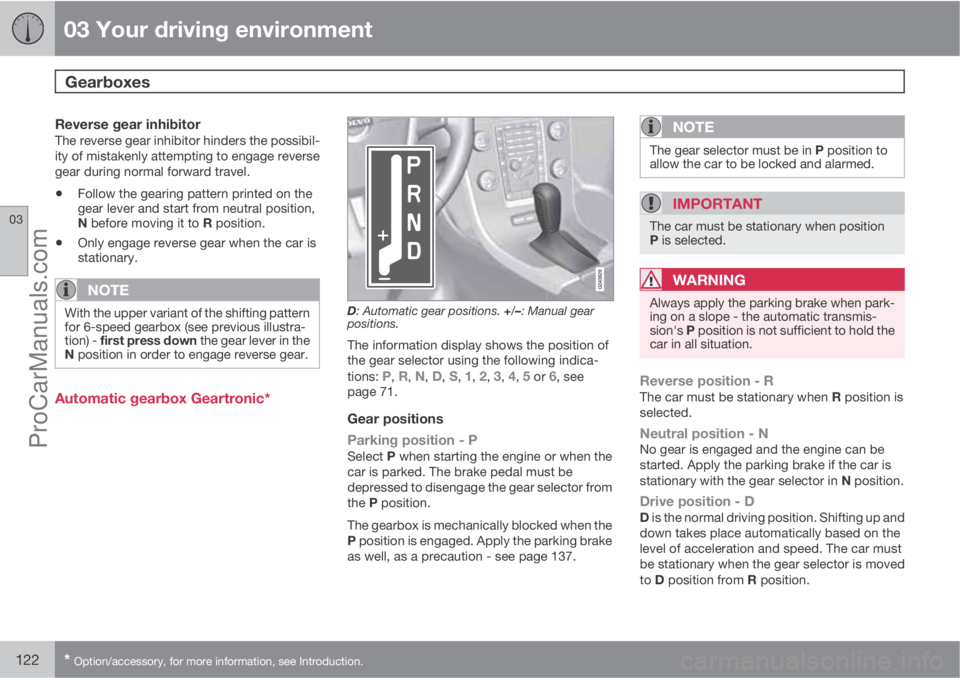
Reverse gear inhibitorThe reverse gear inhibitor hinders the possibil-
ity of mistakenly attempting to engage reverse
gear during normal forward travel.
•Follow the gearing pattern printed on the
gear lever and start from neutral position,
N before moving it to R position.
•Only engage reverse gear when the car is
stationary.
NOTE
With the upper variant of the shifting pattern
for 6-speed gearbox (see previous illustra-
tion) - first press down the gear lever in the
N position in order to engage reverse gear.
Automatic gearbox Geartronic*
D: Automatic gear positions. +/–: Manual gear
positions.
The information display shows the position of
the gear selector using the following indica-
tions:
P, R, N, D, S, 1, 2, 3, 4, 5 or 6, see
page 71.
Gear positions
Parking position - P
Select P when starting the engine or when the
car is parked. The brake pedal must be
depressed to disengage the gear selector from
the P position.
The gearbox is mechanically blocked when the
P position is engaged. Apply the parking brake
as well, as a precaution - see page 137.
NOTE
The gear selector must be in P position to
allow the car to be locked and alarmed.
IMPORTANT
The car must be stationary when position
P is selected.
WARNING
Always apply the parking brake when park-
ing on a slope - the automatic transmis-
sion's P position is not sufficient to hold the
car in all situation.
Reverse position - RThe car must be stationary when R position is
selected.
Neutral position - NNo gear is engaged and the engine can be
started. Apply the parking brake if the car is
stationary with the gear selector in N position.
Drive position - DD is the normal driving position. Shifting up and
down takes place automatically based on the
level of acceleration and speed. The car must
be stationary when the gear selector is moved
to D position from R position.
ProCarManuals.com
Page 143 of 422
03 Your driving environment
HomeLinkŸŸ *
03
* Option/accessory, for more information, see Introduction.141 General
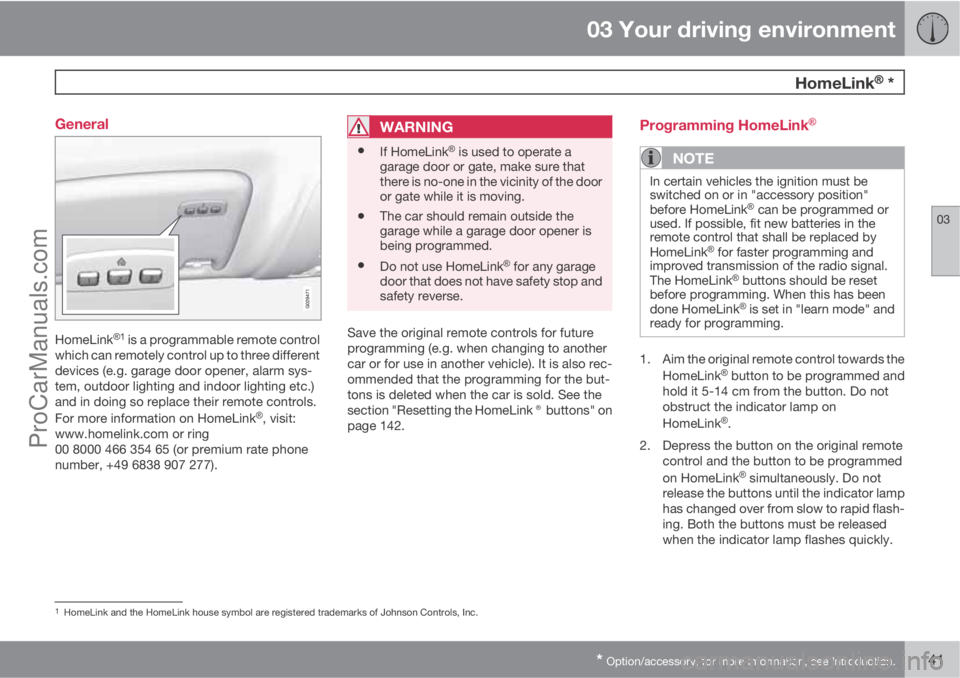
HomeLinkŸ1 is a programmable remote control
which can remotely control up to three different
devices (e.g. garage door opener, alarm sys-
tem, outdoor lighting and indoor lighting etc.)
and in doing so replace their remote controls.
For more information on HomeLink
Ÿ, visit:
www.homelink.com or ring
00 8000 466 354 65 (or premium rate phone
number, +49 6838 907 277).
WARNING
•If HomeLinkŸ is used to operate a
garage door or gate, make sure that
there is no-one in the vicinity of the door
or gate while it is moving.
•The car should remain outside the
garage while a garage door opener is
being programmed.
•Do not use HomeLinkŸ for any garage
door that does not have safety stop and
safety reverse.
Save the original remote controls for future
programming (e.g. when changing to another
car or for use in another vehicle). It is also rec-
ommended that the programming for the but-
tons is deleted when the car is sold. See the
section "Resetting the HomeLink® buttons" on
page 142.
Programming HomeLinkŸ
NOTE
In certain vehicles the ignition must be
switched on or in "accessory position"
before HomeLink
Ÿ can be programmed or
used. If possible, fit new batteries in the
remote control that shall be replaced by
HomeLink
Ÿ for faster programming and
improved transmission of the radio signal.
The HomeLink
Ÿ buttons should be reset
before programming. When this has been
done HomeLink
Ÿ is set in "learn mode" and
ready for programming.
1. Aim the original remote control towards the
HomeLinkŸ button to be programmed and
hold it 5-14 cm from the button. Do not
obstruct the indicator lamp on
HomeLink
Ÿ.
2. Depress the button on the original remote
control and the button to be programmed
on HomeLink
Ÿ simultaneously. Do not
release the buttons until the indicator lamp
has changed over from slow to rapid flash-
ing. Both the buttons must be released
when the indicator lamp flashes quickly.
1HomeLink and the HomeLink house symbol are registered trademarks of Johnson Controls, Inc.
ProCarManuals.com
Page 144 of 422

03 Your driving environment
HomeLinkŸŸ *
03
142* Option/accessory, for more information, see Introduction.
3.
Depress the HomeLinkŸ button being
programmed, hold it depressed for
5 seconds and then release it. Repeat if
necessary until the garage door is acti-
vated. If the door is not activated, press the
programmed HomeLink
Ÿ button and hold
it depressed and check the indicator lamp.
>
Constant glow: The indicator lamp illu-
minates with a constant glow when the
button is kept depressed, this indicates
that the programming is complete.
The garage door, gate or similar should
now be activated when the pro-
grammed HomeLink
Ÿ button is
depressed.
Glow not constant: The indicator lamp
flashes quickly for approx. 2 seconds
and then changes over to a constant
glow. In which case, continue with the
programming steps 4-6 in order to com-
plete the programming of a device with
rolling code (usually a garage door
opener).
4.
Locate the "programming button
2" on the
receiver for the garage door for example,
normally located close to the antenna's
bracket on the receiver.5. Depress and release the receiver's "pro-
gramming button". The button flashes for
approx. 30 seconds and the next step must
be carried out within this period.
6. While the receiver's "programming button"
is still flashing, press the button on
HomeLink
Ÿ being programmed and hold it
depressed for approx. 2 seconds and then
release it. Repeat the press/hold/release
sequence up to 3 times to conclude the
programming.
Operation
When HomeLinkŸ is fully programmed it can be
used in place of the separate original remote
controls.
Press the programmed button and hold it
depressed until the garage door, alarm system,
etc. is activated (may take several seconds).
Naturally the original remote controls can still
be used in parallel with HomeLink
Ÿ if required.
NOTE
If the ignition is switched off, HomeLinkŸ will
work for 30 minutes after the driver's door
has been opened.
If programming problems persist, contact
HomeLinkŸ on: www.homelink.com or ring
00 8000 466 354 65 (or premium rate phone
number +49 6838 907 277).
Resetting the HomeLinkŸ buttons
It is only possible to reset all of the
HomeLinkŸ buttons at the same time, not each
button individually. However, individual but-
tons can be reprogrammed, see the following
section "Programming individual buttons".
1. Depress the two outer buttons on
HomeLink
Ÿ and do not release until the
indicator lamp starts to flash.
2. Release the buttons.
>
HomeLink
Ÿ is now set in so-called
"learn mode" and is ready to be reprog-
rammed, see section "Programming
HomeLink®" on page 141.
2Button designation and colour vary depending on manufacturer.
ProCarManuals.com
Page 153 of 422
04 Driver support
Speed limiter*
04
* Option/accessory, for more information, see Introduction.151
temporarily exceed the set maximum
speed.
The speed limiter is re-activated by one
press on
at which the display's
brackets disappear and the car's maxi-
mum speed is again limited.
Temporary deactivation with the
accelerator pedal
The speed limiter can also be set in standby
mode with the accelerator pedal, e.g. for rap-
idly accelerating the car out of a situation:
–Depress the accelerator pedal fully.
> The display shows the stored maximum
speed in brackets (5) and the driver can
temporarily exceed the set maximum
speed.
The speed limiter is automatically re-
activated after the release of the accel-
erator pedal and the car's speed is
slowed down to below the selected/
stored maximum speed - the display's
brackets disappear and the car's maxi-
mum speed is again limited.
Alarm for speed exceededOn steep roads the engine braking effect may
be inadequate and the selected maximum
speed exceeded. The driver is alerted about
this with an acoustic signal.The signal is active until the driver has slowed
to below the selected maximum speed.
NOTE
The alarm is only activated after 5 seconds
if the speed has been exceeded by at least
3 km/h provided that none of the buttons
or has been depressed during the last
half minute.
DeactivateTo deactivate the speed limiter:
–
Press the steering wheel button
.
> The display's symbol for the speed lim-
iter and the set speed (5) are cleared.
The selected and stored speed are thus
deleted from the memory and cannot be
resumed with the
button.
The driver can then use the accelerator
pedal to choose a speed without limita-
tion.
ProCarManuals.com