2013 VOLKSWAGEN GOLF engine
[x] Cancel search: enginePage 186 of 321

Brake fluid specifications
Volkswagen has developed a special brake fluid that is optimized for the brake system in your
Volkswagen. Volkswagen recommends that you use brake fluid that expressly conforms to quality
standard VW Standard 501 14 for optimum performance of the brake system. Check the information
on the container for the brake fluid you want to use to make sure it meets the requirements for your
vehicle.
Brake fluid that complies with VW Standard 501 14 can be purchased from your authorized
Volkswagen dealer or authorized Volkswagen Service Facility.
If this special brake fluid is not available you may – under these circumstances – use another high-
quality brake fluid that complies with U.S. Federal Motor Vehicle Safety Standard (FMVSS) 116 DOT 4
⇒ .
Please note, however, that not all brake fluids that comply with U.S. Federal Motor Vehicle Safety
Standard FMVSS 116 DOT 4 have the same chemical composition. Some of these brake fluids can
contain chemicals that could, over time, degrade or damage internal parts of the vehicle’s brake
system.
Volkswagen therefore recommends that you use brake fluid that expressly complies with VW
Standard 501 14 for optimum brake system performance over the long term.
Brake fluid level
The fluid level in the transparent brake fluid reservoir must always be between the MIN and MAX
marking ⇒ .
On some vehicles, engine components block the view of the brake fluid reservoir and make it
impossible to see the brake fluid level. If you cannot clearly see the brake fluid level in the brake fluid
reservoir, please see an authorized Volkswagen dealer or authorized Volkswagen Service Facility.
The brake fluid level drops slightly when the vehicle is being used as the brake pads wear and the
brakes are automatically adjusted.
Changing brake fluid
Brake fluid must be changed according to the service schedule in your ⇒ Booklet Warranty and
Maintenance. Have the brake fluid checked by an authorized Volkswagen dealer or an authorized
Volkswagen Service Facility. Refill only with new brake fluid that meets the standards listed above.
WARNING
Brake failure and reduced brake performance can be caused by not having enough brake
fluid in the reservoir or by old or incorrect brake fluid.
x Check the brake system and brake fluid level regularly.
x Always change the brake fluid according to the service schedule in your
⇒ Booklet Warranty and Maintenance.
x Hard braking with old brake fluid may cause vapor lock. Vapor lock reduces braking
performance, increases stopping distances and can even cause total brake failure.
x Always make sure that only the correct brake fluid is used. Only use brake fluid that
expressly conforms to VW Standard 501 14 or, if it is not available, only use a high-quality
brake fluid that conforms to U.S. Standard FMVSS 116 DOT 4 requirements.
x Using another brake fluid, or one that is not of high quality, can impair the function of the
brake system and reduce its effectiveness. If the container does not say that the brake fluid
complies with VW Standard 501 14, or U.S. Standard FMVSS 116 DOT 4, do not use it.
x The brake fluid must be new.
Page 189 of 321

speed fluctuations caused by taking your foot off the accelerator. Active braking and accelerating is
then not necessarily required.
Calm and smooth driving
Consistency is more important than speed. The more smoothly you drive, the less fuel the vehicle
consumes.
When driving on the highway or freeway, a constant, moderate speed is more efficient and economical
than constantly accelerating and braking. Usually you can reach your destination just as quickly by
driving at a moderate, but steady speed.
The cruise control system can assist in maintaining a uniform driving style.
Moderate use of extra electrical loads
Comfort inside the vehicle is nice and important, but it is important to use them in an environmentally
conscious manner.
Some devices can increase fuel consumption when activated (examples):
x Climate control system (air conditioner): If the air conditioner has to produce starkly contrasting
temperatures, it requires a large amount of energy, which is generated by the engine. The temperature
in the vehicle should therefore not be extremely different from that of the outside temperature. It may
be helpful to ventilate the vehicle before driving and then to drive a short distance with the windows
open. After that, switch on the air conditioner with the windows closed. Keep the windows closed when
driving at high speeds. Open windows increase fuel consumption.
x Switch off seat heating once it has served its purpose.
x Switch off the rear window defroster as soon as the windows are free of fog and ice.
Additional factors that increase fuel consumption (examples):
x Malfunctioning engine control.
x Driving in the mountains.
x Towing a trailer.
NOTICE
Never let the vehicle coast or roll down a hill in Neutral (N), especially when the engine is not
running. The transmission will not be lubricated and will be damaged.
Page 191 of 321

Adjust the tire pressure
The proper tire pressure helps reduce rolling resistance as well as fuel consumption.
When purchasing new tires, always make sure that the tires are optimized for lower rolling resistance.
Use low viscosity engine oil
Fully “synthetic,” low viscosity engine oils that expressly comply with Volkswagen oil quality standards
reduce fuel consumption. Low viscosity engine oils reduce the frictional resistance on the engine and
are distributed more evenly and quickly, particularly when cold-starting the engine. The effect is
particularly apparent in vehicles that frequently travel short distances.
Always ensure the right engine oil level is maintained and keep to the scheduled service intervals
(engine oil changes).
Make sure the engine oil that you purchase expressly complies with Volkswagen oil quality standards
and is the oil approved by Volkswagen for your vehicle.
Avoid unnecessary weight
The lighter the vehicle, the more economical and eco-friendly it will be. For example, an extra 220 lbs
(100 kg) of weight increases fuel consumption by up to 1 pint per 60 miles (0.3 l/100 km).
Remove all unnecessary items and unnecessary dead weight from the vehicle.
Remove unnecessary aftermarket components
The more aerodynamic the vehicle, the less fuel it will consume. Aftermarket components such as
bicycle racks reduce its aerodynamic performance.
Therefore, remove unnecessary structures and unused rack systems, particularly if planning to drive at
higher speeds.
Page 193 of 321
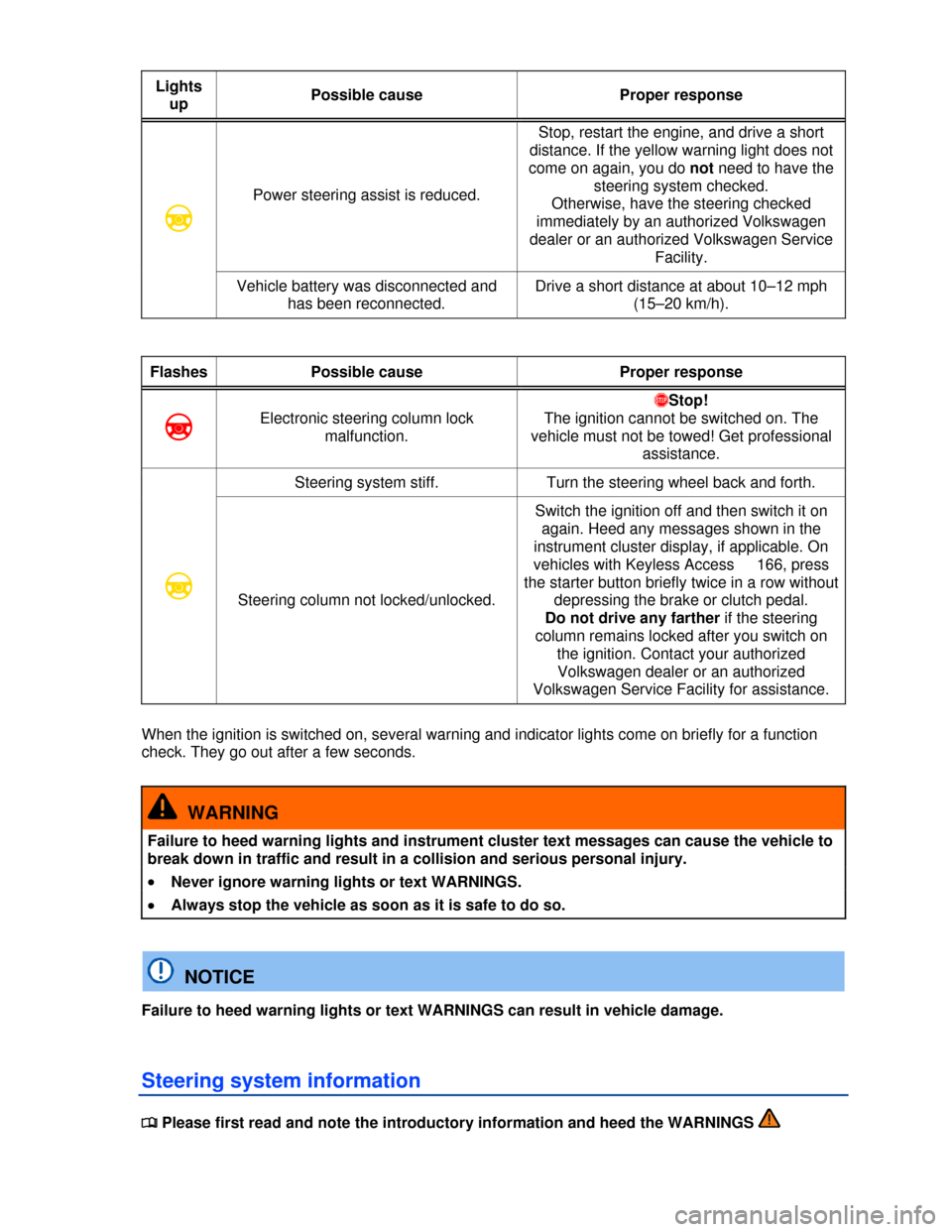
Lights
up Possible cause Proper response
D
Power steering assist is reduced.
Stop, restart the engine, and drive a short
distance. If the yellow warning light does not
come on again, you do not need to have the
steering system checked.
Otherwise, have the steering checked
immediately by an authorized Volkswagen
dealer or an authorized Volkswagen Service
Facility.
Vehicle battery was disconnected and
has been reconnected.
Drive a short distance at about 10–12 mph
(15–20 km/h).
Flashes Possible cause Proper response
D Electronic steering column lock
malfunction.
Page 194 of 321

To help make it more difficult to steal your vehicle, you should always make sure the steering column
is locked before leaving the vehicle.
Electronic steering column lock
Vehicles with Keyless Access: The steering column is locked if the driver door is opened with the
ignition switched off. The vehicle must be standing still and the transmission must be in Park (P) on an
automatic transmission vehicle.
If the driver door is opened before the ignition is switched off, the electronic steering column lock is
activated only after the vehicle has been locked with the vehicle key or via the sensor in the door
handle.
Mechanical steering column lock
Vehicles without Keyless Access: The steering column is locked if the vehicle is stationary and the
vehicle key is removed from the ignition switch.
Engaging the steering column
lock
Disengaging the steering column
lock
Parking the vehicle Turn the steering wheel slightly to
take pressure off the steering
column lock.
Remove the vehicle key. Insert the vehicle key into the
ignition switch.
Turn the steering wheel slightly until
you hear the steering column lock
engage.
Hold the steering wheel in this
position and turn the ignition switch.
Power steering
Power steering automatically adjusts to driving speed, steering torque, and the steering angle of the
wheels. Power steering works only when the engine is running.
If power steering is reduced or lost completely, it will be much harder to steer and control the vehicle.
Counter-steering assistance
Counter-steering assistance is part of Electronic Stability Control (ESC). This feature makes it easier
for the driver to control the vehicle in difficult situations. For example, if you have to brake hard on a
surface that provides uneven traction, the vehicle could pull to the right or left. ESC detects this
situation and helps the driver counter-steer with additional steering power ⇒ .
WARNING
The counter-steering assistance in ESC can do no more than help the driver steer in difficult
situations. The driver must still control the vehicle. The vehicle does not steer by itself with
this feature!
NOTICE
If the ignition is off, the steering column lock will engage and the vehicle cannot be steered.
For this reason, you must leave the ignition on when going through an automatic car wash, for
example, so that the wheels will still steer.
Page 196 of 321

Hill Hold keeps the brake applied for not quite 2 seconds with the same force you used to prevent the
vehicle from moving. This gives you time to take your foot off the brake, let the clutch out on a manual
transmission vehicle, and gently depress the accelerator to get the vehicle moving again. If you do not
depress the accelerator pedal and get the vehicle moving again within this time, the brakes will release
and the vehicle will roll downhill. Furthermore, if any requirement for engaging Hill Hold is no longer
met while the vehicle is stopped, Hill Hold disengages and the brakes are automatically released and
will no longer hold the vehicle.
Hill Hold is activated automatically when the following conditions are all met at the same
time.
Points 1 to 3 must all be met at the same time:
Manual transmission Automatic transmission
1. Hold the stopped vehicle on an incline with the foot or parking brake.
2. The engine must be running “smoothly.”
3.
A manual transmission vehicle must be in 1st
gear (1) if headed up a hill or in Reverse (R) if
backing up a hill; you must hold the clutch
down and the foot brake must be depressed to
keep the vehicle from moving.
An automatic transmission vehicle must be in
Reverse (R), Drive (D), or Sport Drive (S) and
the foot brake must be depressed to keep the
vehicle from moving.
4.
To drive off, take your foot off the brake pedal
as you let the clutch out and gently depress
the accelerator within 2 seconds.
To drive off, take your foot off the brake pedal
and gently depress the accelerator within
2 seconds.
Hill Hold is immediately deactivated:
x If any requirement listed in the table above is no longer met (see , Hill Hold is activated
automatically when the following conditions are all met at the same time.).
x If the engine is not running smoothly or the engine malfunctions.
x If the engine stalls or is switched off.
x Automatic transmission vehicles: If the transmission is in Neutral (N).
x Automatic transmission vehicles: If a tire does not have enough road contact (such as when the
vehicle is tipped or at an angle).
WARNING
The intelligent technology of Hill Hold cannot overcome the laws of physics. Never let the
increased convenience provided by Hill Hold tempt you into taking risks.
x The Hill Hold feature cannot hold the vehicle in all hill start situations (for example, if the
surface is icy or slippery).
x Hill Hold can only help keep the vehicle from moving for less than 2 seconds. After that,
the brakes will be released and the vehicle can roll down the hill.
Page 207 of 321
WARNING
Poor visibility increases the risk of collisions and other accidents that cause serious
personal injuries.
x Always make sure all windows are clear of ice, snow and condensation for good visibility
to the front, sides, and rear.
x Maximum heating output and defrosting performance are not possible until the engine has
reached operating temperature. Wait until you have good visibility before driving off.
x Always make sure you know how to properly use the climate control system as well as the
rear window defroster that you will need for good visibility.
x Never use air recirculation for long periods of time. When the air conditioner is off and
recirculation mode is on, condensation can quickly form on the windows and greatly reduce
visibility.
x Always switch off recirculation mode when it is not needed.
WARNING
Stale air causes driver fatigue and reduces driver alertness, which can cause accidents,
collisions and serious personal injury.
x Never switch off the fan for a long period of time and never use air recirculation a long
period of time because no fresh air will enter the passenger compartment.
NOTICE
x If you think the air conditioner is not working properly or may be damaged, switch it off to
help prevent more damage. Have the air conditioner checked by an authorized Volkswagen
dealer or an authorized Volkswagen Service Facility.
x Air conditioner repair requires specialized knowledge and special tools. Volkswagen
recommends that you see an authorized Volkswagen dealer or an authorized Volkswagen
Service Facility.
x Do not smoke when air recirculation is switched on. Smoke drawn into the ventilation
system can leave residue on the evaporator and on the dust and pollen active carbon filter,
resulting in permanent odors whenever the air conditioner is switched on.
If the air conditioner is switched off, the fresh outside air will not be dehumidified. To help keep
the windows from fogging over, Volkswagen recommends leaving the air conditioner (compressor)
switched on. Press the !
Page 208 of 321
Emergency starting and starting the engine with a very weak vehicle battery or after the vehicle
battery has been replaced may change or delete system settings (including time, date, personal
convenience settings, and programming). Check the settings and correct as necessary once the
vehicle battery has built up a sufficient charge.
Applicable only in the United States
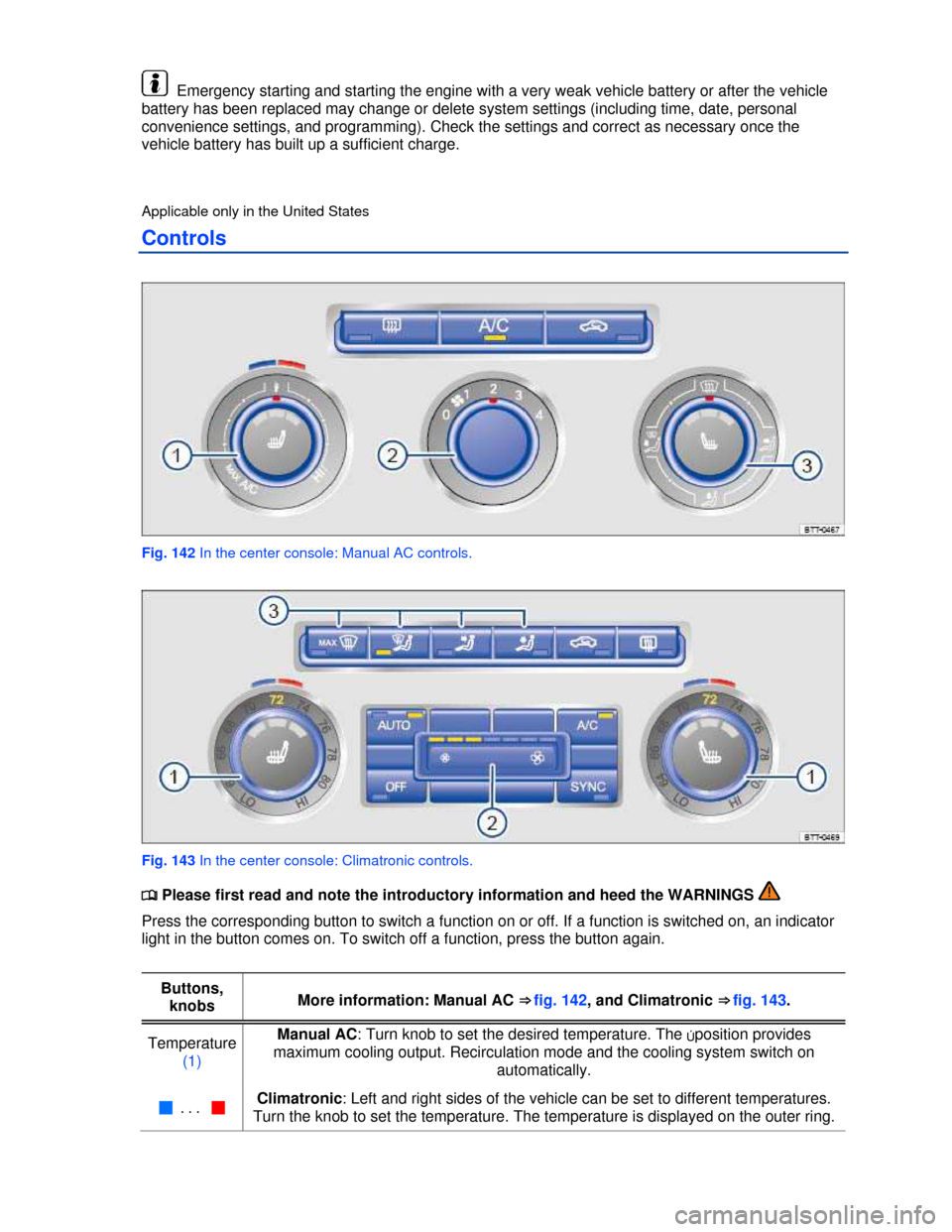
Controls
Fig. 142 In the center console: Manual AC controls.
Fig. 143 In the center console: Climatronic controls.