2013 SKODA YETI lock
[x] Cancel search: lockPage 231 of 266

Negative cable - colour coding in the majority of cases is black.
Jump-starting in vehicles with the START-STOP system
Fig. 180
Engine earth: START-STOP sys-
tem
First read and observe the introductory information and safety warn- ings on page 226.
On vehicles with the START-STOP system, the jump-start cable of the charger
must never be connected directly to the negative pole of the vehicle battery, but
only to the engine earth » Fig. 180.
Towing the vehicle
Introduction
This chapter contains information on the following subjects:
Front towing eye
229
Rear towing eye
229
Vehicles with a tow hitch
230
Vehicles with manual transmission may be towed in with a tow bar or a tow rope
or with the front or rear wheels raised.
Vehicles with automatic transmission may be towed in with a tow bar or a tow
rope or with the front wheels raised. If the vehicle is raised at rear, the automatic
gearbox is damaged!
A tow bar is the safest way of towing a vehicle and also minimises any shocks.
Only use a tow rope if a suitable tow bar is not available.
When towing, the following guidelines must be observed.
Driver of the tow vehicle›
Release the clutch particularly gently when starting off or depress the accelera-
tor particularly gently if the vehicle is fitted with an automatic gearbox.
›
On vehicles with a manual transmission, only push down on the accelerator pedal once the rope is taught.
The maximum towing speed is 50 km/h.
Driver of the towed vehicle
›
Switch on the ignition so that the steering wheel is not blocked and so that the
turn signal lights, horn, windscreen wipers and windscreen washer system can be used.
›
Take the vehicle out of gear or move the selector lever into position N if the ve-
hicle is fitted with an automatic gearbox.
Please note that the brake servo unit and power steering only operate if the en-
gine is running. If the engine is not running, significantly more physical force is re- quired to depress the brake pedal and steer the vehicle.
If using a tow rope, ensure that it is always kept taught.
CAUTION
■ Do not tow start the engine – there is a risk of damaging the engine and the
catalytic converter! The battery from another vehicle can be used as a jump-start aid » page 226 , Jump-starting .■
If the gearbox no longer contains any oil because of a defect, your vehicle must
only be towed with the driven wheels raised clear of the ground or on a special
breakdown vehicle or trailer.
■
The vehicle must be transported on a special breakdown vehicle or trailer if it is
not possible to tow in the vehicle in the way described or if the towing distance is
greater than 50 km.
■
To protect both vehicles when tow-starting or towing, the tow rope should be
elastic. Thus one should only use plastic fibre rope or a rope made out of a simi-
larly elastic material.
■
While towing, take care to avoid impermissibly high tensile forces or jerky loads.
There is always a risk of excessive stresses and damage resulting at the points to which you attach the tow rope or tow bar when you attempt to tow a vehicle
which is not standing on a paved road.
■
Attach the tow rope or the tow bar to the towing eyes » page 229
or » page 229 to the detachable ball head of the towing device » page 152 .
228Do-it-yourself
Page 234 of 266

Replacing the battery in the remote control keyFig. 183
Remove cover/take out battery
First read and observe the introductory information and safety warn-
ings
on page 230.
The battery change is carried out as follows.
›
Flip out the key.
›
Press off the battery cover
A
» Fig. 183 with your thumb or using a flat screw-
driver in the region of the arrows
1
.
›
Remove the discharged battery from the key by pressing the battery down in
the region of the arrow
2
.
›
Insert the new battery.
›
Place the battery cover
A
on the key and press it down until it clicks into place.
Note
■ The key has to be synchronised if the vehicle cannot be unlocked or locked with
the remote control key after replacing the battery » page 34.■
If a key has an affixed decorative cover, this will be destroyed when the battery
is replaced. A replacement cover can be purchased from a ŠKODA Partner.
replace battery in the remote control the auxiliary heating
(auxiliary heating)Fig. 184
Radio remote control: Battery
cover
First read and observe the introductory information and safety warn-
ings on page 230.
The battery is located under a cover on the back of the radio remote con-
trol » Fig. 184 .
›
Insert a flat, blunt object, such as a coin, into the gap of the battery cover.
›
Turn the cover against the direction of the arrow up to the mark to open the
cover.
›
Replace the battery.
›
Return the battery cover.
›
Turn the cover in the direction of the arrow up to the initial marking, engage.
231Emergency equipment and self-help
Page 235 of 266

replace batteries of the removable lightsFig. 185
Taking out the lamp
First read and observe the introductory information and safety warn-
ings on page 230.
The battery change is carried out as follows.
›
Take out the light in the direction of arrow » Fig. 185 .
›
Lever off the cover for the rechargeable batteries with a narrow and pointed
object from the location of the lock-off clips
A
.
›
Remove the faulty rechargeable batteries from the lamp.
›
Insert the new rechargeable batteries.
›
Insert the cover for the rechargeable batteries and press it down until it clicksinto place.
CAUTION
■ We recommend having faulty rechargeable batteries replaced by a ŠKODA serv-
ice partner. If the lamp is not correctly opened, it can be damaged.■
The replacement rechargeable batteries must have the same specification as
the original rechargeable batteries. If other types of rechargeable batteries are
used, the power output can be reduced or it can lead to a malfunction of the
lamp.
Emergency unlocking/locking
Introduction
This chapter contains information on the following subjects:
Unlocking/locking the driver's door
232
Locking the door without a locking cylinder
233
Unlocking the tailgate
233
Selector lever-emergency unlocking
233
Unlocking/locking the driver's door
Fig. 186
Handle on the driver: covered
door lock cylinder
First read and observe the introductory information given on page 232.
›
Pull on the handle.
›
Push the vehicle key into the recess on the bottom side of the cover in the re-
gion of the arrow and fold it upwards » Fig. 186.
›
Insert the vehicle key bit into the lock cylinder and unlock or lock the vehicle.
CAUTION
Make sure you do not damage the paint when performing an emergency locking/
unlocking.
232Do-it-yourself
Page 236 of 266

Locking the door without a locking cylinderFig. 187
Left rear door: Emergency lock-
ing
First read and observe the introductory information given on page 232.
An emergency locking mechanism is located on the face side of the doors which
have no locking cylinder, it is only visible after opening the door.
›
Remove the panel
A
» Fig. 187 .
›
Insert the key into the slot
B
and turn it into the horizontal position in the di-
rection of the arrow (mirror-inverted on the right doors).
›
Replace the cover.
After closing the door, it cannot be opened from the outside. The door is unlocked by pulling on the door opening lever and is then opened from the outside.
Unlocking the tailgate
Fig. 188
Emergency unlocking of the boot
lidFirst read and observe the introductory information given on page 232.
The boot lid can be unlocked manually if there is a fault in the central locking sys-
tem.
Unlocking
›
Fold the rear seat backrest forward » page 67, Rear seats .
›
Insert a screwdriver or similar tool into the opening in the trim » Fig. 188 as far
as the stop.
›
Unlock the lid in the direction of the arrow.
›
Open the boot lid.
Selector lever-emergency unlocking
Fig. 189
Selector lever-emergency unlocking
First read and observe the introductory information given on page 232.
›
Firmly apply the handbrake.
›
Insert a flathead screwdriver into the gap in the arrow range
1
» Fig. 189 and
lift the cover in arrow direction
2
.
›
Use a finger to press the yellow plastic part in the direction of the arrow
3
.
›
At the same time, press the locking button in the selector lever and move the selector lever to position N.
If the selector lever is moved again to position P, it is once again blocked.
233Emergency equipment and self-help
Page 238 of 266

CAUTIONIf the windscreen wipers are handled carelessly, there is a risk of damage to the
windscreen.
Replacing front windscreen wipers
Fig. 191
Windscreen wiper blade
First read and observe the introductory information and safety warn-
ings on page 234.
When in the rest position, the wiper arms cannot be fold down from the wind- screen. Before replacing the windscreen wiper blade, put the windscreen wiper
arms into the service position.
Service position for changing wiper blades
›
Closing the bonnet.
›
Switch the ignition off and on again.
›
Then press the windscreen wiper lever into position
4
» Fig. 36 on page 57
within 10 seconds – the wiper arms move into the service position.
Removing the wiper blade
›
Lift the windscreen wiper arm away from the windscreen.
›
Press the locking button
1
» Fig. 191 to unlock the wiper blade and pull off in
the direction of the arrow
2
.
Attaching the wiper blade
›
Push the windscreen wiper blade until the stop and it locks in place.
›
Check that the wiper blade is correctly attached.
›
Fold the wiper arms back to the windscreen.
The windscreen wiper arms move back into the rest position - after switching on
the ignition and changing the position of the window wiper lever or when driving
at a speed of more than 6°km/h.
Windshield wiper blades in proper condition are essential to obtain good visibility.
Wiper blades should not be allowed to become dirtied by dust, insect remains and
preserving wax.
Juddering or smearing of the wiper blades could then be due to wax residues left
on the windshield by vehicle washing in automatic vehicle wash systems. It is
therefore important to degrease the lips of the windshield wiper blades after ev-
ery pass through an automatic vehicle wash system .
Replacing the rear window wiper blade
Fig. 192
Rear window wiper blade
First read and observe the introductory information and safety warn-
ings on page 234.
Removing the wiper blade
›
Lift the wiper arm away from the window » Fig. 192.
›
Tilt the wiper blade to the stop in the direction of the wiper arm.
›
Hold the upper part of the wiper arm and unlock the securing mechanism
1
.
›
Remove the wiper blade in the direction of the arrow
2
.
Attaching the wiper blade
›
Push the windscreen wiper blade until the stop and it locks in place.
›
Check that the wiper blade is correctly attached.
›
Fold the wiper arm back to the windscreen.
235Emergency equipment and self-help
Page 240 of 266

›Insert a new fuse.›Replace the bracket at the original position.›
Re-insert the cover of the fuse box .
Fuse assignment in the dash panel
No.Power consumer1Heating of the gearbox ventilation (diesel engine)
Control unit for automatic gearbox DSG2-3Tow hitch4Instrument cluster, windshield wiper lever, turn signal light lever,
camera5Air blower for heating, radiator fan, air conditioning system, Clima-
tronic6Rear window wiper7Phone8Tow hitch9Vehicle voltage control unit - interior lights
Rear fog light10Rain sensor, light switch, diagnosis connector, removable light11Left side cornering lights12Right side cornering lights13Radio, DVD14Central control unit, engine control unit15Light switch16Haldex17KESSY controller, steering wheel locking18Diagnostic socket, engine control unit, brake sensor, Haldex19Control unit for ABS, ESP, switch for tyre air pressure control, control
unit for parking aid, switch for OFF ROAD mode, START STOP button20Switch and airbag control unit21WIV, tail lamp, dimming mirror, pressure sensor, telephone prepara- tion, air mass sensor, control unit for headlight range control and
headlight tilt22Instrument cluster controller for electro-mechanical power steering, control unit for data bus23Central locking system and bonnet lidNo.Power consumer24Rear power window25Rear window heater, auxiliary heating and ventilation26Power socket in the boot27Electric sliding/tilting roof, electric sun screen28Fuel pump, injection valves29Front power window30front and rear lighter31Headlight cleaning system32Front seat heating, regulator for seat heating33Heating, air conditioning, Climatronic, remote control for auxiliary
heating34Alarm, spare horn35Control unit for automatic gearbox DSG36Tow hitch
Fuses in the engine compartment
Fig. 194
Cover for the fuse box in the engine compartment / fuses
First read and observe the introductory information and safety warn-
ings
on page 236.
On some vehicles, the battery cover must be removed before removing the cover
for the fuse box » page 208.
237Fuses and light bulbs
Page 241 of 266
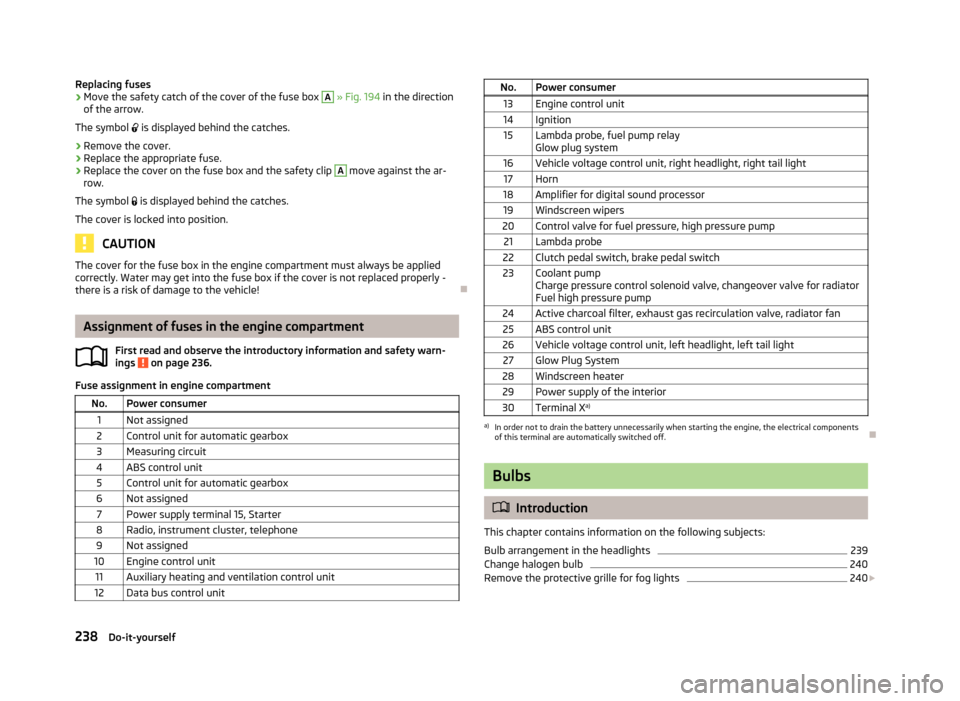
Replacing fuses›Move the safety catch of the cover of the fuse box A » Fig. 194 in the direction
of the arrow.
The symbol is displayed behind the catches.›
Remove the cover.
›
Replace the appropriate fuse.
›
Replace the cover on the fuse box and the safety clip
A
move against the ar-
row.
The symbol is displayed behind the catches.
The cover is locked into position.
CAUTION
The cover for the fuse box in the engine compartment must always be applied
correctly. Water may get into the fuse box if the cover is not replaced properly -
there is a risk of damage to the vehicle!
Assignment of fuses in the engine compartment
First read and observe the introductory information and safety warn-ings
on page 236.
Fuse assignment in engine compartment
No.Power consumer1Not assigned2Control unit for automatic gearbox3Measuring circuit4ABS control unit5Control unit for automatic gearbox6Not assigned7Power supply terminal 15, Starter8Radio, instrument cluster, telephone9Not assigned10Engine control unit11Auxiliary heating and ventilation control unit12Data bus control unitNo.Power consumer13Engine control unit14Ignition15Lambda probe, fuel pump relay
Glow plug system16Vehicle voltage control unit, right headlight, right tail light17Horn18Amplifier for digital sound processor19Windscreen wipers20Control valve for fuel pressure, high pressure pump21Lambda probe22Clutch pedal switch, brake pedal switch23Coolant pump
Charge pressure control solenoid valve, changeover valve for radiator
Fuel high pressure pump24Active charcoal filter, exhaust gas recirculation valve, radiator fan25ABS control unit26Vehicle voltage control unit, left headlight, left tail light27Glow Plug System28Windscreen heater29Power supply of the interior30Terminal X a)a)
In order not to drain the battery unnecessarily when starting the engine, the electrical components
of this terminal are automatically switched off.
Bulbs
Introduction
This chapter contains information on the following subjects:
Bulb arrangement in the headlights
239
Change halogen bulb
240
Remove the protective grille for fog lights
240
238Do-it-yourself
Page 243 of 266

Change halogen bulbFig. 196
Principle sketch: Change halogen bulb
First read and observe the introductory information and safety warn-
ings
on page 238.
›
Turn the respective protective cap » Fig. 195 on page 239 counter-clockwise and
remove.
When removing the cap, make sure that this does not fall into the engine com-
partment.
›
Turn the connector with the bulb in downwards in the direction of the arrow
1
» Fig. 196 and remove it in the direction of the arrow
2
.
›
Remove the connector.
›
Insert the connector with the new bulb so that the fixing lug
A
» Fig. 196 ad-
justs the bulb into the recess on the reflector.
›
Insert the respective protective cap » Fig. 195 on page 239 and rotate it clock-
wise until it stops.
Note
We recommend you have the bulb replacement performed by a specialist garage.
Remove the protective grille for fog lightsFig. 197
Guard: Version 1 / version 2
First read and observe the introductory information and safety warn- ings
on page 238.
›
Undo the protective grille in the direction of the arrow » Fig. 197 using the
clamp for removing the wheel trims » page 220, Vehicle tool kit .
›
Remove the protective grille.
240Do-it-yourself