2013 SKODA SUPERB seats
[x] Cancel search: seatsPage 86 of 274

Storage compartment in the rear armrestFig. 78
Opening the storage compart-
ment
First read and observe the introductory information and safety warn-
ings on page 74.
Opening
›
Lift button
A
on the front of the armrest and lift the storage compartment cov-
er in the direction of the arrow » Fig. 78.
Closing
›
Fold back the storage compartment lid in the opposite direction to that of the arrow » Fig. 78 until it clicks.
Rear seat backrest with long-cargo channel
Fig. 79
Rear seats: Cover handle/boot: Unlock button
First read and observe the introductory information and safety warn-
ings on page 74.
After folding the rear armrest and cover up, an opening in the seat backrest be-
comes visible through which the removable through-loading bag with skis can be
pushed. The armrest and cover can be folded forward from the passenger com-
partment or the boot.
Opening from the passenger compartment
›
Fold down the rear armrest » Fig. 58 on page 73.
›
Pull the handle
A
pull up to the stop in the direction of the arrow and fold the
cover down » Fig. 79 .
Opening from the boot
›
Push the unlock button
B
» Fig. 79 in the direction of the arrow and fold the
cover including the armrest forwards.
Closing
›
Fold the cover and rear armrest upwards to the stop - the cover must click into place.
Ensure that the armrest is always locked into place after closing. This is apparent
as the red field above the unlocking button
B
» Fig. 79 is not visible from the
boot.
WARNINGThe through-loading channel is only intended for transporting skis that are
placed in a properly secured, removable through-loading bag » page 84.
83Seats and useful equipment
Page 88 of 274

›Distribute loads as evenly as possible.›Place heavy objects as far forward as possible.›
Attach the items of luggage to the lashing eyes or using the nets
» page 86.
In the event of an accident, even small and light objects gain so much kinetic en-
ergy that they can cause severe injuries.
The magnitude of the kinetic energy is dependent on the speed at which the ve-
hicle is travelling and the weight of the object.
Example: In the event of a frontal collision at a speed of 50 km/h, an object with a
weight of 4.5 kg produces an energy, which corresponds to 20 times its own
weight. This means that it results in a weight of approx. 90 kg “ ”.
Luggage compartment light
The light switches on/off when the luggage compartment lid is opened or closed.
If the boot lid is open and the ignition switched off, the light will extinguish auto-
matically after around 10 minutes.
Boot light for Superb Combi vehicles » page 90.
WARNING■
Store the objects in the boot and attach them to the lashing eyes.■Loose objects can be thrown forward during a sudden manoeuvre or in case
of an accident and can injure the occupants or other road users.■
Loose objects could hit a deployed airbag and injure occupants – danger of
death!
■
Please note that transporting heavy objects alters the handling properties
of the vehicle due to the displacement of the centre of gravity – risk of acci-
dent! The speed and style of driving must be adjusted accordingly.
■
If the items of luggage or objects are attached to the lashing eyes with un-
suitable or damaged lashing straps, injuries can occur in the event of braking manoeuvres or accidents. To prevent items of luggage from moving around,
always use suitable lashing straps which must be firmly attached to the lash-
ing eyes.
■
The transported items must be stowed in such a way that no objects are
able to slip forward on sudden driving or braking manoeuvres – risk of injury!
■
When transporting objects in the luggage compartment that has been en-
larged by folding the rear seats forward, ensure the safety of the passengers transported on the other rear seats » page 171.
WARNING (Continued)■
If the rear seat next to the folded forward seat is occupied, ensure maxi-
mum safety, e.g. by placing the goods to be transported in such a way that the
seat is prevented from folding back in case of a rear collision.■
Do not drive with the luggage compartment lid fully opened or slightly ajar
otherwise exhaust gases may get into the interior of the vehicle – risk of poi-
soning!
■
Do not exceed the permissible axle loads and permissible gross weight of
the vehicle – risk of accident!
■
Do not transport people in the boot!
CAUTION
Make sure that transported objects with sharp edges do not damage the follow-
ing:■
heating elements in the rear window;
■
elements of the aerial integrated in the rear window;
■
Aerial filaments integrated in the rear side windows (Superb Combi).
Note
Tyre pressure must be adjusted to the load » page 221.
Class N1 vehicles
First read and observe the introductory information and safety warn-
ings
on page 84.
On class N1 vehicles, which are not fitted with a protective grille, a lashing set
which complies with the standard EN 12195 (1 - 4) must be used for fastening the
load.
85Seats and useful equipment
Page 90 of 274
›Superb Combi: Grip the hook B direction of the arrow and fold down in the di-
rection of arrow 2» Fig. 83 .
CAUTION
The maximum permissible load of the hook is 7.5 kg.
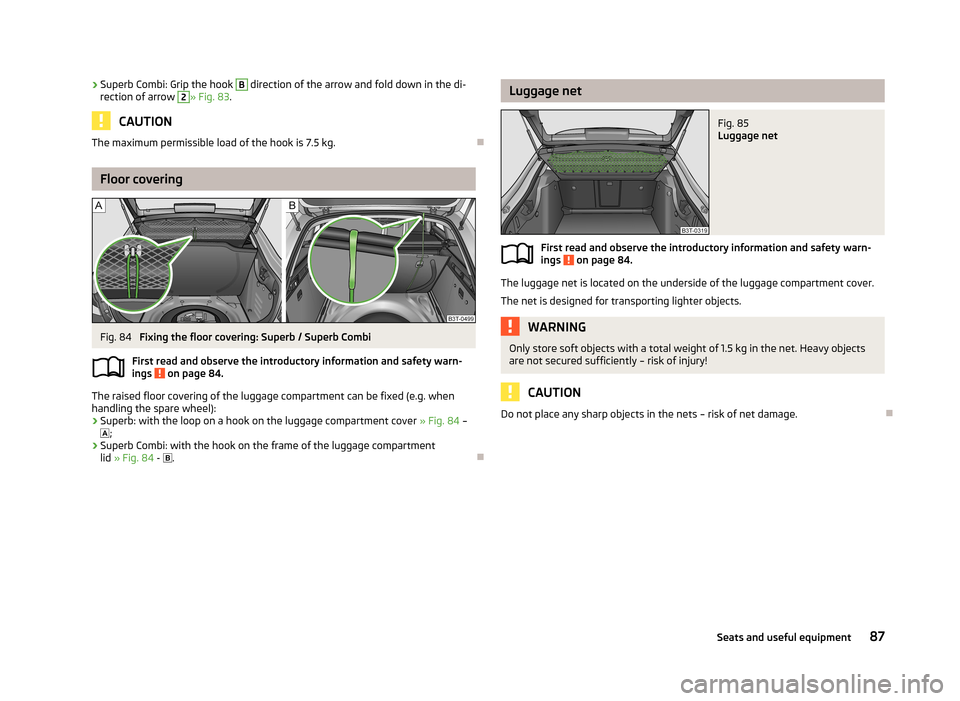
Floor covering
Fig. 84
Fixing the floor covering: Superb / Superb Combi
First read and observe the introductory information and safety warn- ings
on page 84.
The raised floor covering of the luggage compartment can be fixed (e.g. when
handling the spare wheel):
› Superb: with the loop on a hook on the luggage compartment cover
» Fig. 84 –
;
› Superb Combi: with the hook on the frame of the luggage compartment
lid » Fig. 84 -
.
Luggage netFig. 85
Luggage net
First read and observe the introductory information and safety warn-
ings on page 84.
The luggage net is located on the underside of the luggage compartment cover.
The net is designed for transporting lighter objects.
WARNINGOnly store soft objects with a total weight of 1.5 kg in the net. Heavy objects are not secured sufficiently – risk of injury!
CAUTION
Do not place any sharp objects in the nets – risk of net damage.
87Seats and useful equipment
Page 92 of 274

Automatic Retractable cargo cover (Superb Combi)First read and observe the introductory information and safety warn-
ings
on page 84.
The automatic rolling up of the foldable boot cover enables an easier entry into
the boot.
›
Open the boot lid.
The foldable boot cover rolls up automatically in the position
1
to » Fig. 87 on
page 88.
›
Push the cover in the area of the handle in the direction of the arrow
3
.
The cover retracts completely.
When the boot lid is opened quickly, the automatic rolling up of the foldable boot
cover is blocked for a delay time of approx. 2 seconds.
The function to automatically roll up the foldable boot cover can be activated/de- activated via the MAXI DOT display in the menu:
■ Settings
■ Auto Rollo
Side pockets in luggage compartment
Fig. 88
Superb boot: Open side compartment left / right
Fig. 89
Superb Combi boot: Open right
compartment
First read and observe the introductory information and safety warn-
ings on page 84.
Open / close compartment (Superb)
›
Turn the bolts in direction of arrow » Fig. 88 .
Closing takes place in the reverse order.
The CD changer and TV tuner are located in the right compartment » Fig. 88.
The first-aid box can also be stored in this compartment.
Open and close compartment / (Superb Combi)
›
Pull the handle in the direction of the arrow » Fig. 89.
Closing takes place in the reverse order.
The CD changer and TV Tuner are housed in this compartment.
The first-aid box and warning triangle can also be stored in this compartment.
89Seats and useful equipment
Page 94 of 274

The lamp is supplied by three rechargeable type AAA batteries. The rechargeable
batteries are constantly charged when the engine is running. It takes approx. 3
hours to fully charge the rechargeable batteries.
The lamp is fitted with magnets. Therefore it is possible to attach the lamp, forexample on the vehicle body, after removing it.
CAUTION
The removable lamp is not watertight and must therefore be protected against
moisture.
Note
■ If the lamp is not correctly inserted into the holder, it does not light up when
the boot lid is opened and the rechargeable batteries are not charged.■
If the lamp is not switched off and it is correctly inserted in the holder, the bulbs
in the front part
C
» Fig. 92 on page 91 of the lamp are automatically switched
off.
Use light
Fig. 92
Use light / remove light
First read and observe the introductory information and safety warn-
ings
on page 90.
Use light
›
If you press button
A
» Fig. 92 once, the lamp lights up with 100 % light inten-
sity.
›
If you press button
A
again, the lamp lights up with 50 % light intensity.
›
Press
A
button once again - the light goes out.
Remove the lamp from the holder›Grasp the lamp in the areas of the arrows D » Fig. 92 and swivel it in the direc-
tion of the arrow E
.
Reinserting the lamp the holder
›
First of all place the deactivated lamp in the holder on the side facing the boot lid and then press on the lamp from the other side until it is clicks into place.
Changing rechargeable light batteries
First read and observe the introductory information and safety warn-ings
on page 90.
Proceed as follows if you wish to replace the faulty rechargeable batteries your-
self:
›
Remove the lamp.
›
Lever off the cover for the rechargeable batteries with a narrow and pointed object from the location of the lock-off clips
F
» Fig. 92 on page 91.
›
Remove the faulty rechargeable batteries from the lamp.
›
Insert the new rechargeable batteries.
›
Insert the cover for the rechargeable batteries and press it down until it clicks
into place.
CAUTION
We recommend having faulty rechargeable batteries replaced by a ŠKODA service
partner. If the lamp is not correctly opened, it can be damaged.
For the sake of the environment
Dispose of used rechargeable batteries in accordance with national legal provi-
sions.
Note
■ Pay attention to the correct polarity when changing the rechargeable batteries.■The replacement rechargeable batteries must have the same specification as
the original rechargeable batteries. If other types of rechargeable batteries are
used, the power output can be reduced or it can lead to a malfunction of the
lamp.
91Seats and useful equipment
Page 96 of 274

Fit and remove variable loading floor94Fixing set94
Movable lashing eyes
95
The variable loading floor makes handling of bulky items of luggage easier.
CAUTION
The maximum permissible load of the variable loading floor is 75 kg.
Note
The space below the variable loading floor can be used for stowing objects, for
example the fastening elements, removed foldable boot cover, etc.
Partial extension of variable load floor
Fig. 95
Boot: partially pulling out the variable loading floor
First read and observe the introductory information and safety warn- ings
on page 92.
The variable loading floor can be partially pulled out over the rear bumper.
›
Grasp the rear of the variable loading floor by the handle and lift gently in the direction of the arrow
1
» Fig. 95 .
›
Extend the variable load floor over the bumper in the direction of the arrow
2
until it engages in the opening
C
.
The variable loading floor which is pulled out in such a way is solely used as a seat, for example for changing shoes.
› To push in the rear section of the variable loading floor, grasp by the handle and
lift slightly in the direction of the arrow 1.›
Slide the variable load floor forward up to the stop.
When pulling out the variable loading floor, the front edge (close to the rear seats) is lifted at the same time. Thus, small objects can no longer fall into the
space between the boot floor and the variable loading floor.
CAUTION
Ensure that the raised front edge of the variable loading floor is not damaged.
Divide boot
Fig. 96
Dividing the boot
First read and observe the introductory information and safety warn- ings on page 92.
The boot can be divided with the variable loading floor.
›
Grasp the rear of the variable loading floor by the handle and lift in the direction
of the arrow
1
» Fig. 95 on page 93 .
›
Insert the trailing edge in one of the openings
A
» Fig. 96 .
The variable loading floor is secured in the openings
A
against movement.
The variable loading floor can be pulled out a little more before dividing the boot
with the variable loading floor » page 93. This enlarges the space between the
rear seats and the separation.
CAUTION
Ensure that the raised front edge of the variable loading floor is not damaged.
93Seats and useful equipment
Page 98 of 274

›Ensure that the holder is correctly locked in place.›Place the object that is to be secured behind the tensioning strap.›
Press the button
5
on the top side of the holder and tighten the strap.
WARNINGThe objects in the boot must be firmly secured with the fixing set so that they
cannot move freely and uncontrollably and to prevent damage to objects or
injuries to occupants.
Note
■ Do not use the fixing set to secure objects that might damage the fixing set.■The tensioning strap can also be fully reeled up by pressing the button5
» Fig. 99 .
Movable lashing eyes
Fig. 100
Moveable lashing eyes
First read and observe the introductory information and safety warn-
ings on page 92.
There are four moveable lashing eyes in the boot that can, for example, be used
to attach the fixing nets.
›
Press the button
1
» Fig. 100 and push the lashing eye in the desired position
in the direction of the arrow
2
.
›
Fold up the clamp
3
» Fig. 100 and, for example, attach the fixing net.
Net partition (Superb Combi)
Introduction
This chapter contains information on the following subjects:
Using the net partition behind the rear seats
95
Using the net partition behind the front seats
96
Removing and refitting the net partition housing
96WARNING■ Ensure that the cross rod is inserted into the mounts C » Fig. 101 on
page 95 or » Fig. 102 on page 96 in the front position!■
The belt locks and the belts must be in their original position after folding
back the seat cushions and backrests - they must be ready to use.
■
The seat backrests must be securely locked in position so that no objects in
the luggage compartment can slide into the passenger compartment on sud-
den braking – risk of injury.
■
Ensure that the rear seat backrests are properly engaged. Only then can the
seat belt for the middle seat reliably fulfil its function.
Using the net partition behind the rear seats
Fig. 101
Net partition behind the front
seats in the pulled-out state
First read and observe the introductory information and safety warn-
ings on page 95.
Pulling out
›
Pull the net partition by the tab
A
» Fig. 101 in the direction of the fasteners
C
.
›
Insert the cross rod into one of the mounts
C
and push forwards.
95Seats and useful equipment
Page 99 of 274

›In the same way, insert the cross rod into the mount C on the other side of the
vehicle.
Folding›
First pull the cross rod back slightly on the one side and then on the other side and remove it from the mounts
C
» Fig. 101 .
›
Hold the cross rod in such a way that the net partition can slowly roll up into the
housing
B
without being damaged.
Note
If you wish to use the entire luggage compartment, the roll-up luggage compart-
ment cover can be removed » page 88.
Using the net partition behind the front seats
Fig. 102
Net partition behind the front
seats in the pulled-out state
First read and observe the introductory information and safety warn-
ings on page 95.
Pulling out
›
Fold the rear seats forward » page 73
.
›
Pull the net partition by the tab
A
» Fig. 102 .
›
First of all insert the cross rod into the mount
C
on one side and push it for-
ward.
›
In the same way, insert the cross rod into the mount
C
on the other side of the
vehicle.
Folding
›
First pull the cross rod back slightly on the one side and then on the other side and remove it from the mounts
C
» Fig. 102 .
›
Hold the cross rod in such a way that the net partition can slowly roll up into
the housing
B
without being damaged.
› Fold the rear seats back into their original positions
» page 73.
Removing and refitting the net partition housing
Fig. 103
Rear seats: Removing the net
partition housing
First read and observe the introductory information and safety warn- ings on page 95.
Removing
›
Fold the rear seats forward » page 73.
›
Open the rear right door.
›
Push the housing
A
in the direction of the arrow
1
and remove it from the
mounts on the right seat backrests in the direction of the arrow
2
» Fig. 103 .
Install
›
Insert the recesses on the housing
A
» Fig. 103 into the mounts on the rear
seat backrests.
›
Push the net partition housing in the opposite direction of the arrow
1
as far
as the stop.
›
Fold the rear seats back into their original positions » page 73.
Roof rack system
Introduction
This chapter contains information on the following subjects:
Attachment points
97
Roof load
97
96Using the system