2013 SKODA SUPERB alarm
[x] Cancel search: alarmPage 83 of 274

Glasses storage boxFig. 72
Opening the glasses storage box
First read and observe the introductory information and safety warn-ings on page 74.
Opening
›
Press the button
A
» Fig. 72 .
The box folds in the direction of the arrow.
Closing
›
Swivel the lid on the glasses storage box against the direction of the ar- row » Fig. 72 until it is heard to lock.
WARNING■
The compartment must only be opened when removing or inserting the
spectacles and otherwise must be kept closed!■
The box must be closed before leaving and locking the vehicle – risk of im-
pairment to the functions of the anti-theft alarm system!
CAUTION
Do not put any heat-sensitive objects in the glasses storage box - they may be
damaged.
Storage compartment on the passenger sideFig. 73
Tray open / operating air supply
First read and observe the introductory information and safety warn- ings
on page 74.
A pen holder is provided in the stowage compartment.
Opening
›
Press the button » Fig. 73 -
.
The flap folds down.
Closing
›
Lift the lid upwards until it clicks into place.
Air supply
›
Open the air supply by pulling the lever in the direction of the arrow » Fig. 73 -
.
›
The air supply is closed by pressing the lever in the opposite direction to that of
the arrow.
Opening the air supply when the air conditioning system is switched on allows
cooled air to flow into the storage compartment.
Opening the air inlet when the air conditioning system is on causes fresh or inte-rior air to flow into the storage compartment.
We recommend closing the air supply if it is operated in heating mode or the cool-ing system for the storage compartment is not being used.
80Using the system
Page 168 of 274

CAUTION■If the lever is held firm and not pushed downwards as far as it can go, it will go
back up after the ball head is removed and will not latch into the ready position.
The tow bar will then need to be brought into this position before the next time it is fitted.■
Stow the ball head in the ready position with the key inserted in the box. When
doing so, make the side opposite to the inserted key face downwards – there is a
risk of damaging the key.
■
Do not use excessive force when handling the operating lever (e.g. do not step
on it).
Note
■ We recommend putting the protective cover onto the ball head before removing
the tow bar.■
Clean any dirt from the tow bar before stowing it away in the box with the vehi-
cle tool kit.
Use and care
First read and observe the introductory information and safety warn-
ings
on page 162.
Close the mounting recess with the cover to prevent any dirt from getting in.
Always check the tow bar before hitching a trailer. Apply suitable grease where
necessary.
Use the protective cover when stowing away the tow bar, in order to stop the
boot from getting dirty.
In the event of dirt, clean the surfaces of the mounting recess and treat with a
suitable preservative.
CAUTION
Apply grease to the upper part of the mounting recess. Make sure you do not re-
move any grease.
Trailer
Introduction
This chapter contains information on the following subjects:
Loading a trailer
165
Driving with a trailer
166
Trailer stabilisation
167
Anti-theft alarm system
167WARNINGAlways drive particularly carefully with the trailer.
Loading a trailer
First read and observe the introductory information and safety warn-
ings
on page 165.
The vehicle/trailer combination must be balanced, whereby the maximum permis-
sible drawbar load must be utilised. If the drawbar load is too low, it jeopardises the performance of the vehicle/trailer combination.
Distribution of the load
Distribute the load in the trailer in such a way that heavy items are located as close to the axle as possible. Secure the items from slipping.
The distribution of the weight is very poor if your vehicle is unladen and the trail-
er is laden. Maintain a particularly low speed if you cannot avoid driving with this combination.
Tyre pressure
Correct the tyre inflation pressure on your vehicle for a “full load” » page 221,
Service life of tyres .
Trailer load
The permissible trailer load must not be exceeded under any circumstan-
ces » page 252 , Technical data .
The trailer loads specified apply only to altitudes up to 1 000 metres above mean
sea level.
165Towing a trailer
Page 170 of 274

WARNING■Never use the safety eyelet for towing!■Adapt your speed to the conditions of the road surface and to the traffic sit-
uation.■
Improper or incorrectly connected electric cables can energise the trailer and
cause functional faults to the vehicle's entire electrical system as well as acci-
dents and severe injuries.
■
Work on the electrical system must only be carried out by specialist garages.
■
Never directly connect the trailer's electrical system with the electrical con-
nections for the tail lights or other current sources.
Note
■ After coupling the trailer and connecting the power socket, check that the rear
lights on the trailer are working correctly.■
If there is an error in the trailer lighting, check the fuses in the fuse box in the
dash panel » page 244.
■
Contact between the breakaway cable and the safety eyelet can result in me-
chanical wear on the surface protection of the eyelet. Such wear does not impair
the functioning of the safety eyelet and does not constitute a fault. It is excluded from the warranty coverage.
■
If you tow a trailer frequently, you should also have your vehicle inspected be-
tween service intervals.
■
The handbrake on the towing vehicle must be applied when coupling and un-
coupling the trailer.
Trailer stabilisation
First read and observe the introductory information and safety warn-
ings
on page 165.
The trailer stabilisation is an extension of the stabilisation control that works in
conjunction with the counter-steering assistance to reduce the amount the trail-
er "sways".
After turning on the ignition, the ESC indicator light
in the instrument cluster
lights up for about 2 seconds longer than the ABS indicator light.
Function requirements for trailer stabilisation.
The coupling device was factory-fitted or purchased from the ŠKODA OriginalAccessories.
The ESC is active. (Warning lights or do not illuminate in the instrument
cluster).
The trailer is electrically connected to the towing vehicle via the trailer sock-
et.
The speed is higher than approx. 60 km/h.
The trailer has a rigid drawbar.WARNINGThe increased safety offered by the trailer stabilisation must not tempt you to take greater risks than otherwise.
CAUTION
■ The trailer stabilisation need not be able to correctly detect all of driving situa-
tions.■
Light trailers that sway are not always detected and therefore stabilised accord-
ingly by the trailer stabilisation.
■
Release the pressure on the accelerator pedal if the system is being regulated.
■
Avoid abrupt and sudden driving/braking manoeuvres.
Note
The trailer stabilisation works for both braked and unbraked trailers.
Anti-theft alarm system
First read and observe the introductory information and safety warn-
ings
on page 165.
When the vehicle is locked, the alarm is activated when the electrical connection
to the trailer is interrupted.
Always switch off the anti-theft alarm system before a trailer is coupled or uncou- pled » page 38 .
167Towing a trailer
Page 171 of 274

Conditions for including a trailer in the anti-theft alarm system.The vehicle is factory-fitted with an anti-theft alarm system and towing de-
vice.
The trailer is electrically connected to the towing vehicle via the trailer sock-
et.
The electrical system of the vehicle and trailer is functional.
The vehicle is locked with the vehicle key and the anti-theft alarm system is
activated.
Note
For technical reasons, trailers with rear LED lights cannot be connected to the an-
ti-theft alarm system.168Driving
Page 248 of 274

›Clip it onto the respective fuse and pry out.›Insert a new fuse.›
Return the clip to its original place.
›
Re-insert the cover of the fuse box .
Fuse assignment in the dash panel
No.Power consumer1Diagnostic socket, engine control unit, fuel pump relay, fuel pump
control unit2ABS control unit, ESC switch for tyre pressure warning, brake sensor, for START-STOP coil of the starter relay only3Switch and airbag control unit4WIV, tail lights, dimming mirrors, pressure sensor, telephone preinstal-lation5Control unit for headlight beam adjustment and headlight swivel, con-trol unit for parking aid, control unit for park assist6Instrument cluster, control unit for electromechanical power steering,
selector lever lock, power supply for data bus7Heated opening of the crankcase ventilation, air flow meter8Control unit for trailer detection9Relay for auxiliary heating and ventilation10Adaptive left main headlight11Adaptive right main headlight12Not assigned13Diagnostic socket, light switch, rain sensor, clock14Central locking system and bonnet lid15Central control unit - interior lights16The air conditioning system17Not assigned18Phone19Instrument cluster, wind-shield wiper lever and turn signal lever, the relay coil for heating wind-shield20KESSY21KESSY ELV22Air blower for Climatronic23Front power window, central locking of the front doorsNo.Power consumer24Selector lever lock25Rear window heater, relay for auxiliary heating and ventilation26Power socket in the boot27Fuel pump relay, control unit for fuel pump, injection valves28Electric boot lid29Haldex30Climate controlled front seats31DVD pre-installation32Front power window, central locking system of the rear doors33Electric sliding/tilting roof34Alarm, spare horn35front and rear lighter36Headlight cleaning system37Heated front seats38Heated rear seats39Rear window wiper40Fan air-conditioning system, relay for auxiliary heating and ventilation41Not assigned42Light switch43Control unit for trailer detection44Control unit for trailer detection45Control unit for trailer detection46Switch for seat heating47Telephone preinstallation48Preparation for the aftermarket radio49Only for START-STOP: Central control unit, DC-DC converter, the en-
gine control unit
245Fuses and light bulbs
Page 263 of 274
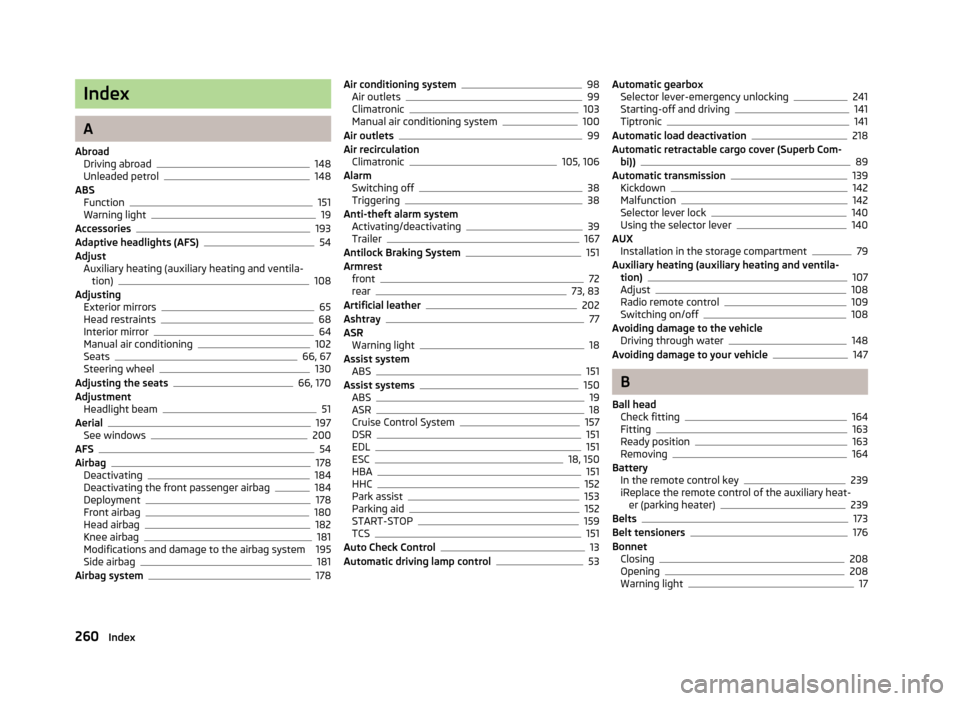
Index
A
Abroad Driving abroad
148
Unleaded petrol148
ABS Function
151
Warning light19
Accessories193
Adaptive headlights (AFS)54
Adjust Auxiliary heating (auxiliary heating and ventila-
tion)
108
Adjusting Exterior mirrors
65
Head restraints68
Interior mirror64
Manual air conditioning102
Seats66, 67
Steering wheel130
Adjusting the seats66, 170
Adjustment Headlight beam
51
Aerial197
See windows200
AFS54
Airbag178
Deactivating184
Deactivating the front passenger airbag184
Deployment178
Front airbag180
Head airbag182
Knee airbag181
Modifications and damage to the airbag system 195 Side airbag
181
Airbag system178
Air conditioning system98
Air outlets99
Climatronic103
Manual air conditioning system100
Air outlets99
Air recirculation Climatronic
105, 106
Alarm Switching off
38
Triggering38
Anti-theft alarm system Activating/deactivating
39
Trailer167
Antilock Braking System151
Armrest front
72
rear73, 83
Artificial leather202
Ashtray77
ASR Warning light
18
Assist system ABS
151
Assist systems150
ABS19
ASR18
Cruise Control System157
DSR151
EDL151
ESC18, 150
HBA151
HHC152
Park assist153
Parking aid152
START-STOP159
TCS151
Auto Check Control13
Automatic driving lamp control53
Automatic gearbox Selector lever-emergency unlocking241
Starting-off and driving141
Tiptronic141
Automatic load deactivation218
Automatic retractable cargo cover (Superb Com- bi))
89
Automatic transmission139
Kickdown142
Malfunction142
Selector lever lock140
Using the selector lever140
AUX Installation in the storage compartment
79
Auxiliary heating (auxiliary heating and ventila- tion)
107
Adjust108
Radio remote control109
Switching on/off108
Avoiding damage to the vehicle Driving through water
148
Avoiding damage to your vehicle147
B
Ball head Check fitting
164
Fitting163
Ready position163
Removing164
Battery In the remote control key
239
iReplace the remote control of the auxiliary heat-
er (parking heater)
239
Belts173
Belt tensioners176
Bonnet Closing
208
Opening208
Warning light17
260Index