2013 SKODA ROOMSTER immobilizer
[x] Cancel search: immobilizerPage 99 of 219

It is still fully possible to steer the vehicle if the power steering fails or if the en-gine is not running (e.g. when towing). However, greater physical effort is re-
quired to turn the steering wheel.
CAUTION
You will place great stresses on the power steering system if the steering is
turned to full lock when the vehicle is stationary. Turning the steering to full lock
in such a situation will be accompanied by noises. Never leave the steering wheel at full lock for more than 15 seconds when the engine is running - there is a risk of
damaging the power steering.
Starting and stopping the engine
Introduction
This chapter contains information on the following subjects:
Electronic immobilizer
97
Ignition lock
97
Engine
97
Switching off the engine
98
The engine can only be started using a correctly coded original key. The engine running noises may louder at first be louder for a short time afterstarting the cold engine. This is quite normal and is not an operating problem.
WARNING■ When the vehicle is travelling with the engine off, the ignition key must al-
ways be in position 2 » Fig. 89 on page 97 (ignition switched on). This posi-
tion is indicated by the warning lights coming on. If this is not the case, this
could result in unexpected locking of the steering wheel – risk of accident!■
Only pull the ignition key from the ignition lock when the vehicle has come
to a complete stop (by applying the handbrake). Otherwise, the steering could
be blocked – risk of accident!
■
When leaving the vehicle, the ignition must always be removed. This is par-
ticularly important if children are left in the vehicle. Children could otherwise
start the engine for example – risk of accident or injury!
WARNING (Continued)■ Never leave the vehicle unattended with the engine running.■Never switch off the engine before the vehicle is stationary – risk of acci-
dent!WARNING■ Never leave the engine running in unventilated or closed rooms. The ex-
haust gases from the engine contain substances such as odourless and col-
ourless carbon monoxide (a poisonous gas) – risk to life! ■ Carbon monoxide can cause unconsciousness and death.
CAUTION
■The starter must only be operated when the engine is not running and the vehi-
cle is at a standstill. The starter or engine can be damaged if the starter is activa-
ted when the engine is running 3
» Fig. 89 on page 97.
■
If the engine does not start up after a second attempt, the fuse for the fuel
pump may have a fault. Check the fuse and replace if necessary » page 191, or
seek assistance from a specialist garage.
■
Let go of the ignition key as soon as the engine starts otherwise the starter
could be damaged.
■
Do not tow start the engine – there is a risk of damaging the engine and the
catalytic converter. The battery from another vehicle can be used as a jump-start
aid » page 186 , Jump-starting .
CAUTION
■
Avoid high engine revolutions, full throttle and high engine loads before the en-
gine has reached its operating temperature – risk of damaging the engine!■
Do not switch the engine off immediately at the end of your journey after the
engine has been operated over a prolonged period at high loads but leave it to
run at an idling speed for about 1 minute. This prevents any possible accumulation
of heat when the engine is switched off.
For the sake of the environment
Do not warm up the engine while the vehicle is stationary. If possible, start your
journey as soon as the engine has started. Through this the engine reaches its
operating temperature more rapidly and the pollutant emissions are lower. 96Driving
Page 100 of 219
NoteAfter switching off the ignition, the radiator fan can intermittently continue to op-
erate for approx. 10 minutes.
Electronic immobilizer
First read and observe the introductory information and safety warn-ings
on page 96.
An electronic chip is integrated in the head of the key. The immobiliser is deacti-
vated with the aid of this chip when the key is inserted in the ignition lock. The
electronic immobiliser is automatically activated when the ignition key is with-
drawn from the lock.
The engine will not start if a non-authorized ignition key is used.
The MAXI DOT display shows the following: Immobilizer active.
Ignition lock
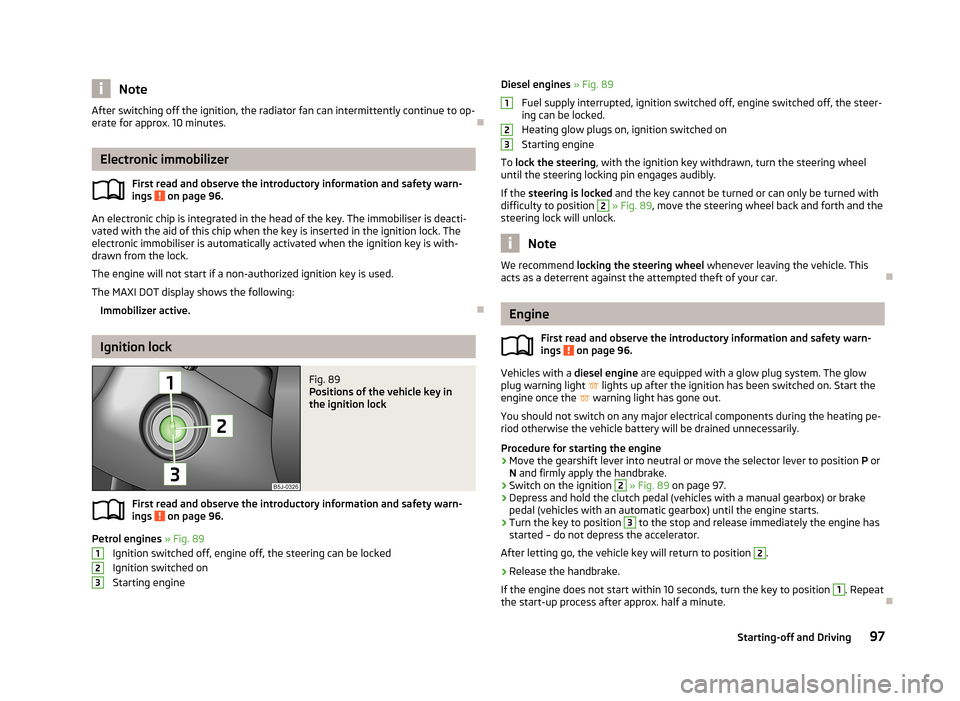
Fig. 89
Positions of the vehicle key in
the ignition lock
First read and observe the introductory information and safety warn-
ings on page 96.
Petrol engines » Fig. 89
Ignition switched off, engine off, the steering can be locked
Ignition switched on Starting engine
123Diesel engines » Fig. 89
Fuel supply interrupted, ignition switched off, engine switched off, the steer-
ing can be locked.
Heating glow plugs on, ignition switched on
Starting engine
To lock the steering , with the ignition key withdrawn, turn the steering wheel
until the steering locking pin engages audibly.
If the steering is locked and the key cannot be turned or can only be turned with
difficulty to position 2
» Fig. 89 , move the steering wheel back and forth and the
steering lock will unlock.
Note
We recommend locking the steering wheel whenever leaving the vehicle. This
acts as a deterrent against the attempted theft of your car.
Engine
First read and observe the introductory information and safety warn-
ings
on page 96.
Vehicles with a diesel engine are equipped with a glow plug system. The glow
plug warning light
lights up after the ignition has been switched on. Start the
engine once the
warning light has gone out.
You should not switch on any major electrical components during the heating pe- riod otherwise the vehicle battery will be drained unnecessarily.
Procedure for starting the engine
›
Move the gearshift lever into neutral or move the selector lever to position P or
N and firmly apply the handbrake.
›
Switch on the ignition
2
» Fig. 89 on page 97.
›
Depress and hold the clutch pedal (vehicles with a manual gearbox) or brake
pedal (vehicles with an automatic gearbox) until the engine starts.
›
Turn the key to position
3
to the stop and release immediately the engine has
started – do not depress the accelerator.
After letting go, the vehicle key will return to position
2
.
›
Release the handbrake.
If the engine does not start within 10 seconds, turn the key to position
1
. Repeat
the start-up process after approx. half a minute.
12397Starting-off and Driving
Page 211 of 219

Driving economicallyEconomical gear changing105
Driving through water108
E
Economical and environmentally friendly driving 104
Economical driving Ballast
106
Driving at full throttle105
Idling106
Looking ahead105
Regular maintenance107
Saving energy107
Short distances106
Tyre pressure106
EDL111
Electrical power windows Button in the driver's door
38, 39
Button in the rear door39
Central locking system40
Operational faults40
Electronic Differential Lock111
Electronic immobilizer97
emergency opening the loading door (Praktik)
75
Emergency Changing a wheel
180
Hazard warning light system45
jump-starting187
Jump-starting186
locking of the doors31
Selector lever-unlocking103
Towing the vehicle188
Towing the vehicle using the tow hitch189
Tyre repair184
Unlocking the boot lid38
Emergency equipment Fire extinguisher
179
First aid kit179
Jack180
Vehicle tool kit180
Warning triangle179
Emissions199
Engine Running in
103
Starting and stopping the engine96
Switching off the engine98
Engine compartment159
Brake fluid167
Coolant166
Overview162
Vehicle battery168
Engine oil163
Capacity163
Changing165
Checking164
Replenishing165
Specifications163
Warning light21
Engine revolutions counter11
Environment104
Environmental compatibility107
Environmentally friendly driving104
ESC Function
110
Warning light23
F
Films
152
Fire extinguisher179
First aid kit179
Flashers43
Fog lights44
Folding down the seats
54
Footmats100
see Footmats100
Front airbag134
Front seats52
Fuel157
Diesel159
Fuel gauge11
gauge11
refer to Fuel157
Refuelling157
Unleaded petrol158
Fuel consumption104
Fuses Assignment
191
Colour coding191
Replacing191
G
Gear Recommended gear
13
Gearbox Display messages
19
Gear changing Gear stick
99
General view Cockpit
9
Glow plug system Warning light
24
GSM86
H
Handbrake
99
Hazard warning light system45
Head airbag136
Headlight cleaning system Headlight cleaning system
50
Headlights195
Driving abroad109
Headlight cleaning system50
Headrest Headrest
57
Head restraint56
208Index
Page 212 of 219

HeatingDeicing the windows79
Exterior mirrors51
Operating78
Operation79
Rear window47
Recirculated air mode80
Seats53
Heating and air-conditioning77
Hill hold control110
Horn9
I
Ignition
97
Ignition lock97
Immobilizer97
Individual settings locking
32
unlocking32
Inertia reels130
Instrument cluster10
Overview10
Interior monitor36
Internal lighting Praktik
75
Internal lights Praktik
75
ISOFIX141
J
Jack
180
Jacking points Raise vehicle
183
Jump-starting186, 187
L
lashings Praktik
74
LightCockpit46
Headlight beam adjustment42
Headlight flash43
Replacing bulbs194
Lights41
Cockpit46
Daylight running42
Fog lights44
Foglights with the CORNER function44
Halogen projector headlights with cornering light
function
43
Hazard warning light system45
Low beam lights41
Main beam lights43
Parking lights41, 45
Rear fog light44
Switching on and off41
Tourist lights44
Turn signals43
warning lights20
Loads199
Lock Central locking system
33
Locking Emergency locking
31
Remote control34
without central locking30
Locking and unlocking from the inside33
Low beam lights41
Luggage compartment Class N1 vehicles
58
Lighting47
Variable loading floor61
Luggage compartment lid37
M
Main beam
43
Maintenance107
Decorative films152
Manual air conditioning Recirculated air mode82
Manual gear changing see gear changing
99
Materials defect liability5
MAXI DOT Main menu
18
see MAXI DOT display18
Settings18
MAXI DOT display18
Maximum speed202
MDI94
Mirror Exterior mirrors
51
Manually dimmed rear-view mirror51
Vanity48
Mobile phone86
Connecting to the hands-free system89
Modes of the automatic transmission101
Modifications146
Modifications and technical alterations Airbags
148
Service147
Spoiler148
Multifunction display Functions
13
Memory14
Operation14
Multimedia92
N
N1
58
Net partition60
O
Oil See Engine oil
164
Oil pressure Display messages
21
209Index