2013 SKODA ROOMSTER towing
[x] Cancel search: towingPage 72 of 219
stowage compartments in the luggage73Flexible storage compartment73WARNING■Do not place anything on the dash panel. These objects might slide or fall
down while you are driving (under acceleration or when cornering) and could
distract you from the traffic - there is a risk of an accident.■
Make sure that no objects from the centre console or from other storage
compartments can get into the driver's footwell while you are driving. You
would then no longer be able to apply the brakes or operate the clutch or ac-
celerator pedal – there is a risk of an accident.
Storage compartment on the front passenger side
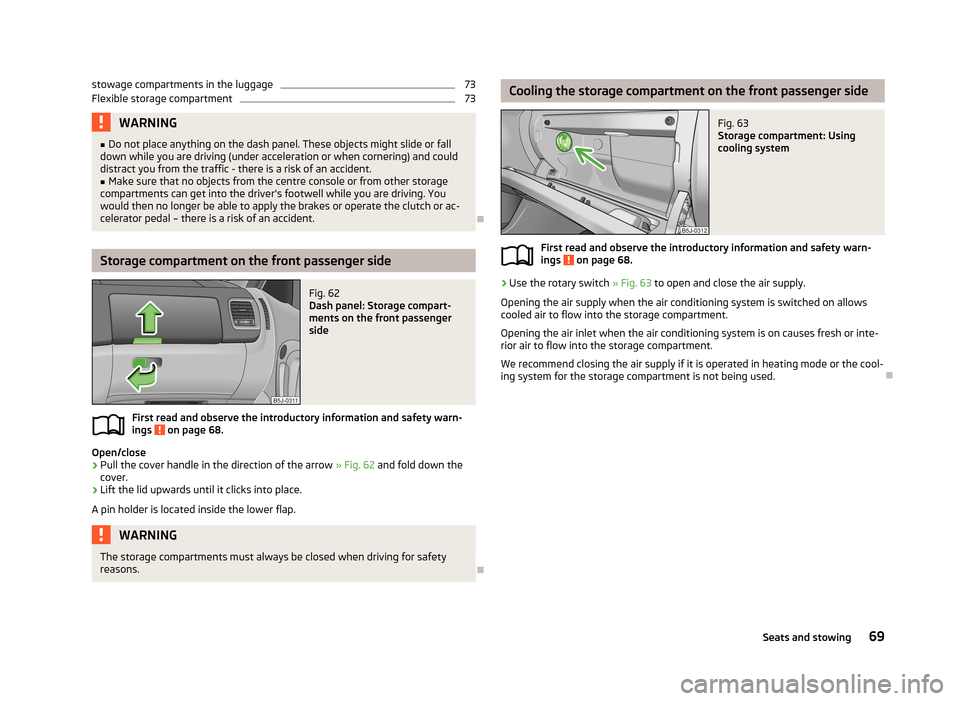
Fig. 62
Dash panel: Storage compart-
ments on the front passenger
side
First read and observe the introductory information and safety warn- ings on page 68.
Open/close
›
Pull the cover handle in the direction of the arrow » Fig. 62
and fold down the
cover.
›
Lift the lid upwards until it clicks into place.
A pin holder is located inside the lower flap.
WARNINGThe storage compartments must always be closed when driving for safety
reasons.
Cooling the storage compartment on the front passenger sideFig. 63
Storage compartment: Using
cooling system
First read and observe the introductory information and safety warn-
ings on page 68.
›
Use the rotary switch » Fig. 63 to open and close the air supply.
Opening the air supply when the air conditioning system is switched on allows
cooled air to flow into the storage compartment.
Opening the air inlet when the air conditioning system is on causes fresh or inte-rior air to flow into the storage compartment.
We recommend closing the air supply if it is operated in heating mode or the cool-ing system for the storage compartment is not being used.
69Seats and stowing
Page 74 of 219
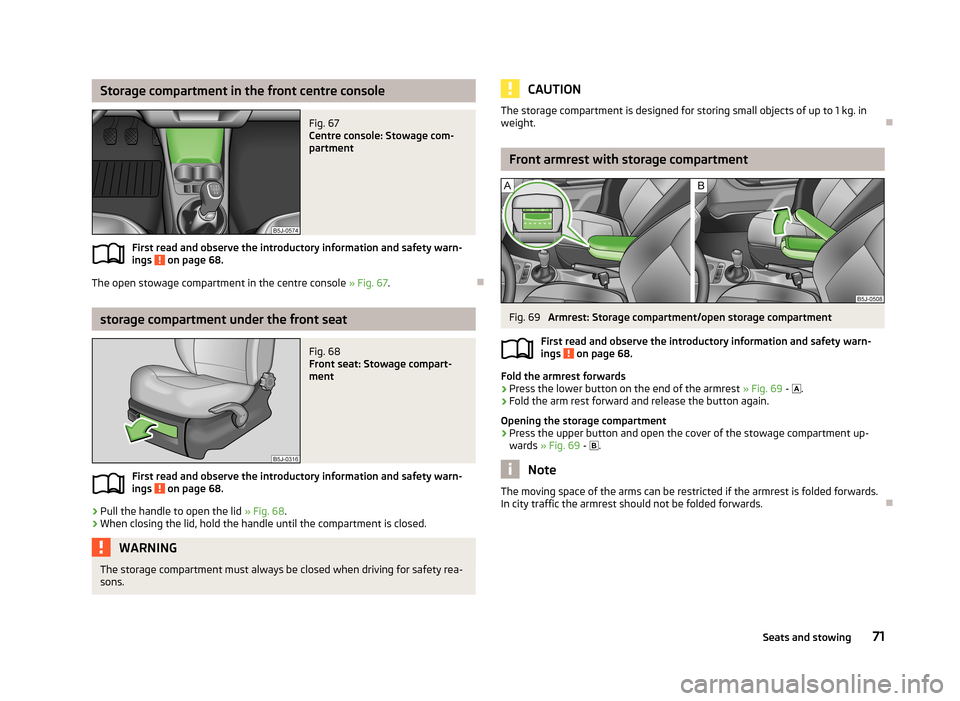
Storage compartment in the front centre consoleFig. 67
Centre console: Stowage com-
partment
First read and observe the introductory information and safety warn-
ings on page 68.
The open stowage compartment in the centre console » Fig. 67.
storage compartment under the front seat
Fig. 68
Front seat: Stowage compart-
ment
First read and observe the introductory information and safety warn-
ings on page 68.
›
Pull the handle to open the lid » Fig. 68.
›
When closing the lid, hold the handle until the compartment is closed.
WARNINGThe storage compartment must always be closed when driving for safety rea-
sons.CAUTIONThe storage compartment is designed for storing small objects of up to 1 kg. in
weight.
Front armrest with storage compartment
Fig. 69
Armrest: Storage compartment/open storage compartment
First read and observe the introductory information and safety warn- ings
on page 68.
Fold the armrest forwards
›
Press the lower button on the end of the armrest » Fig. 69 -
.
›
Fold the arm rest forward and release the button again.
Opening the storage compartment
›
Press the upper button and open the cover of the stowage compartment up- wards » Fig. 69 -
.
Note
The moving space of the arms can be restricted if the armrest is folded forwards.
In city traffic the armrest should not be folded forwards.
71Seats and stowing
Page 76 of 219
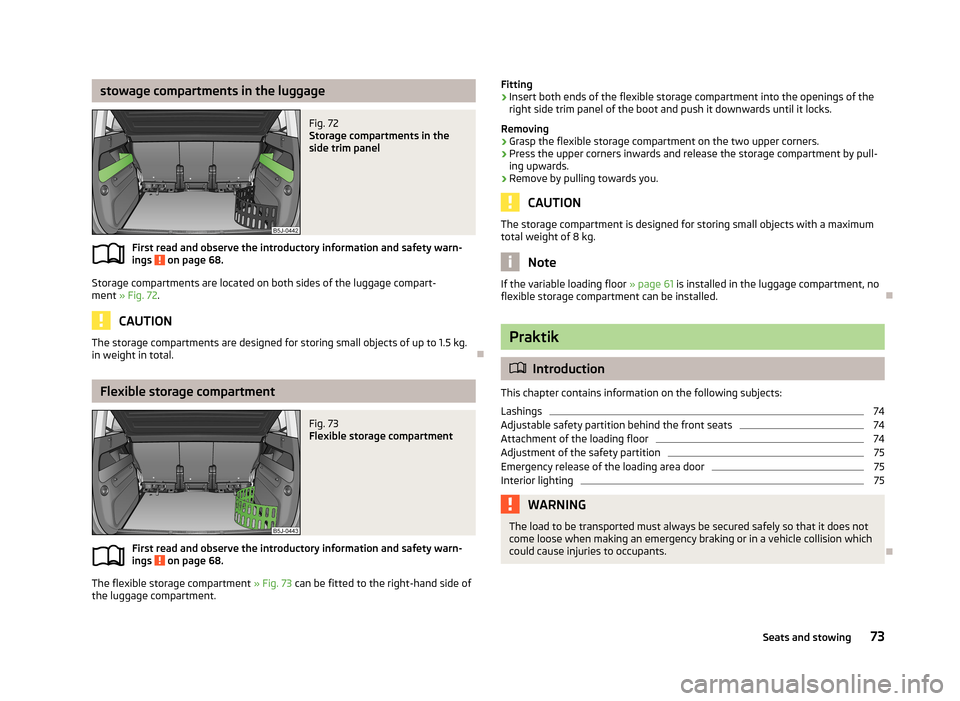
stowage compartments in the luggageFig. 72
Storage compartments in the
side trim panel
First read and observe the introductory information and safety warn-
ings on page 68.
Storage compartments are located on both sides of the luggage compart-
ment » Fig. 72 .
CAUTION
The storage compartments are designed for storing small objects of up to 1.5 kg.
in weight in total.
Flexible storage compartment
Fig. 73
Flexible storage compartment
First read and observe the introductory information and safety warn-
ings on page 68.
The flexible storage compartment » Fig. 73 can be fitted to the right-hand side of
the luggage compartment.
Fitting›Insert both ends of the flexible storage compartment into the openings of the
right side trim panel of the boot and push it downwards until it locks.
Removing›
Grasp the flexible storage compartment on the two upper corners.
›
Press the upper corners inwards and release the storage compartment by pull-
ing upwards.
›
Remove by pulling towards you.
CAUTION
The storage compartment is designed for storing small objects with a maximum
total weight of 8 kg.
Note
If the variable loading floor » page 61 is installed in the luggage compartment, no
flexible storage compartment can be installed.
Praktik
Introduction
This chapter contains information on the following subjects:
Lashings
74
Adjustable safety partition behind the front seats
74
Attachment of the loading floor
74
Adjustment of the safety partition
75
Emergency release of the loading area door
75
Interior lighting
75WARNINGThe load to be transported must always be secured safely so that it does not
come loose when making an emergency braking or in a vehicle collision which
could cause injuries to occupants.
73Seats and stowing
Page 78 of 219
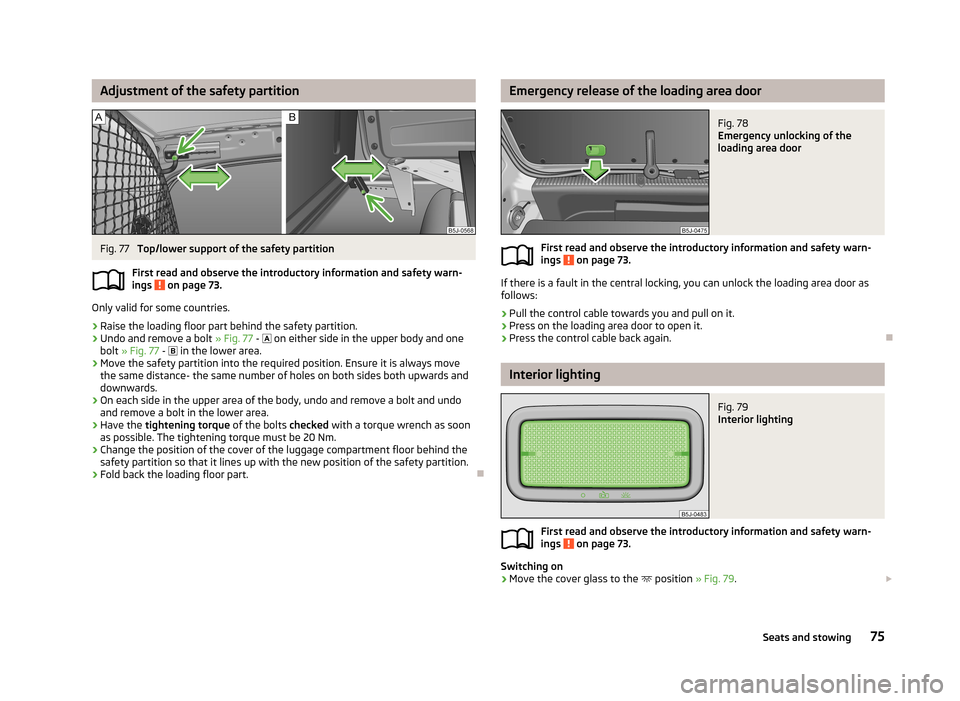
Adjustment of the safety partitionFig. 77
Top/lower support of the safety partition
First read and observe the introductory information and safety warn-
ings
on page 73.
Only valid for some countries.
›
Raise the loading floor part behind the safety partition.
›
Undo and remove a bolt » Fig. 77 -
on either side in the upper body and one
bolt » Fig. 77 -
in the lower area.
›
Move the safety partition into the required position. Ensure it is always move
the same distance- the same number of holes on both sides both upwards anddownwards.
›
On each side in the upper area of the body, undo and remove a bolt and undoand remove a bolt in the lower area.
›
Have the tightening torque of the bolts checked with a torque wrench as soon
as possible. The tightening torque must be 20 Nm.
›
Change the position of the cover of the luggage compartment floor behind the safety partition so that it lines up with the new position of the safety partition.
›
Fold back the loading floor part.
Emergency release of the loading area doorFig. 78
Emergency unlocking of the
loading area door
First read and observe the introductory information and safety warn-
ings on page 73.
If there is a fault in the central locking, you can unlock the loading area door as
follows:
›
Pull the control cable towards you and pull on it.
›
Press on the loading area door to open it.
›
Press the control cable back again.
Interior lighting
Fig. 79
Interior lighting
First read and observe the introductory information and safety warn- ings on page 73.
Switching on
›
Move the cover glass to the position
» Fig. 79.
75Seats and stowing
Page 99 of 219

It is still fully possible to steer the vehicle if the power steering fails or if the en-gine is not running (e.g. when towing). However, greater physical effort is re-
quired to turn the steering wheel.
CAUTION
You will place great stresses on the power steering system if the steering is
turned to full lock when the vehicle is stationary. Turning the steering to full lock
in such a situation will be accompanied by noises. Never leave the steering wheel at full lock for more than 15 seconds when the engine is running - there is a risk of
damaging the power steering.
Starting and stopping the engine
Introduction
This chapter contains information on the following subjects:
Electronic immobilizer
97
Ignition lock
97
Engine
97
Switching off the engine
98
The engine can only be started using a correctly coded original key. The engine running noises may louder at first be louder for a short time afterstarting the cold engine. This is quite normal and is not an operating problem.
WARNING■ When the vehicle is travelling with the engine off, the ignition key must al-
ways be in position 2 » Fig. 89 on page 97 (ignition switched on). This posi-
tion is indicated by the warning lights coming on. If this is not the case, this
could result in unexpected locking of the steering wheel – risk of accident!■
Only pull the ignition key from the ignition lock when the vehicle has come
to a complete stop (by applying the handbrake). Otherwise, the steering could
be blocked – risk of accident!
■
When leaving the vehicle, the ignition must always be removed. This is par-
ticularly important if children are left in the vehicle. Children could otherwise
start the engine for example – risk of accident or injury!
WARNING (Continued)■ Never leave the vehicle unattended with the engine running.■Never switch off the engine before the vehicle is stationary – risk of acci-
dent!WARNING■ Never leave the engine running in unventilated or closed rooms. The ex-
haust gases from the engine contain substances such as odourless and col-
ourless carbon monoxide (a poisonous gas) – risk to life! ■ Carbon monoxide can cause unconsciousness and death.
CAUTION
■The starter must only be operated when the engine is not running and the vehi-
cle is at a standstill. The starter or engine can be damaged if the starter is activa-
ted when the engine is running 3
» Fig. 89 on page 97.
■
If the engine does not start up after a second attempt, the fuse for the fuel
pump may have a fault. Check the fuse and replace if necessary » page 191, or
seek assistance from a specialist garage.
■
Let go of the ignition key as soon as the engine starts otherwise the starter
could be damaged.
■
Do not tow start the engine – there is a risk of damaging the engine and the
catalytic converter. The battery from another vehicle can be used as a jump-start
aid » page 186 , Jump-starting .
CAUTION
■
Avoid high engine revolutions, full throttle and high engine loads before the en-
gine has reached its operating temperature – risk of damaging the engine!■
Do not switch the engine off immediately at the end of your journey after the
engine has been operated over a prolonged period at high loads but leave it to
run at an idling speed for about 1 minute. This prevents any possible accumulation
of heat when the engine is switched off.
For the sake of the environment
Do not warm up the engine while the vehicle is stationary. If possible, start your
journey as soon as the engine has started. Through this the engine reaches its
operating temperature more rapidly and the pollutant emissions are lower. 96Driving
Page 115 of 219

Parking aid
Introduction
This chapter contains information on the following subjects:
Function
112
Activation/deactivation
113WARNING■ The parking aid is not a substitute for the driver paying proper attention and
it is always the driver's responsibility to take care when reversing the vehicle
or carrying out similar manoeuvres. Pay particular attention to small children
and animals as they are not recognised by the parking aid sensors.■
Before reversing, you should make sure that there are no small obstacles,
such as rocks, thin posts, trailer drawbars etc. behind your vehicle. Such ob-
stacles may not be recognised by the parking aid sensors.
■
Under certain circumstances, surfaces of certain objects and types of cloth-
ing cannot reflect the system signals. Thus, these objects or people who wear
such clothing are not recognised by the System sensors.
■
External sound sources can have a detrimental effect on the system. Under
adverse conditions, this may cause objects or people to not be recognised by the system.
CAUTION
■ If a warning signal sounds for about 3 seconds after activating the system and
there is no obstacle close to your car, this indicates a system fault. Have the fault
rectified by a specialist garage.■
The sensors must be kept clean (free of ice, etc.) to enable the parking aid to
operate properly.
■
Under adverse weather conditions (heavy rain, water vapour, very low or high
temperatures etc.) system function may be limited.
■
Additionally installed modules such as bicycle carriers can impair the function of
the parking aid.
FunctionFig. 100
Parking aid: Range of sensors
First read and observe the introductory information and safety warn- ings on page 112.
The parking aid (referred to below solely as system) only works when the ignition
is switched on.
The system supports the driver via audible signals, via the display on the radio or
via the factory-installed navigation system when parking and manoeuvring » Ra-
dio user guide, Navigation system user guide.
The system uses ultrasound waves to calculate the distance between the bumper
and an obstacle. The ultrasonic sensors are integrated in the rear bumper.
Range of sensors
The clearance warning begins at a distance of about 160 cm from the obstacle
(area
A
» Fig. 100 ). The interval between the warning signals becomes shorter as
the clearance is reduced.
A continuous tone sounds from a distance of approx. 30 cm (area
B
) - danger
area. You should not reverse any further after this signal sounds!
On vehicles with a factory-fitted towing device, the border of the danger area starts (continuous tone) 5 cm further away from the vehicle. The length of the ve-
hicle can be increased with an installed detachable towing device.
112Driving
Page 116 of 219
Activation/deactivationFirst read and observe the introductory information and safety warn-
ings
on page 112.
The system is activated automatically by engaging reverse gear. This is confirmed
by a brief audible signal.
The system is deactivated by disengaging reverse gear.
Note
The system cannot be activated on vehicles with a factory-fitted towing device
when towing a trailer.
Cruise Control System
Introduction
This chapter contains information on the following subjects:
Storing a speed
114
Changing a stored speed
114
Switching off temporarily
114
Switching off completely
114
The Cruise Control System (CCS) maintains a set speed, more than 25 km/h, with-
out you having to actuate the accelerator pedal.
This is only possible within the range which is permitted by the power output and
braking power of the engine.
The
warning light in the instrument cluster lights up when the cruise control
system is switched on.
WARNING■ For safety reasons, the cruise control system must not be used in dense
traffic or on unfavourable road surfaces (such as icy roads, slippery roads,
loose gravel) – there is a risk of an accident.■
The saved speed may only be resumed if it is not too high for the current
traffic conditions.
■
Always deactivate the cruise control system after use to prevent the system
being switched on unintentionally.
CAUTION
■ The cruise control system is not able to maintain a constant speed when driving
in areas with steeper gradients. The weight of the vehicle increases the speed at which it travels. Therefore, shift to a lower gear in good time or slow the vehicle
down by applying the foot brake.■
It is not possible to switch on the cruise control system on vehicles fitted with a
manual gearbox if the first gear or reverse gear is engaged.
■
It is not possible on vehicles fitted with an automatic gearbox to switch on the
cruise control system if the selector lever is in the position P, N or R.
■
The Cruise Control System may automatically switch off when some brake as-
sist systems (e.g. ESC) intervene, when the speed exceeds maximum permissible
engine speed, or a similar event takes place.
113Assist systems
Page 120 of 219
Towing a trailer
Towing device
Introduction
This chapter contains information on the following subjects:
Description
117
Adjusting the ready position
118
Fitting the ball head
118
Check proper fitting
119
Removing the ball head
119
Use and care
120
If your vehicle has already been factory-fitted with towing equipment or is fitted
with towing equipment from ŠKODA Original Accessories, then it meets all of the technical requirements and national legal provisions for towing a trailer.
Your vehicle is fitted with a 13-pin power socket for the electrical connection be-tween the vehicle and trailer. If the trailer that is to be towed has a 7-pin connec-
tor , you can use a suitable adapter from ŠKODA Original Accessories.
The maximum trailer drawbar load is 50 kg/h.
WARNING■
Check that the ball head is seated correctly and is secured in the mounting
recess before starting any journey.■
Do not use the ball head if it is not correctly inserted in the mounting recess.
■
Do not use the towing equipment if it is damaged or incomplete.
■
Do not modify or adapt the towing equipment in any way.
■
Never release the ball head while the trailer is still coupled.
CAUTION
Take care with the ball head to avoid damaging the paintwork on the bumper.
DescriptionFig. 103
Remove cover cap: on the rear bumper/for the mounting recess
Fig. 104
Ball head
First read and observe the introductory information and safety warn-
ings on page 117.
The ball head can be removed and is kept in the spare wheel well or in a compart- ment for the spare wheel in the luggage compartment » page 180, Vehicle tool
kit .
Image description » Fig. 103 and » Fig. 104
Clamps for removing the wheel trims
Cover in the rear bumper
13-pin power socket
Cover for the mounting recess
Dust cap
Ball head
Operating lever
1234567117Towing a trailer