Page 142 of 324
140
Safety
The incorrect installation of a child seat in a vehicle compromises the child's protection in
the event of an accident. Ensure that there is no seat belt or seat belt buckle under the child seat, as this could destabilise it.
Remember to fasten the seat belts or the child seat harnesses keeping the slackrelative to the child's body to a minimum,even for shor t journeys. When installing a child seat using the seat belt, ensure that the seat belt is tightenedcorrectly on the child seat and that it securesthe child seat firmly on the seat of your vehicle. If your passenger seat is adjustable,move it for wards if necessary. At rear seating positions, always leavesufficient space between the front seat and:
- a "rear wards facing" child seat,
- the child's feet for a child seat fitted"forwards facing".
Advice on child seats
Installing a booster seat
The chest par t of the seat belt must bepositioned on the child's shoulder without touching the neck.Ensure that the lap part of the seat belt passes correctly over the child's thighs.PEUGEOT recommends the use of a booster seat which has a back, fitted with a seat beltguide at shoulder level.
As a safety precaution, do not leave: - a child or children alone andunsupervised in a vehicle, - a child or an animal in a vehicle which is exposed to the sun, with the windowsclosed, - the keys within reach of children insidethe vehicle.To prevent accidental opening of the doors and rear windows, use the "Child lock". Take care not to open the rear windows bymore than one third.To protect young children from the rays of the sun, fit side blinds on the rear windows.
To d o t h i s, move the front seat for wards and, if necessary, move its backrest into the
upright position.
For optimum installation of the "forwards-facing" child seat, ensure that the back of thechild seat is in contact with the back of the
vehicle's seat and remove the head restraint.
Ensure that the head restraint is stored or attached securely to prevent it from being thrown around the vehicle in the event of sharp braking. Refit it if an adult uses the seating position. Children under the age of 10 must not travel in the "forwards-facing" position on the frontpassenger seat, unless the rear seats are already occupied by other children, cannot be used or are absent.
Deactivate the passenger airbag when a "rearwards-facing" child seat is installed on the front seat. Other wise, the child would risk being seriously injured or killed if the airbag were to inflate.
Page 143 of 324
141
6
Safety
Your vehicle has been approved in accordance
with the new
ISOFIX regulation
.
The seats, represented below, are fitted with
re
gulation ISOFIX mountings:
"ISOFIX" mountings
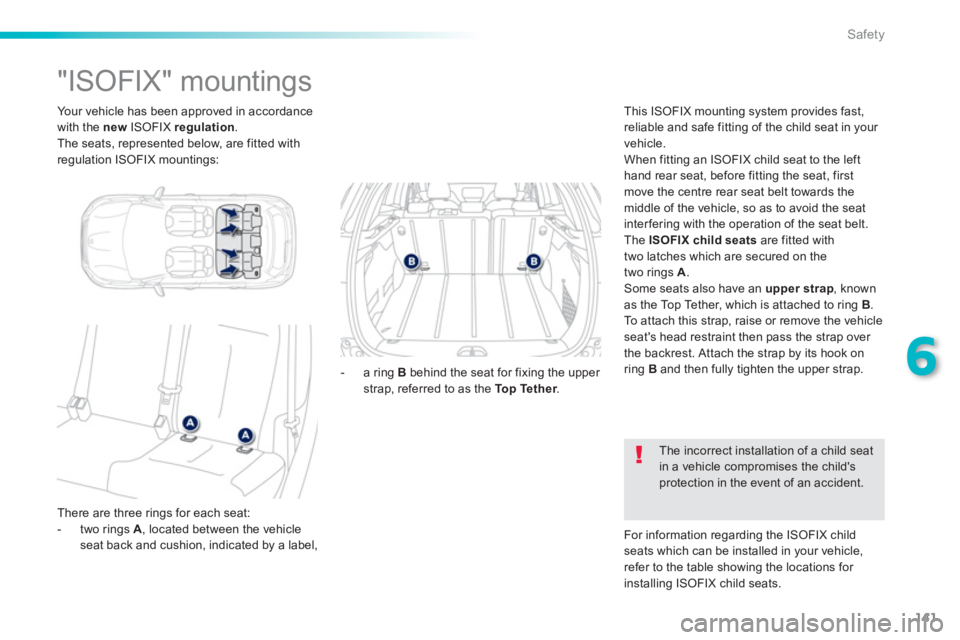
There are three rings for each seat:
- two rings A
, located between the vehicleseat back and cushion, indicated by a label, This I
SOFIX mounting system provides fast,
reliable and safe fitting of the child seat in your
vehicle.
When fitting an ISOFIX child seat to the left
hand rear seat, before fitting the seat, first
move the centre rear seat belt towards themiddle of the vehicle, so as to avoid the seat
interfering with the operation of the seat belt.
The ISOFIX child seats
are fitted with
two latches which are secured on the
two rings A.
Some seats also have an upper strap, known
as the Top Tether, which is attached to ring B.
To attach this strap, raise or remove the vehicle
seat's head restraint then pass the strap over
the backrest. Attach the strap by its hook on
ring Band then fully tighten the upper strap.
The incorrect installation of a child seatin a vehicle compromises the child's protection in the event of an accident.
For information re
garding the ISOFIX child seats which can be installed in your vehicle,
refer to the table showing the locations for
installing ISOFIX child seats. - a r
ing B
behind the seat for fixing the upper strap, referred to as the To p Te t h e r.r
Page 145 of 324
143
6
Safety
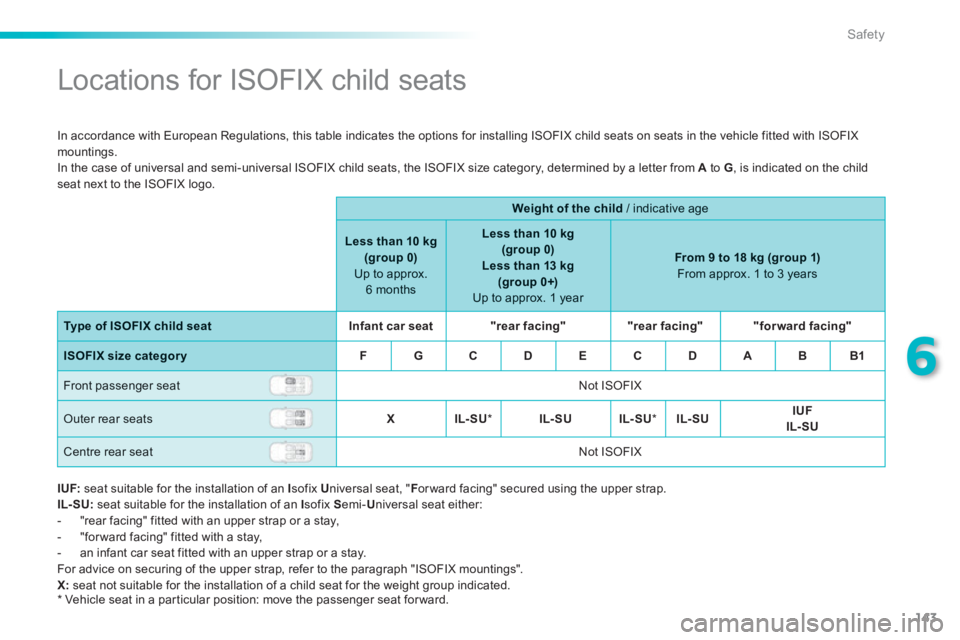
Locations for ISOFIX child seats
In accordance with European Regulations, this table indicates the options for installing ISOFIX child seats on seats in the vehicle fitted with ISOFIX mountings.
In the case of universal and semi-universal ISOFIX child seats, the ISOFIX size category, determined by a letter from A
to G
, is indicated on the childseat next to the ISOFIX logo.
Weight of the child
/ indicative age
Less than 10 kg
(group 0)Up to approx.6 months
Less than 10 kg(group 0)
Less than 13 kg(group 0+)Up to approx. 1 year
From 9 to 18 kg (group 1)From approx. 1 to 3 years
Type of ISOFIX child seatInfant car seat"rear facing""rear facing" "for ward facing"
ISOFIX size categoryFGCDECDABB1
Front passenger seatNot ISOFIX
Outer rear seats XIL-SU*IL-SUIL-SU*IL-SUIUF
IL-SU
Centre rear seat
Not ISOFIX
IUF:seat suitable for the installation of an Isofix U
niversal seat, "F
orward facing" secured using the upper strap. IL-SU:seat suitable for the installation of an I sofix S emi-U
niversal seat either:
- "rear facing" fitted with an upper strap or a stay,
- "forward facing" fitted with a stay,
- an infant car seat fitted with an upper strap or a stay.
For advice on securing of the upper strap, refer to the paragraph "ISOFIX mountings". X:seat not suitable for the installation of a child seat for the weight group indicated.
*
Vehicle seat in a par ticular position: move the passenger seat forward.
Page 153 of 324
151
7
Practical information
Changing a wheel
The tools are installed in the boot under the floor.
To gain access to them: )open the boot, )lift the floor and remove it. )remove the polystyrene spacer,)remove the carrier box containing the tools.
Access to the tools
List of tools *
3."Bolt cover" tool.
For removing the bolt protectors
(covers)on alloy wheels.4.Socket for the security bolts (located in theglove box).
For adapting the wheelbrace to the special
"security" bolts.
5.Towing eye.
See "Towing the vehicle".
Procedure for chan
ging a faulty wheel for the spare wheel using the tools provided with the vehicle.
All o
f these tools are specific to your vehicle andcan vary according to the level of equipment. Donot use them for other purposes.
1.Wheelbrace.
For removing the wheel trim and removing
the wheel bolts.
2. Jack with integral handle.For raising the vehicle.
*
Depending on country of sale.
Page 156 of 324
154
Practical information
Removing a wheel
Parking the vehicle
Immobilise the vehicle where it does notblock traffic: the ground must be level,stable and not slippery. Apply the parking brake, switch off the
ignition and engage first gear *
to blockthe wheels. Check that the parking brake warninglamps in the instrument panel come on.
The occupants must get out of the vehicle and wait where they are safe.
Never go underneath a vehicle raised using a jack; use an axle stand.
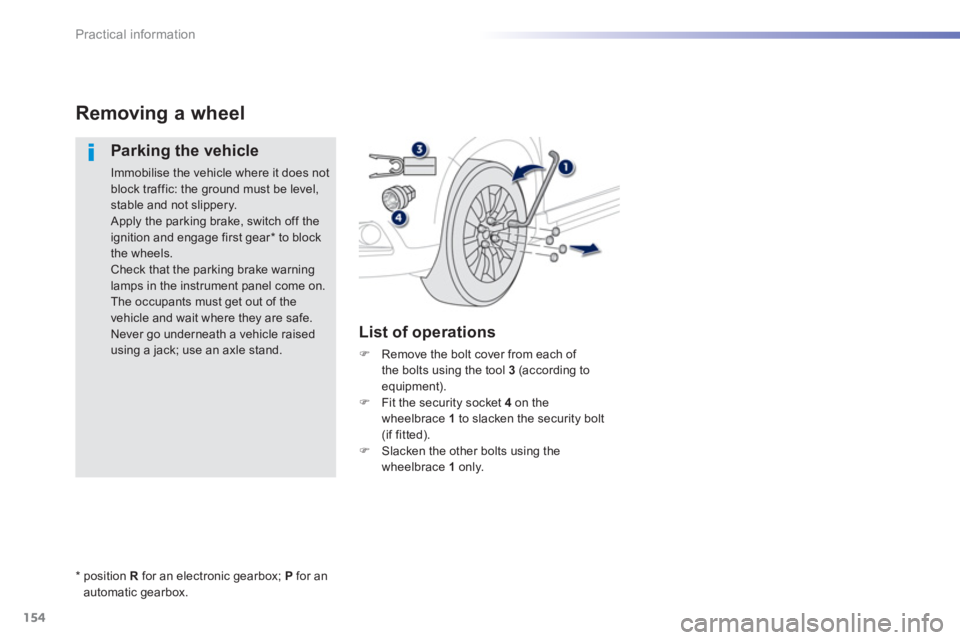
List of operations
)
Remove the bolt cover from each of
the bolts using the tool 3(according toequipment). ) Fit the security socket 4
on thewheelbrace 1
to slacken the security bolt (if fitted).)
Slacken the other bolts using the
wheelbrace 1 only.
*
position R
for an electronic
gearbox; P
for an automatic gearbox.
Page 158 of 324
156
Practical information
Fitting a wheel
Fitting the "space-saver"spare wheel
If your vehicle is fitted with alloy wheels, when tightening the bolts on fitting, it is normal to notice that the washers
do not come into contact with the"space-saver" spare wheel. The wheel is secured by the conical surface of each bolt.
After changing a wheel
To store the punctured wheel in the boot correctly, first remove the central cover. When using the "space-saver" typespare wheel, do not exceed 50 mph(80 km/h). Have the tightening of the bolts and thepressure of the spare wheel checked by a PEUGEOT dealer or a qualified workshop without delay. Have the punctured wheel repairedand refitted to the vehicle as soon as possible.
List of operations
)Put the wheel in place on the hub. )Screw in the bolts fully by hand.)Pre-tighten the security bolt using the
wheelbrace 1fitted with the security socket 4 (if your vehicle has them). )Pre-tighten the other bolts using the
wheelbrace 1only.
Page 159 of 324
157
7
Practical information
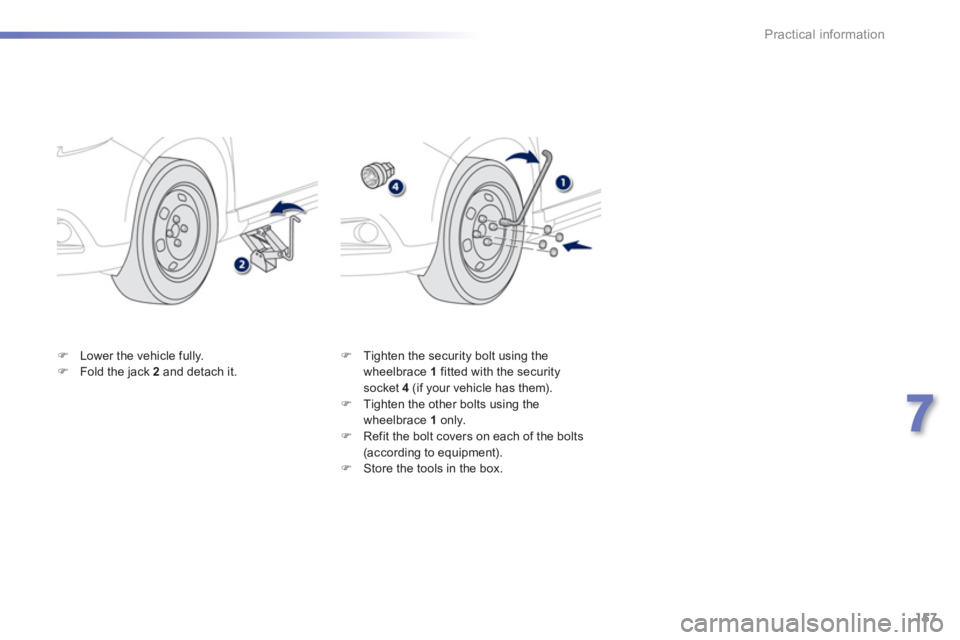
)Lower the vehicle fully.)Fold the jack 2 and detach it. )
Tighten the security bolt using the
wheelbrace 1 fitted with the securitysocket 4(if your vehicle has them). )
Tighten the other bolts using the
wheelbrace 1 only.
)
Refit the bolt covers on each of the bolts(according to equipment). )
Store the tools in the box.
Page 174 of 324
172
Practical information
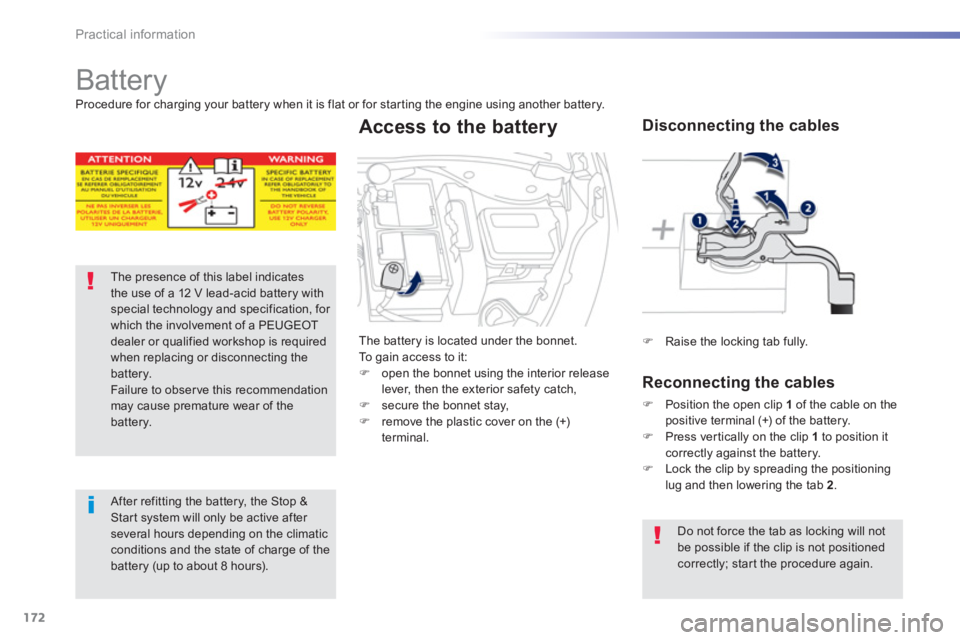
Battery
The presence of this label indicatesthe use of a 12 V lead-acid battery withspecial technology and specification, for which the involvement of a PEUGEOT dealer or qualified workshop is requiredwhen replacing or disconnecting thebattery.
Failure to observe this recommendation may cause premature wear of thebattery.
After refitting the battery, the Stop & Start system will only be active after
several hours depending on the climaticconditions and the state of charge of the battery (up to about 8 hours).
)Raise the locking tab fully.
Disconnecting the cables
Reconnecting the cables
)Position the open clip 1of the cable on the positive terminal (+) of the battery.
)Press ver tically on the clip 1
to position it correctly against the battery.)Lock the clip by spreading the positioning
lug and then lowering the tab 2.
Do not force the tab as locking will not be possible if the clip is not positionedcorrectly; start the procedure again.
Procedure for char
ging your battery when it is flat or for star ting the engine using another battery.
The battery is located under the bonnet.
To gain access to it:) open the bonnet using the interior releaselever, then the exterior safety catch, )
secure the bonnet stay, )
remove the plastic cover on the (+)
t
erminal.
Access to the battery