2013 LINCOLN MKZ light
[x] Cancel search: lightPage 307 of 474

TIRE CARE
Important information for
245/40R19 low-profile tires and
wheels If your vehicle is equipped
with 245/40R19 tires, they are
low-profile tires. These tires and
wheels are designed to give your
vehicle a sport appearance. With
low-profile tires, you may notice an
increase in road noise and faster tire
wear, depending on road conditions
and driving styles. Due to their design,
low-profile tires and wheels are more
prone to road damage from potholes,
rough or unpaved roads, car wash rails
and curb contact than standard tires
and wheels.
Note: Your vehicle ’s warranty does not
cover these types of damage. Tires
should always be kept at the correct
inflation pressures and extra caution
should be taken when operating on
rough roads to avoid impacts that
could cause wheel and tire damage.
Information About Uniform
Tire Quality Grading Tire Quality Grades apply to new
pneumatic passenger car tires. The
Quality grades can be found where
applicable on the tire sidewall
between tread shoulder and
maximum section width. For example:
Treadwear 200 Traction AA
Temperature A
.
These Tire Quality Grades are
determined by standards that the
United States Department of
Transportation has set.
Tire Quality Grades apply to new
pneumatic passenger car tires. They
do not apply to deep tread,
winter-type snow tires, space-saver
or temporary use spare tires, light
truck or LT type tires, tires with
nominal rim diameters of 10 to 12
inches or limited production tires as
defined in Title 49 Code of Federal
Regulations Part 575.104 (c)(2).
U.S. Department of Transportation
Tire quality grades:
The U.S.
Department of Transportation
requires Ford Motor Company to give
you the following information about
tire grades exactly as the government
has written it.
304
Wheels and TiresE142542
Page 309 of 474

Glossary of Tire Terminology
•
Tire label: A label showing the OE
(Original Equipment) tire sizes,
recommended inflation pressure
and the maximum weight the
vehicle can carry.
• Tire Identification Number
(TIN): A number on the sidewall
of each tire providing information
about the tire brand and
manufacturing plant, tire size and
date of manufacture. Also referred
to as DOT code.
• Inflation pressure:
A measure of
the amount of air in a tire.
• Standard load:
A class of
P-metric or Metric tires designed
to carry a maximum load at 35 psi
[37 psi (2.5 bar) for Metric tires].
Increasing the inflation pressure
beyond this pressure will not
increase the tire ’s load carrying
capability.
• Extra load: A class of P-metric or
Metric tires designed to carry a
heavier maximum load at 41 psi
[43 psi (2.9 bar) for Metric tires].
Increasing the inflation pressure
beyond this pressure will not
increase the tire ’s load carrying
capability.
• kPa:
Kilopascal, a metric unit of
air pressure.
• PSI:
Pounds per square inch, a
standard unit of air pressure. •
Cold tire pressure:
The tire
pressure when the vehicle has
been stationary and out of direct
sunlight for an hour or more and
prior to the vehicle being driven for
1 mile (1.6 km).
• Recommended inflation
pressure:
The cold inflation
pressure found on the Safety
Compliance Certification Label
(affixed to either the door hinge
pillar, door-latch post, or the door
edge that meets the door-latch
post, next to the driver's seating
position), or Tire Label located on
the B-Pillar or the edge of the
driver ’s door.
• B-pillar:
The structural member
at the side of the vehicle behind
the front door
• Bead area of the tire: Area of the
tire next to the rim.
• Sidewall of the tire:
Area
between the bead area and the
tread.
• Tread area of the tire: Area of the
perimeter of the tire that contacts
the road when mounted on the
vehicle.
• Rim:
The metal support (wheel)
for a tire or a tire and tube
assembly upon which the tire
beads are seated.
306
Wheels and Tires
Page 310 of 474

Information Contained on the
Tire Sidewall
Both U.S. and Canada Federal
regulations require tire manufacturers
to place standardized information on
the sidewall of all tires. This
information identifies and describes
the fundamental characteristics of
the tire and also provides a U.S. DOT
Tire Identification Number for safety
standard certification and in case of
a recall.
Information on P Type Tires
P215/65R15 95H is an example of a
tire size, load index and speed rating.
The definitions of these items are
listed below. (Note that the tire size,
load index and speed rating for your
vehicle may be different from this
example.) A.
P: Indicates a tire, designated by
the Tire and Rim Association (T&RA),
that may be used for service on cars,
SUVs, minivans and light trucks. Note:
If your tire size does not begin with a
letter this may mean it is designated
by either ETRTO (European Tire and
Rim Technical Organization) or
JATMA (Japan Tire Manufacturing
Association).
B. 215:
Indicates the nominal width of
the tire in millimeters from sidewall
edge to sidewall edge. In general, the
larger the number, the wider the tire.
C. 65: Indicates the aspect ratio which
gives the tire's ratio of height to width.
D. R:
Indicates a radial type tire.
E. 15:
Indicates the wheel or rim
diameter in inches. If you change your
wheel size, you will have to purchase
new tires to match the new wheel
diameter.
F. 95:
Indicates the tire's load index.
It is an index that relates to how much
weight a tire can carry. You may find
this information in your owner ’s
manual. If not, contact a local tire
dealer.
Note: You may not find this
information on all tires because it is not
required by federal law.
307
Wheels and TiresH
I
J
KL
M
A
B
CDEFG
E142543
Page 313 of 474
M.
Maximum Inflation Pressure:
Indicates the tire manufacturers'
maximum permissible pressure or the
pressure at which the maximum load
can be carried by the tire. This
pressure is normally higher than the
vehicle manufacturer's recommended
cold inflation pressure which can be
found on the Safety Compliance
Certification Label (affixed to either
the door hinge pillar, door-latch post,
or the door edge that meets the
door-latch post, next to the driver's
seating position), or Tire Label which
is located on the B-Pillar or the edge
of the driver ’s door. The cold inflation
pressure should never be set lower
than the recommended pressure on
the vehicle label.
The tire suppliers may have additional
markings, notes or warnings such as
standard load, radial tubeless, etc.
Additional Information Contained
on the Tire Sidewall for LT Type
Tires
Note: Tire Quality Grades do not apply
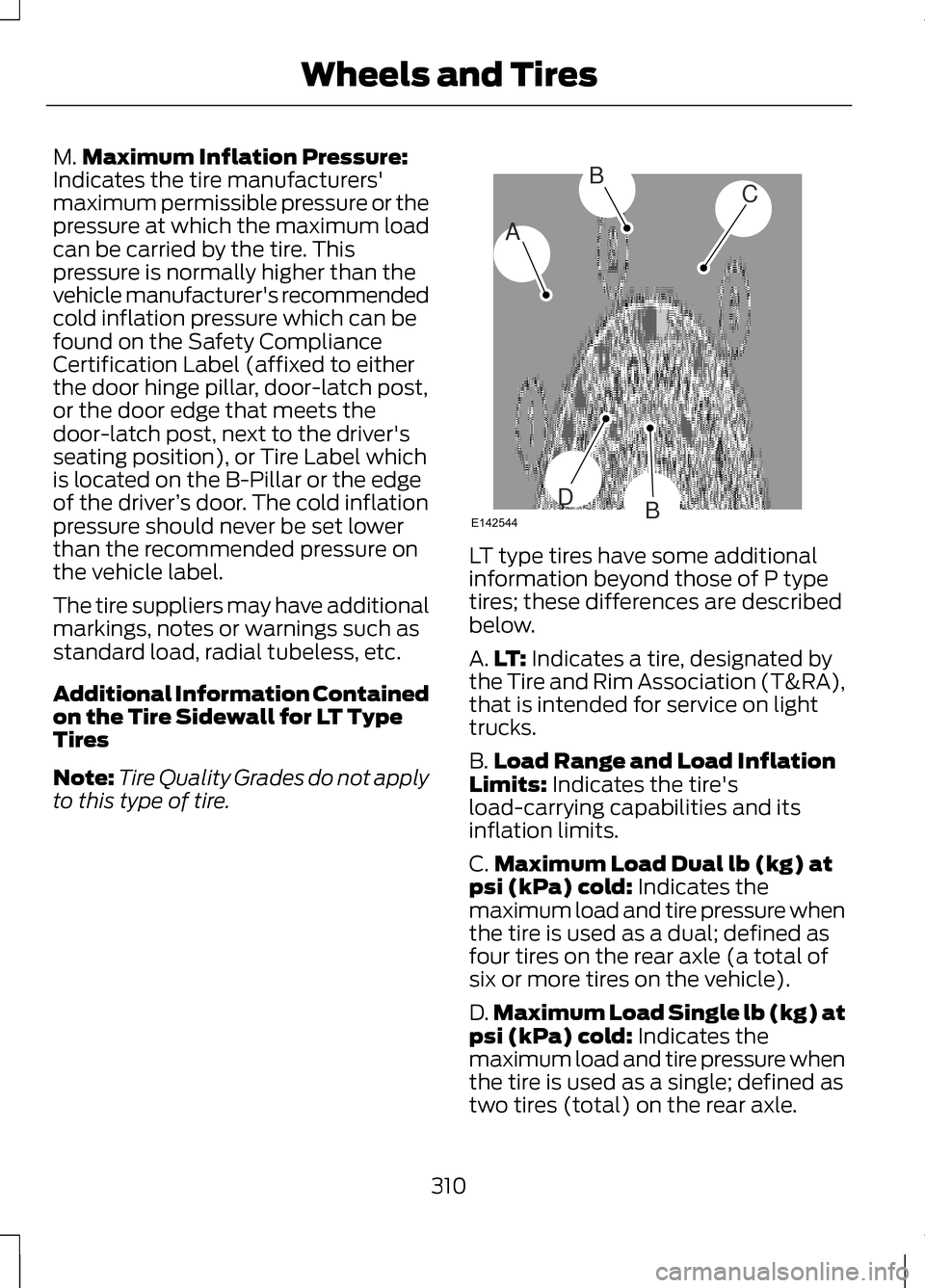
to this type of tire. LT type tires have some additional
information beyond those of P type
tires; these differences are described
below.
A.
LT: Indicates a tire, designated by
the Tire and Rim Association (T&RA),
that is intended for service on light
trucks.
B. Load Range and Load Inflation
Limits:
Indicates the tire's
load-carrying capabilities and its
inflation limits.
C. Maximum Load Dual lb (kg) at
psi (kPa) cold:
Indicates the
maximum load and tire pressure when
the tire is used as a dual; defined as
four tires on the rear axle (a total of
six or more tires on the vehicle).
D. Maximum Load Single lb (kg) at
psi (kPa) cold:
Indicates the
maximum load and tire pressure when
the tire is used as a single; defined as
two tires (total) on the rear axle.
310
Wheels and TiresA
BC
BDE142544
Page 314 of 474

Information on T Type Tires
T145/80D16 is an example of a tire
size.
Note:
The temporary tire size for your
vehicle may be different from this
example. Tire Quality Grades do not
apply to this type of tire. T type tires have some additional
information beyond those of P type
tires; these differences are described
below:
A.
T: Indicates a type of tire,
designated by the Tire and Rim
Association (T&RA), that is intended
for temporary service on cars, SUVs,
minivans and light trucks. B.
145:
Indicates the nominal width of
the tire in millimeters from sidewall
edge to sidewall edge. In general, the
larger the number, the wider the tire.
C. 80:
Indicates the aspect ratio
which gives the tire's ratio of height to
width. Numbers of 70 or lower
indicate a short sidewall.
D. D:
Indicates a diagonal type tire.
R:
Indicates a radial type tire.
E. 16:
Indicates the wheel or rim
diameter in inches. If you change your
wheel size, you will have to purchase
new tires to match the new wheel
diameter.
Location of the Tire Label
You will find a Tire Label containing
tire inflation pressure by tire size and
other important information located
on the B-Pillar or the edge of the
driver ’s door.
Inflating Your Tires
Safe operation of your vehicle requires
that your tires are properly inflated.
Remember that a tire can lose up to
half of its air pressure without
appearing flat.
Every day before you drive, check your
tires. If one looks lower than the
others, use a tire gauge to check
pressure of all tires and adjust if
required.
311
Wheels and TiresA
BCDE
E142545
Page 322 of 474

USING SNOW CHAINS
Snow chains have not been approved
for use on your vehicle.
WARNINGS
If you choose to install snow tires
on your vehicle, they must be the
same size, construction, and load
range as the original tires listed on the
tire placard, and they must be
installed on all four wheels. Mixing
tires of different size or construction
on your vehicle can adversely affect
your vehicle's handling and braking,
and may lead to loss of vehicle
control. Do not use snow chains or cables
on this vehicle as they may cause
damage to your vehicle which may
lead to loss of vehicle control. The original equipment tires on your
vehicle may have an all-weather tread
design to provide traction, handling,
and braking performance in
year-round driving. You may install
snow tires for improved traction when
driving in areas with sustained periods
of snow or icy driving conditions. CHANGING A ROAD WHEEL WARNINGS
The use of tire sealants may
damage your tire pressure
monitoring system and should not be
used. However, if you must use a
sealant, the tire pressure monitoring
system sensor and valve stem on the
wheel must be replaced by an
authorized Ford dealer. See Tire Pressure Monitoring
System (page 298). for
important information. If the tire
pressure monitor sensor becomes
damaged, it will no longer function. Note:
The tire pressure monitoring
system indicator light will illuminate
when the spare tire is in use. To restore
the full function of the monitoring
system, all road wheels equipped with
tire pressure monitoring sensors must
be mounted on the vehicle.
If you get a flat tire while driving, do
not apply the brake heavily. Instead,
gradually decrease your speed. Hold
the steering wheel firmly and slowly
move to a safe place on the side of
the road.
319
Wheels and Tires
Page 341 of 474

•
Street Address
• Intersection
• City Center
• Map
• Edit Route Cancel Route
• Freeway Entrance/Exit
ENTERTAINMENT
Press to select any of the following:
• AM
• FM
• SIRIUS
• CD
• USB
• BT Stereo
• SD Card
• A/V In
CLIMATE
Press to select any of the following:
• Driver Settings
• Recirculated Air
• Auto
• Dual
• Passenger Settings
• A/C
• Defrost HOME Press to access your home screen.
Depending on your vehicle
’s option
package and software, your screens
may vary in appearance from the
screens shown in this section. Your
features may also be limited
depending on your market. Check with
your authorized dealer for availability.
Using the Touch-Sensitive
Controls on Your System
To turn a feature on and off, just touch
the graphic with your finger. To get the
best performance from the
touch-sensitive controls:
• Make sure your hands are clean
and dry.
• Since the touchscreen operates
based on the touch of a finger, you
may have trouble using it if you are
wearing gloves.
• Use your bare finger to touch the
center of a touch-control graphic.
Touching off-center of the graphic
may cause a nearby control to turn
on or off.
• Do not press hard on the controls.
They are sensitive to light touch.
• Metal and other conductive
material should be kept away from
the surface of the touchscreen as
this may cause electronic
interference (i.e. control
activation).
338
MyLincoln Touch
™E142613
Page 354 of 474

The dual mode feature is also
available when the voice system
displays a list of items to pick from
during a voice session, where you
would be able to touch the line item
or say "Line 2". If a command is not
understood or there are multiple
options, the system returns a list for
you to choose from.
SETTINGS
Under the menu setting, you can set
your clock, access and make
adjustments to the display, sound and
vehicle settings as well as access
settings for specific modes or the help
feature.
Clock
Note:
The date is set by your vehicle's
GPS; you cannot manually set the date.
Note: If the battery has been
disconnected, the vehicle needs to
acquire a GPS signal to update the
clock. Once your vehicle acquires the
signal, it may take a few minutes for
the update to display the correct time.
1. Press the Settings icon > Clock.
2. Press + and - to adjust the time.
From this screen, you can also make
other adjustments such as 12-hour or
24-hour mode, activate GPS time
synchronization and have the system
automatically update new time zones. You can also turn the outside air
temperature display on and off. When
the outside air temperature is
displayed, it appears at the top center
of the touchscreen next to the time
and date.
Once you update any settings, they
are automatically saved.
Display
You can make adjustments to the
touchscreen display through the
touchscreen or by pressing the voice
button on your steering wheel controls
and when prompted, say "Display
settings".
To access and make adjustments
using the touchscreen, press the
Settings icon > Display.
•
Brightness allows you to make
the screen display brighter or
dimmer.
• Mode
allows you to set the screen
to a certain brightness or have the
system automatically change
based on the outside light level.
• If you select AUTO or NIGHT,
you have the options of turning
the display's Auto Dim feature
on or off and changing the Auto
Dim Manual Offset feature.
• Edit Wallpaper
•You can have your touchscreen
display the default photo or
upload your own.
351
MyLincoln Touch
™