2013 LINCOLN MKZ HYBRID seats
[x] Cancel search: seatsPage 35 of 475
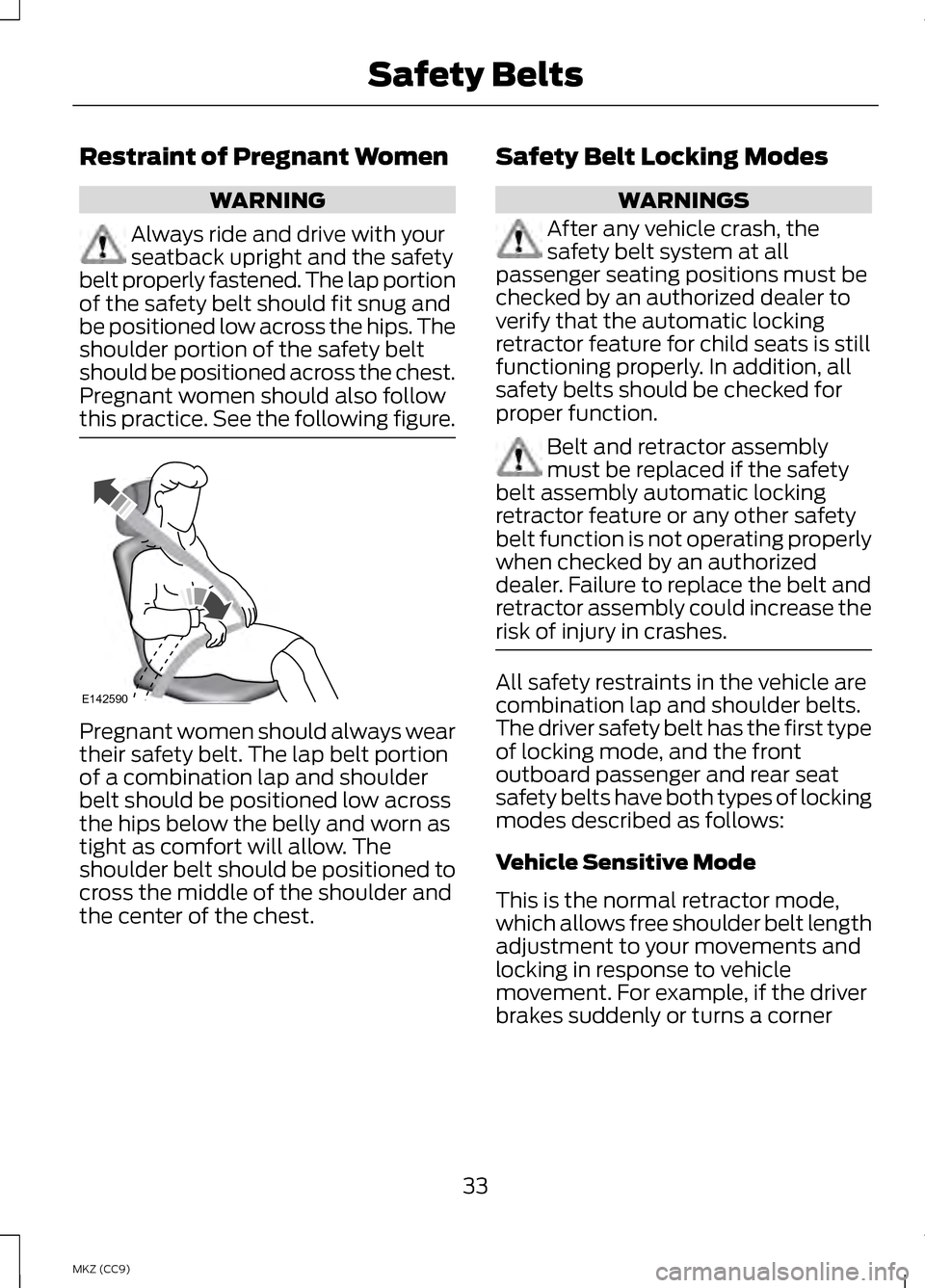
Restraint of Pregnant Women
WARNING
Always ride and drive with your
seatback upright and the safety
belt properly fastened. The lap portion
of the safety belt should fit snug and
be positioned low across the hips. The
shoulder portion of the safety belt
should be positioned across the chest.
Pregnant women should also follow
this practice. See the following figure. Pregnant women should always wear
their safety belt. The lap belt portion
of a combination lap and shoulder
belt should be positioned low across
the hips below the belly and worn as
tight as comfort will allow. The
shoulder belt should be positioned to
cross the middle of the shoulder and
the center of the chest. Safety Belt Locking Modes WARNINGS
After any vehicle crash, the
safety belt system at all
passenger seating positions must be
checked by an authorized dealer to
verify that the automatic locking
retractor feature for child seats is still
functioning properly. In addition, all
safety belts should be checked for
proper function. Belt and retractor assembly
must be replaced if the safety
belt assembly automatic locking
retractor feature or any other safety
belt function is not operating properly
when checked by an authorized
dealer. Failure to replace the belt and
retractor assembly could increase the
risk of injury in crashes. All safety restraints in the vehicle are
combination lap and shoulder belts.
The driver safety belt has the first type
of locking mode, and the front
outboard passenger and rear seat
safety belts have both types of locking
modes described as follows:
Vehicle Sensitive Mode
This is the normal retractor mode,
which allows free shoulder belt length
adjustment to your movements and
locking in response to vehicle
movement. For example, if the driver
brakes suddenly or turns a corner
33
MKZ (CC9) Safety BeltsE142590
Page 37 of 475

3. Allow the belt to retract. As the
belt retracts, you will hear a
clicking sound. This indicates the
safety belt is now in the automatic
locking mode.
How to Disengage the Automatic
Locking Mode
Unbuckle the combination lap and
shoulder belt and allow it to retract
completely to disengage the
automatic locking mode and activate
the vehicle sensitive (emergency)
locking mode.
Rear Inflatable Safety Belt (If
Equipped) WARNING
Do not attempt to service, repair,
or modify the rear inflatable
safety belt. The rear inflatable safety belts are
fitted in the shoulder portion of the
safety belts of the second-row
outboard seating positions.
Note:
The rear inflatable safety belts
are compatible with most infant and
child safety car seats and belt
positioning booster seats when
properly installed. This is because they
are designed to fill with a cooled gas
at a lower pressure and at a slower rate
than traditional airbags. After inflation,
the shoulder portion of the safety belt
remains cool to the touch. The rear inflatable safety belt consists
of the following:
•
An inflatable bag located in the
shoulder safety belt webbing.
• Lap safety belt webbing with
automatic locking mode.
• The same warning light, electronic
control and diagnostic unit as used
for the front safety belts.
• Impact sensors located in various
parts of the vehicle.
How does the rear inflatable safety
belt system work?
The rear inflatable safety belts will
function like standard restraints in
everyday usage. During a crash of sufficient force, the
inflatable belt will inflate from inside
the webbing.
35
MKZ (CC9) Safety BeltsE146364
Page 46 of 475

Proper Driver and Front
Passenger Seating Adjustment
WARNING
National Highway Traffic Safety
Administration (NHTSA)
recommends a minimum distance of
at least 10 inches (25 centimeters)
between an occupant’ s chest and the
driver airbag module. To properly position yourself away
from the airbag:
•
Move your seat to the rear as far
as you can while still reaching the
pedals comfortably.
• Recline the seat slightly (one or
two degrees) from the upright
position.
After all occupants have adjusted
their seats and put on safety belts, it
is very important that they continue
to sit properly. A properly seated
occupant sits upright, leaning against
the seat back, and centered on the
seat cushion, with their feet
comfortably extended on the floor.
Sitting improperly can increase the
chance of injury in a crash event. For
example, if an occupant slouches, lies
down, turns sideways, sits forward,
leans forward or sideways, or puts one
or both feet up, the chance of injury
during a crash is greatly increased. Children and Airbags WARNING
Airbags can kill or injure a child
in a child seat. Never place a
rear-facing child seat in front of an
active airbag. If you must use a
forward-facing child seat in the front
seat, move the seat upon which the
child seat is installed all the way back. Children must always be properly
restrained. Accident statistics suggest
that children are safer when properly
restrained in the rear seating positions
than in the front seating position.
Failure to follow these instructions
may increase the risk of injury in a
crash.
KNEE AIRBAG
A driver
’s and passenger ’s knee airbag
is located under or within the
instrument panel. During a crash, the
restraints control module may
activate the driver ’s and passenger ’s
knee airbag (individually or both)
based on crash severity and
respective occupant conditions. Under
44
MKZ (CC9) Supplementary Restraints SystemE142846
Page 49 of 475

Passenger airbag
Passenger airbag status
indicator
Occupant
ON: Unlit Enabled
OFF: Unlit
Adult
ON: Lit
Note: When the passenger airbag
status indicator OFF light is illuminated,
the passenger (seat mounted) side
airbag may be disabled to avoid the
risk of airbag deployment injuries.
After all occupants have adjusted
their seats and put on safety belts, it
is very important that they continue
to sit properly. A properly seated
occupant sits upright, leaning against
the seat back, and centered on the
seat cushion, with their feet
comfortably extended on the floor.
Sitting improperly can increase the
chance of injury in a crash event. For
example, if an occupant slouches, lies
down, turns sideways, sits forward,
leans forward or sideways, or puts one
or both feet up, the chance of injury
during a crash is greatly increased.
The conditions listed above may
cause the weight of a properly seated
occupant to be incorrectly interpreted
by the front passenger sensing
system. The person in the front
passenger seat may appear heavier
or lighter due to the conditions
described in the list above. To know if the front
passenger sensing system is
operating properly, See
Crash Sensors and Airbag
Indicator (page 50). Do not attempt to repair or service the
system. Take your vehicle
immediately to an authorized dealer.
If it is necessary to modify an
advanced front airbag system to
accommodate a person with
disabilities, contact the Ford
Customer Relationship Center. See
Getting the Services You Need
(page
258).
SIDE AIRBAGS WARNINGS
Do not place objects or mount
equipment on or near the airbag
cover, on the side of the seatbacks (of
the front seats), or in front seat areas
that may come into contact with a
deploying airbag. Failure to follow
these instructions may increase the
risk of personal injury in the event of
a crash. Do not use accessory seat
covers. The use of accessory
seat covers may prevent the
deployment of the side airbags and
increase the risk of injury in an
accident.
47
MKZ (CC9) Supplementary Restraints System
Page 50 of 475

WARNINGS
Do not lean your head on the
door. The side airbag could injure
you as it deploys from the side of the
seatback. Do not attempt to service, repair,
or modify the airbag, its fuses or
the seat cover on a seat containing an
airbag as you could be seriously
injured or killed. Contact your
authorized dealer as soon as possible. If the side airbag has deployed,
the airbag will not function again.
The side airbag system (including the
seat) must be inspected and serviced
by an authorized dealer. If the airbag
is not replaced, the unrepaired area
will increase the risk of injury in a
crash. The side airbags are located on the
outboard side of the seatbacks of the
front seats. In certain sideways
crashes, the airbag on the side
affected by the crash will be inflated.
The airbag was designed to inflate
between the door panel and occupant
to further enhance the protection
provided occupants in side impact
crashes. The system consists of the following:
•
A label or embossed side panel
indicating that side airbags are
fitted to your vehicle.
• Side airbags located inside the
driver and front passenger
seatbacks.
• Front passenger sensing system. ·Crash sensors and
monitoring system with
readiness indicator. See
Crash Sensors and Airbag
Indicator (page 50).
Note: The passenger sensing system
will deactivate the passenger
seat-mounted side airbag if it detects
an empty passenger seat.
The design and development of the
side airbag system included
recommended testing procedures
that were developed by a group of
automotive safety experts known as
the Side Airbag Technical Working
Group. These recommended testing
procedures help reduce the risk of
injuries related to the deployment of
side airbags.
SIDE CURTAIN AIRBAGS WARNINGS
Do not place objects or mount
equipment on or near the
headliner at the siderail that may
come into contact with a deploying
side curtain airbag. Failure to follow
these instructions may increase the
risk of personal injury in the event of
a crash.
48
MKZ (CC9) Supplementary Restraints SystemE152533
Page 51 of 475

WARNINGS
Do not lean your head on the
door. The side curtain airbag
could injure you as it deploys from the
headliner. Do not attempt to service, repair,
or modify the side curtain
airbags, its fuses, the A, B, or C pillar
trim, or the headliner on a vehicle
containing side curtain airbags.
Contact your authorized dealer as
soon as possible. All occupants of the vehicle
including the driver should
always wear their safety belts even
when an airbag supplemental
restraint system and side curtain
airbag is provided. To reduce risk of injury, do not
obstruct or place objects in the
deployment path of the side curtain
airbag. If the side curtain airbags have
deployed, the side curtain
airbags will not function again. The
side curtain airbags (including the A,
B and C pillar trim and headliner)
must be inspected and serviced by an
authorized dealer. If the side curtain
airbag is not replaced, the unrepaired
area will increase the risk of injury in a
crash. The side curtain airbags will deploy
during significant side crashes. The
side curtain airbags are mounted to
the roof side-rail sheet metal, behind
the headliner, above each row of
seats. In certain sideways crashes, the
side curtain airbag on the impacted side of the vehicle will be activated.
The side curtain airbags are designed
to inflate between the side window
area and occupants to further
enhance protection provided in side
impact crashes.
The system consists of the following:
•
Side curtain airbags located above
the trim panels over the front and
rear side windows identified by a
label or wording on the headliner
or roof-pillar trim.
• A flexible headliner which opens
above the side doors to allow side
air curtain deployment. Crash sensors and
monitoring system with
readiness indicator. See
Crash Sensors and Airbag
Indicator (page 50).
Children 12 years old and under should
always be properly restrained in the
back seats. The side curtain airbags
will not interfere with children
restrained using a properly installed
child or booster seat because it is
designed to inflate downward from
the headliner above the doors along
the side window opening.
49
MKZ (CC9) Supplementary Restraints SystemE75004
Page 111 of 475

•
Accessory Power — Indicates electrical power demands from your vehicle ’s
accessory systems. Accessories use power but do not contribute to propelling
the vehicle. The gauge separately displays power demand in kilowatts (kW)
for climate and other accessories.
Climate includes the power being used by high voltage climate control
components such as the electric A/C compressor and the electric heater (Energi
vehicles only)
Other includes all power being used by the low voltage accessories (cabin fans,
headlights, heated seats, etc.).
• Coolant Temp – Indicates engine coolant temperature. At normal operating
temperature, the level indicator will be white and will be in the normal range
(between H and C). If the engine coolant temperature exceeds the normal
range, the level indicator will change to red to indicate that the engine is
overheating. Stop the vehicle as soon as safely possible, turn off the vehicle
and let the engine cool.
The thermometer indicator next to the gauge will illuminate in blue or white to
indicate the following:
• Blue thermometer - This indicates that the hybrid system is not warm enough
to allow EV operation. The gasoline engine will typically run continuously
when the indicator is blue.
Note: During silent key start mode, the thermometer indicator will be blue, but
the gasoline engine will not run. This is the result of the vehicle computer allowing
the engine to be cooler during the silent key start period. This is normal operation
and does not indicate a problem with your vehicle. After the first engine start the
indicator will turn white when the gasoline engine is warm enough to turn off.
• White thermometer - This indicates that the hybrid system is warm enough
to allow EV operation. If the vehicle operates on battery power long enough,
it is possible that the gasoline engine may need to run to keep the system
warm. In this case, the thermometer indicator will revert back to blue.
• Tach rpm x 1000 — When the gasoline engine is running, the tachometer
gauge displays the engine speed in revolutions per minute (RPM). When the
vehicle is operating on battery power only with the engine off, EV is displayed
and the tachometer is greyed out.
Note: The trip data, and average fuel economy cannot be reset in MyView.
109
MKZ (CC9) Information Displays
Page 141 of 475

A/C: Press the button to turn on or turn off the air conditioning system.
To improve air conditioning when starting your vehicle, drive with the
windows slightly open for two to three minutes. Use A/C with
recirculated air to improve cooling performance and efficiency.
F
MAX A/C: Press the button to switch on. Recirculated air flows through
the instrument panel air vents, air conditioning automatically adjusts
to the highest speed and the temperature dial returns to the full cool
position. This re-cooling of the interior is more economical and efficient.
G
AUTO:
Press the button to switch on. Recirculated air flows through
the instrument panel air vents, air conditioning automatically adjusts
to the highest speed and the temperature dial returns to the full cool
position. This re-cooling of the interior is more economical and efficient.
H
Heated rear window:
Turns the heated rear window on and off. See
Heated Windows and Mirrors (page 140).
I
Defrost:
Distributes air through the windshield defroster vents and
de-mister vents. You can also use this setting to defog and clear the
windshield of a thin covering of ice.
J
HINTS ON CONTROLLING
THE INTERIOR CLIMATE
General Hints
Note: Prolonged use of recirculated
air may cause the windows to fog up.
Note: You may feel a small amount of
air from the footwell air vents
regardless of the air distribution setting.
Note: To reduce humidity build-up
inside your vehicle, do not drive with
the system switched off or with
recirculated air always switched on.
Note: Do not place objects under the
front seats as this may interfere with
the airflow to the rear seats. Note:
Remove any snow, ice or leaves
from the air intake area at the base of
the windshield.
Automatic Climate Control
Note: Do not adjust the settings when
your vehicle interior is extremely hot or
cold. The system automatically adjusts
to the previously stored settings. For
the system to function efficiently, the
instrument panel and side air vents
should be fully open.
Note: At low ambient temperatures
with AUTO selected, the system directs
air toward the windshield and side
windows for as long as the engine
remains cold.
Note: When you switch the system off,
outside air cannot enter your vehicle.
139
MKZ (CC9) Climate Control