Page 420 of 655

AUTOMATIC TRANSMISSION — IF EQUIPPED
CAUTION!Damage to the transmission may occur if the follow-
ing precautions are not observed:
• Shift into PARK only after the vehicle has come to
a complete stop.
• Shift into or out of REVERSE only after the vehicle
has come to a complete stop and the engine is at
idle speed.
• Do not shift between PARK, REVERSE, NEU-
TRAL, or DRIVE when the engine is above idle
speed.
• Before shifting into any gear, make sure your foot
is firmly pressing the brake pedal. NOTE: You must press and hold the brake pedal while
shifting out of PARK.
WARNING!• Unintended movement of a vehicle could injure
those in or near the vehicle. As with all vehicles,
you should never exit a vehicle while the engine is
running. Before exiting a vehicle, always apply the
parking brake, shift the transmission into PARK,
and remove the ignition key. Once the ignition key
is removed, the shift lever is locked in PARK,
securing the vehicle against unwanted movement.
• When leaving the vehicle, always remove the key
fob from the ignition key and lock your vehicle.
Never leave children alone in a vehicle, or with
access to an unlocked vehicle. Allowing children to
be in a vehicle unattended is dangerous for a (Continued)418 STARTING AND OPERATING
Page 421 of 655

WARNING! (Continued)number of reasons. A child or others could be
seriously or fatally injured. Children should be
warned not to touch the parking brake, brake pedal
or the shift lever. Do not leave the ignition key in or
near the vehicle. A child could operate power
windows, other controls, or move the vehicle.
• It is dangerous to move the shift lever out of PARK
or NEUTRAL if the engine speed is higher than
idle speed. If your foot is not firmly pressing the
brake pedal, the vehicle could accelerate quickly
forward or in reverse. You could lose control of the
vehicle and hit someone or something. Only shift
into gear when the engine is idling normally and
your foot is firmly pressing the brake pedal. Key Ignition Park Interlock
This vehicle is equipped with a Key Ignition Park Inter-
lock which requires the shift lever to be placed in PARK
before the ignition switch can be turned to the LOCK/
OFF position. The key can only be removed from the
ignition when the ignition is in the LOCK/OFF position
and once removed the shift lever is locked in PARK.
Brake/Transmission Shift Interlock System
This vehicle is equipped with a Brake Transmission Shift
Interlock System (BTSI) that holds the shift lever in PARK
unless the brakes are applied. To move the shift lever out
of PARK, the ignition switch must be turned to the
ON/RUN position (engine running or not) and the brake
pedal must be pressed.
5 STARTING AND OPERATING 419
Page 424 of 655

WARNING!• Never use the PARK position as a substitute for the
parking brake. Always apply the parking brake
fully when parked to guard against vehicle move-
ment and possible injury or damage.
• Your vehicle could move and injure you and others
if it is not completely in PARK. Check by trying to
move the shift lever rearward (with the brake pedal
released), after you have placed it in PARK. Make
sure the transmission is in PARK before leaving
the vehicle.
• It is dangerous to move the shift lever out of PARK
or NEUTRAL if the engine speed is higher than
idle speed. If your foot is not firmly pressing the
brake pedal, the vehicle could accelerate quickly
forward or in reverse. You could lose control of the
vehicle and hit someone or something. Only shift (Continued) WARNING! (Continued)into gear when the engine is idling normally and
when your foot is firmly pressing the brake pedal.
• Unintended movement of a vehicle could injure
those in or near the vehicle. As with all vehicles,
you should never exit a vehicle while the engine is
running. Before exiting a vehicle, always apply the
parking brake, shift the transmission into PARK,
and remove the ignition key. Once the ignition key
is removed, the shift lever is locked in the PARK
position, securing the vehicle against unwanted
movement.
• When leaving the vehicle, always remove the key
fob from the ignition and lock your vehicle. Never
leave children alone in a vehicle, or with access to
an unlocked vehicle. Allowing children to be in a
vehicle unattended is dangerous for a number of (Continued)422 STARTING AND OPERATING
Page 425 of 655

WARNING! (Continued)reasons. A child or others could be seriously or
fatally injured. Children should be warned not to
touch the parking brake, brake pedal or the shift
lever. Do not leave the key in or near the vehicle. A
child could operate power windows, other controls,
or move the vehicle.
CAUTION!• Before moving the shift lever out of PARK, you
must turn the ignition switch from the LOCK/OFF
position to the ON/RUN position, and also press
the brake pedal. Otherwise, damage to the shift
lever could result.
• DO NOT race the engine when shifting from
PARK or NEUTRAL into another gear range, as this
can damage the drivetrain. The following indicators should be used to ensure that
you have engaged the shift lever into the PARK position:
• When shifting into PARK, firmly move the shift lever
all the way forward and to the left until it stops and is
fully seated.
• Look at the shift lever position display and verify that
it indicates the PARK position.
• With brake pedal released, verify that the shift lever
will not move out of PARK.
REVERSE
This range is for moving the vehicle backward. Shift into
REVERSE only after the vehicle has come to a complete
stop.
5 STARTING AND OPERATING 423
Page 426 of 655

NEUTRAL
Use this range when the vehicle is standing for prolonged
periods with the engine running. The engine may be
started in this range. Apply the parking brake and shift
the transmission into PARK if you must leave the vehicle.
WARNING!Do not coast in NEUTRAL and never turn off the
ignition to coast down a hill. These are unsafe
practices that limit your response to changing traffic
or road conditions. You might lose control of the
vehicle and have a collision. CAUTION!Towing the vehicle, coasting, or driving for any other
reason with the transmission in NEUTRAL can cause
severe transmission damage. Refer to “Recreational
Towing” in “Starting And Operating” and “Towing A
Disabled Vehicle” in “What To Do In Emergencies”
for further information.
DRIVE
This range should be used for most city and highway
driving. It provides the smoothest upshifts and down-
shifts, and the best fuel economy. The transmission
automatically upshifts through underdrive first, second,
and third gears, direct fourth gear and overdrive fifth
gear. The DRIVE position provides optimum driving
characteristics under all normal operating conditions.424 STARTING AND OPERATING
Page 429 of 655
WARNING!Do not downshift for additional engine braking on a
slippery surface. The drive wheels could lose their
grip and the vehicle could skid, causing an accident
or personal injury.
Screen Display 12 3 4D
Actual Gear(s)
Allowed 1 1-2 1-3 1-4 1-5
NOTE: To select the proper gear position for maximum
deceleration (engine braking), tap the shift lever to the
left (-) repeatedly as the vehicle slows. The transmission
will shift to the range from which the vehicle can best be
slowed down. Overdrive Operation
The automatic transmission includes an electronically
controlled Overdrive (fifth gear). The transmission will
automatically shift into Overdrive if the following con-
ditions are present:
• the shift lever is in the DRIVE position,
• vehicle speed is sufficiently high, and
• the driver is not heavily pressing the accelerator.
5 STARTING AND OPERATING 427
Page 430 of 655
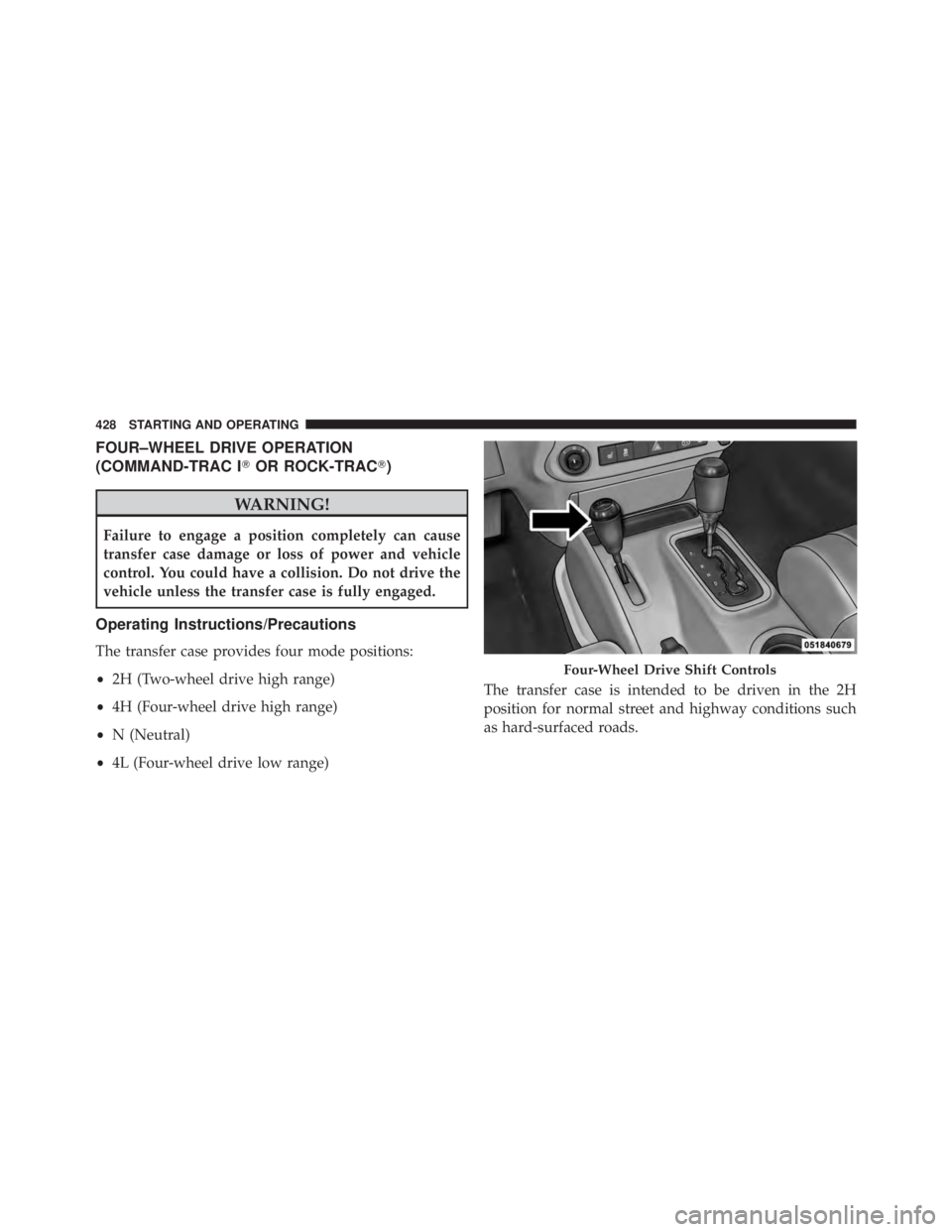
FOUR–WHEEL DRIVE OPERATION
(COMMAND-TRAC I � OR ROCK-TRAC � )
WARNING!Failure to engage a position completely can cause
transfer case damage or loss of power and vehicle
control. You could have a collision. Do not drive the
vehicle unless the transfer case is fully engaged.
Operating Instructions/Precautions
The transfer case provides four mode positions:
• 2H (Two-wheel drive high range)
• 4H (Four-wheel drive high range)
• N (Neutral)
• 4L (Four-wheel drive low range) The transfer case is intended to be driven in the 2H
position for normal street and highway conditions such
as hard-surfaced roads. Four-Wheel Drive Shift Controls428 STARTING AND OPERATING
Page 432 of 655
WARNING!You or others could be injured if you leave the vehicle
unattended with the transfer case in the N (Neutral)
position without first fully engaging the parking brake.
The transfer case N (Neutral) position disengages both
the front and rear driveshaft from the powertrain, and
will allow the vehicle to move regardless of the trans-
mission position. The parking brake should always be
applied when the driver is not in the vehicle.
Shift Positions
For additional information on the appropriate use of each
transfer case mode position, see the information below:
2H Position
This range is used for normal street and highway driving
on hard-surfaced roads. 4H Position
This range locks the front and rear driveshafts together,
forcing the front and rear wheels to rotate at the same
speed. This range (4H) provides additional traction for
loose, slippery road surfaces and should not be used on
dry pavement.
The “4WD Indicator Light” (located in the instrument
cluster) will illuminate when the transfer case is shifted
into the 4H position.
N (Neutral) Position
This range disengages the front and rear driveshafts from
the powertrain. It is to be used for flat towing behind
another vehicle. Refer to “Recreational Towing” in “Start-
ing and Operating” for further information.
4L Position
This range locks the front and rear driveshafts together,
forcing the front and rear wheels to rotate at the same430 STARTING AND OPERATING