Page 17 of 655

3. Push the ignition key inward.
4. Turn the ignition key to the LOCK position, and
remove the key.
WARNING!• Before exiting a vehicle, always apply the parking
brake, shift the transmission into PARK, and re-
move the Key Fob from the ignition. When leaving
the vehicle, always lock your vehicle.
• Never leave children alone in a vehicle, or with
access to an unlocked vehicle.
• Allowing children to be in a vehicle unattended is
dangerous for a number of reasons. A child or
others could be seriously or fatally injured. Chil-
dren should be warned not to touch the parking
brake, brake pedal or the shift lever. (Continued) WARNING! (Continued)• Do not leave the Key Fob in or near the vehicle, and
do not leave the ignition in the ACC or ON/RUN
position. A child could operate power windows,
other controls, or move the vehicle.
• Do not leave children or animals inside parked
vehicles in hot weather. Interior heat build-up may
cause serious injury or death.
CAUTION!An unlocked car is an invitation to thieves. Always
remove key from the ignition and lock all doors
when leaving the vehicle unattended.
2 THINGS TO KNOW BEFORE STARTING YOUR VEHICLE 15
Page 39 of 655
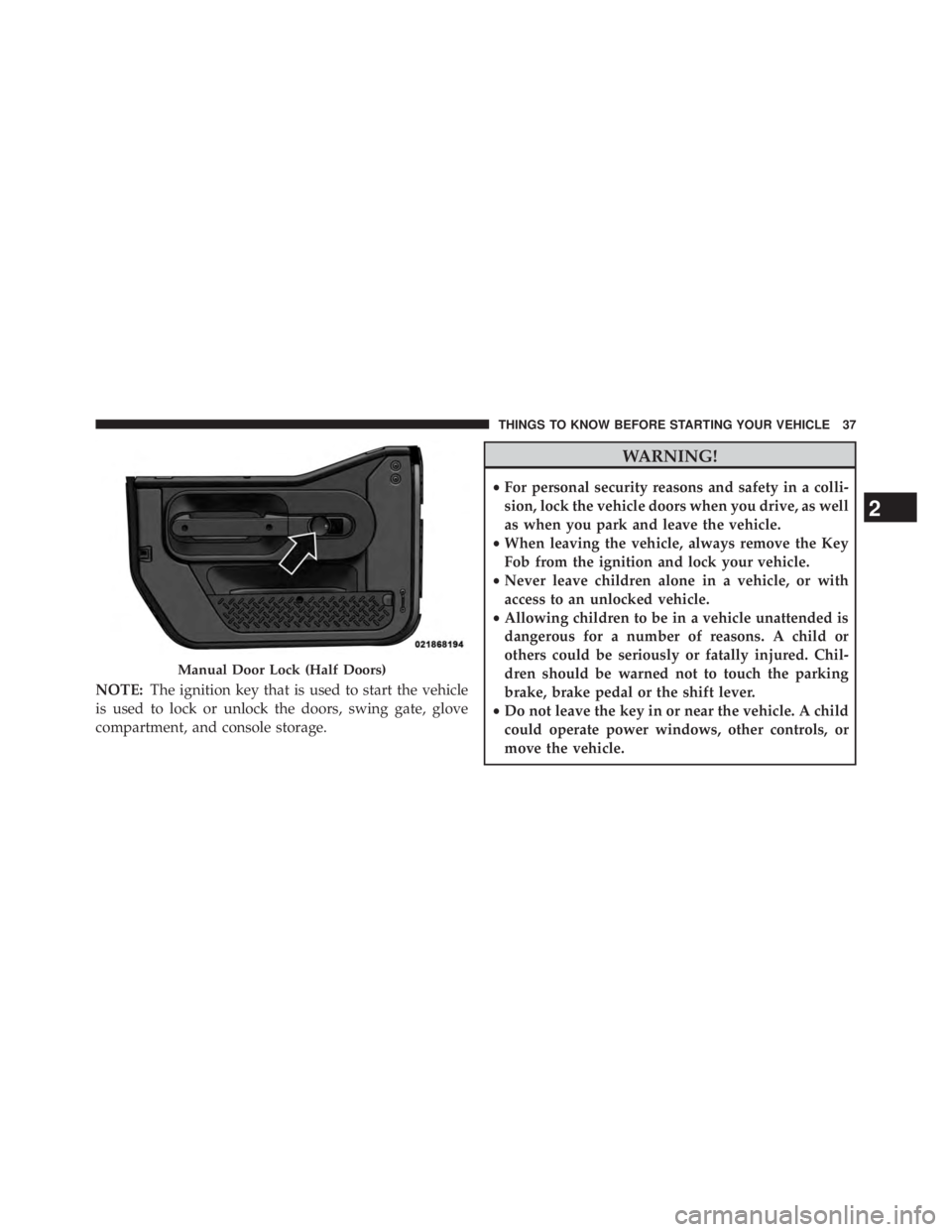
NOTE: The ignition key that is used to start the vehicle
is used to lock or unlock the doors, swing gate, glove
compartment, and console storage. WARNING!• For personal security reasons and safety in a colli-
sion, lock the vehicle doors when you drive, as well
as when you park and leave the vehicle.
• When leaving the vehicle, always remove the Key
Fob from the ignition and lock your vehicle.
• Never leave children alone in a vehicle, or with
access to an unlocked vehicle.
• Allowing children to be in a vehicle unattended is
dangerous for a number of reasons. A child or
others could be seriously or fatally injured. Chil-
dren should be warned not to touch the parking
brake, brake pedal or the shift lever.
• Do not leave the key in or near the vehicle. A child
could operate power windows, other controls, or
move the vehicle.Manual Door Lock (Half Doors)
2 THINGS TO KNOW BEFORE STARTING YOUR VEHICLE 37
Page 40 of 655
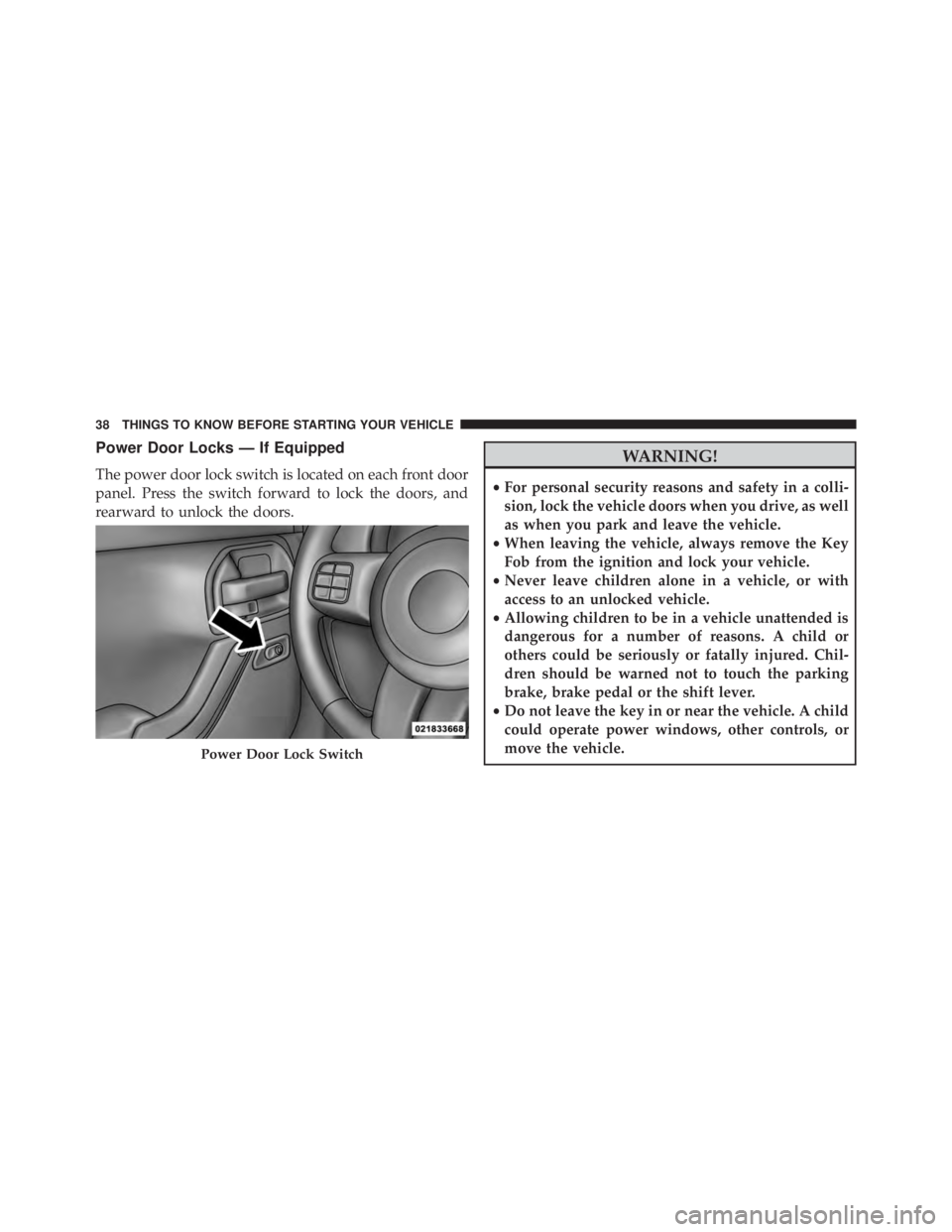
Power Door Locks — If Equipped
The power door lock switch is located on each front door
panel. Press the switch forward to lock the doors, and
rearward to unlock the doors.
WARNING!• For personal security reasons and safety in a colli-
sion, lock the vehicle doors when you drive, as well
as when you park and leave the vehicle.
• When leaving the vehicle, always remove the Key
Fob from the ignition and lock your vehicle.
• Never leave children alone in a vehicle, or with
access to an unlocked vehicle.
• Allowing children to be in a vehicle unattended is
dangerous for a number of reasons. A child or
others could be seriously or fatally injured. Chil-
dren should be warned not to touch the parking
brake, brake pedal or the shift lever.
• Do not leave the key in or near the vehicle. A child
could operate power windows, other controls, or
move the vehicle.Power Door Lock Switch38 THINGS TO KNOW BEFORE STARTING YOUR VEHICLE
Page 105 of 655
Periodic Safety Checks You Should Make Outside
The Vehicle
Tires
Examine tires for excessive tread wear and uneven wear
patterns. Check for stones, nails, glass, or other objects
lodged in the tread or sidewall. Inspect the tread for cuts
and cracks. Inspect sidewalls for cuts, cracks and bulges.
Check the wheel nuts for tightness. Check the tires
(including spare) for proper cold inflation pressure.
Lights
Have someone observe the operation of brake lights and
exterior lights while you work the controls. Check turn
signal and high beam indicator lights on the instrument
panel. Door Latches
Check for positive closing, latching, and locking.
Fluid Leaks
Check area under vehicle after overnight parking for fuel,
engine coolant, oil, or other fluid leaks. Also, if gasoline
fumes are detected or if fuel, power steering fluid, or
brake fluid leaks are suspected, the cause should be
located and corrected immediately.
2THINGS TO KNOW BEFORE STARTING YOUR VEHICLE 103
Page 304 of 655
11. Brake Warning Light
This light monitors various brake functions,
including brake fluid level and parking brake
application. If the brake light turns on it may
indicate that the parking brake is applied, that
the brake fluid level is low, or that there is a problem with
the anti-lock brake system reservoir.
If the light remains on when the parking brake has been
disengaged, and the fluid level is at the full mark on the
master cylinder reservoir, it indicates a possible brake
hydraulic system malfunction or that a problem with the
Brake Booster has been detected by the Anti-Lock Brake
System (ABS) / Electronic Stability Control (ESC) system.
In this case, the light will remain on until the condition
has been corrected. If the problem is related to the brake
booster, the ABS pump will run when applying the brake
and a brake pedal pulsation may be felt during each stop. The dual brake system provides a reserve braking capac-
ity in the event of a failure to a portion of the hydraulic
system. A leak in either half of the dual brake system is
indicated by the Brake Warning Light, which will turn on
when the brake fluid level in the master cylinder has
dropped below a specified level.
The light will remain on until the cause is corrected.
NOTE: The light may flash momentarily during sharp
cornering maneuvers, which change fluid level condi-
tions. The vehicle should have service performed, and
the brake fluid level checked.
If brake failure is indicated, immediate repair is necessary.
WARNING!Driving a vehicle with the red brake light on is
dangerous. Part of the brake system may have failed. (Continued)302 UNDERSTANDING YOUR INSTRUMENT PANEL
Page 305 of 655

WARNING! (Continued)It will take longer to stop the vehicle. You could have
a collision. Have the vehicle checked immediately.
Vehicles equipped with the Anti-Lock Brake System
(ABS), are also equipped with Electronic Brake Force
Distribution (EBD). In the event of an EBD failure, the
Brake Warning Light will turn on along with the ABS
Light. Immediate repair to the ABS system is required.
Operation of the Brake Warning Light can be checked by
turning the ignition switch from the OFF position to the
ON/RUN position. The light should illuminate for ap-
proximately two seconds. The light should then turn off
unless the parking brake is applied or a brake fault is
detected. If the light does not illuminate, have the light
inspected by an authorized dealer. The light also will turn on when the parking brake is
applied with the ignition switch in the ON/RUN posi-
tion.
NOTE: This light shows only that the parking brake is
applied. It does not show the degree of brake application.
12. Anti-Lock Brake (ABS) Light
After the ignition is turned on, the Anti-Lock
Brake System (ABS) light illuminates to indicate
function check at vehicle start-up. If the light remains on
after start-up or comes on and stays on at road speeds, it
may indicate that the ABS has detected a malfunction or
has become inoperative. The system reverts to standard
non-anti-lock brakes.
If both the Brake Warning Light and the ABS Warning Light
are on, see an authorized dealer immediately. Refer to
“Anti-Lock Brake System” in “Starting And Operating”.
4 UNDERSTANDING YOUR INSTRUMENT PANEL 303
Page 408 of 655
� FOUR–WHEEL DRIVE OPERATION
(COMMAND-TRAC I � OR ROCK-TRAC � ) . . . .428
▫ Operating Instructions/Precautions ....... .428
▫ Shift Positions ....................... .430
▫ Shifting Procedure .................... .431
� TRAC-LOK � REAR AXLE — IF EQUIPPED . . . .432
� AXLE LOCK (TRU–LOK � ) — RUBICON
MODELS ........................... .433
� ELECTRONIC SWAY BAR DISCONNECT — IF
EQUIPPED .......................... .434
� ON-ROAD DRIVING TIPS ............... .436
� OFF-ROAD DRIVING TIPS ............... .437
▫ Side Step Removal – If Equipped ......... .437
▫ The Basics Of Off-Road Driving .......... .438 ▫ When To Use 4L (Low) Range ............ .438
▫ Simultaneous Brake And Throttle Operation. . .439
▫ Driving In Snow, Mud And Sand ......... .439
▫ Crossing Obstacles (Rocks And Other High
Points) ............................ .441
▫ Hill Climbing ....................... .443
▫ Driving Through Water ................ .446
▫ After Driving Off-Road ................ .449
� POWER STEERING .................... .450
▫ Power Steering Fluid Check ............. .451
� PARKING BRAKE ..................... .452
� ANTI-LOCK BRAKE SYSTEM ............ .455
� ELECTRONIC BRAKE CONTROL SYSTEM . . . .456406 STARTING AND OPERATING
Page 412 of 655
STARTING PROCEDURES
Before starting your vehicle, adjust your seat, adjust both
inside and outside mirrors, and fasten your seat belts.
WARNING!• When leaving the vehicle, always remove the key
fob from the ignition and lock your vehicle.
• Never leave children alone in a vehicle, or with
access to an unlocked vehicle. Allowing children to
be in a vehicle unattended is dangerous for a
number of reasons. A child or others could be
seriously or fatally injured. Children should be
warned not to touch the parking brake, brake pedal
or the shift lever. Manual Transmission – If Equipped
Apply the parking brake, place the shift lever in NEU-
TRAL, and press the clutch pedal before starting the
vehicle. This vehicle is equipped with a clutch interlock-
ing ignition system. It will not start unless the clutch
pedal is pressed to the floor.
Four-Wheel Drive Models Only
In 4L mode, this vehicle will start regardless of whether
or not the clutch pedal is pressed to the floor. This feature
enhances off-road performance by allowing the vehicle to
start when in 4L without having to press the clutch pedal.
The “4WD Indicator Light” will illuminate when the
transfer case has been shifted into this mode.
Automatic Transmission – If Equipped
Start the vehicle with the shift lever in the PARK position
(vehicle can also be started in NEUTRAL). Apply the
brake before shifting to any driving range.410 STARTING AND OPERATING