2013 HONDA FIT VSA
[x] Cancel search: VSAPage 3 of 286

2
Quick Reference Guide
Quick Reference Guide
Visual Index
❙Gauges (P72)
❙Information Display (P73)
❙System Indicators (P64)
❙Navigation System *
() See Navigation System Manual
❙ (Vehicle Stabi lity Assist (VSA ®)
System OFF) Button (P176)
❙Hazard Warning Button
❙Audio System
(P122)
❙Steering Wheel Adjustments
(P101)
❙Ignition Switch (P94)
❙Heated Mirror Button *
(P100)
❙Rear Window Defogger (P100)
❙Heating and Cooling*
System
(P118)
❙Door Mirror Controls (P102)
Main Menu
Page 9 of 286
8
Quick Reference Guide
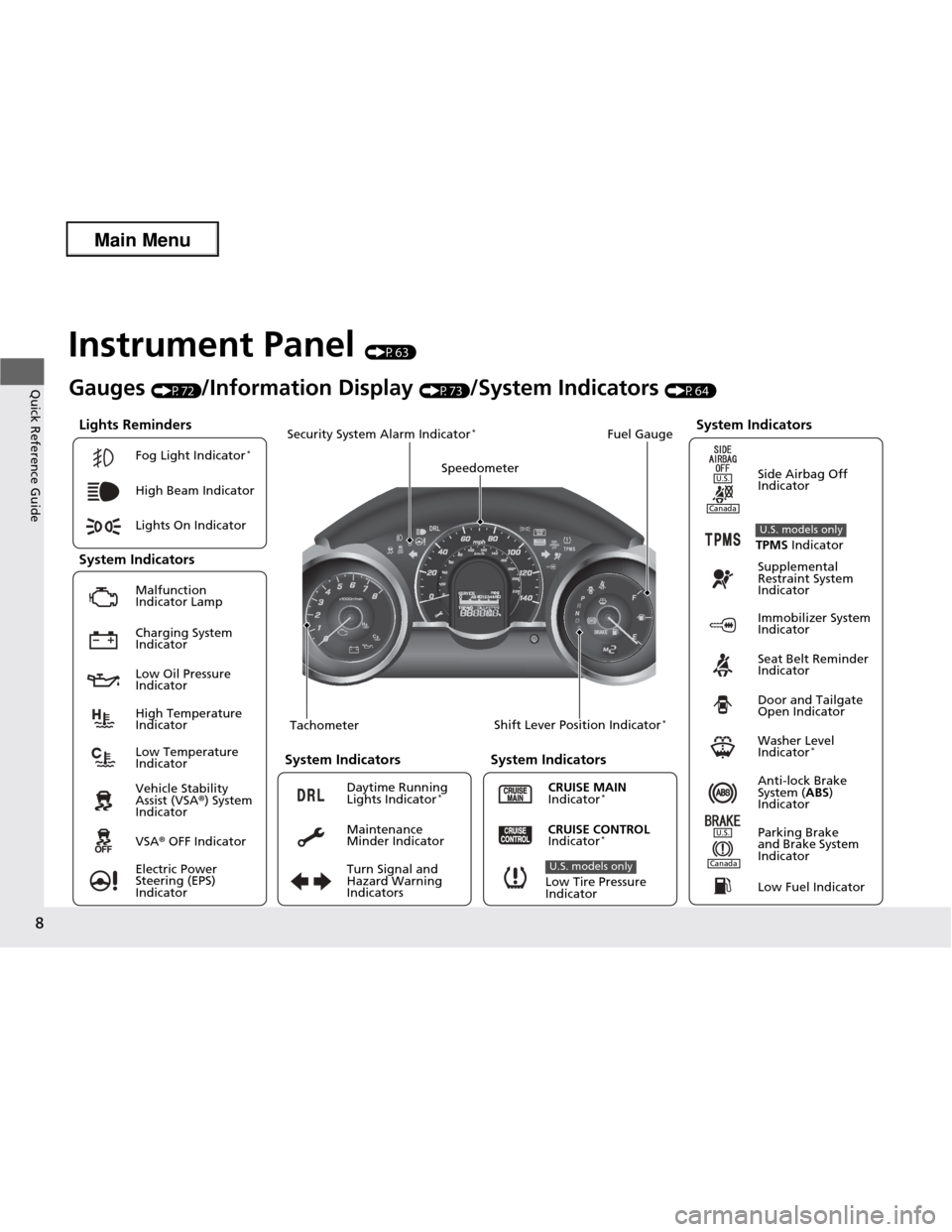
Instrument Panel (P63)
Lights Reminders
Malfunction
Indicator Lamp Low Oil Pressure Indicator Anti-lock Brake
System (ABS)
Indicator
Vehicle Stability Assist (VSA
®) System
Indicator VSA ® OFF Indicator
Electric Power Steering (EPS) Indicator
Lights On Indicator
High Beam Indicator
Immobilizer System
Indicator
Seat Belt Reminder
Indicator
System Indicators
CRUISE MAIN
Indicator * Supplemental
Restraint System
Indicator
Side Airbag Off
Indicator
Door and Tailgate
Open Indicator
Tachometer Speedometer
Fuel Gauge
Security System Alarm Indicator *
Shift Lever Position Indicator *
Low Fuel Indicator
Gauges
(P72)/Information Display (P73)/System Indicators (P64)
Turn Signal and Hazard Warning Indicators
High Temperature Indicator
Low Temperature Indicator
System Indicators System Indicators
Low Tire Pressure
Indicator
U.S. models only
Parking Brake
and Brake System
IndicatorCRUISE CONTROL
Indicator * System Indicators
Charging System Indicator
U.S.
U.S.
Canada
TPMS
Indicator
U.S. models only
Washer Level
Indicator *
Daytime Running Lights Indicator
*
Maintenance
Minder Indicator
Fog Light Indicator
*
Canada
Main Menu
Page 15 of 286

14
Quick Reference Guide
VSA® OFF Button (P177)
● The vehicle stability assist (VSA ®) system
helps stabilize the vehicle during
cornering, and helps maintain traction
while accelerating on loose or slippery road surfaces.
● VSA ® comes on automatically every time
you start the engine.
● To turn VSA ® on or off, press and hold
the button until you hear a beep.
Cruise Control *
(P173)
● Cruise control allows you to maintain a
set speed without keeping your foot on
the accelerator pedal.
● To use cruise control, press the CRUISE
button, then press DECEL/SET once you
have achieved the de sired speed (above
25 mph or 40 km/h).
Tire Pressure Monitoring System (TPMS) (P178)
● TPMS monitors tire pressure.
● TPMS is turned on automatically every time you start the engine.
U.S. models only
Refueling (P186)
Fuel recommendation: Unleaded gasoline with a pump octane number 87 or higher required
Fuel tank capacity: 10.6 US gal (40 L)
a Press on the edge of the fuel fill door to make it
pop up slightly.
b Turn the fuel fill cap
slowly to remove the cap.
c Place the cap in the holder on the fuel fill
door.
d After refueling, screw
the cap back on until it clicks at least once.
Main Menu
Page 69 of 286
68
uuIndicatorsu
Instrument Panel
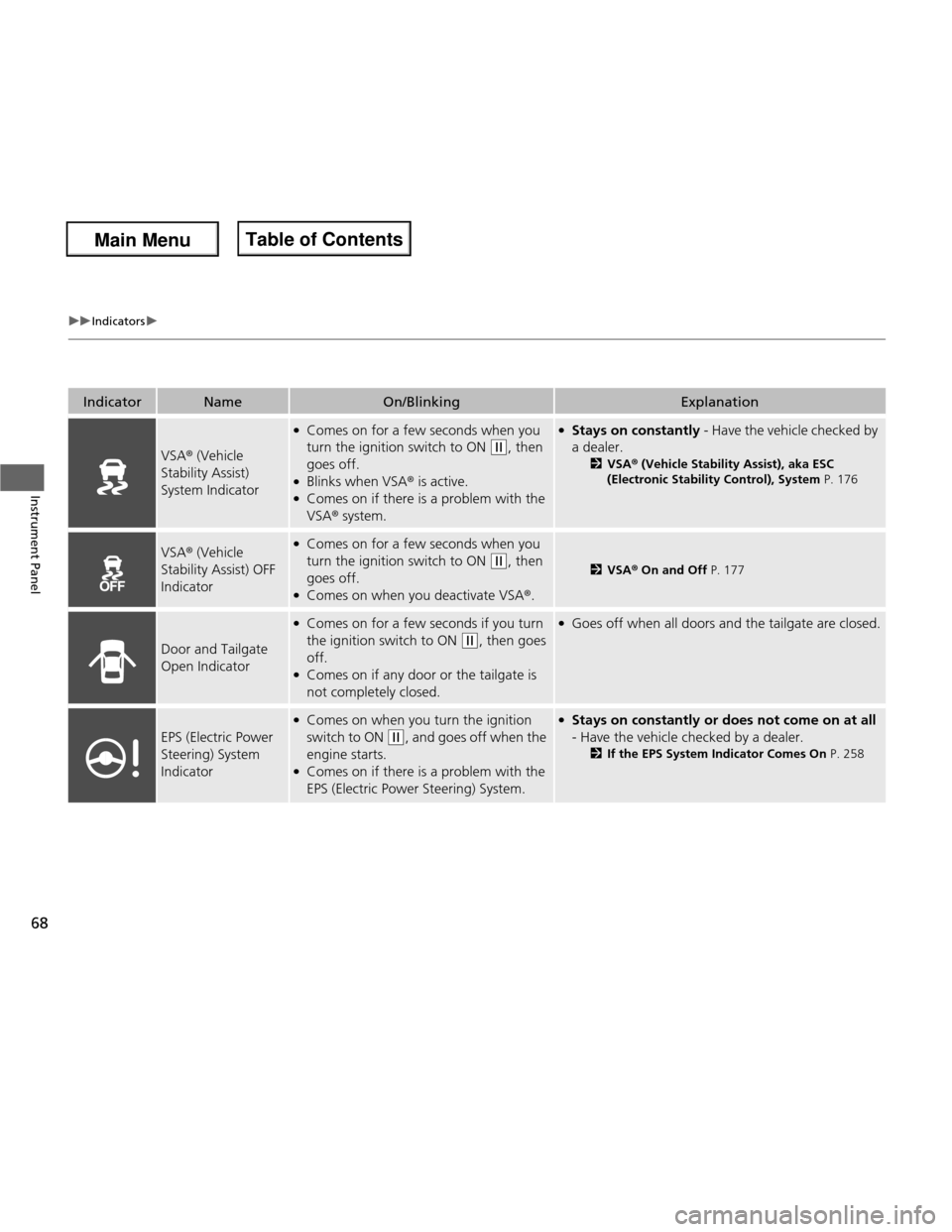
IndicatorNameOn/BlinkingExplanation
VSA® (Vehicle
Stability Assist) System Indicator
● Comes on for a few seconds when you
turn the ignition switch to ON
(w , then
goes off.
● Blinks when VSA ® is active.
● Comes on if there is a problem with the VSA ® system.
●
Stays on constantly - Have the vehicle checked by
a dealer. 2VSA ® (Vehicle Stability Assist), aka ESC
(Electronic Stability Control), System P. 176
VSA® (Vehicle
Stability Assist) OFF
Indicator● Comes on for a few seconds when you
turn the ignition switch to ON
(w , then
goes off.
● Comes on when you deactivate VSA ®.2 VSA ® On and Off P. 177
Door and Tailgate Open Indicator
●
Comes on for a few seconds if you turn
the ignition switch to ON
(w , then goes
off.
● Comes on if any door or the tailgate is
not completely closed.
●Goes off when all doors and the tailgate are closed.
EPS (Electric Power
Steering) System
Indicator
●Comes on when you turn the ignition
switch to ON
(w , and goes off when the
engine starts.
● Comes on if there is a problem with the
EPS (Electric Power Steering) System.
●Stays on constantly or does not come on at all
- Have the vehicle checked by a dealer. 2If the EPS System Indicator Comes On P. 258
Main Menu
Main MenuTable of Contents
Page 154 of 286
153
Driving
This chapter discusses driving, refueling, and information on items such as accessories.
Before Driving Driving Preparation .......................... 154
Maximum Load Limit........................ 157
Towing a Trailer Towing Your Vehicle ........................ 159
When Driving
Starting the Engine .......................... 161
Precautions While Driving................. 163
Automatic Transmission ................... 164
Shifting ............................................ 165
Shifting ............................................ 167
Models with 7 positions AT
Models with 5 positions AT
Shifting ............................................ 171
Cruise Control *
............................... 173
VSA® (Vehicle Stability Assist), aka ESC
(Electronic Stability Control), System ...... 176
TPMS (Tire Pressure Monitoring System) .. 178
Tire Pressure Monitoring System (TPMS) -
Required Federal Explanation ......... 179
Braking
Brake System ................................... 181
ABS (Anti-lock Brake System) ........... 183
Brake Assist System.......................... 184
Manual transmission modelsParking Your VehicleWhen Stopped ................................ 185
Refueling
Fuel Information .............................. 186
How to Refuel ................................. 187
Fuel Economy .................................... 189
Improving Fuel Economy .................. 189
Accessories and Modifications
Accessories ...................................... 190
Modifications................................... 190
* Not available on all models
Main Menu
Main Menu
Page 177 of 286
176
uuWhen DrivinguVSA® (Vehicle Stability Assist), aka ESC (Electronic Stability Control), System
Driving
VSA ® (Vehicle Stability Assist), aka ESC (Electronic
Stability Control), System VSA ® helps to stabilize the vehicle during cornering if the vehicle turns more or less
than what was intended. It also assists in maintaining traction on slippery surfaces.
It does so by regulating engine output and selectively applying the brakes.
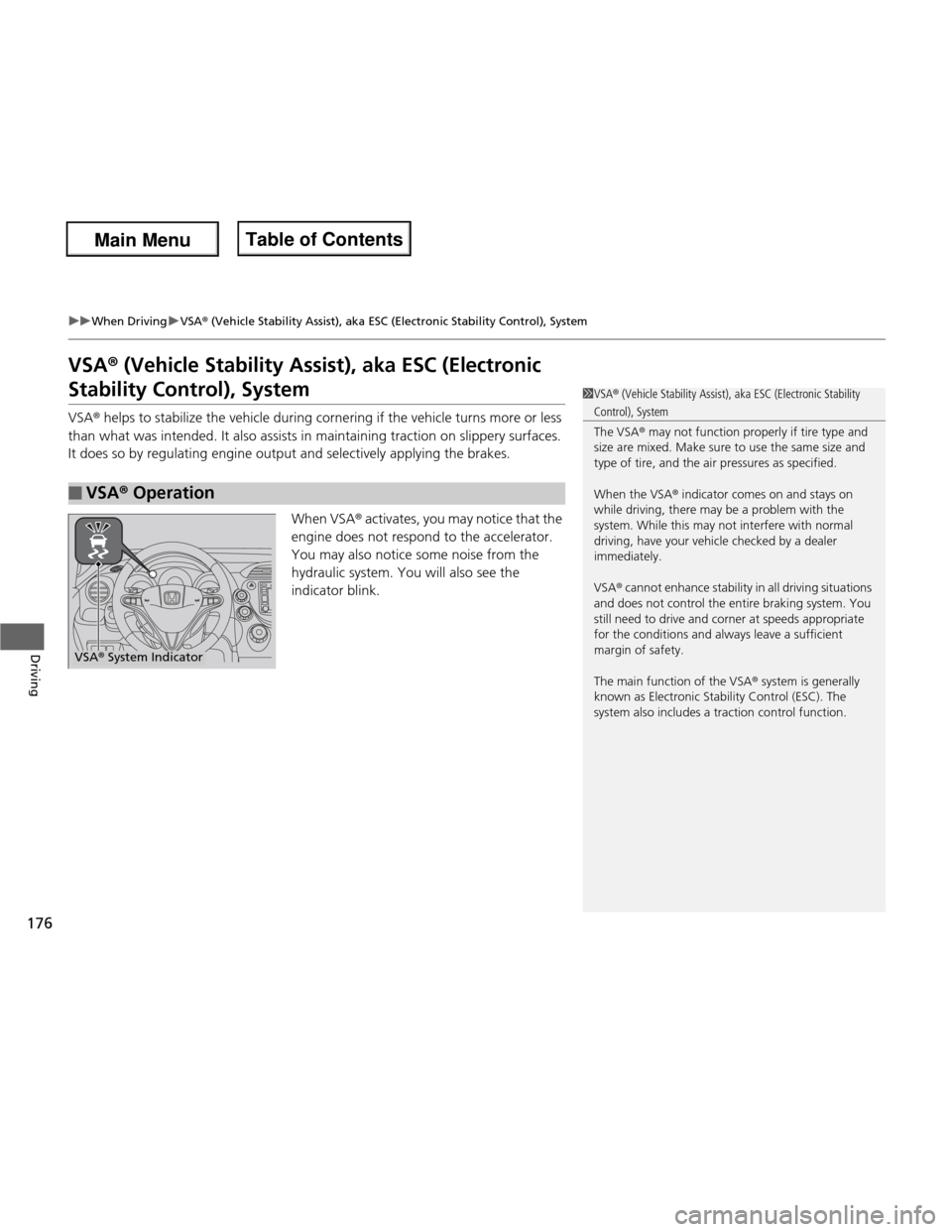
When VSA® activates, you may notice that the
engine does not respond to the accelerator.
You may also notice some noise from the
hydraulic system. You will also see the
indicator blink.
■VSA ® Operation
1VSA ® (Vehicle Stability Assist), aka ESC (Electronic Stability
Control), System
The VSA ® may not function properly if tire type and
size are mixed. Make sure to use the same size and
type of tire, and the ai r pressures as specified.
When the VSA ® indicator comes on and stays on
while driving, there may be a problem with the
system. While this may not interfere with normal
driving, have your vehicle checked by a dealer
immediately.
VSA ® cannot enhance stability in all driving situations
and does not control the entire braking system. You
still need to drive and cor ner at speeds appropriate
for the conditions and always leave a sufficient margin of safety.
The main function of the VSA ® system is generally
known as Electronic Stability Control (ESC). The
system also includes a traction control function.
VSA ® System Indicator
Main Menu
Main MenuTable of Contents
Page 178 of 286

177
uuWhen DrivinguVSA® (Vehicle Stability Assist), aka ESC (Electronic Stability Control), System
Driving
This button is on the driver side control panel.
To turn the VSA ® system on and off, press and
hold it until you hear a beep. VSA ® will stop and the indicator will come on.
To turn it on again, press the (VSA ® OFF)
button until you hear a beep.VSA ® is turned on every time you start the
engine, even if you turned it off the last time
you drove the vehicle.
■VSA ® On and Off1VSA ® (Vehicle Stability Assist), aka ESC (Electronic Stability
Control), System Without VSA ®, your vehicle will have normal braking
and cornering ability, but it will not have VSA ®
traction and stability enhancement.
In certain unusual conditions when your vehicle gets
stuck in shallow mud or fresh snow, it may be easier
to free it with the VSA ® temporarily switched off.
When the VSA ® system is off, the traction control
system is also off. You should only attempt to free
your vehicle with the VSA ® off if you are not able to
free it when the VSA ® is on.
Immediately after freeing your vehicle, be sure to
switch VSA ® on again. We do not recommend driving
your vehicle with the VSA ® and traction control
systems switched off.
If the low tire pressure *
or TPMS indicator *
comes on
or blinks, the VSA ® system comes on automatically. In
this case, you cannot turn the system off by pressing
the button.
You may hear a motor sound coming from the
engine compartment while system checks are being
performed immediatel y after starting the engine or
while driving. This is normal.
VSA ® OFF Indicator
* Not available on all models
Main Menu
Main MenuTable of Contents
Page 198 of 286
197
uuMaintenance MinderTMuTo Use Maintenance Minder TM
Continued
Maintenance
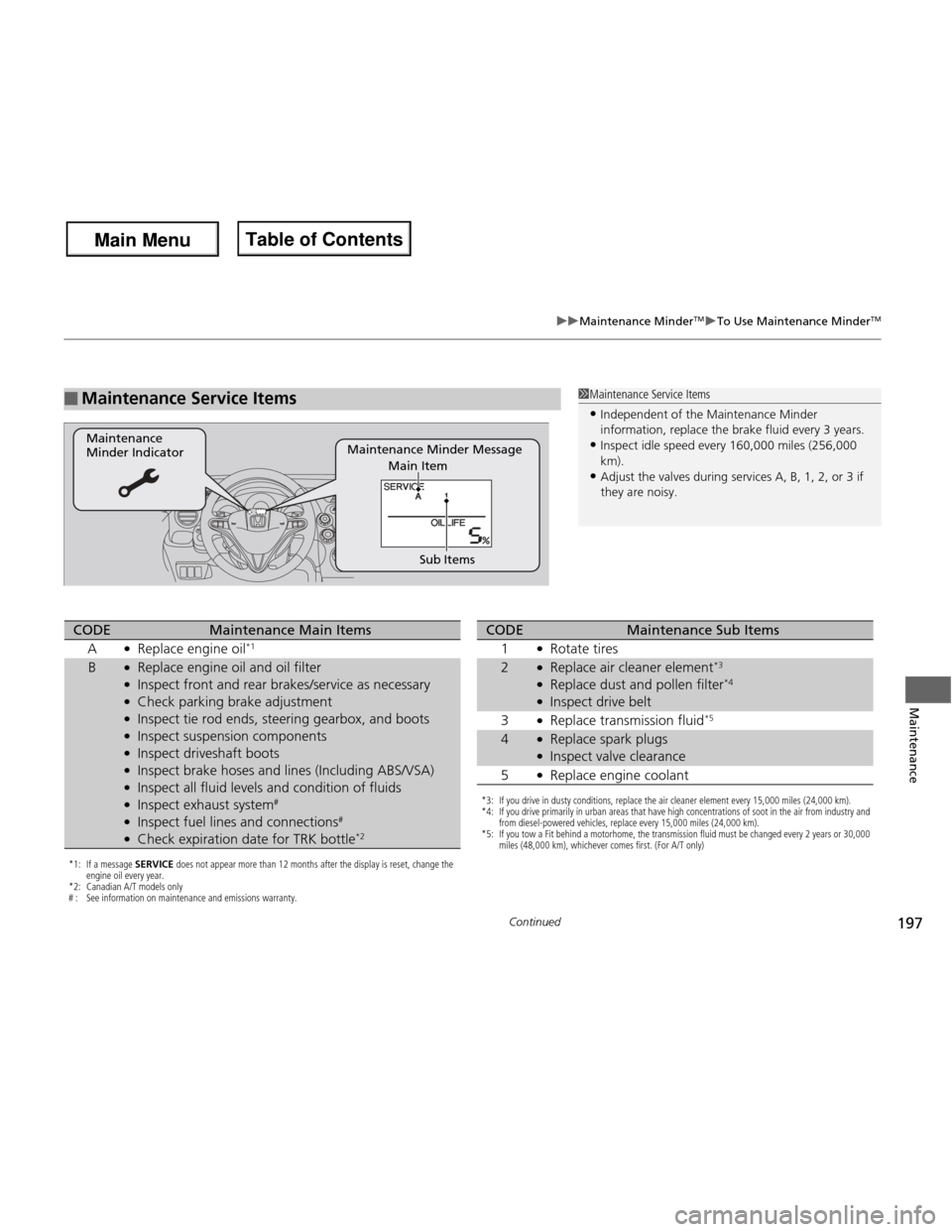
■Maintenance Service Items1Maintenance Service Items
• Independent of the Maintenance Minder
information, replace the brake fluid every 3 years.
• Inspect idle speed every 160,000 miles (256,000 km).
• Adjust the valves during services A, B, 1, 2, or 3 if they are noisy.
Maintenance Minder Message
Maintenance Minder Indicator
Sub Items
Main Item
*1: If a message SERVICE does not appear more than 12 months after the display is reset, change the
engine oil every year.
*2: Canadian A/T models only
# : See information on maintenance and emissions warranty.
CODEMaintenance Main Items
A ●
Replace engine oil *1
B●
Replace engine oil and oil filter
● Inspect front and rear brakes/service as necessary
● Check parking brake adjustment
● Inspect tie rod ends, steering gearbox, and boots
● Inspect suspension components
● Inspect driveshaft boots
● Inspect brake hoses and lines (Including ABS/VSA)
● Inspect all fluid levels and condition of fluids
● Inspect exhaust system #
● Inspect fuel lines and connections #
● Check expiration date for TRK bottle *2
*3: If you drive in dusty conditions, replace the air cleaner element every 15,000 miles (24,000 km).
*4: If you drive primarily in urban areas that have high concentrations of soot in the air from industry and
from diesel-powered vehicles, replace every 15,000 miles (24,000 km).
*5: If you tow a Fit behind a motorhome, the transmission fluid must be changed every 2 years or 30,000 miles (48,000 km), whichever comes first. (For A/T only)
CODEMaintenance Sub Items
1 ●
Rotate tires
2●Replace air cleaner element *3
● Replace dust and pollen filter *4
● Inspect drive belt
3 ●
Replace transmission fluid *5
4●
Replace spark plugs
● Inspect valve clearance
5 ●
Replace engine coolant
Main Menu
Main MenuTable of Contents